Open Now
3903 Bellaire Blvd Suite E, Houston, TX 77025
Braeswood sits directly astride Brays Bayou in FEMA Zone AE — a designation that makes water and flood restoration not a rare emergency but a recurring operating reality for homeowners on dozens of blocks that have flooded multiple times since 2001, including during Harvey in 2017 and Beryl in 2024. The neighborhood's unusual mix of original 1950s–1960s ranch homes (some still pier-and-beam, many slab-on-grade) alongside post-flood teardown rebuilds means restoration contractors encounter vastly different structural systems lot-by-lot, and every scope must account for both the current event and the cumulative moisture load from prior flood cycles. Understanding how Brays Bayou floodwater classification, the City of Houston's permit process, and Braeswood's patchwork of mandatory HOAs intersect will determine how fast and how completely your home actually dries out and gets rebuilt.
Ranked by verified Google rating × review volume × verification tier. How we rank →
Some highly-rated pros serve Braeswood from nearby and may not keep a Braeswood street address. Those are listed under "Also serving Braeswood" with their real city and distance, so you always know where each business is based.
3903 Bellaire Blvd Suite E, Houston, TX 77025
Highly-rated pros based nearby who cover Braeswood. Distance shown from the Braeswood area.
Serving Braeswood Based in Medical Center · 1.5 mi away
Serving Braeswood Based in Bellaire · 2.9 mi away
Serving Braeswood Based in Bellaire · 3 mi away
Serving Braeswood Based in Upper Kirby · 3.2 mi away
Serving Braeswood Based in Meyerland · 3.4 mi away
Serving Braeswood Based in Sharpstown · 3.5 mi away
Serving Braeswood Based in Upper Kirby · 3.5 mi away
Serving Braeswood Based in Tanglewood · 3.8 mi away
Serving Braeswood Based in Tanglewood · 3.9 mi away
Why it matters to you
When Brays Bayou overtops its banks and enters your Braeswood home — as it did during Harvey 2017 and again during Beryl 2024 — the water is not clean stormwater. Combined sewer infrastructure and bayou-borne contaminants automatically push the loss into Category 3 (black water) classification under IICRC S500 standards, requiring full demolition of all porous materials — drywall, insulation, flooring, and bottom plates — to at least 12 inches above the flood line. Insurers sometimes contest this and attempt to reclassify a bayou flood as Category 2 gray water to reduce the demo scope and payout, a dispute that is particularly common on FEMA Repetitive Loss properties where cumulative claims already exceed thresholds. On blocks nearest the bayou, parcel-level flood depths routinely exceed 24 hours of inundation, compounding the contamination problem and the structural saturation.
What a good pro does
A qualified restoration contractor must collect water samples and document the flood's source — Brays Bayou overflow, not a supply line break — with written evidence to defend Category 3 classification with your insurer. IICRC S500 demo protocols should be followed in full: no selective drywall cuts, no leaving saturated bottom plates in place. The City of Houston Permitting Center requires a demolition permit for structural demo work, which the restoration contractor pulls; any plumbing or electrical work exposed during demo requires separate permits pulled by a TSBPE-licensed plumber or TDLR-licensed electrician respectively.
Sources: IICRC (water/mold restoration standards), Harris County Flood Control District, City of Houston Permitting Center, FEMA National Flood Hazard Layer (NFHL)
Why it matters to you
Braeswood's older ranch homes that remain on their original slab-on-grade foundations sit directly on the Beaumont/Houston Black clay that underlies most of southwest Houston — and that clay holds floodwater against the slab perimeter long after standing water inside the home has been extracted. Water wicks upward into bottom plates and drywall continuously as long as the soil stays saturated, meaning standard three-to-five-day drying timelines simply do not apply here. Post-flood teardown rebuilds on new elevated slabs face the same soil condition; even with better drainage detailing, the clay perimeter delays drying on any structure that experienced extended inundation. The 1950s–1960s original ranch homes are particularly vulnerable because their slab edges are typically un-insulated and uncoated.
What a good pro does
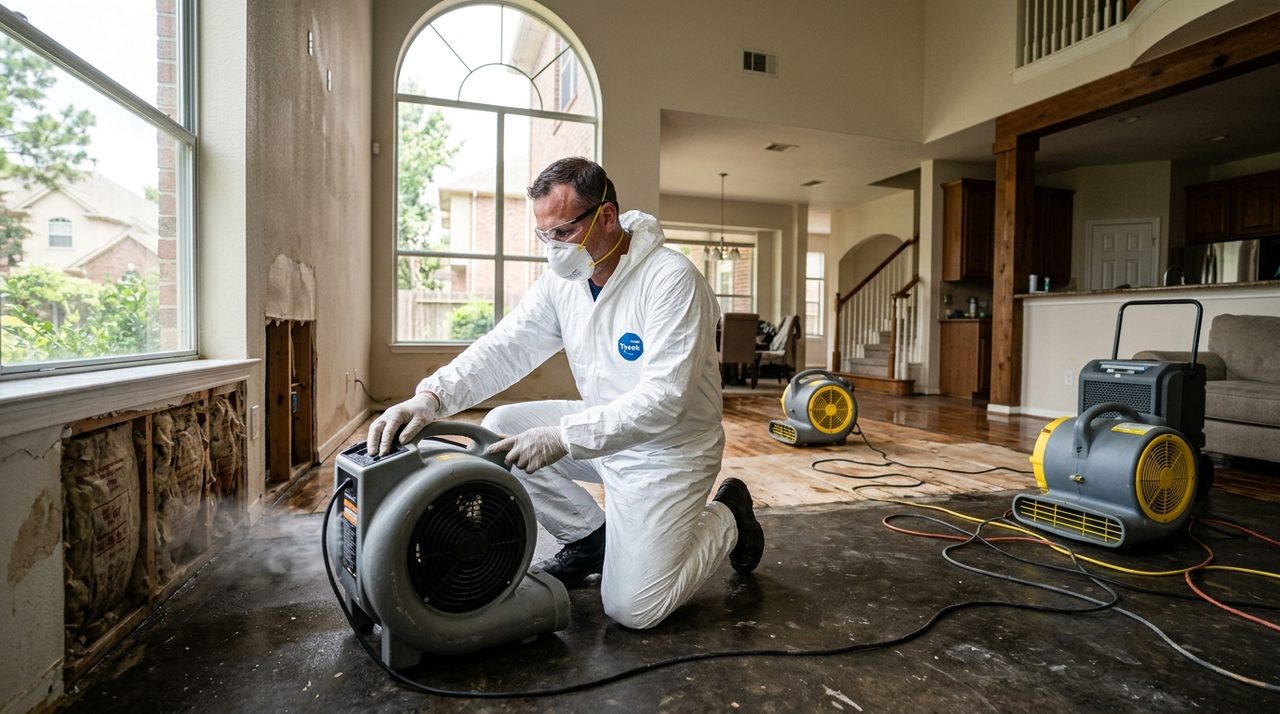
Professional drying in Braeswood requires extended equipment deployment — typically 10 to 21 days rather than the national average of 3 to 5 — with daily moisture meter and thermal imaging readings to verify that bottom plates and slab-adjacent wall cavities are actually drying, not just the interior air. A restoration contractor should take baseline readings at the slab edge on day one and track them through completion, providing a documented drying log. This log becomes critical evidence if your insurer later disputes the equipment rental duration or scope.
Sources: IICRC (water/mold restoration standards), FEMA National Flood Hazard Layer (NFHL)
Why it matters to you
Braeswood's block-by-block mix of original 1950s–1960s ranch homes and post-flood custom rebuilds means HVAC systems range from aging flex duct installations with deteriorated vapor barriers to modern high-SEER systems — sometimes within a few doors of each other. When floodwater enters a home and reaches the air handler or saturates flex duct insulation, Houston's ambient conditions — average relative humidity above 74% and summer temperatures exceeding 90°F — create active Aspergillus and Cladosporium growth conditions within 48 to 72 hours of inundation. Original ranch homes with horizontal air handlers located in unconditioned closets or attic-adjacent spaces are particularly at risk because the units are low to the flood line and draw in humid post-flood air if they restart prematurely.
What a good pro does
Any restoration scope on a flooded Braeswood home must include duct inspection with fiber optic or borescope camera documentation before the HVAC system is returned to service. In original ranch homes with pre-2000 flex duct, full duct replacement is frequently the correct call rather than attempted remediation of saturated duct liner. Mold remediation firms performing this work in Texas must hold a TDLR-issued Mold Remediation Contractor (MRC) license under Texas Occupations Code Chapter 1958; confirm license status before any mold-related scope begins.
Sources: IICRC (water/mold restoration standards), Texas Department of Licensing & Regulation, Texas Commission on Environmental Quality
Why it matters to you
Braeswood is not governed by a single HOA — it is a section-by-section patchwork of mandatory associations including the Braeswood Place HOA (BPHA), the Seventy-Six Fifty-Five South Braeswood HOA, and individually restricted plats with no umbrella organization. Architectural review requirements in these associations technically apply even to emergency flood demolition work that affects the exterior: dumpster placement, removal of damaged brick veneer or exterior cladding, and selection of replacement materials can all trigger review. IICRC S500 standards call for drying initiation within 24 to 48 hours of water intrusion; a Category 2 loss can escalate to Category 3 if demo and drying are delayed waiting for HOA approval of an exterior dumpster placement.
What a good pro does
Before any exterior demo or dumpster placement, verify which HOA or deed restriction governs your specific lot — the answer changes section by section in Braeswood. Many associations have emergency provisions or expedited review tracks for documented flood damage; ask your HOA board or property manager explicitly for the emergency path. The City of Houston Permitting Center also requires a demolition permit for structural work regardless of HOA status, so the two approval tracks run in parallel and should both be initiated on day one of the restoration project.
Sources: Local HOA / deed restrictions (see area profile), City of Houston Permitting Center, IICRC (water/mold restoration standards)
Hiring water & flood restoration in Braeswood? Braeswood straddles Brays Bayou in southwest Houston, placing flood mitigation at the center of virtually every home service decision. The neighborhood's mix of original 1950s–1960s ranch homes and post-flood teardown rebuilds means contractors encounter widely varying foundation types, electrical panels, and plumbing systems on a single block. Multiple mandatory HOAs and recorded deed restrictions add a layer of compliance review before exterior modifications.
Building era
1950s–1960s original construction with significant teardown/infill waves in the late 1990s–2010s, accelerating after repeated flood events.
Typical style
Original one-story ranch and mid-century traditional homes alongside newer two-story traditional, transitional, and soft Mediterranean custom infill.
Foundations
Mixed — older homes include both pier-and-beam and slab-on-grade; virtually all post-1990s infill and rebuilds are slab-on-grade (not explicitly documented for this neighborhood; based on typical Houston-area patterns).
Common systems
Original homes may have galvanized or cast-iron drain lines, R-22 HVAC systems, and Federal Pacific or Zinsco electrical panels. Rebuilt homes typically feature PEX or copper plumbing, modern high-SEER HVAC, and 200-amp panels. Mixed vintage makes system audits essential.
What that means for repairs
Post-flood teardown-and-rebuild is the dominant renovation activity, often involving full elevation of new structures. Remaining original ranch homes frequently undergo foundation repair, re-plumbing with PEX, HVAC replacement, and flood-damage remediation including mold abatement and drywall replacement.
Permit jurisdiction
City of Houston — Houston Permitting Center.
HOA & deed restrictions
Braeswood Place Homeowners Association (BPHA) operates as a mandatory-membership POA for certain sections of Braeswood Place, with a section-by-section reconstitution effort underway. Additional smaller mandatory HOAs exist (e.g., Seventy-Six Fifty-Five South Braeswood HOA). The broader Braeswood corridor is a patchwork of multiple associations, condo/townhome HOAs, and some individually restricted plats with no single umbrella organization.
Historic districts
No City of Houston historic district designation confirmed.
Contractor note
Contractors must verify which HOA or POA governs a specific lot before exterior work, as deed restrictions vary section by section. Elevation and flood-proofing projects may trigger additional City of Houston floodplain development permits and FEMA Substantial Improvement/Substantial Damage reviews.
FEMA flood zone
FEMA Zone AE (high flood risk) — source: fema_nfhl. The neighborhood is situated along Brays Bayou, one of Houston's most flood-prone waterways, with direct exposure to bayou overflow during major rain events.
Hurricane Harvey impact
Braeswood and the adjacent Braeswood Place area along Brays Bayou were among the hardest-hit neighborhoods during Hurricane Harvey (2017), consistent with severe flooding also experienced during the Memorial Day 2015 and Tax Day 2016 flood events. Widespread home inundation triggered a major wave of teardowns, elevations, and full rebuilds throughout the corridor. Specific block-level inundation depths were not confirmed in available research but are well-documented in FEMA and Harris County Flood Control District records.
Heat & humidity load
High heat and humidity stress aging HVAC systems in original 1950s–1960s homes, many of which still run undersized or outdated units. Mold recurrence is a persistent concern in previously flooded structures, particularly in pier-and-beam crawl spaces and behind repaired drywall. Summer storms can re-saturate soils near the bayou, exacerbating foundation movement on clay soils.
Working with contractors here
Flood remediation and prevention dominate the contractor workload in Braeswood — from mold abatement and drywall replacement in previously inundated homes to full structural elevation of new builds. Foundation repair is common on original 1950s–1960s slab and pier-and-beam homes settling on expansive clay soils worsened by repeated saturation cycles. Re-plumbing from galvanized or cast-iron to PEX and upgrading electrical panels from original 100-amp service are frequent companion scopes on older homes. Contractors should scope every project with flood history in mind: verify whether a property has triggered FEMA Substantial Improvement thresholds, which can mandate elevation or floodproofing for any renovation exceeding 50% of the structure's market value. The section-by-section HOA and deed restriction landscape means exterior modification approvals — fencing, roofing material, paint colors — require lot-specific verification before work begins.
Local Tip
Always ask for a written estimate before work begins. Texas contractors are required to provide one on jobs over $1,000.
Braeswood straddles Brays Bayou in southwest Houston, placing flood mitigation at the center of virtually every home service decision. The neighborhood's mix of original 1950s–1960s ranch homes and post-flood teardown rebuilds means contractors encounter widely varying foundation types, electrical panels, and plumbing systems on a single block. Multiple mandatory HOAs and recorded deed restrictions add a layer of compliance review before exterior modifications.
Source: U.S. Census Bureau, ACS 5-Year 2023
Much of Braeswood maps to FEMA Zone AE (high flood risk), so flood-resilient detailing -- elevated equipment, water-tolerant materials, and drainage-first thinking -- is essential here, not optional; risk climbs sharply on blocks nearest Brays Bayou, where it varies parcel to parcel.
Source: FEMA National Flood Hazard Layer (NFHL). Flood zones vary by parcel — verify your individual FIRM panel.
In Braeswood, where FEMA Zone AE inside the 100-year floodplain and proximity to Brays Bayou puts structures in the 100-year floodplain, schedule a pre-season moisture inspection so an IICRC-certified water-restoration contractor can document dry baselines and confirm sump systems are operational before the first named storm. Harvey 2017 showed that homes without pre-event documentation faced months of delayed insurance settlements. Confirm the current FEMA panel for your Braeswood parcel — the area maps to Zone AE, but adjacent lots can differ.
Straight-line winds from Houston's frequent squall lines can drive water under exterior door thresholds and through weep holes into block or brick veneer in Braeswood, saturating insulation in areas that standard air movement cannot dry. A licensed restoration firm with a calibrated moisture meter and low-grain refrigerant dehumidifiers can document and resolve these intrusions before your next storm season adds to existing hidden moisture. Confirm the current FEMA panel for your Braeswood parcel — the area maps to Zone AE, but adjacent lots can differ.
Freeze-related water losses in Braeswood homes typically affect multiple floors simultaneously as water follows pipe runs downward through wall assemblies, requiring a restoration strategy that addresses vertical moisture migration rather than just visible surface damage. Engage a water-restoration contractor with commercial drying equipment and psychrometric tracking before a re-freeze event catches the structure with unresolved saturation. In-city Braeswood work falls under City of Houston floodplain and permitting rules.
Sources: FEMA National Flood Hazard Layer (NFHL), Ready.gov -- Hurricanes, CenterPoint Energy -- Storm Center, City of Houston -- Emergency Preparedness, Ready.gov -- Winter Weather, Harris County Flood Control District
Houston-specific estimators to plan your project before you call a pro. All results are planning estimates — a licensed local pro confirms the details on site.
Disconnect & drain every outdoor hose bib
Remove hoses, drain the spigots, and cover each with an insulated faucet sock. Un-drained hose bibs are the #1 burst point in a Houston freeze.
Insulate exposed pipes in the attic & garage
Wrap any pipe in an unconditioned space (attic runs, garage walls) with foam sleeves. Houston homes rarely insulate these because they only matter a few nights a year — which is exactly why they burst.
Open cabinet doors & keep a pencil-width drip
On hard-freeze nights, open kitchen/bath cabinets so warm air reaches the pipes and let faucets on exterior walls drip to relieve pressure.
Protect the attic/garage water heater & its lines
An attic or garage tank sits in unconditioned space. Insulate the cold-inlet and hot-outlet lines and confirm the emergency drain pan is clear so a leak doesn't reach the ceiling.
This is a planning estimate only — actual requirements depend on an on-site assessment by a licensed Houston pro. If a pipe has already burst, shut off your main water supply and call a licensed Houston plumber immediately — freeze bursts flood fast.
Sources: City of Houston Permitting CenterFEMA National Flood Hazard Layer (NFHL)
Sources: Local HOA / deed restrictions (see area profile)
Sources: FEMA National Flood Hazard Layer (NFHL)Harris County Flood Control District
Sources: IICRC (water/mold restoration standards)City of Houston Permitting Center
Sources: Texas Department of Licensing & RegulationCity of Houston Permitting Center