Open Now
10820 Craighead Dr, Houston, TX 77025
Braeswood's position straddling Brays Bayou in FEMA Zone AE means electrical work here is inseparable from flood history — nearly every original 1950s–1960s ranch home on these blocks has either been inundated at least once or sits next door to one that has. Homeowners navigating the neighborhood's mix of original 100-amp Federal Pacific panels, post-Harvey rebuild systems, and a section-by-section HOA patchwork need electricians who understand both CenterPoint's reconnect process and the City of Houston Permitting Center's floodplain requirements before a single breaker is touched.
Ranked by verified Google rating × review volume × verification tier. How we rank →
Some highly-rated pros serve Braeswood from nearby and may not keep a Braeswood street address. Those are listed under "Also serving Braeswood" with their real city and distance, so you always know where each business is based.
10820 Craighead Dr, Houston, TX 77025
Highly-rated pros based nearby who cover Braeswood. Distance shown from the Braeswood area.
Serving Braeswood Based in Bellaire · 2.9 mi away
Serving Braeswood Based in Bellaire · 3 mi away
Serving Braeswood Based in Bellaire · 3.2 mi away
Serving Braeswood Based in Upper Kirby · 3.3 mi away
Serving Braeswood Based in Tanglewood · 3.6 mi away
Serving Braeswood Based in Westbury · 3.6 mi away
Serving Braeswood Based in Meyerland · 3.9 mi away
Serving Braeswood Based in Westbury · 4.1 mi away
Serving Braeswood Based in Upper Kirby · 4.3 mi away
Why it matters to you
Braeswood's location along Brays Bayou placed dozens of blocks in standing water during Harvey 2017 and again during Beryl 2024. Homeowners who dried out and moved back in often left original Federal Pacific or Zinsco main panels in place — panels that were already flagged as problematic before submersion. Even a brief inundation corrodes internal bus bars, compromises breaker-clip tension, and voids UL listings, meaning a panel that appears functional can fail dangerously under load years after the flood.
What a good pro does
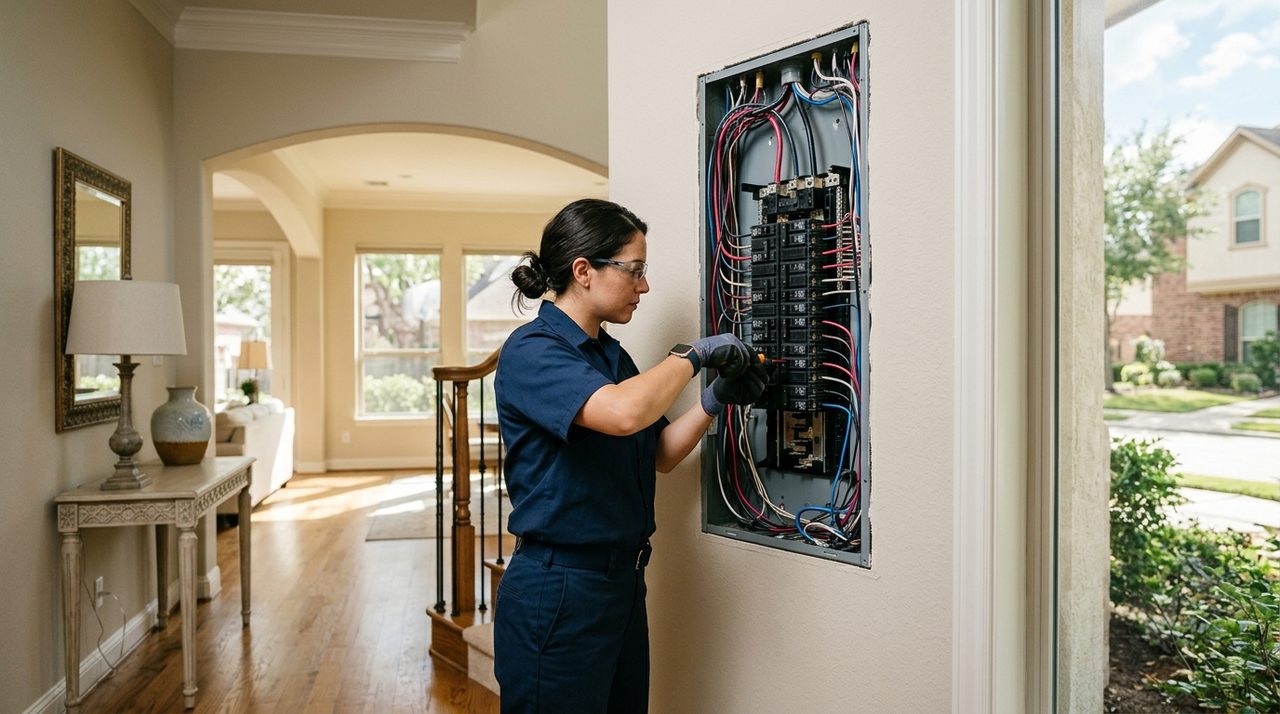
A qualified electrician should perform a thermal-imaging scan and a full breaker-by-breaker load test on any Braeswood panel with a documented flood history before the home changes hands or undergoes renovation. Because Braeswood falls under City of Houston permit jurisdiction, the panel replacement requires a permit pulled by a TDLR-licensed Master Electrician through the Houston Permitting Center, followed by a CenterPoint disconnect-reconnect appointment — a sequence that typically adds two to five business days to the project timeline. Budget estimates for a 200-amp panel replacement here run $1,800–$3,200 installed, though homes still carrying original 100-amp service will need a full service upgrade, not just a panel swap.
Sources: FEMA National Flood Hazard Layer (NFHL), City of Houston Permitting Center, Texas Department of Licensing & Regulation
Why it matters to you
Any Braeswood property in FEMA Zone AE that has already been damaged — or is undergoing a renovation exceeding 50 percent of the structure's pre-improvement market value — triggers FEMA's Substantial Improvement review, which can require elevation of all electrical equipment including panels, meter bases, and subpanels to or above the Base Flood Elevation. Homeowners who scope only an electrical upgrade without flagging this threshold risk a City of Houston stop-work order mid-project when floodplain staff catch the combined valuation during permit review.
What a good pro does
Before signing any electrical contract on an original Braeswood ranch, have your electrician coordinate with the City of Houston's Floodplain Management office to verify whether prior damage claims have been recorded against the property and where the cumulative improvement valuation stands. If elevation is required, the electrician's scope expands to include a new exterior meter can mounted at the compliant height and conduit rerouting — work that should be detailed in the permit drawings submitted to the Houston Permitting Center. A TDLR Master Electrician familiar with FEMA AE elevation requirements is not optional here; it is the difference between a permit that clears and one that triggers a full floodplain development review.
Sources: FEMA National Flood Hazard Layer (NFHL), City of Houston Permitting Center, Texas Department of Licensing & Regulation
Why it matters to you
The original ranch homes along Braeswood's interior streets that have not yet been torn down were largely built between 1955 and 1972 — squarely within the aluminum branch-circuit wiring era. Single-strand aluminum wiring oxidizes at every receptacle and switch termination, and that oxidation accelerates in Braeswood's chronically high-humidity environment, where attic temperatures routinely exceed 130°F in summer and the neighborhood's repeated flood events introduce additional moisture cycling into wall cavities. Inspectors flag aluminum wiring on virtually every pre-1975 Braeswood home that comes to market.
What a good pro does
Proper remediation on a Braeswood ranch requires either a full copper replacement or the installation of CO/ALR-rated devices and listed AlumiConn connectors at every single termination — not just the receptacles a buyer's inspector happened to open. Whole-home remediation on a typical 1,800–2,400 square foot Braeswood ranch runs an estimated $3,500–$8,000 depending on circuit count and accessibility; the City of Houston requires an electrical permit for this scope. Request that your electrician document every termination point with photos before closing wall cavities, since many Braeswood homes have had partial and undocumented repairs by prior owners over the decades.
Sources: Texas Department of Licensing & Regulation, City of Houston Permitting Center, International Residential Code (as adopted by City of Houston)
Why it matters to you
The May 2024 derecho and Hurricane Beryl both tracked directly over the Braeswood corridor, snapping mature live oaks that are a signature of the neighborhood onto overhead service drops and shearing weatherhead mast risers off the rooflines of the older one-story ranches that still carry aerial service rather than underground laterals. CenterPoint Energy is responsible only for restoring the utility-side drop; the homeowner owns the weatherhead, mast, meter can, and the conductors from the mast to the panel — and none of that can be re-energized until a licensed electrician repairs and inspects the homeowner's equipment.
What a good pro does
After any wind event, visually inspect your weatherhead and the conduit mast from the ground before assuming power loss is purely a CenterPoint issue. If the mast is bent, the weatherhead cap is missing, or the service entrance conductors show visible abrasion against roofing material, call a TDLR Master Electrician before calling CenterPoint — the utility will not reconnect to a damaged mast. In the City of Houston, mast and meter-base repairs require a permit through the Houston Permitting Center; CenterPoint schedules the reconnect appointment only after the permit inspection is closed. For Braeswood homes with mature tree canopy overhanging the service drop, ask your electrician to evaluate whether converting to an underground lateral is cost-effective as a permanent solution.
Sources: Texas Department of Licensing & Regulation, City of Houston Permitting Center
Hiring electricians in Braeswood? Braeswood straddles Brays Bayou in southwest Houston, placing flood mitigation at the center of virtually every home service decision. The neighborhood's mix of original 1950s–1960s ranch homes and post-flood teardown rebuilds means contractors encounter widely varying foundation types, electrical panels, and plumbing systems on a single block. Multiple mandatory HOAs and recorded deed restrictions add a layer of compliance review before exterior modifications.
Building era
1950s–1960s original construction with significant teardown/infill waves in the late 1990s–2010s, accelerating after repeated flood events.
Typical style
Original one-story ranch and mid-century traditional homes alongside newer two-story traditional, transitional, and soft Mediterranean custom infill.
Foundations
Mixed — older homes include both pier-and-beam and slab-on-grade; virtually all post-1990s infill and rebuilds are slab-on-grade (not explicitly documented for this neighborhood; based on typical Houston-area patterns).
Common systems
Original homes may have galvanized or cast-iron drain lines, R-22 HVAC systems, and Federal Pacific or Zinsco electrical panels. Rebuilt homes typically feature PEX or copper plumbing, modern high-SEER HVAC, and 200-amp panels. Mixed vintage makes system audits essential.
What that means for repairs
Post-flood teardown-and-rebuild is the dominant renovation activity, often involving full elevation of new structures. Remaining original ranch homes frequently undergo foundation repair, re-plumbing with PEX, HVAC replacement, and flood-damage remediation including mold abatement and drywall replacement.
Permit jurisdiction
City of Houston — Houston Permitting Center.
HOA & deed restrictions
Braeswood Place Homeowners Association (BPHA) operates as a mandatory-membership POA for certain sections of Braeswood Place, with a section-by-section reconstitution effort underway. Additional smaller mandatory HOAs exist (e.g., Seventy-Six Fifty-Five South Braeswood HOA). The broader Braeswood corridor is a patchwork of multiple associations, condo/townhome HOAs, and some individually restricted plats with no single umbrella organization.
Historic districts
No City of Houston historic district designation confirmed.
Contractor note
Contractors must verify which HOA or POA governs a specific lot before exterior work, as deed restrictions vary section by section. Elevation and flood-proofing projects may trigger additional City of Houston floodplain development permits and FEMA Substantial Improvement/Substantial Damage reviews.
FEMA flood zone
FEMA Zone AE (high flood risk) — source: fema_nfhl. The neighborhood is situated along Brays Bayou, one of Houston's most flood-prone waterways, with direct exposure to bayou overflow during major rain events.
Hurricane Harvey impact
Braeswood and the adjacent Braeswood Place area along Brays Bayou were among the hardest-hit neighborhoods during Hurricane Harvey (2017), consistent with severe flooding also experienced during the Memorial Day 2015 and Tax Day 2016 flood events. Widespread home inundation triggered a major wave of teardowns, elevations, and full rebuilds throughout the corridor. Specific block-level inundation depths were not confirmed in available research but are well-documented in FEMA and Harris County Flood Control District records.
Heat & humidity load
High heat and humidity stress aging HVAC systems in original 1950s–1960s homes, many of which still run undersized or outdated units. Mold recurrence is a persistent concern in previously flooded structures, particularly in pier-and-beam crawl spaces and behind repaired drywall. Summer storms can re-saturate soils near the bayou, exacerbating foundation movement on clay soils.
Working with contractors here
Flood remediation and prevention dominate the contractor workload in Braeswood — from mold abatement and drywall replacement in previously inundated homes to full structural elevation of new builds. Foundation repair is common on original 1950s–1960s slab and pier-and-beam homes settling on expansive clay soils worsened by repeated saturation cycles. Re-plumbing from galvanized or cast-iron to PEX and upgrading electrical panels from original 100-amp service are frequent companion scopes on older homes. Contractors should scope every project with flood history in mind: verify whether a property has triggered FEMA Substantial Improvement thresholds, which can mandate elevation or floodproofing for any renovation exceeding 50% of the structure's market value. The section-by-section HOA and deed restriction landscape means exterior modification approvals — fencing, roofing material, paint colors — require lot-specific verification before work begins.
Local Tip
Always ask for a written estimate before work begins. Texas contractors are required to provide one on jobs over $1,000.
Braeswood straddles Brays Bayou in southwest Houston, placing flood mitigation at the center of virtually every home service decision. The neighborhood's mix of original 1950s–1960s ranch homes and post-flood teardown rebuilds means contractors encounter widely varying foundation types, electrical panels, and plumbing systems on a single block. Multiple mandatory HOAs and recorded deed restrictions add a layer of compliance review before exterior modifications.
Source: U.S. Census Bureau, ACS 5-Year 2023
Much of Braeswood maps to FEMA Zone AE (high flood risk), so flood-resilient detailing -- elevated equipment, water-tolerant materials, and drainage-first thinking -- is essential here, not optional; risk climbs sharply on blocks nearest Brays Bayou, where it varies parcel to parcel.
Source: FEMA National Flood Hazard Layer (NFHL). Flood zones vary by parcel — verify your individual FIRM panel.
In Braeswood, where FEMA Zone AE inside the 100-year floodplain and proximity to Brays Bayou puts electrical panels at direct risk, have a TDLR-licensed electrician relocate your main panel and subpanels to at least two feet above the base flood elevation before hurricane season opens June 1. Harvey 2017 showed that panels submerged even briefly require full replacement, so pre-storm elevation is far cheaper than post-flood rewiring. Confirm the current FEMA panel for your Braeswood parcel — the area maps to Zone AE, but adjacent lots can differ.
The May 2024 derecho that ripped through Houston with 100-mph straight-line winds downed transformers and sent destructive voltage surges through the grid the moment power was restored — in Braeswood, where FEMA Zone AE inside the 100-year floodplain and proximity to Brays Bayou already stresses your electrical system, a whole-house surge arrester at the meter base is the single highest-value electrician upgrade you can make this season. Have a TDLR-licensed electrician install one before the June–September severe-storm peak. Confirm the current FEMA panel for your Braeswood parcel — the area maps to Zone AE, but adjacent lots can differ.
Winter Storm Uri 2021 exposed a critical vulnerability for Braeswood homeowners in FEMA Zone AE inside the 100-year floodplain and proximity to Brays Bayou zones: sump pumps and flood-mitigation circuits that had never been tested under load failed when the freeze hit, leaving homes unprotected when pipes burst. Before the next hard freeze, have a TDLR-licensed electrician load-test your sump-pump circuits, verify GFCI functionality in below-grade spaces, and confirm your panel is rated for the draw of any portable heat source you plan to use. In-city Braeswood work falls under City of Houston floodplain and permitting rules.
Sources: FEMA National Flood Hazard Layer (NFHL), Ready.gov -- Hurricanes, CenterPoint Energy -- Storm Center, City of Houston -- Emergency Preparedness, Ready.gov -- Winter Weather, Harris County Flood Control District
Houston-specific estimators to plan your project before you call a pro. All results are planning estimates — a licensed local pro confirms the details on site.
Disconnect & drain every outdoor hose bib
Remove hoses, drain the spigots, and cover each with an insulated faucet sock. Un-drained hose bibs are the #1 burst point in a Houston freeze.
Insulate exposed pipes in the attic & garage
Wrap any pipe in an unconditioned space (attic runs, garage walls) with foam sleeves. Houston homes rarely insulate these because they only matter a few nights a year — which is exactly why they burst.
Open cabinet doors & keep a pencil-width drip
On hard-freeze nights, open kitchen/bath cabinets so warm air reaches the pipes and let faucets on exterior walls drip to relieve pressure.
Protect the attic/garage water heater & its lines
An attic or garage tank sits in unconditioned space. Insulate the cold-inlet and hot-outlet lines and confirm the emergency drain pan is clear so a leak doesn't reach the ceiling.
This is a planning estimate only — actual requirements depend on an on-site assessment by a licensed Houston pro. If a pipe has already burst, shut off your main water supply and call a licensed Houston plumber immediately — freeze bursts flood fast.
Sources: City of Houston Permitting CenterTexas Department of Licensing & RegulationFEMA National Flood Hazard Layer (NFHL)
Sources: City of Houston Permitting CenterFEMA National Flood Hazard Layer (NFHL)
Sources: Local HOA / deed restrictions (see area profile)
Sources: City of Houston Permitting CenterFEMA National Flood Hazard Layer (NFHL)
Sources: Local HOA / deed restrictions (see area profile)City of Houston Permitting Center