Serving Angleton Based in Lake Jackson · 8.9 mi away
Best Water & Flood Restoration in Angleton, TX
Angleton's median home was built in 1978, meaning the bulk of the city's ranch-style brick stock carries aging galvanized plumbing, original flex ductwork, and slab-on-grade foundations sitting on Brazoria County's notoriously expansive black clay soil — a combination that turns even a modest plumbing failure or tropical-band rainstorm into a multi-week drying project. Although most of Angleton maps to FEMA Zone X, Brazoria County's coastal position means tropical moisture, stalled Gulf fronts, and events like Beryl (2024) can dump inches of water on streets not designed for those volumes, and the clay soil holds that moisture against slab edges long after the street dries out. This page explains the specific water and flood restoration challenges Angleton homeowners actually face, how permitting works inside city limits versus unincorporated Brazoria County, and what realistic scopes and costs look like.
Verified against Google Business data
Updated 2026
See the 1 Water & Flood Restoration Serving Angleton 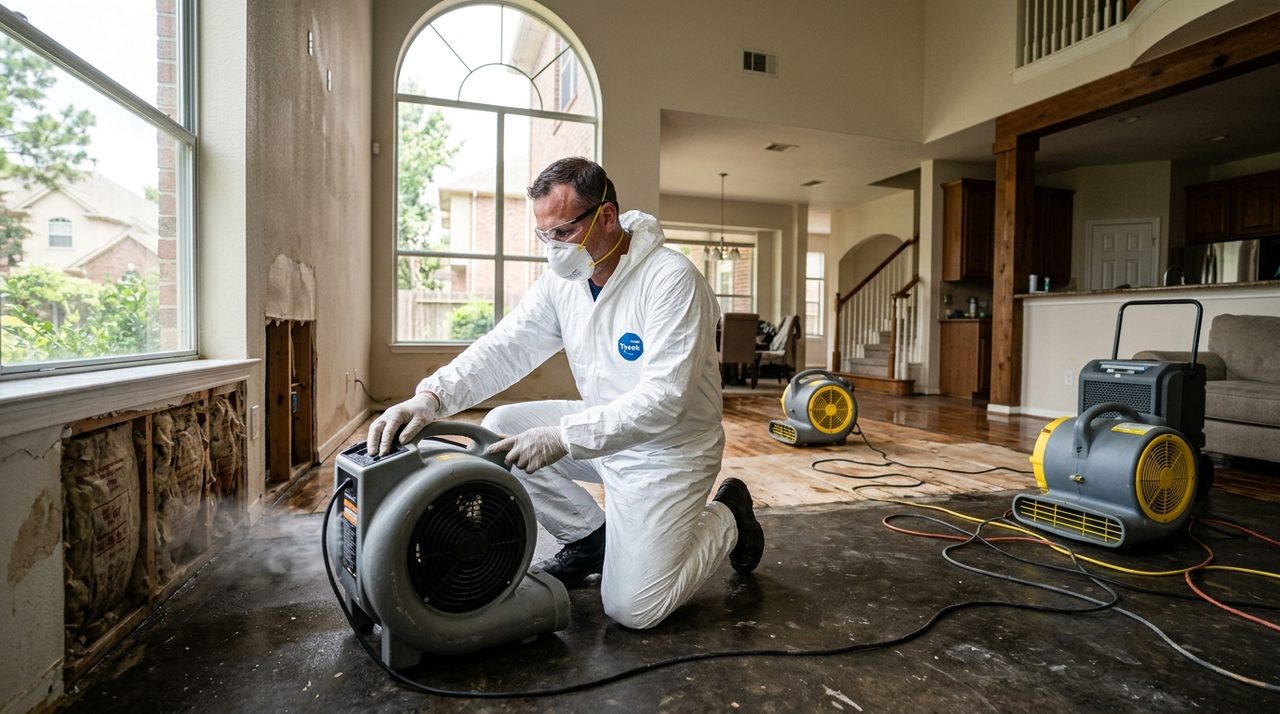
- Median home built
- 1978
- Median home value
- $187,400
- FEMA flood zone
- X (low)
- Typical mitigation cost (est.)
- $3,500–$40,000 depending on water category and scope
- Most common local issue
- Clay-soil slab moisture wicking into 1950s–1980s ranch home wall cavities after water events
Ranked by verified Google rating × review volume × verification tier. How we rank →
Some highly-rated pros serve Angleton from nearby and may not keep a Angleton street address. Those are listed under "Also serving Angleton" with their real city and distance, so you always know where each business is based.
Min rating:
1 resultAlso serving Angleton
Highly-rated pros based nearby who cover Angleton. Distance shown from the Angleton area.
Water & Flood Restoration in Angleton: What You Should Know
Brazoria Clay Keeps Slab Edges Wet Long After the Water Recedes
Why it matters to you
Angleton sits on the same Houston Black expansive clay belt that runs through Brazoria County, and that soil absorbs water like a sponge during a Gulf-driven rain event. Even after surface water is gone, the saturated clay pressed against the perimeter of a slab-on-grade foundation — the dominant foundation type in Angleton's post-1950s housing stock — continues pushing moisture into the concrete edge, bottom plates, and lower drywall for days or weeks. Homeowners who assume the problem is solved once the floors feel dry are often surprised to find microbial growth behind baseboards two months later.
What a good pro does
A qualified restoration contractor will deploy thermal imaging cameras and calibrated moisture meters along all exterior wall bottom plates, not just the visibly wet areas, and establish a drying goal that accounts for the extended soil-moisture cycle specific to Brazoria County clay. IICRC S500 protocols require drying to pre-loss moisture content before any encapsulation or repair, and on clay-soil lots that timeline is often 30–50% longer than the national average. If moisture readings remain elevated past the equipment drying window, the scope should be expanded to include bottom-plate replacement rather than drying in place.
Aging Flex Duct in 1960s–1980s Ranch Homes Becomes a Mold Incubator After Any Inundation
Why it matters to you
Angleton's substantial stock of 1960s through 1980s ranch homes — many of which still have original or first-replacement flex duct routed through unconditioned attic space — is particularly vulnerable after any water event that runs the HVAC during or shortly after intrusion. Flex duct insulation absorbs ambient humidity readily, and Angleton's Gulf-proximity climate (average summer relative humidity well above 70%) means the interior of flooded or storm-saturated duct runs can reach Aspergillus and Cladosporium growth conditions within 48 to 72 hours. Because the duct is hidden in the attic, homeowners often continue running the system, circulating spores through every room.
What a good pro does
Restoration contractors should include a full duct inspection — visual plus moisture probe — in any scope involving a 1960s–1980s Angleton ranch home that experienced extended inundation or humidity intrusion. If duct insulation reads above baseline moisture content, replacement is generally more cost-effective than attempting to dry flex duct in place, and it removes the microbial risk entirely. Any mold remediation work that follows must be performed by a contractor holding a TDLR-issued Mold Remediation Contractor (MRC) license under Texas Occupations Code Chapter 1958.
Sources: IICRC (water/mold restoration standards), Texas Department of Licensing & Regulation
Tropical Wind-Driven Rain Enters Brick Veneer and Older Windows Without Any Floor Flooding
Why it matters to you
Angleton's position as a Brazoria County coastal community means tropical bands, Gulf-stall events, and storms like Beryl (2024) deliver sustained wind-driven rain at angles that force water through brick veneer weep holes, aging window flanges, and soffit vents on older ranch homes — completely separate from any street or yard flooding. The damage pattern is top-down and wall-cavity-centered, not the bottom-up slab-edge pattern most homeowners expect, which means interior wall surfaces can look perfectly dry while sheathing and insulation behind them are saturated. Angleton's 1950s–1970s ranch homes are especially susceptible because original window installations rarely included modern flexible flashing.
What a good pro does
After any tropical or high-wind event, homeowners should have a restoration contractor perform a thermal imaging scan of all exterior-facing walls, not just areas with visible staining or peeling paint. The intrusion path typically runs from roof deck to wall sheathing to bottom plate, requiring a completely different drying equipment layout than floor-based flood work — wall cavity drying mats and directional air movers rather than floor-level air movement. Work touching any exposed electrical wiring during demo requires a TDLR-licensed electrician, and if the scope involves opening exterior walls, a demolition permit through the City of Angleton Building Department (for in-city properties) or Brazoria County Engineering (for unincorporated lots) is required before work begins.
Sources: IICRC (water/mold restoration standards), Texas Department of Licensing & Regulation, Municipal permit office (see area profile)
Dual Permit Jurisdiction Means One Wrong Phone Call Can Delay Your Insurance Claim
Why it matters to you
Unlike properties in the City of Houston, which routes all trade permits through a single municipal office, Angleton homeowners face a split jurisdiction: properties inside Angleton city limits pull demolition, plumbing, and electrical permits through the City of Angleton Building Department, while properties in unincorporated Brazoria County go through Brazoria County Engineering — different forms, different fee schedules, and different inspection cadences. Mis-routing a permit application is not a minor clerical issue; it can delay the Certificate of Completion that most insurers require before releasing reconstruction funds, extending the period a damaged home sits in a partially demoed state. The complication is real in Angleton because the city boundary is not always obvious, and some newer subdivision lots on the city fringe straddle the line.
What a good pro does
Before any restoration work begins, the contractor should verify the property's jurisdictional status using the Brazoria County Appraisal District parcel records and confirm the correct permit office in writing. Restoration contractors typically pull the demolition permit themselves; licensed plumbing subs pull their own permits under TSBPE, and licensed electricians pull theirs under TDLR. For subdivisions with active POAs — such as Angleton Heritage Court — the contractor should also check whether the POA's architectural review process applies to exterior demo or dumpster placement, since HOA approval delays can push a Category 2 water loss toward Category 3 contamination thresholds if wet materials are not removed promptly.
Sources: Municipal permit office (see area profile), Texas State Board of Plumbing Examiners, Texas Department of Licensing & Regulation, Local HOA / deed restrictions (see area profile)
Water & Flood Restoration in Angleton: What You Should Know
Hiring water & flood restoration in Angleton? Angleton is the Brazoria County seat with housing ranging from 1950s ranch homes near downtown to newer production-built subdivisions on the outskirts. There is no single mandatory HOA—restrictions and associations vary by subdivision, requiring lot-level verification. Contractors should confirm whether a property falls inside city limits (City of Angleton permitting) or in unincorporated Brazoria County, as the permitting jurisdiction and requirements differ.
- Housing era
- 1950s–1980s in older in-town areas
- Foundation
- Predominantly slab-on-grade for post-1950s construction
- Flood zone
- FEMA Zone X (low flood risk) per official NFHL data
- Permits
- City of Angleton Building Department for properties within city limits
Housing stock & systems
Building era
1950s–1980s in older in-town areas; 1990s–present in newer subdivisions at the city fringe.
Typical style
Ranch-style one-story brick or brick/wood homes in older areas; traditional suburban brick-and-siding 1–2 story homes in newer subdivisions; scattered farmhouses and manufactured homes in unincorporated areas.
Foundations
Predominantly slab-on-grade for post-1950s construction; some older homes may have pier-and-beam, but slab dominates across the area.
Common systems
Older in-town homes (1950s–1970s) may have original galvanized or cast-iron plumbing, aging electrical panels (60–100 amp), and older central HVAC or window units. Newer subdivision homes (1990s+) typically have copper or PEX plumbing, 200-amp panels, and central HVAC with ductwork in attics.
What that means for repairs
Older in-town homes frequently need plumbing re-pipes, electrical panel upgrades, and HVAC modernization. Kitchen and bath remodels are common in 1960s–1980s ranch homes. Newer subdivisions see cosmetic updates and occasional foundation repair due to Brazoria County's expansive clay soils.
Permits & restrictions
Permit jurisdiction
City of Angleton Building Department for properties within city limits; Brazoria County Engineering for properties in unincorporated areas. Not under City of Houston permitting jurisdiction.
HOA & deed restrictions
No citywide mandatory HOA. Multiple individual subdivision POAs/HOAs exist (e.g., Angleton Heritage Court Property Owners Association, Inc.), each governing only its own subdivision. Many older platted areas have only deed restrictions with no active association. HOA status must be verified by subdivision name via the Texas HOA/POA Management Certificate Search for Brazoria County and the property's deed and title commitment.
Historic districts
No City of Houston historic district designation confirmed. Angleton is not within Houston's HAHC jurisdiction.
Contractor note
Contractors must first determine whether a property is inside Angleton city limits or in unincorporated Brazoria County, as permit requirements, inspections, and fee structures differ. Some subdivisions have architectural review requirements through their POA that must be satisfied in addition to municipal or county permits.
Flood & weather
FEMA flood zone
FEMA Zone X (low flood risk) per official NFHL data. However, portions of greater Angleton and Brazoria County near Bastrop Bayou and other local waterways may carry higher flood designations; buyers and contractors should verify flood zone status for specific parcels via FEMA's Flood Map Service Center.
Hurricane Harvey impact
Not confirmed from research for specific Angleton neighborhoods. Brazoria County experienced widespread flooding during Hurricane Harvey (2017), and mandatory evacuations were issued for parts of the county due to Brazos River and bayou flooding. Specific Harvey impact for individual Angleton subdivisions should be verified through Brazoria County Clerk records and FEMA damage reports.
Heat & humidity load
Angleton's humid subtropical climate and Brazoria County's coastal proximity drive heavy HVAC demand from May through October. Older homes with undersized or aging systems are prone to compressor failure and ductwork condensation issues. Slab foundations on expansive clay soils may shift during summer drought cycles, potentially causing foundation stress and related plumbing issues.
Working with contractors here
Contractors in Angleton most commonly handle HVAC replacements, plumbing re-pipes, and electrical upgrades in the town's substantial stock of 1950s–1980s ranch homes. Foundation repair is a recurring need due to Brazoria County's expansive clay soils, which shift with seasonal moisture changes. Newer subdivisions generate demand for cosmetic remodeling, fence installation, and roof replacements after storm events. Job scoping should account for the lack of a unified HOA—restrictions vary by subdivision, and some older lots have minimal or expired deed restrictions, while newer developments may require architectural committee approval. Contractors unfamiliar with the area should verify the permitting jurisdiction (city vs. county) before beginning work, as inspection schedules and code enforcement practices differ between the two.
Local Tip
Always ask for a written estimate before work begins. Texas contractors are required to provide one on jobs over $1,000.
About Angleton
Angleton is the Brazoria County seat with housing ranging from 1950s ranch homes near downtown to newer production-built subdivisions on the outskirts. There is no single mandatory HOA—restrictions and associations vary by subdivision, requiring lot-level verification. Contractors should confirm whether a property falls inside city limits (City of Angleton permitting) or in unincorporated Brazoria County, as the permitting jurisdiction and requirements differ.
- Median year built
- 1978
- Median home value
- $187,400
- Owner-occupied
- 66.3%
- Population
- 19,597
- Housing units
- 8,358
- Median income
- $83,981
Source: U.S. Census Bureau, ACS 5-Year 2023
Flood & storm risk
FEMA Zone XLow flood riskMost of Angleton maps to FEMA Zone X (low mapped flood risk), but Houston's flash-flood reality means even low-risk blocks benefit from smart drainage and storm-hardened installs; as a Brazoria County coastal community, tropical surge and wind add a layer generic guidance misses.
Source: FEMA National Flood Hazard Layer (NFHL). Flood zones vary by parcel — verify your individual FIRM panel.
Houston Storm Readiness in Angleton
Hurricane & flooding
Water-restoration companies serving Angleton, TX can install or recommend backflow prevention add-ons on floor drains and advise on contents-elevation strategies that limit category-2 water contact during a tropical event. The May 2024 derecho reminded Houston homeowners that extreme rain is not exclusive to named hurricanes, making year-round readiness essential. Confirm the current FEMA panel for your Angleton parcel — the area maps to Zone X, but adjacent lots can differ.
Severe storms & hail
Even in low-flood-mapped areas of Angleton, TX, intense thunderstorm rainfall can overwhelm gutter systems and force water through foundation weep holes or into slab expansion joints, creating sub-floor moisture that feeds mold undetected. An IICRC-certified water-restoration technician can use penetrating moisture meters to confirm whether a post-storm inspection is clear or whether targeted structural drying is needed. Confirm the current FEMA panel for your Angleton parcel — the area maps to Zone X, but adjacent lots can differ.
Ice storms & freezes
Ice accumulation on exterior pipe chases and uninsulated attic runs caused widespread freeze-and-burst events across Angleton, TX during Uri 2021, and the resulting water losses required IICRC-trained technicians with commercial dehumidifiers to dry out wall and ceiling cavities that building materials alone could not off-gas. Confirming you have a preferred restoration contractor's number before a freeze forecast arrives eliminates critical delays when crews are in high demand across the metro. With a median build year of 1978, the older building stock here is more exposed to hard-freeze damage than newer construction. Confirm the current FEMA panel for your Angleton parcel — the area maps to Zone X, but adjacent lots can differ.
Sources: FEMA National Flood Hazard Layer (NFHL), Ready.gov -- Hurricanes, CenterPoint Energy -- Storm Center, City of Houston -- Emergency Preparedness, Ready.gov -- Winter Weather, Harris County Flood Control District
Free Angleton Tools & Calculators
Houston-specific estimators to plan your project before you call a pro. All results are planning estimates — a licensed local pro confirms the details on site.
Houston Freeze Prep & Pipe Insulation Checklist
Open full tool & FAQ →Your freeze checklist — 4 tasks
- 1
Disconnect & drain every outdoor hose bib
Remove hoses, drain the spigots, and cover each with an insulated faucet sock. Un-drained hose bibs are the #1 burst point in a Houston freeze.
- 2
Insulate exposed pipes in the attic & garage
Wrap any pipe in an unconditioned space (attic runs, garage walls) with foam sleeves. Houston homes rarely insulate these because they only matter a few nights a year — which is exactly why they burst.
- 3
Open cabinet doors & keep a pencil-width drip
On hard-freeze nights, open kitchen/bath cabinets so warm air reaches the pipes and let faucets on exterior walls drip to relieve pressure.
- 4
Protect the attic/garage water heater & its lines
An attic or garage tank sits in unconditioned space. Insulate the cold-inlet and hot-outlet lines and confirm the emergency drain pan is clear so a leak doesn't reach the ceiling.
This is a planning estimate only — actual requirements depend on an on-site assessment by a licensed Houston pro. If a pipe has already burst, shut off your main water supply and call a licensed Houston plumber immediately — freeze bursts flood fast.
Frequently Asked Questions
My Angleton home is inside city limits — do I need a permit from the City of Angleton Building Department before a restoration crew starts demolishing wet drywall?
Yes. For properties inside Angleton city limits, structural demolition work — including removing flood-damaged drywall, insulation, and bottom plates — requires a permit from the City of Angleton Building Department, not the City of Houston Permitting Center or Brazoria County Engineering. If your property sits in unincorporated Brazoria County, you route the same permit application through Brazoria County Engineering instead, and the inspection schedules and fee structures are different. Your restoration contractor should confirm your exact jurisdiction before pulling any permits, because a mis-routed application can delay the Certificate of Completion your insurer needs to close the claim.
Sources: Municipal permit office (see area profile)
Angleton is in FEMA Zone X, so does that mean my water damage claim will be treated differently than a Harvey-era Zone AE claim in Houston?
Zone X means Angleton has a low mapped flood risk, but it does not change how IICRC S500 water-damage categories apply to your loss — a Category 3 contaminated-water event from a storm drain backup or sewage overflow is still Category 3 regardless of flood zone, and your restoration contractor must document the water source and any testing results to defend that classification with your insurer. What Zone X does affect is that most Angleton homeowners carry standard homeowners insurance rather than an NFIP policy, so the claim process, adjuster timelines, and scope-dispute rules differ from the NFIP process common in AE-zone neighborhoods closer to Brays or Buffalo Bayou. If your loss was triggered by a named storm like Beryl (2024), check whether your policy separates wind and water perils, as that split can complicate scope approval.
Sources: FEMA National Flood Hazard Layer (NFHL)IICRC (water/mold restoration standards)
My 1968 Angleton ranch home has galvanized supply lines — if a pipe bursts and soaks the walls, can the restoration contractor also handle the re-pipe, or do I need a separate plumber?
A water and flood restoration crew handles the structural drying, demolition, and mold remediation portions of the job, but any actual plumbing repair or re-pipe requires a separately licensed plumber holding a TSBPE license — the restoration contractor cannot legally perform that work unless they are also a licensed plumbing company. In practice, most reputable Angleton restoration firms coordinate directly with a licensed sub-trade plumber and pull the required trade permit through the City of Angleton Building Department or Brazoria County Engineering depending on your lot's jurisdiction. For a 1968-vintage home with original galvanized pipe, insurers often require the re-pipe scope to be quoted alongside the drying scope so the adjuster can evaluate all related damage at once.
Sources: Texas State Board of Plumbing ExaminersMunicipal permit office (see area profile)
How long should I realistically expect the drying phase to take for a slab-on-grade ranch home in Angleton after several inches of interior water?
For a typical 1,500–2,200 square-foot slab-on-grade ranch home in Angleton, the active structural drying phase — running commercial dehumidifiers and air movers after water extraction — typically takes 3 to 5 days under IICRC S500 standards, but Brazoria County's expansive black clay soil can push that estimate closer to 7 to 10 days because the clay retains moisture against the slab perimeter and continues wicking into bottom plates long after surface water is gone. Your contractor should be taking daily moisture-meter readings at the slab edge and wall cavities, not just visually inspecting, before calling the structure dry. Rushing this phase to save money on equipment rental is the single most common reason Angleton homeowners end up calling for mold remediation 60 to 90 days later.
My Angleton subdivision has a POA — do I need their approval before a dumpster shows up in my driveway for flood demo debris?
It depends entirely on which subdivision you are in, because Angleton has no citywide mandatory HOA — each POA or deed-restriction set governs only its own plat, and requirements vary from formal architectural committee review to no active enforcement at all. Check your property's deed and the Texas HOA/POA Management Certificate search for Brazoria County to identify whether your POA has rules on dumpster placement, exterior material visibility, or temporary equipment staging before your contractor mobilizes. Time matters in flood restoration because IICRC S500 calls for drying initiation within 24 to 48 hours of water entry, so contact your POA immediately and in writing so that any required approval does not push your Category 2 loss into Category 3 territory.
Sources: IICRC (water/mold restoration standards)Local HOA / deed restrictions (see area profile)
Does the restoration contractor need a TDLR mold license, or is that only required if visible mold is already present in my Angleton home?
Under Texas Occupations Code Chapter 1958, a firm must hold a TDLR-issued Mold Remediation Contractor (MRC) license any time it performs mold remediation work — meaning the physical removal or treatment of mold — regardless of whether the mold is widespread or a small isolated area discovered during flood demo. A separately licensed Mold Assessment Consultant (MAC) must write the remediation protocol and issue the clearance report; the same company cannot legally perform both assessment and remediation on the same project. When interviewing restoration contractors for your Angleton home, ask for both the MRC license number and the name of the MAC they coordinate with, and verify both are current on the TDLR license lookup before work begins.