Open Now
9300 Joan Ln, Conroe, TX 77306
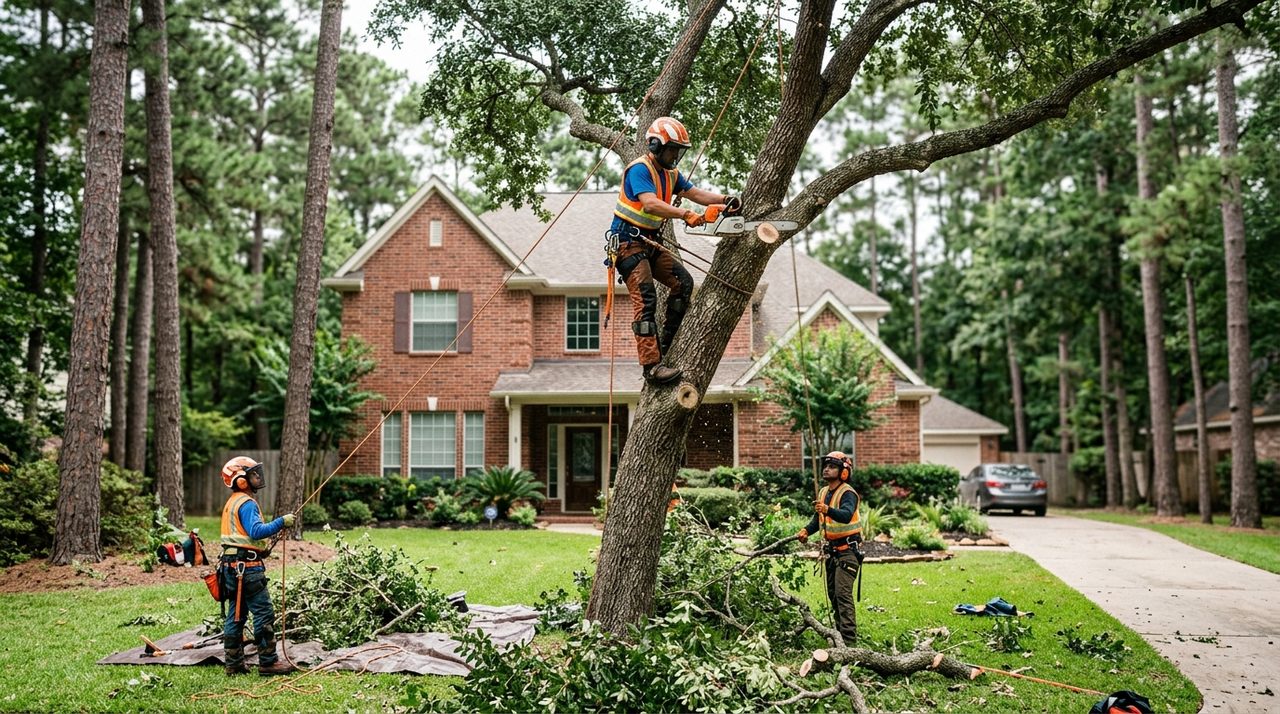
Porter's sprawling mix of 1970s acreage tracts, 1990s–2000s subdivisions, and brand-new Valley Ranch production builds creates a tree-removal landscape unlike any single incorporated city in the Houston metro — landowners deal with Montgomery County permitting instead of a municipal permit office, while the subdivision they happen to live in may impose strict HOA approval requirements that are entirely separate from the county. Add in the area's substantial pine canopy on older wooded lots, proximity to the Piney Woods transition zone, and the straight-line wind damage from the May 2024 derecho that cut through the north Houston corridor, and Porter homeowners have concrete, property-specific decisions to make before a chainsaw ever starts.
Ranked by verified Google rating × review volume × verification tier. How we rank →
9300 Joan Ln, Conroe, TX 77306
24445 Cunningham Dr Trlr 3, Porter, TX 77365
1702 Athens Dr, New Caney, TX 77357
24032 Ford Rd, Porter, TX 77365
22589 Cuttler Rd, New Caney, TX 77357
3911 Long Leaf Ln, Porter, TX 77365
23991 Orchid Bee Ln, New Caney, TX 77357
13080 Forest Trail, Conroe, TX 77306
18872 Caterpillar Ct, Porter, TX 77365
Why it matters to you
Porter's older unrestricted tracts and 1970s–1990s subdivisions on the Montgomery County side of the Piney Woods transition zone carry significant loblolly pine canopy. Southern pine beetle kill has taken a sustained toll on these trees, and a dead standing pine becomes dangerously brittle within 12–18 months of death — the wood fractures unpredictably during climbing, making removal substantially more complex and expensive than the same tree removed while living. With median homes built around 2001 and many rural lots predating that by decades, dead pines near driveways, outbuildings, and home rooflines are a real and underappreciated risk on Porter acreage properties.
What a good pro does
A qualified crew should assess each dead pine for lean, root-plate stability, and decay stage before any climbing or rigging begins — many beetle-killed trees require crane-assisted sectioning rather than standard climb-and-cut methods. Expect a hazard premium of 25–50% above the base price for a live tree of comparable size; a dead pine over 60 feet can realistically run $2,500–$5,000 or more as an estimate. Verify that the contractor carries current liability insurance and, ideally, holds ISA Certified Arborist credentials, since Texas does not license this trade through TDLR and voluntary certification is the primary quality signal.
Sources: Local HOA / deed restrictions (see area profile)
Why it matters to you
Unlike incorporated cities where one code governs everyone, Porter's unincorporated Montgomery County status means tree removal rules are set at the subdivision level — and they vary dramatically block by block. Valley Ranch HOA and North Country Homeowners Association both require architectural committee (ACC) approval before exterior work that includes tree removal over a specified caliper, while properties on unrestricted rural tracts face no private covenant restrictions at all. A homeowner who removes a mature tree without ACC sign-off in a governed subdivision can face fines and mandatory replanting requirements that cost more than the removal itself.
What a good pro does
Before any contractor quotes the job, pull the property's deed records or check the TREC HOA management-certificate database to confirm whether a mandatory HOA applies and what its tree-removal threshold is — commonly 6 to 8 inches diameter at breast height in area communities. Any reputable contractor working in Porter should ask this question upfront and build ACC review time into the project schedule, since committee meetings in smaller subdivision HOAs may occur only monthly. Montgomery County Engineering does not separately permit routine private-property tree removal, so the HOA covenant is the binding layer of approval for governed lots.
Sources: Local HOA / deed restrictions (see area profile), Municipal permit office (see area profile)
Why it matters to you
The May 2024 derecho tracked through the north Houston corridor with straight-line winds exceeding 100 mph, and Porter's tree canopy — particularly on older wooded lots — took real damage. Hurricane Beryl followed in summer 2024. After any major regional storm event, every legitimate tree company in the Houston metro is backlogged for weeks, and out-of-state operators with no local track record flood in to capture the surge. Post-storm pricing in the Houston area routinely runs 40–80% above normal rates (an estimate), and emergency work — a tree on a roof or blocking a driveway — commands a premium on top of that.
What a good pro does
Get at least two written quotes and verify that each contractor carries liability insurance with limits adequate for your home's value — request the certificate of insurance directly, not just a verbal assurance. ISA Certified Arborist status is searchable on the ISA website and is worth confirming before committing to a large job. Porter homeowners in FEMA Zone X are not in a federally mapped high-flood area, so FEMA Public Assistance debris reimbursement after a declared disaster is unlikely to cover private-property tree removal — this work is typically private-pay regardless of storm origin.
Sources: FEMA National Flood Hazard Layer (NFHL), Local HOA / deed restrictions (see area profile)
Why it matters to you
Porter's rapid growth from the 1990s onward left many properties with back lots, drainage easements, and undeveloped edges where Chinese tallow (Triadica sebifera) — a state-listed invasive in Texas — seeds freely and grows five or more feet per year. On older 1970s–1980s acreage tracts with clay sewer laterals, tallow roots are aggressive enough to intrude into aging pipe joints. On newer production-build lots in master-planned communities, tallow volunteers along fence lines and drainage swales are often mistaken for ornamental trees until they're large enough to crack hardscape or shade out landscaping.
What a good pro does
Standard stump grinding alone is insufficient for Chinese tallow — stumps resprout vigorously from lateral roots if the herbicide treatment step is skipped, and many regional mulch and recycling facilities refuse tallow wood. Insist that your contractor applies a cut-stump herbicide treatment (typically a basal bark or stump application of triclopyr) immediately after felling, before the wood dries. Budget stump grinding at $150–$400 per stump as an estimate, plus the herbicide step, and budget for a follow-up inspection 60–90 days later to catch resprouting.
Sources: Texas Commission on Environmental Quality, Local HOA / deed restrictions (see area profile)
Hiring tree removal in Porter? Porter is a sprawling, unincorporated Montgomery County area composed of dozens of individual subdivisions—some master-planned with mandatory HOAs, others completely unrestricted rural tracts. Housing ranges from 1970s-era homes on acreage to brand-new production builds in communities like Valley Ranch. Homeowners must navigate county-level permitting and widely varying deed restrictions, making it essential to verify rules at the subdivision level before any project.
Building era
1970s–2020s, with significant growth from the 1990s through 2010s and ongoing new construction.
Typical style
Mix of traditional single-family brick and frame homes in older plats, and newer production-style traditional homes in master-planned communities.
Foundations
Predominantly concrete slab-on-grade for post-1960 construction; some pier-and-beam in older or custom rural builds — specific subdivision data not confirmed.
Common systems
Newer homes typically feature central HVAC with high-SEER units, PEX or copper plumbing, and 200-amp electrical panels; older 1970s–1990s homes may have original R-22 HVAC systems, galvanized or CPVC plumbing, and 100–150-amp panels.
What that means for repairs
Older subdivisions see HVAC replacements, re-plumbing from galvanized to PEX, and kitchen/bath remodels. Unrestricted acreage tracts attract new construction, additions, and outbuilding projects. Master-planned communities focus on cosmetic updates and energy efficiency upgrades.
Permit jurisdiction
Montgomery County Engineering and applicable special utility districts (MUDs). Not within City of Houston or any incorporated city permit jurisdiction.
HOA & deed restrictions
Varies widely by subdivision. Valley Ranch HOA is mandatory for all property owners. North Country Homeowners Association, Inc. operates as a subdivision HOA. The Highlands is governed by a mandatory HOA. Many properties in broader Porter have no HOA at all. Confirm for any specific property via deed records or TREC HOA management-certificate database.
Historic districts
No historic district designation confirmed. Porter is in unincorporated Montgomery County with no City of Houston HAHC jurisdiction.
Contractor note
Contractors must obtain permits through Montgomery County rather than a city permit office. Additionally, many subdivisions require separate HOA architectural review committee (ACC) approval before exterior work begins, so contractors should verify both county and private-covenant requirements for each job.
FEMA flood zone
FEMA Zone X (low flood risk) per official NFHL data. However, properties near the East Fork of the San Jacinto River and its tributaries may carry higher risk; confirm flood zone at the parcel level as conditions vary across this large unincorporated area.
Hurricane Harvey impact
Parts of Montgomery County, including areas along the San Jacinto River and its tributaries, experienced flooding during Hurricane Harvey. Subdivision-specific or street-level Harvey impact data for the broader Porter area was not confirmed in available sources. Property-specific flood history should be verified through FEMA NFIP records and the Montgomery County floodplain administrator.
Heat & humidity load
Extreme summer heat and humidity drive heavy HVAC demand; older 1970s–1990s systems may struggle with efficiency. Slab foundations on expansive clay soils can shift during prolonged dry spells, and homes on rural lots with septic systems face additional stress during saturated-soil conditions in late summer storms.
Working with contractors here
Porter's wide range of housing ages means contractors encounter everything from 1970s-era galvanized re-pipes and aging R-22 HVAC changeouts to warranty work in brand-new master-planned communities. Unrestricted acreage properties frequently generate new-build, barndominium, and accessory-structure projects that require Montgomery County permitting and septic coordination. In HOA-governed subdivisions like Valley Ranch and North Country, exterior projects require ACC approval in addition to county permits, and contractors should budget time for that review process. The area's rapid growth means utility infrastructure varies—some neighborhoods are served by MUDs with specific tap and connection standards that affect plumbing and site work. Job scoping should always include verifying the specific subdivision's HOA status, applicable deed restrictions, and whether the property is on municipal water/sewer or septic.
Local Tip
Always ask for a written estimate before work begins. Texas contractors are required to provide one on jobs over $1,000.
Porter is a sprawling, unincorporated Montgomery County area composed of dozens of individual subdivisions—some master-planned with mandatory HOAs, others completely unrestricted rural tracts. Housing ranges from 1970s-era homes on acreage to brand-new production builds in communities like Valley Ranch. Homeowners must navigate county-level permitting and widely varying deed restrictions, making it essential to verify rules at the subdivision level before any project.
Source: U.S. Census Bureau, ACS 5-Year 2023
Most of Porter maps to FEMA Zone X (low mapped flood risk), but Houston's flash-flood reality means even low-risk blocks benefit from smart drainage and storm-hardened installs.
Source: FEMA National Flood Hazard Layer (NFHL). Flood zones vary by parcel — verify your individual FIRM panel.
Beryl 2024 left tens of thousands of trees down across the Houston area, and lower-flood-risk zones like Porter, TX were not spared from wind-throw damage that crushed vehicles, fences, and rooflines. Scheduling removal of any large tree with a cavity, dead crown, or proximity to your home now means you are not competing for post-storm crews when wait times stretch to weeks. As a Montgomery County community, Porter may follow county rather than City of Houston storm rebuild rules.
Wind and lightning are the dominant tree hazards in Porter, TX during severe Houston thunderstorms, and the May 2024 derecho proved that low-flood-risk areas are not insulated from widespread tree-on-structure damage when straight-line winds exceed 75 mph. A pre-season inspection by a licensed tree removal contractor focused on dead wood, weak branch attachments, and trees leaning toward structures is the most direct mitigation step available. Confirm the current FEMA panel for your Porter parcel — the area maps to Zone X, but adjacent lots can differ.
The most actionable winter prep for tree removal in Porter, TX is removing any tree or large limb that hangs directly over a roofline, vehicle parking area, or power service drop before the first freeze advisory. Ice adds weight faster than most homeowners expect, and Houston trees that have never experienced sustained ice loading have no adaptive resilience to that stress. As a Montgomery County community, Porter may follow county rather than City of Houston storm rebuild rules.
Sources: FEMA National Flood Hazard Layer (NFHL), Ready.gov -- Hurricanes, CenterPoint Energy -- Storm Center, City of Houston -- Emergency Preparedness, Ready.gov -- Winter Weather, Harris County Flood Control District
Houston-specific estimators to plan your project before you call a pro. All results are planning estimates — a licensed local pro confirms the details on site.
Grouped by mature root aggression & water demand.
Trunk center to the nearest exterior wall.
The root zone likely reaches your foundation's soil during Houston's dry summers, when clay shrinks most. Watch for sticking doors and diagonal cracks, keep soil moisture even with a soaker hose during drought, and have a foundation pro evaluate if you see any movement.
Find a Houston foundation pro →This is a planning estimate only — actual requirements depend on an on-site assessment by a licensed Houston pro. Guidance is based on general species root behavior in expansive clay, not a soil test.
Disconnect & drain every outdoor hose bib
Remove hoses, drain the spigots, and cover each with an insulated faucet sock. Un-drained hose bibs are the #1 burst point in a Houston freeze.
Insulate exposed pipes in the attic & garage
Wrap any pipe in an unconditioned space (attic runs, garage walls) with foam sleeves. Houston homes rarely insulate these because they only matter a few nights a year — which is exactly why they burst.
Open cabinet doors & keep a pencil-width drip
On hard-freeze nights, open kitchen/bath cabinets so warm air reaches the pipes and let faucets on exterior walls drip to relieve pressure.
Protect the attic/garage water heater & its lines
An attic or garage tank sits in unconditioned space. Insulate the cold-inlet and hot-outlet lines and confirm the emergency drain pan is clear so a leak doesn't reach the ceiling.
This is a planning estimate only — actual requirements depend on an on-site assessment by a licensed Houston pro. If a pipe has already burst, shut off your main water supply and call a licensed Houston plumber immediately — freeze bursts flood fast.
Sources: Municipal permit office (see area profile)
Sources: Local HOA / deed restrictions (see area profile)