2261 Northpark Dr, Kingwood, TX 77339
Best Tree Removal in Kingwood, TX
Kingwood's identity as the 'Livable Forest' is not marketing — the community was deliberately platted around a dense pine-and-hardwood canopy that still defines its character five decades into its build-out, and that same canopy is now aging alongside the 1970s–1990s sections of villages like Greentree and Woodland Hills. Southern pine beetle kill, HOA architectural review requirements, and a post-Harvey/post-Beryl flood of out-of-state tree crews make Kingwood a uniquely complicated place to get tree work done right. Reading this page before you call anyone could save you an HOA fine, a slab repair bill, or a seriously dangerous encounter with a beetle-killed loblolly that a fly-by-night crew bids cheap for good reason.
Verified against Google Business data
Updated 2026
See the 6 Tree Removal Serving Kingwood 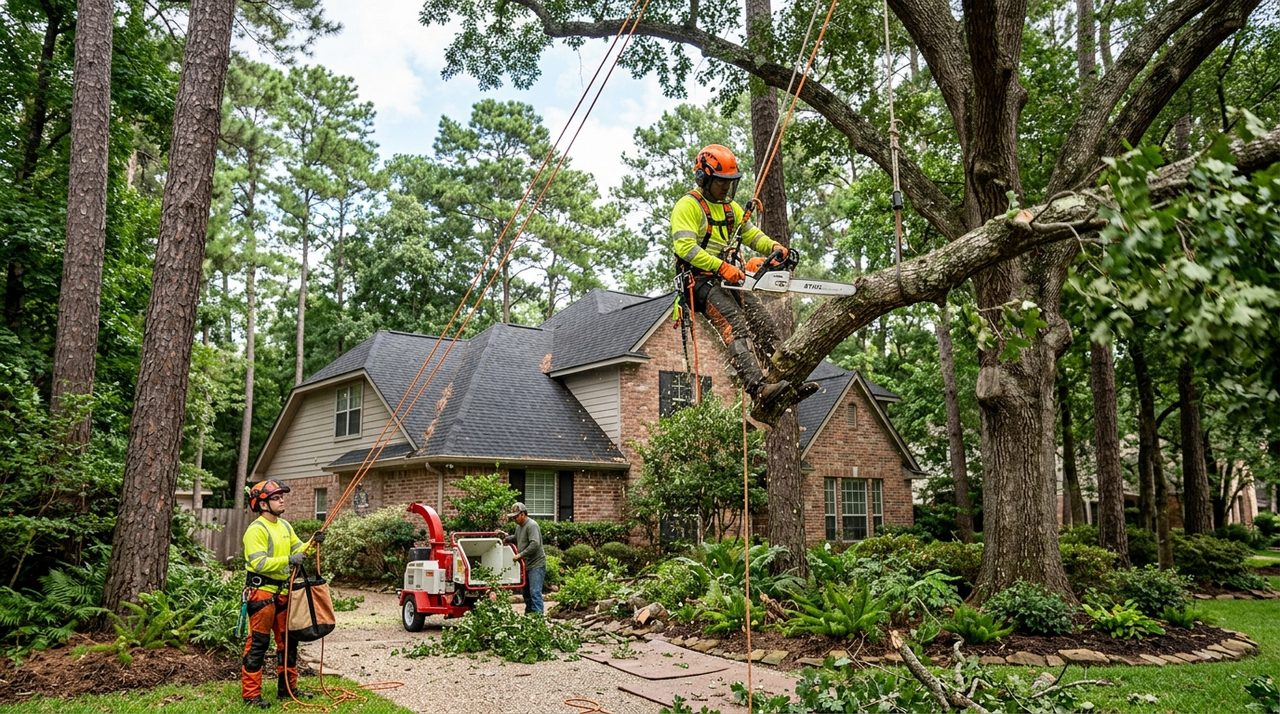
- Median home built
- 1997
- Median home value
- $282,517
- FEMA flood zone
- X (low)
- Typical removal cost (est.)
- $750–$5,000+
- Most common local issue
- Beetle-killed standing pines — brittle, hazardous, and pricier to remove
Ranked by verified Google rating × review volume × verification tier. How we rank →
Some highly-rated pros serve Kingwood from nearby and may not keep a Kingwood street address. Those are listed under "Also serving Kingwood" with their real city and distance, so you always know where each business is based.
Min rating:
6 resultsBased in Kingwood
Open Now
808 Russell Palmer Rd Suite 262, Kingwood, TX 77339
Open Now
2203 Friarwood Trail, Kingwood, TX 77339
Also serving Kingwood
Highly-rated pros based nearby who cover Kingwood. Distance shown from the Kingwood area.
Serving Kingwood Based in Humble · 2.1 mi away
Open Now
Serving Kingwood Based in Porter · 5.6 mi away
Open Now
Serving Kingwood Based in Humble · 6.1 mi away
Tree Removal in Kingwood: What You Should Know
Dead Standing Pines Are a Ticking Clock in Kingwood's Older Villages
Why it matters to you
Kingwood sits at the western edge of Houston's Piney Woods transition zone, and the southern pine beetle has been steadily working through loblolly and shortleaf pines in the older sections of Greentree, Woodland Hills, and Kings Forest — trees that were planted or preserved when the community was built in the 1970s and 1980s. A beetle-killed pine goes from stressed to brittle-dead within 12–18 months, and a 70-foot dead loblolly overhanging a 1979 slab-on-grade home is not a project to defer until next season. Dead wood fails unpredictably during climbing, which is why hazard premiums of 25–50% above the base price are standard for these jobs — budgeting $2,500–$6,000 or more for a large dead specimen close to a structure is a reasonable estimate.
What a good pro does
A qualified crew with an ISA Certified Arborist on-site will assess the degree of decay and plan the drop sequence before a single cut is made — often using a crane for trees within striking distance of a roof or fence line. Because the City of Houston does not require a homeowner permit for private-property tree removal, there is no permit delay, but you should still verify the contractor carries general liability and workers' compensation insurance before any beetle-killed tree work begins.
Sources: City of Houston Permitting Center, Local HOA / deed restrictions (see area profile)
HOA Architectural Review Comes Before the Chainsaw — Not After
Why it matters to you
Kingwood operates under a mandatory master association structure through the Lake Houston Community Association, and most individual villages layer an additional HOA with their own architectural review committees on top of that. Removing any tree above a threshold diameter — typically 6 to 8 inches DBH depending on the village's deed restrictions — without prior written architectural committee approval can result in fines and mandatory replanting requirements that cost more than the original removal job. This is not hypothetical: enforcement activity in deed-restricted master-planned communities is routine, and the review process can add one to three weeks of lead time to your project schedule.
What a good pro does
Before you get a single quote, pull your specific village's deed restrictions and submit an architectural review request to your village HOA — not just the master Lake Houston Community Association — because they have separate approval chains. A reputable Kingwood-area tree company will already know this and should ask for your HOA approval documentation before scheduling work. Do not accept a contractor who says the permit situation 'doesn't apply' to your removal.
Sources: Local HOA / deed restrictions (see area profile), City of Houston Permitting Center
Post-Beryl and Post-Derecho Surge Pricing — and Vetting Out-of-State Crews
Why it matters to you
Hurricane Beryl in July 2024 and the May 2024 derecho both hit northeast Houston hard, and Kingwood's dense canopy meant significant tree failures across multiple villages. After both events, legitimate local tree crews were booked four to six weeks out, and out-of-state operators moved in — many carrying no local insurance verification and no ISA credentials. Texas does not license tree removal contractors through the Texas Department of Licensing and Regulation (TDLR), which means there is no state license number to check, and post-storm desperation makes homeowners vulnerable to poor work and contract disputes. Surge pricing of 40–80% above normal rates is common in the weeks immediately following a named storm, making budgeting at the high end of any range prudent.
What a good pro does
Ask every bidder for their certificate of insurance naming you as additionally insured, and verify ISA Certified Arborist credentials at treesaregood.org before signing anything. If storm damage is blocking a public right-of-way or creating an immediate safety hazard, the City of Houston's debris and emergency-work rules govern — but work on your private property remains your financial responsibility regardless of any FEMA disaster declaration. Getting three written bids, even in an emergency, is worth the extra 24 hours.
Sources: City of Houston Permitting Center, FEMA National Flood Hazard Layer (NFHL), Municipal permit office (see area profile)
Chinese Tallow Near Kingwood's Bayou Corridors — Stumps That Come Back
Why it matters to you
The San Jacinto River and Lake Houston shoreline areas bordering Kingwood create exactly the disturbed, moist soil conditions that Chinese tallow (Triadica sebifera) — a state-listed invasive in Texas — exploits most aggressively. Post-Harvey and post-Beryl flood disturbance accelerated tallow recruitment in backyards and drainage easements throughout the lower-lying sections of Kingwood closest to the water. Homeowners who pay to have a tallow removed but skip professional stump grinding routinely find vigorous multi-stem resprouts within a single growing season, essentially paying for the same job twice. Some green-waste recycling facilities also refuse tallow wood due to its invasive status.
What a good pro does
Specify stump grinding to at least 8–10 inches below grade — not just flush cut — and ask the crew about herbicide treatment of the cut surface immediately after felling, which the Texas A&M AgriLife Extension recommends as the most effective tallow control method. Budget $150–$400 per stump for grinding as a separate line item. Confirm in advance that your contractor has a legitimate disposal plan for the wood, and flag any tallow removal to your village HOA in the same architectural review submission as other tree work.
Sources: Texas Commission on Environmental Quality, Local HOA / deed restrictions (see area profile), Harris County Flood Control District
Tree Removal in Kingwood: What You Should Know
Hiring tree removal in Kingwood? Kingwood is a large master-planned community in northeast Houston with a mandatory community association structure and deed restrictions governing exterior modifications. The neighborhood encompasses multiple villages with varying build periods, meaning housing stock age and systems vary significantly by subdivision. Homeowners should verify both community-wide and village-level deed restrictions before undertaking exterior or structural work.
- Housing era
- Mixed — development spans from the 1970s through the 2010s across various villages
- Foundation
- Not confirmed — slab-on-grade is typical for Houston-area suburban construction of this era, but…
- Flood zone
- FEMA Zone X (low flood risk) — source
- Permits
- Houston Permitting Center — Kingwood is within City of Houston limits
Housing stock & systems
Building era
Mixed — development spans from the 1970s through the 2010s across various villages. Specific decade varies by subdivision.
Typical style
Not confirmed from available sources — likely a mix of traditional suburban styles typical of Houston master-planned communities across multiple decades.
Foundations
Not confirmed — slab-on-grade is typical for Houston-area suburban construction of this era, but specific confirmation not available for all Kingwood villages.
Common systems
Given the multi-decade build-out, systems range widely: older sections may have original HVAC, galvanized or copper plumbing, and older electrical panels, while newer sections feature modern systems. Homes from the 1970s–1980s may have aging ductwork and R-22 refrigerant HVAC units requiring replacement.
What that means for repairs
Renovation activity likely varies by village age — older Kingwood sections (Greentree, Woodland Hills) may see full HVAC replacements, kitchen/bath remodels, and roof replacements, while newer sections focus on cosmetic updates. All exterior modifications must comply with deed restrictions enforced by the community association.
Permits & restrictions
Permit jurisdiction
Houston Permitting Center — Kingwood is within City of Houston limits. No separate Kingwood municipal permit office exists.
HOA & deed restrictions
Mandatory master association structure — the Lake Houston Community Association manages community-wide facilities and business. Mandatory Kingwood Association fees are approximately $200–$400 annually. Many villages/subdivisions have additional HOAs with fees of $100–$600 annually. Some areas include gated-community surcharges. Deed restrictions are enforced by community associations in lieu of municipal zoning.
Historic districts
No City of Houston historic district designation confirmed.
Contractor note
Contractors must obtain City of Houston permits for regulated work and ensure all exterior modifications comply with both the master community association deed restrictions and any applicable village-level HOA architectural review requirements before beginning work.
Flood & weather
FEMA flood zone
FEMA Zone X (low flood risk) — source: fema_nfhl. Note: Kingwood is situated near the San Jacinto River and Lake Houston; flood risk can vary significantly by specific tract and proximity to waterways. Homeowners in areas closer to the river or drainage channels should verify their individual FIRM panel.
Hurricane Harvey impact
Parts of Kingwood were impacted by Hurricane Harvey in 2017, but specific streets and recurring flood areas could not be confirmed from available sources. Homeowners should check Harris County Flood Control District records and FEMA flood insurance claims data for tract-specific Harvey impact information.
Heat & humidity load
Houston's extreme summer heat and humidity stress HVAC systems heavily across Kingwood's varied housing stock. Older homes may have undersized or aging units struggling to maintain efficiency. High humidity also creates conditions for mold growth in attics and crawl spaces, and heavy summer storms can expose roofing and drainage vulnerabilities.
Working with contractors here
Kingwood's multi-decade build-out means contractors encounter a wide range of systems and conditions depending on the specific village. Older sections built in the 1970s–1980s commonly need HVAC replacements, re-roofing, plumbing upgrades, and electrical panel modernization. Newer sections may focus on cosmetic remodeling and energy efficiency improvements. All exterior work must be pre-approved through the relevant community association or village HOA architectural review process, which can add lead time to project scheduling. Contractors should also be aware that flood remediation and moisture mitigation remain relevant trades in sections closer to waterways, even in areas mapped as Zone X.
Local Tip
Always ask for a written estimate before work begins. Texas contractors are required to provide one on jobs over $1,000.
About Kingwood
Kingwood is a large master-planned community in northeast Houston with a mandatory community association structure and deed restrictions governing exterior modifications. The neighborhood encompasses multiple villages with varying build periods, meaning housing stock age and systems vary significantly by subdivision. Homeowners should verify both community-wide and village-level deed restrictions before undertaking exterior or structural work.
- Median year built
- 1997
- Median home value
- $282,517
- Owner-occupied
- 73.2%
- Population
- 131,451
- Housing units
- 50,892
- Median income
- $101,033
Source: U.S. Census Bureau, ACS 5-Year 2023
Flood & storm risk
FEMA Zone XLow flood riskMost of Kingwood maps to FEMA Zone X (low mapped flood risk), but Houston's flash-flood reality means even low-risk blocks benefit from smart drainage and storm-hardened installs; risk climbs sharply on blocks nearest the San Jacinto River and Lake Houston, where it varies parcel to parcel.
Source: FEMA National Flood Hazard Layer (NFHL). Flood zones vary by parcel — verify your individual FIRM panel.
Houston Storm Readiness in Kingwood
Hurricane & flooding
Beryl 2024 left tens of thousands of trees down across the Houston area, and lower-flood-risk zones like Kingwood, TX were not spared from wind-throw damage that crushed vehicles, fences, and rooflines. Scheduling removal of any large tree with a cavity, dead crown, or proximity to your home now means you are not competing for post-storm crews when wait times stretch to weeks. Confirm the current FEMA panel for your Kingwood parcel — the area maps to Zone X, but adjacent lots can differ.
Severe storms & hail
Proactive removal of trees with significant deadwood or structural defects in Kingwood, TX costs a fraction of the emergency extraction and roof repair that follows a thunderstorm failure. Severe storms in the Houston area can produce 70-plus mph gusts with almost no advance warning, which means the pre-storm window is the only realistic time to act before a low-flood-risk yard becomes a debris field. As a Harris County community, Kingwood may follow county rather than City of Houston storm rebuild rules.
Ice storms & freezes
Wind loading on ice-coated canopies in Kingwood, TX during a hard freeze creates the same failure risk as a severe windstorm, and lower flood-risk areas are just as exposed to ice-storm tree damage as any other part of the Houston metro. Uri 2021 left neighborhoods across the city dealing with fallen trees on homes and vehicles for weeks, primarily because no pre-storm removal of structurally weak specimens had been completed. Confirm the current FEMA panel for your Kingwood parcel — the area maps to Zone X, but adjacent lots can differ.
Sources: FEMA National Flood Hazard Layer (NFHL), Ready.gov -- Hurricanes, CenterPoint Energy -- Storm Center, City of Houston -- Emergency Preparedness, Ready.gov -- Winter Weather, Harris County Flood Control District
Free Kingwood Tools & Calculators
Houston-specific estimators to plan your project before you call a pro. All results are planning estimates — a licensed local pro confirms the details on site.
Houston Soil & Tree Proximity Risk Calculator
Open full tool & FAQ →Grouped by mature root aggression & water demand.
Trunk center to the nearest exterior wall.
Moderate risk
The root zone likely reaches your foundation's soil during Houston's dry summers, when clay shrinks most. Watch for sticking doors and diagonal cracks, keep soil moisture even with a soaker hose during drought, and have a foundation pro evaluate if you see any movement.
Find a Houston foundation pro →This is a planning estimate only — actual requirements depend on an on-site assessment by a licensed Houston pro. Guidance is based on general species root behavior in expansive clay, not a soil test.
Houston Freeze Prep & Pipe Insulation Checklist
Open full tool & FAQ →Your freeze checklist — 4 tasks
- 1
Disconnect & drain every outdoor hose bib
Remove hoses, drain the spigots, and cover each with an insulated faucet sock. Un-drained hose bibs are the #1 burst point in a Houston freeze.
- 2
Insulate exposed pipes in the attic & garage
Wrap any pipe in an unconditioned space (attic runs, garage walls) with foam sleeves. Houston homes rarely insulate these because they only matter a few nights a year — which is exactly why they burst.
- 3
Open cabinet doors & keep a pencil-width drip
On hard-freeze nights, open kitchen/bath cabinets so warm air reaches the pipes and let faucets on exterior walls drip to relieve pressure.
- 4
Protect the attic/garage water heater & its lines
An attic or garage tank sits in unconditioned space. Insulate the cold-inlet and hot-outlet lines and confirm the emergency drain pan is clear so a leak doesn't reach the ceiling.
This is a planning estimate only — actual requirements depend on an on-site assessment by a licensed Houston pro. If a pipe has already burst, shut off your main water supply and call a licensed Houston plumber immediately — freeze bursts flood fast.
Frequently Asked Questions
Do I need a City of Houston permit to remove a large tree in Kingwood?
Because Kingwood falls within City of Houston limits — not a separate municipal jurisdiction — the City of Houston Permitting Center does not require a homeowner permit for routine tree removal on private residential property. However, that does not mean you can simply call a crew and start cutting: your Kingwood village HOA or the master community association almost certainly requires architectural committee approval before any tree over a specified caliper (often 6–8 inches DBH) is removed, and that approval must come first. Getting the city side right while skipping the HOA step is the most common and costly mistake Kingwood homeowners make.
Sources: City of Houston Permitting CenterLocal HOA / deed restrictions (see area profile)
My Kingwood home is in Greentree, built in the late 1970s — are the clay sewer lines under my yard at risk from my water oak roots?
Homes built in the 1970s and early 1980s throughout the Houston metro, including Greentree and similarly aged Kingwood villages, were commonly plumbed with clay or Orangeburg sewer laterals that are now decades past their design life and highly vulnerable to root intrusion from large surface-feeding trees like water oaks and live oaks. Houston's expansive Beaumont Black clay soil compounds the problem by allowing roots to follow moisture gradients directly into any pipe joint gap. Before removing a large tree near an older home, it is worth running a sewer scope camera to document whether roots are already inside the line — that finding can actually justify tree removal to your HOA on structural/utility grounds rather than aesthetics alone.
How long does the Kingwood HOA architectural review process take, and can I get emergency approval for a tree that is actively leaning toward my house?
Standard architectural review timelines through Kingwood village associations typically run two to four weeks, but most community associations have an expedited or emergency review pathway for documented imminent hazards — a tree visibly leaning toward a structure, a split trunk, or a freshly storm-damaged specimen generally qualifies. Document the hazard with dated photographs and submit them with your application; some village-level HOAs can turn around an emergency decision in 48 to 72 hours. If a tree is creating an immediate life-safety risk (actively falling or impaling a structure), contact your HOA in writing immediately after stabilizing the situation, not before, and keep all documentation for any insurance or FEMA assistance claim.
Sources: Local HOA / deed restrictions (see area profile)
Kingwood maps mostly to FEMA Zone X — does that mean storm debris from my trees won't qualify for any public pickup or assistance after a hurricane?
Being in FEMA Zone X (low mapped flood risk) does not by itself disqualify you from curbside storm debris pickup or federal disaster assistance — eligibility depends on whether a presidential disaster declaration is issued for Harris County, which has happened after Harvey 2017 and after Beryl 2024 regardless of individual flood zone designations. When a declaration is in effect, Harris County and the City of Houston coordinate time-limited curbside pickup of storm debris placed at the right-of-way; the key is to separate tree debris from household waste and meet the posted pickup windows, which are strictly enforced. Private tree removal costs on your property — getting a tree off your roof or cut and hauled away by a contractor — are generally not reimbursed through FEMA Public Assistance for individual homeowners and come out of pocket or through homeowner's insurance.
Sources: FEMA National Flood Hazard Layer (NFHL)Harris County Flood Control District
Is late fall or winter the best time to book tree removal in Kingwood, and will it cost less than scheduling right after a storm?
In the Kingwood area, late fall through early February is generally the most favorable window for scheduling non-emergency tree removals: demand is lower, crews are more available, and pricing tends to run closer to base estimates rather than the 40–80% surge premiums that follow named storm events. Deciduous trees are also easier to assess and work on without a full leaf canopy, and beetle-killed pines do not become more dangerous seasonally, so there is no downside to removing them in cooler months. By contrast, booking within the first two to four weeks after a major storm like Beryl 2024 means competing with hundreds of other Kingwood homeowners simultaneously, which is when out-of-state crews with no local accountability flood the market — patience, when the tree is not an active hazard, typically saves both money and headache.
What should I specifically ask a tree company before hiring them in Kingwood — especially after a big storm brought crews in from out of state?
Ask for a current Certificate of Insurance showing general liability of at least $1 million and workers' compensation coverage, and call the insurer to verify it is active — not just a PDF the crew printed before their policy lapsed. Request the lead arborist's ISA Certified Arborist credential number, which you can verify directly at the ISA website, since Texas has no state tree-removal license through TDLR. Ask specifically whether the crew has experience with beetle-killed pine removal, because dead brittle pines require different rigging techniques than live trees and crews unfamiliar with them take on substantially more risk near your home or fence line. Finally, confirm in writing that the company will haul all wood and brush off-site, as Chinese tallow wood in particular is sometimes refused at local recycling facilities and inexperienced crews may leave it for you to deal with.