Closed
1224 N Post Oak Rd # 160B, Houston, TX 77055
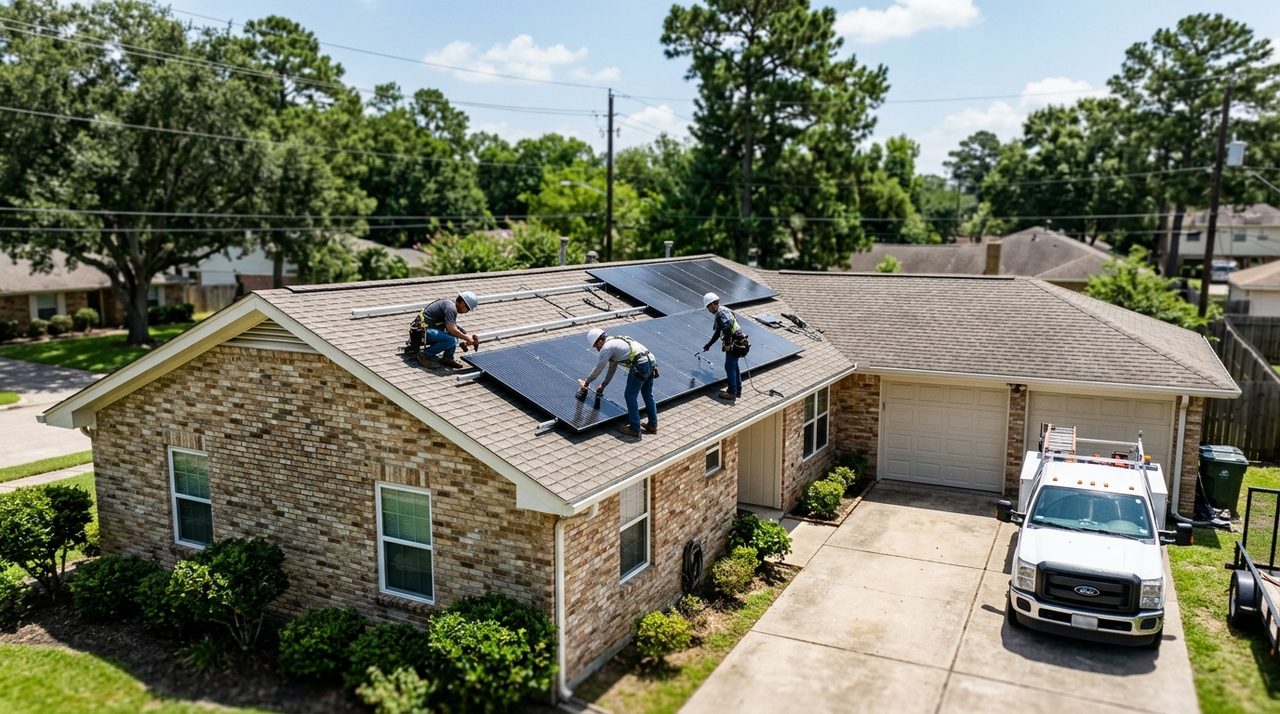
Lazybrook and Timbergrove's 1950s–1960s brick ranch homes—inside the 610 Loop under City of Houston permit jurisdiction—present a distinctive solar challenge: original electrical panels routinely run 60–100 amps, roofs laid during mid-century builds are well past the point where a 25-year panel array can safely share their remaining lifespan, and the Timbergrove Manor Civic Club adds a design review step that must happen before the City of Houston will accept a permit application. Understanding those three local realities up front separates a smooth installation from one that stalls for months or forces a costly mid-project re-roof.
Ranked by verified Google rating × review volume × verification tier. How we rank →
Some highly-rated pros serve Lazybrook / Timbergrove from nearby and may not keep a Lazybrook / Timbergrove street address. Those are listed under "Also serving Lazybrook / Timbergrove" with their real city and distance, so you always know where each business is based.
1224 N Post Oak Rd # 160B, Houston, TX 77055
1213 Reinerman St, Houston, TX 77007
2525 N Loop W STE 510D, Houston, TX 77008
Highly-rated pros based nearby who cover Lazybrook / Timbergrove. Distance shown from the Lazybrook / Timbergrove area.
Serving Lazybrook / Timbergrove Based in Spring Branch · 1.3 mi away
Serving Lazybrook / Timbergrove Based in Brookhollow · 2.4 mi away
Serving Lazybrook / Timbergrove Based in Brookhollow · 2.6 mi away
Serving Lazybrook / Timbergrove Based in Tanglewood · 3.1 mi away
Serving Lazybrook / Timbergrove Based in Upper Kirby · 4.6 mi away
Serving Lazybrook / Timbergrove Based in Midtown · 4.6 mi away
Serving Lazybrook / Timbergrove Based in Tanglewood · 4.6 mi away
Why it matters to you
The original ranch homes throughout Lazybrook and Timbergrove were built when 60- or 100-amp service was standard, long before air conditioning, EV chargers, or solar inverters existed. A solar interconnection on an undersized or outdated panel doesn't just fail inspection—it's a fire risk. City of Houston electrical inspectors will flag the existing service before approving an interconnection, and CenterPoint Energy requires the panel to meet current capacity standards before it will approve the interconnection agreement that allows your system to be energized.
What a good pro does
A qualified installer licensed by TDLR and pulling permits through the City of Houston Permitting Center will assess your panel at the initial site visit, not after contracts are signed. Expect a 200-amp panel upgrade to add $2,000–$4,500 (estimated) to the project scope—budget for it upfront rather than treating it as a surprise change order. Confirm your installer holds an active TDLR Electrical Contractor license and that a master electrician of record is named on the permit application.
Sources: Texas Department of Licensing & Regulation, City of Houston Permitting Center, North American Board of Certified Energy Practitioners (NABCEP)
Why it matters to you
Many unrenovated ranch homes in Lazybrook and Timbergrove still carry their second or third roof—and Houston's combination of 95°F+ summers, UV index routinely hitting 10–11, and annual rainfall averaging 52 inches degrades standard asphalt shingles faster than northern-climate ratings suggest. An array mounted on shingles with fewer than 10 years of remaining life will almost certainly require panel removal and reinstallation for a full re-roof within the first half of the panel warranty period, a cost that typically runs $8,000–$14,000 (estimated) and is almost never volunteered by installers at the sales stage.
What a good pro does
Before any racking is spec'd, insist on a documented roof age and condition assessment—ideally an independent roofing inspection, not just the solar company's walk-and-note. If the roof is at or past 15 years, treating a full re-roof as part of the solar project scope (coordinated under a single City of Houston permit pull where applicable) avoids the future removal-reinstall expense. Bundle that work with your panel upgrade if both are needed; a single mobilization is far less expensive than two separate projects.
Sources: City of Houston Permitting Center, International Residential Code (as adopted by City of Houston)
Why it matters to you
Unlike most Houston suburbs where an HOA is separate from the permit process, the Timbergrove Manor Civic Club requires design review approval for exterior modifications before the City of Houston will issue a building or electrical permit for new construction and major renovations—solar installations included. Texas Property Code §202.010 protects your right to install solar but explicitly allows civic organizations to require that panels not be visible from the street, which on a one-story south-facing ranch could mean rear-slope or east-facing placement that reduces annual production by an estimated 15–25% compared to optimal south orientation.
What a good pro does
Build the civic club review into your project timeline from day one, not as an afterthought. A thorough installer will request your lot's specific recorded deed restrictions before drawing up a layout proposal, since restrictions vary by section across Lazybrook and Timbergrove. If a rear-slope placement is required, demand that the installer model the production impact using your actual CenterPoint historical usage data rather than a national average—undersized systems that offset only 40–50% of Houston's 9-month cooling season are a documented pattern when sizing is done generically.
Sources: Local HOA / deed restrictions (see area profile), City of Houston Permitting Center, North American Board of Certified Energy Practitioners (NABCEP)
Why it matters to you
Winter Storm Uri (February 2021) hit inner-loop neighborhoods hard, and White Oak Bayou proximity means Lazybrook and Timbergrove homeowners experienced both the freeze and the subsequent flood-stress. Battery backup systems (Tesla Powerwall, Enphase IQ Battery) are now a common add-on request in this area, but homes with original 60–100-amp panels—already flagged above—cannot support battery integration without the panel upgrade being completed first. Beyond that, CenterPoint's interconnection tariff for storage-paired systems requires a separate metering application that adds an estimated 6–10 weeks to the project timeline, and City of Houston inspectors enforce battery enclosure fire-separation rules that not every out-of-area installer is current on.
What a good pro does
If battery backup is part of your goal, disclose it at the very first installer meeting so the panel upgrade, solar array, and battery storage are permitted together in a single coordinated submittal to the City of Houston Permitting Center. This is faster and less expensive than returning for a second permit after the solar system is already operating. Verify that your installer's master electrician has completed recent permitted battery installations within the City of Houston—not just Harris County ETJ—since the submittal requirements differ.
Sources: Texas Department of Licensing & Regulation, City of Houston Permitting Center, North American Board of Certified Energy Practitioners (NABCEP)
Hiring solar installers in Lazybrook / Timbergrove? Lazybrook/Timbergrove is defined by 1950s–1960s ranch-style brick homes inside the 610 Loop, many of which are now reaching the age where major systems need replacement or full renovation. Proximity to White Oak Bayou introduces flood-risk considerations for any ground-level work, and the Timbergrove Manor Civic Club requires design review approval before permitting for new construction and renovations, adding a step contractors must plan for.
Building era
1950s–1960s, with ongoing infill and teardown rebuilds.
Typical style
One-story, mid-century ranch-style brick homes; newer two-story infill construction is increasing.
Foundations
Not confirmed from available sources - both slab-on-grade and pier-and-beam are common in 1950s–1960s Houston construction. Verify on a per-property basis.
Common systems
Original homes likely have galvanized or cast-iron drain lines, copper supply lines, older electrical panels (60–100 amp), and aging central HVAC systems. Many have undergone partial updates over the decades.
What that means for repairs
Teardowns and full rebuilds are common as land values inside the Loop have risen. Whole-home remodels of original ranches are also frequent, including kitchen and bath modernizations, re-plumbing, and electrical panel upgrades. Timbergrove Manor Civic Club requires design review before City of Houston permitting for new construction and major renovations.
Permit jurisdiction
City of Houston Permitting Center (neighborhood is within Houston city limits, inside the 610 Loop).
HOA & deed restrictions
No mandatory master HOA. Governance is through civic clubs: Timbergrove Manor Civic Club (TMCC, 501(c)(4)) and Lazybrook Civic Club. Deed restrictions are enforced at the subdivision level and vary by section. Whether civic club dues are legally mandatory varies by section and is not definitively documented in public-facing materials.
Historic districts
No City of Houston historic district designation confirmed. HAHC Certificates of Appropriateness are not required for exterior work based on available research.
Contractor note
Contractors working in Timbergrove must obtain civic club design review approval before applying for City of Houston permits for new construction and major renovations. Deed restrictions vary by section, so scope of work and exterior modifications should be verified against the specific lot's recorded restrictions.
FEMA flood zone
FEMA Zone X (low flood risk) per official NFHL data. However, the neighborhood borders White Oak Bayou, and properties closer to the bayou may carry higher effective flood risk. Individual properties should be checked against HCFCD inundation maps and may require elevation certificates.
Hurricane Harvey impact
Specific Harvey 2017 impact data for Lazybrook/Timbergrove is not available from the sources reviewed. The neighborhood's adjacency to White Oak Bayou suggests some homes near the bayou likely experienced flooding, but street-level or block-level inundation data was not confirmed. Check HCFCD Harvey inundation maps and Harris County Repetitive Loss/Severe Repetitive Loss lists for property-specific history.
Heat & humidity load
Original 1950s–1960s homes with aging HVAC systems face heavy summer cooling loads. Older ductwork in attics or crawlspaces may be poorly insulated, driving up energy costs. Pier-and-beam homes (where present) may see moisture-related issues under the house during Houston's humid summers. Bayou-adjacent lots may experience increased mosquito pressure and standing water concerns.
Working with contractors here
The dominant work in Lazybrook/Timbergrove involves either full teardown-and-rebuild projects or deep renovations of 60–70-year-old ranch homes. Re-plumbing (replacing galvanized or cast-iron lines), electrical panel upgrades, and HVAC replacement are among the most common system jobs. Foundation evaluation is important given the age of the housing stock, though the predominant foundation type is not uniformly documented. Contractors should budget time for Timbergrove Manor Civic Club design review when scoping exterior-facing or new construction work, as this approval is required before the City of Houston will issue permits. Flood risk near White Oak Bayou should be assessed before any ground-level or below-grade scope, including foundation work and landscaping drainage.
Local Tip
Always ask for a written estimate before work begins. Texas contractors are required to provide one on jobs over $1,000.
Lazybrook/Timbergrove is defined by 1950s–1960s ranch-style brick homes inside the 610 Loop, many of which are now reaching the age where major systems need replacement or full renovation. Proximity to White Oak Bayou introduces flood-risk considerations for any ground-level work, and the Timbergrove Manor Civic Club requires design review approval before permitting for new construction and renovations, adding a step contractors must plan for.
Source: U.S. Census Bureau, ACS 5-Year 2023
Most of Lazybrook / Timbergrove maps to FEMA Zone X (low mapped flood risk), but Houston's flash-flood reality means even low-risk blocks benefit from smart drainage and storm-hardened installs.
Source: FEMA National Flood Hazard Layer (NFHL). Flood zones vary by parcel — verify your individual FIRM panel.
Wind damage, not flooding, is the primary hurricane threat for solar systems in lower-risk Lazybrook / Timbergrove, so prioritize a pre-season inspection confirming your racking's hurricane-rated uplift capacity meets the local design wind speed in the City of Houston building code. Loose or improperly torqued rail clamps were a leading cause of panel loss across the metro after Beryl 2024's sustained tropical-force winds. In-city Lazybrook / Timbergrove work falls under City of Houston floodplain and permitting rules.
Hail damage to solar panels in Lazybrook / Timbergrove is often invisible from the ground but detectable through performance monitoring — if your system's daily output drops noticeably after a storm, that is a signal to request a licensed inspection before the damage compounds. Cracked panel glass also creates a ground-fault risk that your inverter's built-in GFCI may flag as an error code. In-city Lazybrook / Timbergrove work falls under City of Houston floodplain and permitting rules.
Ice accumulation temporarily cuts solar panel output in Lazybrook / Timbergrove, but the larger freeze-related risk for solar homeowners is an inverter or battery enclosure mounted in an uninsulated garage or attic space exposed to sub-freezing temperatures — equipment manufacturers specify minimum operating temperatures, and falling below them can cause shutdowns or permanent damage. Ask your installer to confirm all system components are within their rated temperature range before the next hard freeze. In-city Lazybrook / Timbergrove work falls under City of Houston floodplain and permitting rules.
Sources: FEMA National Flood Hazard Layer (NFHL), Ready.gov -- Hurricanes, CenterPoint Energy -- Storm Center, City of Houston -- Emergency Preparedness, Ready.gov -- Winter Weather, Harris County Flood Control District
Houston-specific estimators to plan your project before you call a pro. All results are planning estimates — a licensed local pro confirms the details on site.
Disconnect & drain every outdoor hose bib
Remove hoses, drain the spigots, and cover each with an insulated faucet sock. Un-drained hose bibs are the #1 burst point in a Houston freeze.
Insulate exposed pipes in the attic & garage
Wrap any pipe in an unconditioned space (attic runs, garage walls) with foam sleeves. Houston homes rarely insulate these because they only matter a few nights a year — which is exactly why they burst.
Open cabinet doors & keep a pencil-width drip
On hard-freeze nights, open kitchen/bath cabinets so warm air reaches the pipes and let faucets on exterior walls drip to relieve pressure.
Protect the attic/garage water heater & its lines
An attic or garage tank sits in unconditioned space. Insulate the cold-inlet and hot-outlet lines and confirm the emergency drain pan is clear so a leak doesn't reach the ceiling.
This is a planning estimate only — actual requirements depend on an on-site assessment by a licensed Houston pro. If a pipe has already burst, shut off your main water supply and call a licensed Houston plumber immediately — freeze bursts flood fast.
Sources: City of Houston Permitting CenterLocal HOA / deed restrictions (see area profile)
Sources: City of Houston Permitting CenterTexas Department of Licensing & Regulation
Sources: City of Houston Permitting Center
Sources: Texas Department of Licensing & RegulationNorth American Board of Certified Energy Practitioners (NABCEP)City of Houston Permitting Center
Sources: City of Houston Permitting CenterInternational Residential Code (as adopted by City of Houston)