Closed
2617 Bissonnet St #462, Houston, TX 77005
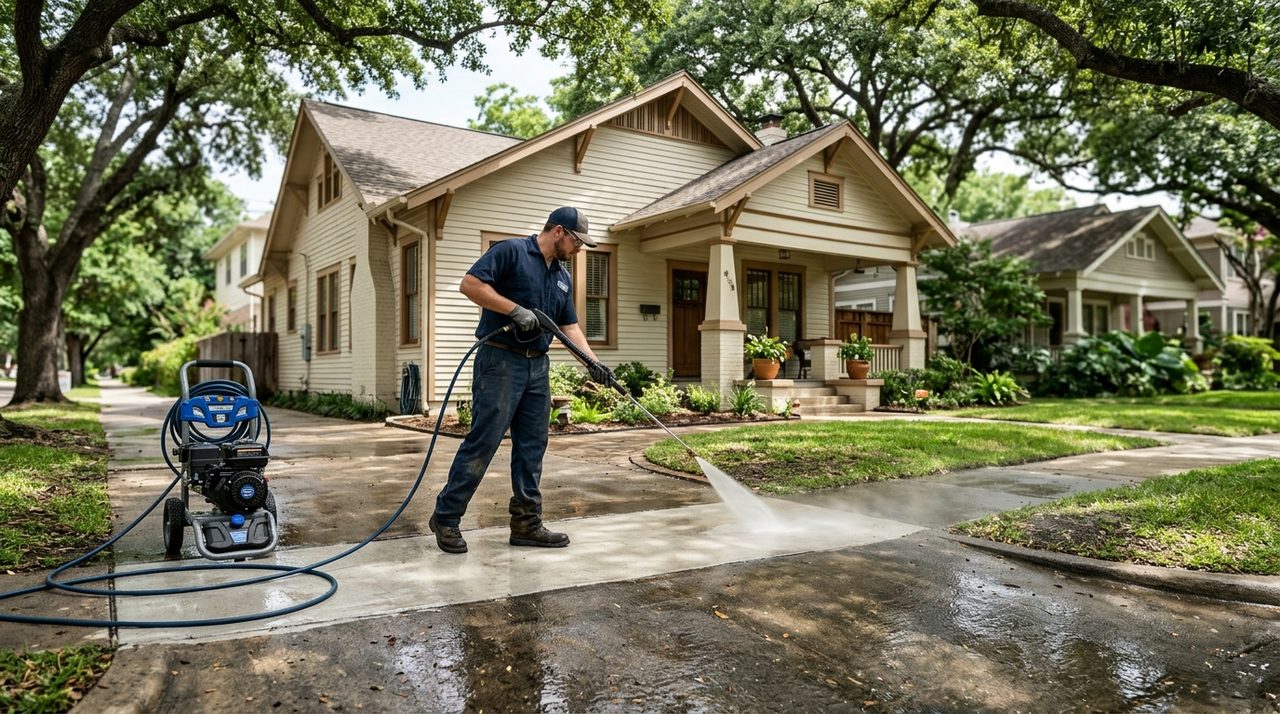
West University Place's blend of 1930s–1950s brick bungalows and large custom rebuilds from the 1980s onward means a single block can have weathered mortar joints wicking clay-mineral efflorescence next door to a 2020 neo-colonial with HOA-pristine aggregate concrete — each requiring a different pressure and chemistry approach. The neighborhood's mature live-oak canopy along streets like Oberlin and Bellaire Boulevard accelerates year-round mold and algae growth on every surface the shade touches, while the FEMA Zone X500 designation means that even moderate storms deposit mud-line staining on foundation-level brick and stucco. This page explains exactly which surfaces in West U are highest-risk, what cleaning methods protect them, and how West University Place's independent permitting authority fits into the picture.
Ranked by verified Google rating × review volume × verification tier. How we rank →
Some highly-rated pros serve West University from nearby and may not keep a West University street address. Those are listed under "Also serving West University" with their real city and distance, so you always know where each business is based.
2617 Bissonnet St #462, Houston, TX 77005
2525 Robinhood St, Houston, TX 77005
Highly-rated pros based nearby who cover West University. Distance shown from the West University area.
Serving West University Based in Galleria · 0.9 mi away
Serving West University Based in Upper Kirby · 1.1 mi away
Serving West University Based in Medical Center · 1.1 mi away
Serving West University Based in Upper Kirby · 1.3 mi away
Serving West University Based in Braeswood · 1.5 mi away
Serving West University Based in Bellaire · 1.6 mi away
Serving West University Based in Bellaire · 2.5 mi away
Serving West University Based in Tanglewood · 2.6 mi away
Why it matters to you
West University's signature tree-lined streets — many with 60- to 80-year-old live oaks arching over 1930s–1950s brick bungalows — create near-permanent shade and trapped humidity that fuels Gloeocapsa magma black algae and green mold on brick faces, mortar joints, and limestone sills. Houston's average annual humidity already exceeds 75%, and in shaded West U lots it barely dips, meaning surfaces cleaned without a post-treatment biocide typically show re-colonization within six to nine months. At median home values over $1.3 million, streaked brick visibly undercuts a property's premium curb appeal and can flag poorly-maintained mortar to buyers during inspections.
What a good pro does
A qualified operator should use low-pressure soft-wash (under 500 PSI on mortar joints older than 1960) combined with a sodium hypochlorite-based biocide solution that dwell-kills the algae organism rather than just blasting the surface stain off. Because some algaecide products trigger TDA pesticide applicator licensing requirements in Texas, ask operators to confirm their chemical certifications before work begins. No permit from the City of West University Place is required for routine residential exterior washing, but confirming the operator carries general liability insurance protects homeowners in this high-value jurisdiction.
Sources: Texas Commission on Environmental Quality, City of Houston Permitting Center
Why it matters to you
Newer custom homes in West U built from the 1980s onward — the majority of the teardown-rebuild stock — sit on slab-on-grade foundations over Houston's Beaumont Black clay, which swings dramatically between wet and dry seasons. This moisture cycling wicks calcium and mineral salts upward through the concrete slab edge, exposed brick piers, and driveway aprons, leaving chalky white efflorescence deposits and rust-orange clay smear that ordinary cold-water rinsing cannot dissolve. Ignoring it allows mineral salts to slowly deteriorate mortar and concrete surfaces that are expensive to patch on a premium custom home.
What a good pro does
Effective removal requires a diluted acidic pre-treatment — typically a proprietary efflorescence cleaner — applied dwell time before low-to-medium pressure (800–1,200 PSI) rinsing with a surface cleaning attachment. Operators should neutralize the pH of runoff before it reaches the street, since acidic wash water entering storm drains violates TCEQ stormwater rules that prohibit chemical-laden discharge into Houston-area bayous and Galveston Bay. West University Place's own code enforcement can address violations independently of the City of Houston, so both the homeowner and the operator share compliance responsibility.
Sources: Texas Commission on Environmental Quality, FEMA National Flood Hazard Layer (NFHL)
Why it matters to you
The first wave of large West U teardown-rebuilds from the late 1980s and 1990s is now producing roofs that are 25–35 years old, with architectural asphalt shingles showing the dark Gloeocapsa magma black streaks that Houston's humidity generates within two to three years of a new roof. These aging shingles have already lost granule density over decades of 100°F+ summers; any pressure above 500 PSI will accelerate granule loss, potentially void residual manufacturer warranties, and shorten the remaining service life of a roof that may already be approaching replacement age.
What a good pro does
The correct approach is a no-pressure or very-low-pressure soft-wash using a sodium hypochlorite and surfactant mix applied from the ground or with a pump sprayer, left to dwell and neutralize the algae organism, then rinsed with garden-hose-level pressure. No City of West University Place permit is required for roof washing, but because the chemical concentration used can qualify the product as a pesticide under Texas Department of Agriculture rules, confirm your operator holds a TDA pesticide applicator license if they use commercial-grade algaecides. Estimates for a single-story West U home run $300–$600 for this service.
Sources: City of Houston Permitting Center, International Residential Code (as adopted by City of Houston)
Why it matters to you
West University Place sits in FEMA Zone X500 — outside the 100-year floodplain but inside the 500-year — meaning that events like Hurricane Beryl in July 2024 and heavy Harris County rain events push sheet-flow water against foundation-level brick and stucco on homes that would never appear in a standard flood loss claim. This leaves a distinct 'bathtub ring' of tan silt, tannic leaf stain, and oxidized mud at the waterline height on exterior masonry, which bakes under the following weeks of Houston summer UV into staining that resists standard detergent washing and requires a tannin- or iron-specific pre-treatment chemistry.
What a good pro does
Post-storm mud-line removal should be scoped as a specialty clean, not a standard house-wash — operators should photograph the stain height before starting, identify whether the substrate is painted stucco, natural brick, or EIFS (all common on West U custom homes), and select the appropriate non-acid stain remover to avoid bleaching mortar or damaging a painted surface. Expect a 20–40% cost premium over a standard house wash for chemical pre-treatment and spot work. TCEQ rules still apply: silted wash water containing chemical cleaners must be contained or directed to landscaped areas, not allowed to sheet-drain directly into West U's storm inlets.
Sources: FEMA National Flood Hazard Layer (NFHL), Texas Commission on Environmental Quality
Hiring pressure washing in West University? West University Place is an independent municipality within the Inner Loop featuring a mix of original 1930s–1950s bungalows and larger custom homes built from the 1980s onward as teardown-rebuild cycles reshaped the neighborhood. Homeowners here navigate the city's own permitting process—separate from Houston's—and must account for aging systems in older homes alongside modern construction standards in newer builds. The tree-lined streets and high property values drive demand for premium finishes and careful code compliance.
Building era
Mixed: original homes from 1930s–1950s with significant infill and teardown-rebuild construction from the 1980s–2000s and continuing today.
Typical style
Traditional brick, Georgian/Colonial-influenced, neo-traditional custom homes (2-story), with some remaining early-20th-century bungalows and cottages.
Foundations
Not confirmed from available sources - likely mixed pier-and-beam on older pre-1950s homes and slab-on-grade on newer construction. Verify on a per-property basis.
Common systems
Older homes (1930s–1950s) may have original galvanized or cast-iron plumbing, outdated electrical panels, and window AC or early central HVAC. Newer construction (1980s–present) typically features copper or PEX plumbing, modern electrical, and high-efficiency central HVAC systems.
What that means for repairs
Teardown-and-rebuild activity has been the dominant renovation pattern for decades, replacing smaller original cottages with larger custom homes. Remaining older homes frequently undergo full-gut renovations including electrical rewiring, plumbing replacement, foundation repair, and HVAC modernization to meet current standards and market expectations.
Permit jurisdiction
City of West University Place (independent municipality - own permit office, not City of Houston Permitting Center and not Harris County).
HOA & deed restrictions
No mandatory city-wide master HOA. West U functions as an independent municipality with its own zoning and code enforcement. Individual condo and townhome associations exist (e.g., The Oaks at West University Condominium Association), but most single-family homes have no HOA. Deed restrictions may exist on individual plats—check Harris County Clerk records for specific lots.
Historic districts
No City of Houston historic district designation applies. West University Place is an independent municipality outside Houston city limits, so HAHC Certificates of Appropriateness are not required. West U may have its own local design or zoning controls—check with the City of West University Place directly.
Contractor note
Contractors must pull permits through the City of West University Place, not through Houston or Harris County. West U's own inspectors enforce local codes, and the city's zoning and building requirements may differ from Houston's, so contractors unfamiliar with the jurisdiction should review local ordinances before bidding.
FEMA flood zone
FEMA Zone X500 (moderate flood risk) per official NFHL data. West University Place sits between Brays Bayou to the south and Rice University to the east, with drainage flowing into Harris County Flood Control District channels.
Hurricane Harvey impact
Specific Harvey 2017 flood impact data for West University Place streets was not available in the research provided. The moderate flood risk zone designation and proximity to Brays Bayou suggest potential vulnerability, but confirmed street-level flooding details and repetitive-loss areas should be verified through HCFCD inundation maps and City of West University Place floodplain reports.
Heat & humidity load
Houston's extreme summer heat and humidity stress HVAC systems across all housing eras. Older pier-and-beam homes may experience moisture-related subfloor issues, while the mature tree canopy—a signature feature of West U—creates ongoing gutter maintenance demands and potential root intrusion into aging sewer lines.
Working with contractors here
Contractors in West University most commonly handle full-home renovations and teardown-rebuilds, driven by buyers acquiring older cottages on valuable lots and replacing them with larger custom homes. For surviving 1930s–1950s homes, foundation repair, whole-house repiping (replacing galvanized with copper or PEX), electrical panel upgrades, and HVAC replacement are frequent scopes. Newer 1990s–2000s homes generate demand for roof replacements, exterior paint, and kitchen/bath remodels as they reach their first major maintenance cycles. Job scoping must account for West University Place's independent permitting process, which can differ from Houston's in turnaround times and inspection requirements. The high-end market expectations in West U mean contractors should budget for premium materials and meticulous finish work.
Local Tip
Always ask for a written estimate before work begins. Texas contractors are required to provide one on jobs over $1,000.
West University Place is an independent municipality within the Inner Loop featuring a mix of original 1930s–1950s bungalows and larger custom homes built from the 1980s onward as teardown-rebuild cycles reshaped the neighborhood. Homeowners here navigate the city's own permitting process—separate from Houston's—and must account for aging systems in older homes alongside modern construction standards in newer builds. The tree-lined streets and high property values drive demand for premium finishes and careful code compliance.
Source: U.S. Census Bureau, ACS 5-Year 2023
West University carries FEMA Zone X500 (moderate flood risk): outside the 100-year floodplain but inside the 500-year, so heavy-rain events still reach homes and flood-aware work pays off.
Source: FEMA National Flood Hazard Layer (NFHL). Flood zones vary by parcel — verify your individual FIRM panel.
Sources: City of Houston Permitting Center
Sources: Local HOA / deed restrictions (see area profile)