5233 Bellaire Blvd ste b-123, Bellaire, TX 77401
Best Pressure Washing in Bellaire
Bellaire sits almost entirely inside FEMA Zone AE, and the post-Harvey teardown-rebuild wave that reshaped block after block has left homeowners managing two very different exterior surfaces on the same street: original 1950s–60s brick ranch slabs at grade and brand-new elevated two-story traditionals with fresh stucco, Hardie, and exposed concrete pier caps. That split housing stock — combined with Bellaire's year-round Gulf humidity and a documented flood-line history from Harvey (2017) and Beryl (2024) — makes pressure washing far more consequential here than a routine cosmetic chore.
Verified against Google Business data
Updated 2026
See the 10 Pressure Washing Serving Bellaire 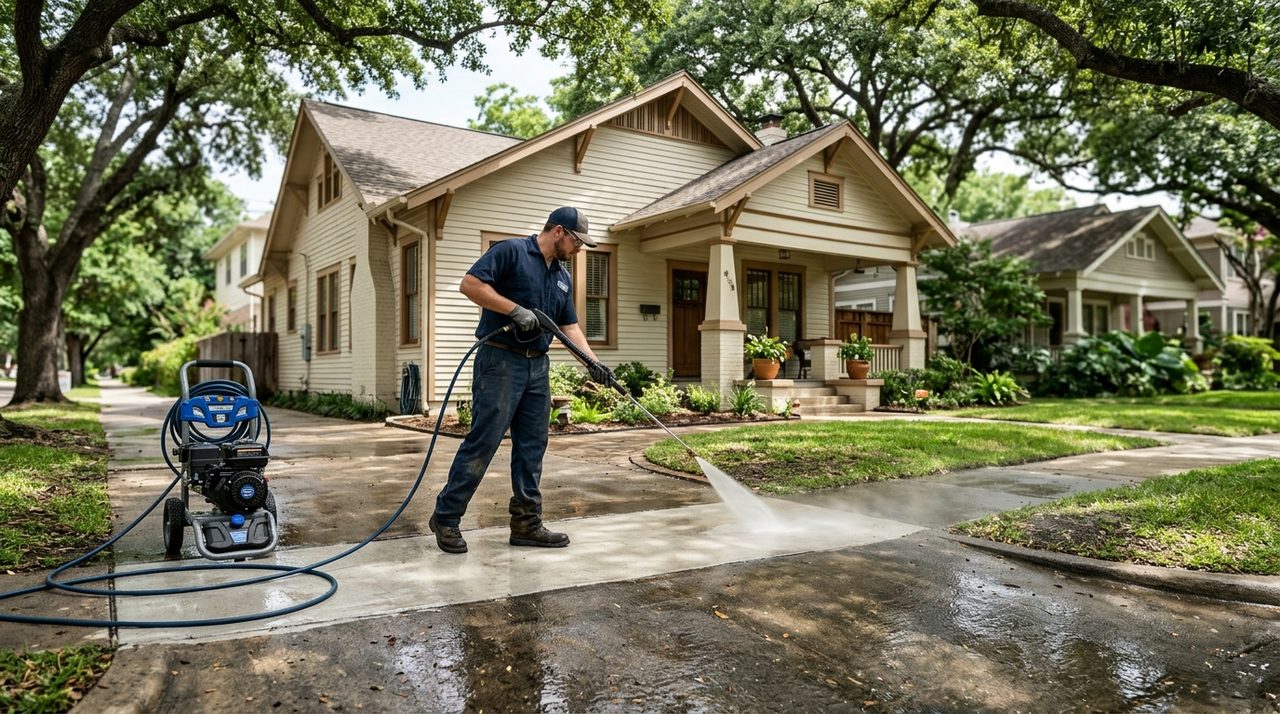
- Median home built
- 1981
- Median home value
- $420,778
- FEMA flood zone
- AE (high)
- Typical cost (est.)
- $250–$900
- Most common local issue
- Harvey/Beryl flood-line mud staining on brick and stucco at flood-water height
Ranked by verified Google rating × review volume × verification tier. How we rank →
Some highly-rated pros serve Bellaire from nearby and may not keep a Bellaire street address. Those are listed under "Also serving Bellaire" with their real city and distance, so you always know where each business is based.
Min rating:
10 resultsBased in Bellaire
Closed
4612 Locust St, Bellaire, TX 77401
Also serving Bellaire
Highly-rated pros based nearby who cover Bellaire. Distance shown from the Bellaire area.
Closed
Serving Bellaire Based in Meyerland · 2.1 mi away
Closed
Serving Bellaire Based in Braeswood · 2.3 mi away
Closed
Serving Bellaire Based in Medical Center · 2.5 mi away
Serving Bellaire Based in Galleria · 2.5 mi away
Closed
Serving Bellaire Based in West University · 2.7 mi away
Closed
Serving Bellaire Based in West University · 2.7 mi away
Open Now
Serving Bellaire Based in Upper Kirby · 2.8 mi away
Open Now
Serving Bellaire Based in Tanglewood · 2.8 mi away
Pressure Washing in Bellaire: What You Should Know
Flood-Line 'Bathtub Ring' Staining on Brick and Stucco
Why it matters to you
Homes that flooded during Harvey (2017) or Beryl (2024) — which is most of Bellaire, given its near-universal FEMA Zone AE mapping — often carry a visible mud-line tide mark on brick and stucco at the exact height floodwater reached. On the 1950s–60s brick ranches that survived both storms, that line can be years old and deeply embedded in the mortar joints. Standard cold-water rinsing disperses surface mud but leaves the tannic and mineral residue locked in the porous masonry.
What a good pro does
A competent operator uses a chemical pre-soak — typically a low-pH oxalic acid blend for mineral staining or an alkaline degreaser for organic tide lines — at low pressure (under 500 PSI on aged brick to avoid joint erosion), then follows with a thorough rinse directed away from storm drain inlets. Because wash water containing degreasers cannot legally discharge into Bellaire's storm drain system, which flows to bayous and ultimately Galveston Bay, the operator should contain and properly dispose of runoff in compliance with TCEQ stormwater rules.
Sources: FEMA National Flood Hazard Layer (NFHL), Texas Commission on Environmental Quality
Gloeocapsa Magma and Mold on Elevated New-Construction Exteriors
Why it matters to you
The wave of elevated two-story homes rebuilt in Bellaire after Harvey — many completed between 2018 and 2022 — are now reaching the 3-to-5-year mark where Houston's 75%-plus average annual humidity and 60-inch annual rainfall drive visible black algae streaks and green mold onto Hardie plank, painted brick, and the exposed concrete faces of structural pier systems. Because these homes are elevated, canopy runoff from Bellaire's mature live oak and magnolia tree cover concentrates on the lower-level entry and garage areas, accelerating biological growth exactly where it is most visible from the street.
What a good pro does
Soft-wash application — a low-pressure sodium hypochlorite or quaternary ammonium biocide solution — is the correct approach for Hardie and painted surfaces; high pressure on these finishes can drive moisture behind the cladding or strip paint. After cleaning, a post-treatment biocide residue (applied per Texas Department of Agriculture pesticide applicator licensing requirements if the product qualifies as a regulated pesticide) extends the clean-surface window from a few months to 12-plus months between services.
Spalled and Oil-Stained Driveways on Original 1950s–60s Ranch Slabs
Why it matters to you
The original ranch homes that were not torn down after Harvey — Bellaire's median year built is 1981, but a meaningful share of housing stock predates 1970 — sit on at-grade concrete slabs poured directly over Houston Black clay. Decades of clay movement have micro-cracked those surfaces, and Winter Storm Uri (2021) accelerated surface spalling on already-porous concrete. Baked-in motor oil from half a century of driveway parking is now embedded in open-pored concrete that standard cold-water pressure washing cannot fully clean.
What a good pro does
Hot-water pressure washing (above 180°F) combined with an alkaline degreaser pre-treatment breaks the oil bond in aged, porous concrete; a surface rotary cleaner attachment delivers consistent PSI across the slab without creating stripes. Operators should confirm that any chemical runoff is not directed toward the nearest storm drain inlet — on Bellaire's flat, AE-zone streets, drain inlets are frequently within a few feet of residential driveways — and contain wash water as required under TCEQ discharge rules.
Sources: Texas Commission on Environmental Quality, FEMA National Flood Hazard Layer (NFHL)
Deed-Restriction Appearance Standards Vary Block by Block
Why it matters to you
Bellaire has no city-wide mandatory HOA, but individual subdivisions each carry their own recorded deed restrictions, and a number of those documents include explicit exterior-appearance maintenance requirements covering driveways, fences, and home exteriors. Because Bellaire is an incorporated city with its own building department — entirely separate from the Houston Permitting Center and Harris County — homeowners cannot assume that City of Houston norms apply here. Subdivision deed-restriction committees have issued written notices for algae-stained driveways and discolored wood fencing, with cure windows that can be as short as 30 days.
What a good pro does
Before scheduling a cleaning, pull the property's recorded CC&Rs through Harris County property records to confirm whether an architectural review process or specific material restrictions apply — some older Bellaire deed restrictions prohibit pressure-washing methods that can damage masonry or fencing materials. Routine residential pressure washing in Bellaire does not require a permit from the City of Bellaire Building Department, but any associated chemical application that uses a regulated pesticide product requires the operator to hold a Texas Department of Agriculture pesticide applicator credential. Confirming both before work begins avoids compliance issues with the subdivision committee.
Sources: Local HOA / deed restrictions (see area profile), City of Houston Permitting Center
Pressure Washing in Bellaire: What You Should Know
Hiring pressure washing in Bellaire? Bellaire is an incorporated city almost entirely within the FEMA AE high-risk flood zone, which means elevation requirements, floodplain permitting, and post-Harvey rebuilds dominate the home service landscape. Housing stock ranges from 1950s slab-on-grade ranches to elevated new-construction traditionals, so contractors must be prepared for both legacy and modern systems on the same block. The city runs its own permitting office, and deed restrictions vary by subdivision, making pre-project due diligence essential.
- Housing era
- 1950s–1960s (original ranch stock) with a major wave of teardown/rebuild infill from the 1990s–2020s,…
- Foundation
- Mixed — older homes are commonly slab-on-grade
- Flood zone
- FEMA Zone AE (high flood risk) — source
- Permits
- City of Bellaire Building Department (Bellaire is an incorporated city with its own permitting…
Housing stock & systems
Building era
1950s–1960s (original ranch stock) with a major wave of teardown/rebuild infill from the 1990s–2020s, accelerated after Hurricane Harvey.
Typical style
Traditional brick two-story (newer builds), single-story brick ranch (original 1950s–60s stock), transitional/Mediterranean customs, and remaining bungalows/cottages from the 1920s–1940s.
Foundations
Mixed — older homes are commonly slab-on-grade; post-Harvey new construction and major remodels are typically elevated on pier-and-beam or raised structural piers to meet floodplain requirements.
Common systems
Older ranches: original copper or galvanized plumbing, single-stage HVAC, 100–150 amp electrical panels. Newer builds: PEX plumbing, high-efficiency multi-stage HVAC, 200+ amp panels with whole-home surge protection. Tankless water heaters increasingly standard in post-2010 construction.
What that means for repairs
The dominant renovation activity is full teardown-and-rebuild or substantial elevation of existing structures to comply with the city's requirement that permitted construction be above the 500-year floodplain. Post-Harvey, many 1950s–60s ranches were demolished and replaced with larger two-story homes on elevated foundations.
Permits & restrictions
Permit jurisdiction
City of Bellaire Building Department (Bellaire is an incorporated city with its own permitting office, independent of Houston Permitting Center and Harris County).
HOA & deed restrictions
No single city-wide mandatory HOA. Bellaire is composed of individual subdivisions, each with its own recorded deed restrictions. Some subdivisions have mandatory HOAs with dues and architectural controls; others rely on voluntary civic clubs or deed-restriction committees for enforcement. HOA status is lot-specific — check recorded CC&Rs via Harris County property records.
Historic districts
No City of Houston historic district designation confirmed. Bellaire is an independent incorporated city and does not fall under the Houston Archaeological and Historical Commission (HAHC).
Contractor note
Bellaire's floodplain regulations require an elevation certificate for most permitted work, and new construction or substantial improvements must meet or exceed the 500-year floodplain elevation. Contractors should confirm current BFE requirements and any deed-restriction architectural controls with the Bellaire Building Department before scoping work.
Flood & weather
FEMA flood zone
FEMA Zone AE (high flood risk) — source: fema_nfhl. Virtually the entire city of Bellaire sits within the 100-year floodplain. Brays Bayou runs along Bellaire's northern boundary, and localized drainage issues compound flood risk throughout the city.
Hurricane Harvey impact
Hurricane Harvey (2017) caused significant flooding across Bellaire, inundating a large number of homes — particularly the older slab-on-grade ranch stock. The storm accelerated an already-active teardown cycle, with many flooded homes demolished and replaced by elevated new construction. Post-Harvey, the city enforces strict elevation requirements for permitted work, requiring structures to be built above the 500-year floodplain.
Heat & humidity load
Houston's extreme summer heat and humidity stress older HVAC systems in 1950s–60s ranches, many of which have limited insulation and single-pane windows. Elevated pier-and-beam homes require attention to moisture management and ventilation beneath the structure. Seasonal thunderstorms can overwhelm aging drainage infrastructure, making sump pumps and proper grading critical even for elevated homes.
Working with contractors here
Contractors in Bellaire most commonly handle full teardown-and-rebuild projects, structural elevation of existing homes, and flood damage remediation — all driven by the city's AE flood zone status and post-Harvey rebuilding activity. Older 1950s–60s ranches frequently need complete plumbing re-pipes (galvanized-to-PEX), electrical panel upgrades, and HVAC replacement. Because Bellaire is an incorporated city with its own building department, contractors must pull permits through the City of Bellaire rather than Harris County or Houston, and must navigate subdivision-specific deed restrictions that can impose setback, height, and material requirements. Job scoping should always begin with an elevation certificate review and a check of the property's specific deed restrictions and HOA status, as these vary block by block.
Local Tip
Always ask for a written estimate before work begins. Texas contractors are required to provide one on jobs over $1,000.
About Bellaire
Bellaire is an incorporated city almost entirely within the FEMA AE high-risk flood zone, which means elevation requirements, floodplain permitting, and post-Harvey rebuilds dominate the home service landscape. Housing stock ranges from 1950s slab-on-grade ranches to elevated new-construction traditionals, so contractors must be prepared for both legacy and modern systems on the same block. The city runs its own permitting office, and deed restrictions vary by subdivision, making pre-project due diligence essential.
- Median year built
- 1981
- Median home value
- $420,778
- Owner-occupied
- 26.2%
- Population
- 68,491
- Housing units
- 27,944
- Median income
- $88,690
Source: U.S. Census Bureau, ACS 5-Year 2023
Flood & storm risk
FEMA Zone AEHigh flood riskMuch of Bellaire maps to FEMA Zone AE (high flood risk), so flood-resilient detailing -- elevated equipment, water-tolerant materials, and drainage-first thinking -- is essential here, not optional.
Source: FEMA National Flood Hazard Layer (NFHL). Flood zones vary by parcel — verify your individual FIRM panel.
Frequently Asked Questions
Do I need a permit from the City of Bellaire to pressure wash my house or driveway?
Routine residential pressure washing does not require a permit from the City of Bellaire Building Department — no trade permit is triggered for cleaning an exterior surface. However, if your home is in Bellaire's FEMA Zone AE and any surface repair or caulking is done alongside the wash as part of a broader scope, that ancillary work may require a permit, so it's worth a quick call to the Bellaire Building Department at 5100 Maple Ave to confirm before scheduling.
Sources: FEMA National Flood Hazard Layer (NFHL)City of Houston Permitting Center
My Bellaire home was rebuilt after Harvey on elevated piers — are those exposed concrete pier caps and the new Hardie siding safe to pressure wash?
Exposed structural piers on post-Harvey elevated builds can accumulate efflorescence and clay-mud staining quickly given Bellaire's AE flood zone soil conditions, and they are generally safe to clean at moderate pressure (1,200–1,500 PSI) with a wide-angle tip. Hardie fiber-cement siding, however, requires a soft-wash approach — high pressure can force water behind the lap joints and into the framing, which is a serious concern on any elevated structure where drainage details must be watertight. Ask your operator specifically whether they have experience with elevated new-construction homes and can adjust technique for both surfaces in the same visit.
How long after a flood event like Beryl (2024) should I wait before pressure washing flood-line staining off my brick?
You should wait until the brick and mortar have fully dried — typically a minimum of 4–6 weeks after standing water recedes, and longer for thick masonry walls that held water for days — before applying any pressure or chemical treatment. Washing wet or still-damp flood-saturated brick can drive contaminants deeper into the mortar joints and accelerate efflorescence from the mineral salts already mobilized by floodwater. If your home is in a Bellaire AE zone subdivision and you had interior flooding as well, coordinate the exterior wash with your remediation contractor so surface cleaning doesn't interfere with drying-in and insurance documentation.
Is there a best season to pressure wash in Bellaire, or is the humidity so constant that timing doesn't matter?
Late October through early March is genuinely the most productive window in Bellaire: relative humidity dips slightly, the daily high temperatures are moderate enough for cleaning solutions to dwell without flash-drying, and tree pollen and post-tropical-storm debris cycles have typically passed. That said, Gloeocapsa magma and green mold grow year-round in Bellaire's climate, so a spring wash to address whatever accumulated over the dormant season is also common. What matters most is scheduling at least two to three weeks before any planned exterior painting or staining, since even in winter Bellaire's humidity can slow surface dry-down.
My subdivision in Bellaire has deed restrictions — can my HOA or deed-restriction committee tell me what cleaning method I'm required to use on my roof?
Bellaire has no city-wide HOA, but individual subdivision deed restrictions recorded with Harris County can impose appearance-maintenance obligations, and a handful of Bellaire-area CC&Rs do reference approved cleaning methods or prohibit treatments that visibly alter roofing material color. Pull your property's recorded deed restrictions through Harris County's real property records portal before hiring, and ask your pressure washing operator for a written description of the method (soft-wash vs. high-pressure) so you can verify it against any language your deed-restriction committee might cite. If your subdivision has an active architectural review committee, a brief email to them before scheduling avoids any after-the-fact dispute.
Sources: Local HOA / deed restrictions (see area profile)
What should a Bellaire homeowner expect to pay, and how long does a full exterior wash take on a post-Harvey two-story rebuild versus an original 1950s ranch?
As a rough estimate, a full soft-wash on a post-Harvey two-story (typically 2,800–3,500 sq ft of exterior surface with stucco or Hardie) runs $400–$700, while an original 1950s single-story brick ranch at grade is usually $250–$450 — these are estimates and vary by surface condition, access around elevated foundations, and whether flood-line chemical pre-treatment is needed. Time on site runs about two to four hours for the ranch and three to five hours for the elevated two-story, given the additional ladder or lift work around pier caps and upper-story gables. Jobs requiring degreaser on an oil-stained original slab driveway or a documented flood-line chemical treatment typically carry a 20–40% premium for containment and product cost.