Open Now
7102 W Sam Houston Pkwy N Suite 224, Houston, TX 77040
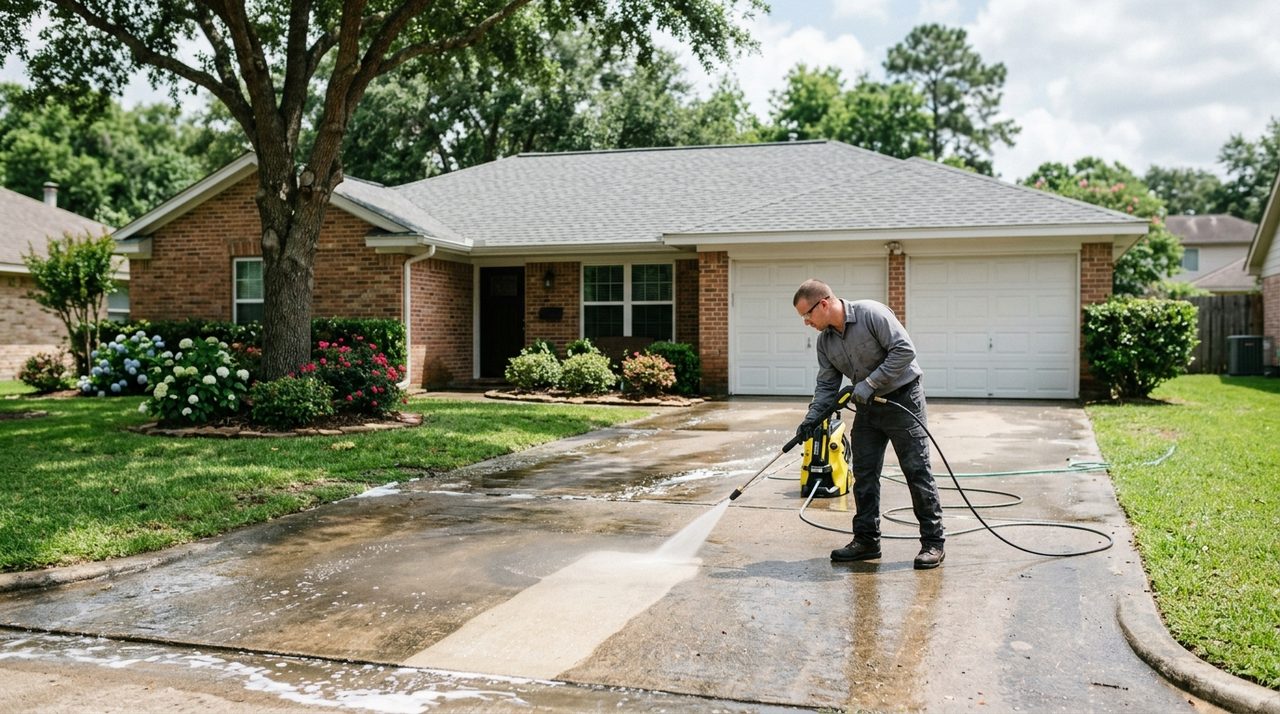
NW Houston's sprawl of 1980s–1990s brick-and-siding tract homes — most sitting on slab-on-grade foundations over Harris County's expansive Beaumont clay — creates a predictable pressure-washing cycle: mineral salts wick through concrete, black algae colonizes every shaded north-facing surface within a season, and subdivision HOAs from Memorial Northwest to Meadows of Northwest Park send written violation notices with 30-day cure windows. Understanding which surfaces tolerate high pressure, which require soft-wash, and how wash-water runoff is regulated (rules differ depending on whether your address falls inside Houston city limits or in unincorporated Harris County) will save you money and keep you out of HOA trouble.
Ranked by verified Google rating × review volume × verification tier. How we rank →
Some highly-rated pros serve NW Houston from nearby and may not keep a NW Houston street address. Those are listed under "Also serving NW Houston" with their real city and distance, so you always know where each business is based.
7102 W Sam Houston Pkwy N Suite 224, Houston, TX 77040
15518 Shanghai St, Jersey Village, TX 77040
Highly-rated pros based nearby who cover NW Houston. Distance shown from the NW Houston area.
Serving NW Houston Based in Jersey Village · 1.6 mi away
Serving NW Houston Based in Jersey Village · 1.7 mi away
Serving NW Houston Based in Jersey Village · 3.2 mi away
Serving NW Houston Based in Brookhollow · 3.4 mi away
Serving NW Houston Based in Jersey Village · 5.2 mi away
Serving NW Houston Based in Brookhollow · 5.4 mi away
Serving NW Houston Based in Spring Branch · 5.4 mi away
Why it matters to you
Dozens of NW Houston subdivisions — including Memorial Northwest and comparable 1980s–1990s-era POAs — maintain active architectural review committees that issue written notices when driveways, fences, or roofs show visible algae or mold staining. With the neighborhood's median year built at 1985, many original concrete surfaces are porous enough to accumulate Gloeocapsa magma (black algae) and green mold within a single Houston humid season, and a notice can arrive with a 30-day cure deadline whether or not you planned for the expense.
What a good pro does
Request your subdivision's specific CC&R language before any work begins — some NW Houston HOAs prohibit high-pressure washing on asphalt shingle roofs, requiring documented soft-wash application instead. A qualified operator will apply a post-treatment biocide after cleaning to extend results 12–18 months and provide you a written service record you can submit to the architectural committee as proof of cure. Confirm whether your parcel is inside Houston city limits or unincorporated Harris County, as neither jurisdiction requires a municipal permit for routine residential washing, but the address determines which code-enforcement body handles any complaint.
Sources: Local HOA / deed restrictions (see area profile), City of Houston Permitting Center
Why it matters to you
NW Houston sits on Beaumont/Houston Black clay that expands with rain and contracts in drought, wicking mineral salts upward through slab concrete and depositing white efflorescence and red-clay mud staining at the slab edge and along driveway aprons. Homes built in the 1970s–1990s often have original concrete that has never been sealed; after 30–40 years of clay-moisture cycles — exacerbated by Winter Storm Uri's 2021 freeze-thaw damage — the surface is spalled and porous enough to absorb vehicle oil that bakes in under Houston's summer UV.
What a good pro does
Effective treatment on these driveways requires a hot-water pressure washer combined with a chemical degreaser pre-soak, not standard cold-water rinsing; expect a 20–40% cost premium over a basic wash for oil-saturated or heavily efflorescent surfaces. After cleaning, a penetrating concrete sealer applied to the dry surface significantly slows re-staining by reducing the clay-moisture absorption cycle at the slab face. TCEQ rules prohibit degreaser-containing wash water from entering street storm drains, which in NW Houston flow to Harris County bayous, so verify your operator uses containment booms or berms on any job involving chemical degreasers.
Sources: Texas Commission on Environmental Quality, International Residential Code (as adopted by City of Houston)
Why it matters to you
The dominant roofing material on NW Houston's 1980s–1990s production homes is 3-tab or early architectural asphalt shingles; many of these roofs have been replaced once after hail and are now 10–20 years into a second lifecycle. Houston's humidity causes Gloeocapsa magma black streaks to reappear on north-facing and shaded slopes within 2–3 years of installation, and the combination of heat-aged granule adhesion and Houston's UV load means high-pressure washing above roughly 500 PSI will strip granules and void whatever manufacturer warranty remains.
What a good pro does
The correct method is low-pressure soft-wash: a sodium hypochlorite or approved algaecide solution applied at low pressure and allowed to dwell before a gentle rinse. Operators who carry a Texas Department of Agriculture pesticide applicator license are equipped to handle stronger algaecide concentrations legally. If your HOA notice cites roof appearance, get a written description of the method used — 'soft-wash' applied at under 500 PSI — so you can document compliance with both the CC&R requirement and the manufacturer's cleaning guidance.
Sources: Local HOA / deed restrictions (see area profile), City of Houston Permitting Center
Why it matters to you
NW Houston driveways and wood privacy fences occupy lots that drain rapidly to Harris County storm infrastructure flowing toward the region's bayou network and ultimately Galveston Bay. TCEQ's Texas Pollutant Discharge Elimination System (TPDES) rules prohibit wash water containing detergents, degreasers, or chemical cleaners from entering storm drains — a rule that applies whether your parcel is inside Houston city limits or in unincorporated Harris County, though enforcement intensity differs between the two jurisdictions.
What a good pro does
For any NW Houston pressure-wash job that involves chemical pre-treatment — driveway degreasing, fence brightener, or algaecide wash — ask your operator to describe their containment plan before work starts. Acceptable approaches include portable berms or wet vacuums that capture runoff for proper off-site disposal rather than allowing it to sheet into the curb drain. TCEQ has issued notices of violation to Houston-area operators for discharge violations, and responsibility can extend to the property owner who contracted the work; a short conversation about containment upfront protects both parties.
Sources: Texas Commission on Environmental Quality, City of Houston Permitting Center
Hiring pressure washing in NW Houston? NW Houston encompasses dozens of separate subdivisions spanning construction eras from the 1960s through the 2010s, each with its own HOA and deed restrictions. Homeowners here typically manage aging slab-on-grade foundations on expansive clay soils, production-era HVAC systems, and roofing exposed to severe summer heat. Permit jurisdiction varies between the City of Houston and Harris County depending on whether the specific parcel falls inside or outside city limits.
Building era
1970s–2000s, with the largest concentration in the 1980s–1990s.
Typical style
Traditional suburban brick or brick-and-siding one- and two-story homes, Texas traditional with gables and attached garages.
Foundations
Concrete slab-on-grade (predominant for post-1960 tract housing in Harris County).
Common systems
Central A/C with forced-air gas furnaces typical of 1980s–1990s production builds; copper or CPVC supply lines with cast iron or PVC drains; 200-amp electrical panels in newer sections, 100-amp in older 1970s-era homes.
What that means for repairs
Kitchen and bath remodels are common in 1970s–1980s homes reaching 40+ years. Foundation repair due to expansive clay soils is frequent. Roof replacements cycle every 15–20 years due to hail and heat exposure. HOA architectural review is typically required before exterior modifications.
Permit jurisdiction
Mixed — parcels within Houston city limits use the Houston Permitting Center; unincorporated Harris County parcels (common in NW Houston) use Harris County Engineering Department. Verify annexation status per address.
HOA & deed restrictions
Most platted subdivisions have mandatory HOAs or POAs. Notable examples include Memorial Northwest Homeowners Association (mandatory for all property owners) and Meadows of Northwest Park HOA (mandatory). Older unplatted acreage tracts may lack formal HOAs. Confirm HOA status per property via deed records and the TREC HOA Management Certificate Database.
Historic districts
No City of Houston historic district designation confirmed.
Contractor note
Contractors must verify whether a specific address is inside Houston city limits or unincorporated Harris County, as permit requirements and inspection processes differ. Most subdivision HOAs require architectural committee approval before exterior work begins.
FEMA flood zone
FEMA Zone X500 (moderate flood risk) — source: fema_nfhl. Portions of NW Houston near Cypress Creek, White Oak Bayou tributaries, and low-lying creek corridors may carry higher localized flood risk; confirm zone by specific address.
Hurricane Harvey impact
Harvey impact varied significantly across NW Houston. Areas near Cypress Creek and low-lying bayou tributaries experienced serious structural flooding, while higher-ground subdivisions saw little to no flooding. No single characterization applies area-wide. Some NW Houston subdivisions faced post-Harvey HOA disputes including foreclosure actions over unpaid dues and legal costs.
Heat & humidity load
Prolonged 95°F+ heat and high humidity stress aging HVAC systems in 1980s–1990s homes, accelerating compressor failures and ductwork degradation in unconditioned attic spaces. Slab movement peaks during summer drought cycles on expansive clay soils, causing doors to stick and drywall cracks to appear.
Working with contractors here
The most common service calls in NW Houston involve foundation leveling and pier installation on expansive clay soils, HVAC system replacement in 1980s–1990s production homes, and composition shingle roof replacements after hail events. Plumbing repiping is increasingly common as original polybutylene and CPVC lines in 1980s–1990s homes reach end of life. Contractors should plan for HOA architectural review timelines before scheduling exterior work—approval can take two to six weeks depending on the subdivision. Because permit jurisdiction is split between Houston and Harris County, job scoping must begin with confirming the property's municipal status to ensure correct permits and inspections.
Local Tip
Always ask for a written estimate before work begins. Texas contractors are required to provide one on jobs over $1,000.
NW Houston encompasses dozens of separate subdivisions spanning construction eras from the 1960s through the 2010s, each with its own HOA and deed restrictions. Homeowners here typically manage aging slab-on-grade foundations on expansive clay soils, production-era HVAC systems, and roofing exposed to severe summer heat. Permit jurisdiction varies between the City of Houston and Harris County depending on whether the specific parcel falls inside or outside city limits.
Source: U.S. Census Bureau, ACS 5-Year 2023
NW Houston carries FEMA Zone X500 (moderate flood risk): outside the 100-year floodplain but inside the 500-year, so heavy-rain events still reach homes and flood-aware work pays off.
Source: FEMA National Flood Hazard Layer (NFHL). Flood zones vary by parcel — verify your individual FIRM panel.
Sources: City of Houston Permitting CenterTexas Commission on Environmental Quality
Sources: Local HOA / deed restrictions (see area profile)