Open Now
8800 Jameel Rd #100B, Houston, TX 77040
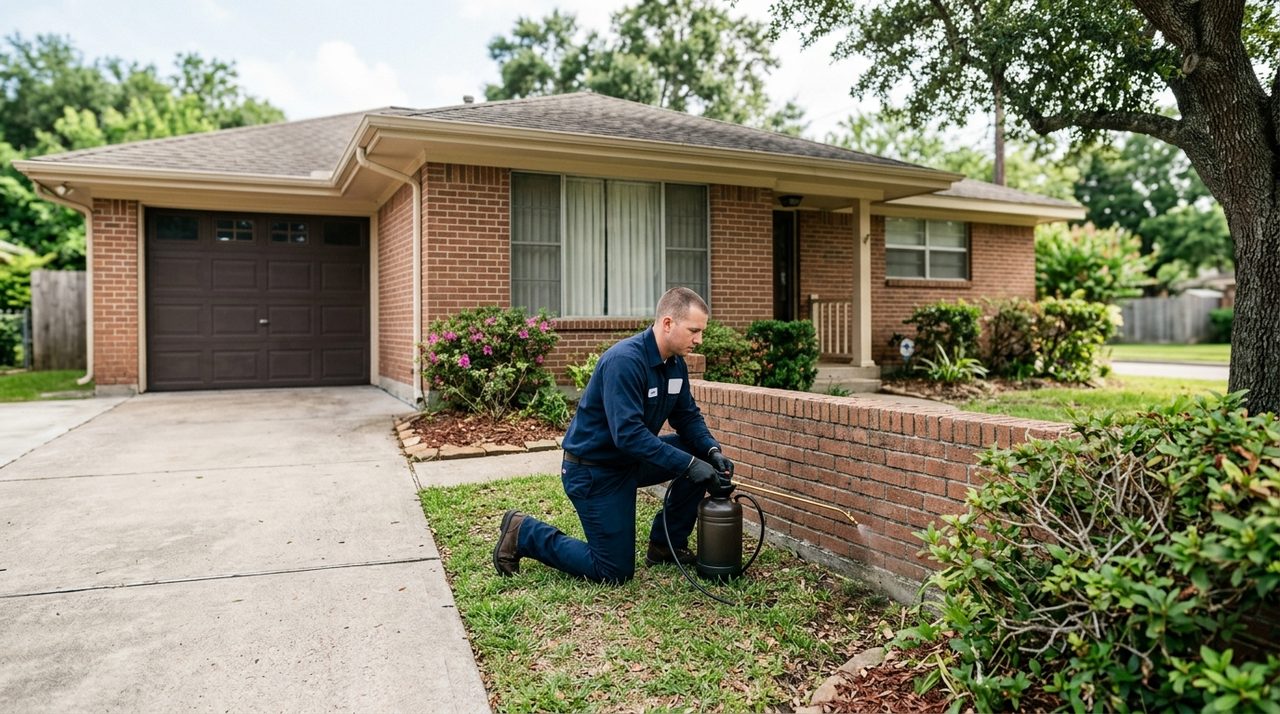
NW Houston's patchwork of 1970s–2000s slab-on-grade brick homes — sitting on some of Harris County's most expansive Beaumont Black clay — creates a near-perfect environment for subterranean termites, American cockroaches, and rodents that exploit foundation gaps reopened season after season by soil movement. With most platted subdivisions enforcing mandatory HOA deed restrictions and permit jurisdiction split between the Houston Permitting Center and the Harris County Engineering Department depending on your exact parcel, even exterior pest treatments here involve a layer of compliance most homeowners don't expect. This page cuts through that complexity with NW Houston-specific guidance on the pest pressures that actually hit 1980s–1990s brick tract homes in this corridor.
Ranked by verified Google rating × review volume × verification tier. How we rank →
Some highly-rated pros serve NW Houston from nearby and may not keep a NW Houston street address. Those are listed under "Also serving NW Houston" with their real city and distance, so you always know where each business is based.
8800 Jameel Rd #100B, Houston, TX 77040
14300 Northwest Fwy #A-14, Houston, TX 77040
6961 Brookhollow W Dr Suite 120, Houston, TX 77040
10050 W Gulf Bank Rd, Houston, TX 77040
15825 Texas 249 Access Rd #36, Houston, TX 77086
6961 Brookhollow W Dr Suite 140, Houston, TX 77040
14300 Northwest Fwy b16, Houston, TX 77040
7302 Senate Ave Suite 104, Houston, TX 77040
8600 Jameel Rd Suite 120, Houston, TX 77040
Highly-rated pros based nearby who cover NW Houston. Distance shown from the NW Houston area.
Serving NW Houston Based in Jersey Village · 2.2 mi away
Why it matters to you
The largest concentration of NW Houston homes was built in the 1980s and early 1990s — before termiticide pre-treatment of slab forms became standard practice. Those slabs now have four decades of expansion-joint cycling driven by Houston Black clay soil, and every gap around a plumbing penetration or post-tension cable sleeve is a direct soil-to-wood highway for Formosan and native subterranean termites. NW Houston's brick-veneer construction also means weep holes sit at grade level, giving foraging termites easy access behind the brick to wall framing with no visual warning to the homeowner.
What a good pro does
A TDLR-licensed termite operator (with the Subterranean Termite category endorsement) should perform a full slab-perimeter inspection, probing brick weep holes and any plumbing chase covers for mud tubes. For homes without original pre-treatment documentation, a liquid barrier application (Termidor-type) along the interior slab edge and exterior perimeter is the primary remedy, estimated at $800–$1,800 depending on linear footage; a bait station network (Sentricon-type) at $1,200–$2,000 plus a $300–$500 annual monitoring contract is a lower-chemical alternative suited to occupied homes during treatment.
Why it matters to you
NW Houston homes built in the 1970s and early 1980s commonly have original cast-iron sanitary drain lines that are now 40–50 years old — well past the point where joint failures and offset sections create permanent harborage inside the slab. After any significant rainfall event, displaced Periplaneta americana from area storm sewers push through floor drains, weep holes, and failed plumbing penetrations into kitchens and utility rooms. The flat topography and clay soil that dominates this part of Harris County slows drainage and prolongs the displacement pressure that drives these migrations indoors.
What a good pro does
Interior perimeter spraying alone will not break this cycle. A licensed TDLR operator should apply a combination of exterior foundation crack exclusion (caulking weep holes selectively), drain-line gel bait placement, and a granular perimeter barrier — addressing the point of entry, not just the interior population. Homeowners in 1970s-era sections should also budget for a plumbing camera inspection to identify collapsed cast-iron sections that serve as a roach superhighway even pest control cannot fully overcome without structural repair.
Why it matters to you
Harris County's expansive Beaumont Black clay causes measurable seasonal slab movement, and NW Houston's 1980s–1990s tract homes — many of which had plumbing chases or gas line penetrations improperly resealed after Winter Storm Uri pipe repairs in 2021 — are especially vulnerable to Rattus norvegicus and house mouse entry. Brick weep holes at grade level offer additional unscreened entry points, and NW Houston's active new-construction pockets (displacing existing rodent colonies) push pressure onto adjacent established subdivisions. Attic activity tends to spike in late fall as roof rats seek warmth through damaged soffits.
What a good pro does
A TDLR-licensed operator with a Rodent Control endorsement should conduct a full exterior exclusion audit — physically probing every pipe penetration, weep hole, garage sweep, and HVAC line-set entry — before placing any interior bait, since unsealed entry points simply recruit new animals. Exclusion materials (copper mesh, hardware cloth, expanding foam rated for rodent resistance) address the clay-soil gap problem directly. Estimated cost for exclusion plus interior treatment runs $400–$900; homeowners should request a written entry-point report to share with their foundation contractor if slab-level gaps are identified.
Why it matters to you
The majority of NW Houston's platted subdivisions — including those governed by Memorial Northwest Homeowners Association and Meadows of Northwest Park HOA — carry deed restrictions that regulate the visibility and placement of exterior pest control equipment. Visible bait stations along front foundations, broadcast fire ant treatments on common-area turf adjacent to your lot, and certain exterior spray schedules near community amenity areas may require advance architectural committee notification or approval. Because permit jurisdiction across NW Houston is split — some parcels fall under the Houston Permitting Center, others under the Harris County Engineering Department — neither the contractor nor the homeowner can assume a single approval path applies.
What a good pro does
Before scheduling any exterior bait station installation or broadcast perimeter treatment, request your subdivision's deed restriction document (available via the TREC HOA Management Certificate Database) and ask your pest control operator for a site plan showing equipment placement. Reputable TDLR-licensed operators serving NW Houston will be familiar with HOA coordination and can provide a written service summary suitable for an architectural committee submission. Fumigation (tenting) — rare for slab homes but occasionally used for severe drywood termite or German cockroach infestations — additionally requires fire marshal notification regardless of HOA status.
Sources: Local HOA / deed restrictions (see area profile), Texas Department of Licensing & Regulation
Hiring pest control in NW Houston? NW Houston encompasses dozens of separate subdivisions spanning construction eras from the 1960s through the 2010s, each with its own HOA and deed restrictions. Homeowners here typically manage aging slab-on-grade foundations on expansive clay soils, production-era HVAC systems, and roofing exposed to severe summer heat. Permit jurisdiction varies between the City of Houston and Harris County depending on whether the specific parcel falls inside or outside city limits.
Building era
1970s–2000s, with the largest concentration in the 1980s–1990s.
Typical style
Traditional suburban brick or brick-and-siding one- and two-story homes, Texas traditional with gables and attached garages.
Foundations
Concrete slab-on-grade (predominant for post-1960 tract housing in Harris County).
Common systems
Central A/C with forced-air gas furnaces typical of 1980s–1990s production builds; copper or CPVC supply lines with cast iron or PVC drains; 200-amp electrical panels in newer sections, 100-amp in older 1970s-era homes.
What that means for repairs
Kitchen and bath remodels are common in 1970s–1980s homes reaching 40+ years. Foundation repair due to expansive clay soils is frequent. Roof replacements cycle every 15–20 years due to hail and heat exposure. HOA architectural review is typically required before exterior modifications.
Permit jurisdiction
Mixed — parcels within Houston city limits use the Houston Permitting Center; unincorporated Harris County parcels (common in NW Houston) use Harris County Engineering Department. Verify annexation status per address.
HOA & deed restrictions
Most platted subdivisions have mandatory HOAs or POAs. Notable examples include Memorial Northwest Homeowners Association (mandatory for all property owners) and Meadows of Northwest Park HOA (mandatory). Older unplatted acreage tracts may lack formal HOAs. Confirm HOA status per property via deed records and the TREC HOA Management Certificate Database.
Historic districts
No City of Houston historic district designation confirmed.
Contractor note
Contractors must verify whether a specific address is inside Houston city limits or unincorporated Harris County, as permit requirements and inspection processes differ. Most subdivision HOAs require architectural committee approval before exterior work begins.
FEMA flood zone
FEMA Zone X500 (moderate flood risk) — source: fema_nfhl. Portions of NW Houston near Cypress Creek, White Oak Bayou tributaries, and low-lying creek corridors may carry higher localized flood risk; confirm zone by specific address.
Hurricane Harvey impact
Harvey impact varied significantly across NW Houston. Areas near Cypress Creek and low-lying bayou tributaries experienced serious structural flooding, while higher-ground subdivisions saw little to no flooding. No single characterization applies area-wide. Some NW Houston subdivisions faced post-Harvey HOA disputes including foreclosure actions over unpaid dues and legal costs.
Heat & humidity load
Prolonged 95°F+ heat and high humidity stress aging HVAC systems in 1980s–1990s homes, accelerating compressor failures and ductwork degradation in unconditioned attic spaces. Slab movement peaks during summer drought cycles on expansive clay soils, causing doors to stick and drywall cracks to appear.
Working with contractors here
The most common service calls in NW Houston involve foundation leveling and pier installation on expansive clay soils, HVAC system replacement in 1980s–1990s production homes, and composition shingle roof replacements after hail events. Plumbing repiping is increasingly common as original polybutylene and CPVC lines in 1980s–1990s homes reach end of life. Contractors should plan for HOA architectural review timelines before scheduling exterior work—approval can take two to six weeks depending on the subdivision. Because permit jurisdiction is split between Houston and Harris County, job scoping must begin with confirming the property's municipal status to ensure correct permits and inspections.
Local Tip
Always ask for a written estimate before work begins. Texas contractors are required to provide one on jobs over $1,000.
NW Houston encompasses dozens of separate subdivisions spanning construction eras from the 1960s through the 2010s, each with its own HOA and deed restrictions. Homeowners here typically manage aging slab-on-grade foundations on expansive clay soils, production-era HVAC systems, and roofing exposed to severe summer heat. Permit jurisdiction varies between the City of Houston and Harris County depending on whether the specific parcel falls inside or outside city limits.
Source: U.S. Census Bureau, ACS 5-Year 2023
NW Houston carries FEMA Zone X500 (moderate flood risk): outside the 100-year floodplain but inside the 500-year, so heavy-rain events still reach homes and flood-aware work pays off.
Source: FEMA National Flood Hazard Layer (NFHL). Flood zones vary by parcel — verify your individual FIRM panel.
Houston-specific estimators to plan your project before you call a pro. All results are planning estimates — a licensed local pro confirms the details on site.
| Pest | Cadence | Active window |
|---|---|---|
Mosquito control A standard 4-week barrier treatment holds a typical suburban lot through Houston's core mosquito season. | Every 28 days | April – October |
Termite (subterranean) A once-a-year spring inspection is the baseline for a drier, sunnier Houston lot — catch mud tubes and swarmer wings before damage compounds. | Annual inspection | Spring |
General pest guard (roaches, ants, spiders) Houston's year-round warmth means general pests never fully die off — a quarterly perimeter treatment is the standard maintenance rhythm. | Quarterly | Mar · Jun · Sep · Dec |
This is a planning estimate only — actual requirements depend on an on-site assessment by a licensed Houston pro. Texas requires an SPCB-licensed applicator for chemical treatment — ask for the technician's license number.
Sources: FEMA National Flood Hazard Layer (NFHL)Harris County Flood Control District
Sources: Local HOA / deed restrictions (see area profile)