Closed
9131 Eaglecove Dr, Houston, TX 77064
Jersey Village's 1960s–1980s brick ranch homes sit in FEMA Zone AE along White Oak Bayou tributaries, meaning exterior surfaces take a double hit: year-round Gulf Coast humidity drives relentless mold growth, and every significant storm — Harvey in 2017, Beryl in 2024 — leaves flood-line staining and tannic debris ground into driveways and brick veneer that standard rinsing cannot touch. This page explains what pressure washing actually requires on 40–60-year-old slab-on-grade construction in Jersey Village's flood-prone corridors, where the permit authority is the City of Jersey Village itself — not Houston Permitting Center.
Ranked by verified Google rating × review volume × verification tier. How we rank →
Some highly-rated pros serve Jersey Village from nearby and may not keep a Jersey Village street address. Those are listed under "Also serving Jersey Village" with their real city and distance, so you always know where each business is based.
9131 Eaglecove Dr, Houston, TX 77064
12551 Steeple Way Blvd C103, Houston, TX 77065
9202 Havenway Ln, Houston, TX 77064
8642 Spring Green Dr, Houston, TX 77095
8315 Greys Ln, Houston, TX 77095
Highly-rated pros based nearby who cover Jersey Village. Distance shown from the Jersey Village area.
Serving Jersey Village Based in NW Houston · 0.4 mi away
Serving Jersey Village Based in NW Houston · 0.9 mi away
Serving Jersey Village Based in Brookhollow · 4.7 mi away
Serving Jersey Village Based in Spring Branch · 5.9 mi away
Why it matters to you
Homes in Jersey Village's FEMA Zone AE corridors along White Oak Bayou tributaries accumulated distinct horizontal mud-and-tannin stain lines during Harvey (2017) and again during Beryl (2024). On the brick veneer that dominates this neighborhood's 1960s–1980s ranch-style stock, those flood marks wick mineral and organic residue deep into mortar joints, where a standard cold-water rinse smears rather than removes them. Left untreated, the staining becomes a persistent record of each flood event on the face of the home.
What a good pro does
A qualified operator should assess the stain height against your FEMA flood zone map, then apply an alkaline presoak or sodium hypochlorite soft-wash solution timed to dwell before low-pressure rinsing — never high-pressure on aged mortar joints, which can be brittle on 50-year-old brick. Expect a 20–40% premium over standard house-wash pricing for the chemical pre-treatment and hot-water equipment needed on set-in flood staining. No City of Jersey Village permit is required for this residential exterior work, but operators using concentrated biocides may need a Texas Department of Agriculture pesticide applicator credential.
Sources: FEMA National Flood Hazard Layer (NFHL), Texas Commission on Environmental Quality
Why it matters to you
Jersey Village's housing stock sits on slab-on-grade foundations over Harris County's expansive Beaumont-series black clay, which swells and contracts with Houston's wet-dry cycles. That movement wicks mineral salts upward through the concrete, depositing white efflorescence and red-clay mud staining on driveways and foundation-level surfaces — especially pronounced on original 1960s–1970s flatwork that has experienced decades of seasonal soil shift. Standard cold-water pressure washing redistributes the chalky deposits rather than neutralizing them.
What a good pro does
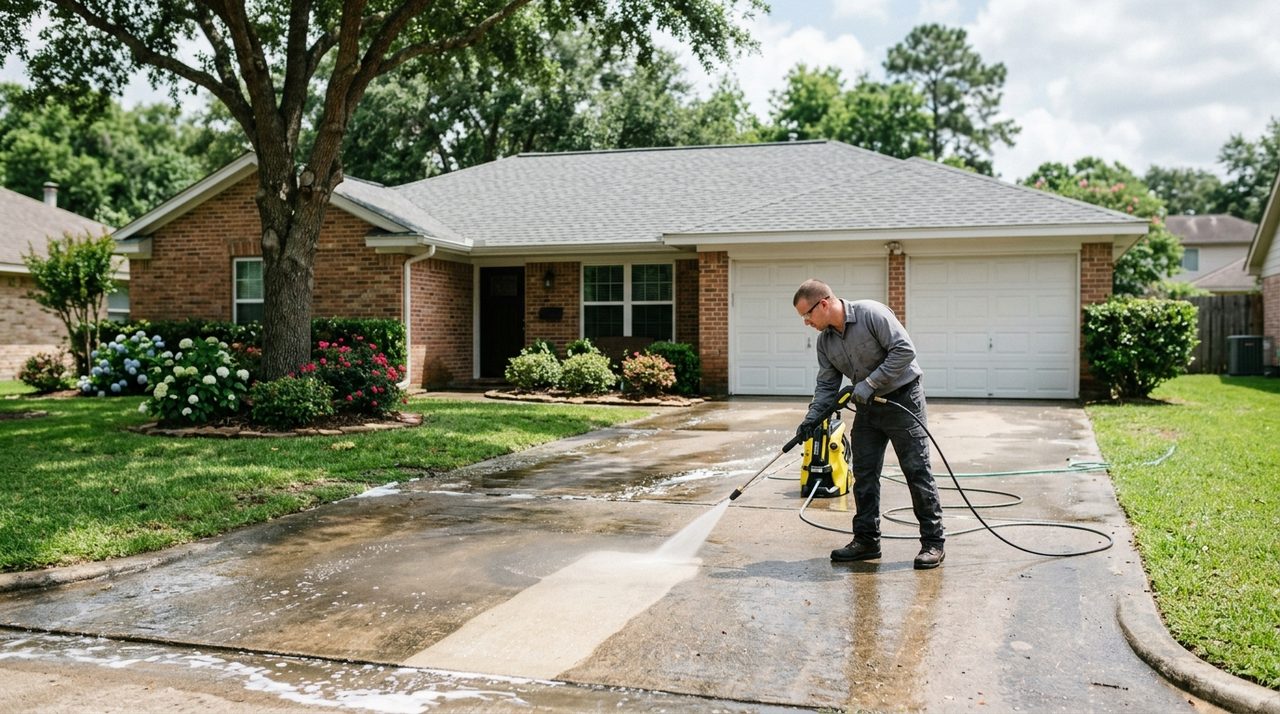
An experienced operator will apply a dilute acid wash (muriatic or phosphoric) to neutralize efflorescence before pressure rinsing at 2,000–3,000 PSI on concrete — a process that also preps the surface for any sealant application. On driveways showing surface spalling from Winter Storm Uri's 2021 freeze-thaw damage, the operator should reduce pressure and flag cracked sections to the homeowner before proceeding, since high pressure accelerates delamination on compromised slabs. No permit is required from the City of Jersey Village for driveway washing.
Sources: International Residential Code (as adopted by City of Houston)
Why it matters to you
Houston's annual average humidity exceeds 75%, and Jersey Village's mature tree canopy along its older subdivision streets keeps siding and roof planes shaded and damp for extended periods — ideal conditions for Gloeocapsa magma black algae and green mold to colonize asphalt shingles and the painted-brick or painted-wood trim common on this neighborhood's traditional homes. On shingles that are already 20–40 years old given the 1960s–1980s build era, high-pressure washing above 500 PSI strips granules and can void any remaining manufacturer warranty coverage.
What a good pro does
Roof cleaning on Jersey Village homes must be performed via low-pressure soft-wash — typically a sodium hypochlorite and surfactant solution applied at under 100 PSI — to kill algae at the root without granule loss. A post-treatment zinc or copper sulfate biocide rinse extends the clean by suppressing regrowth for 12–24 months, which matters in this humidity environment. Operators applying algaecide products that qualify as pesticides under Texas law should carry a Texas Department of Agriculture (TDA) pesticide applicator license; ask to see it before any chemical roof treatment.
Sources: Texas Commission on Environmental Quality, International Residential Code (as adopted by City of Houston)
Why it matters to you
Jersey Village's drainage infrastructure feeds directly into White Oak Bayou tributaries, and many residential streets have storm drain inlets within yards of typical driveway washing work areas. TCEQ regulations prohibit pressure-wash wastewater containing degreasers, algaecides, or chemical cleaners from entering those storm drains — a rule that is actively enforced in incorporated cities with their own code enforcement, as Jersey Village is. For driveway jobs involving oil-stain degreaser treatment, uncaptured runoff creates real regulatory exposure.
What a good pro does
For any Jersey Village driveway wash using chemical degreasers — common on aged concrete with baked-in vehicle oil stains — a responsible operator deploys berms or wet vacuums to capture and contain wash water before it reaches the curb drain. This adds time and cost to the job (budget for the 20–40% chemical-treatment premium), but it is required under TCEQ's Texas Pollutant Discharge Elimination System (TPDES) stormwater rules. The City of Jersey Village handles its own code enforcement independently of Houston and Harris County, so violations are handled through the city's own process.
Sources: Texas Commission on Environmental Quality, City of Houston Permitting Center
Hiring pressure washing in Jersey Village? Jersey Village is an independent municipality with a housing stock predominantly built between the 1960s and 1980s, featuring ranch-style and traditional brick homes on concrete slab foundations. Homeowners face significant flood risk due to proximity to White Oak Bayou and tributaries, making drainage, foundation maintenance, and flood mitigation among the most critical home service needs. The city handles its own code enforcement and permitting, so contractors must work through the City of Jersey Village rather than Houston or Harris County offices.
Building era
1960s–1980s, with some later infill construction.
Typical style
Ranch-style and traditional two-story brick homes with attached garages; suburban production architecture typical of northwest Houston.
Foundations
Slab-on-grade (dominant); pier-and-beam may exist on rare older or custom structures but is not documented.
Common systems
Original homes likely have copper or galvanized steel plumbing (transitioning to CPVC/PEX in later builds), R-22 refrigerant HVAC systems nearing or past end of life, and 100–200 amp electrical panels. Many systems in this era are candidates for full replacement.
What that means for repairs
Kitchen and bathroom remodels are common as homeowners update 40–60-year-old finishes. Re-piping from galvanized to PEX, HVAC upgrades to modern refrigerant systems, and flood-related restoration work (raised electrical panels, moisture-resistant materials) are frequent renovation drivers.
Permit jurisdiction
City of Jersey Village Permitting (independent municipality – permits are not issued through Houston Permitting Center or Harris County).
HOA & deed restrictions
No mandatory city-wide HOA for core Jersey Village neighborhoods; property standards are enforced through city code enforcement and deed restrictions. The Park at Jersey Village HOA exists but appears to be a separate, newer subdivision not located in the traditional Jersey Village city limits. Specific section-level deed restrictions may exist but were not confirmed in public records.
Historic districts
No City of Houston historic district designation confirmed. Jersey Village is an independent city and not subject to HAHC review.
Contractor note
Contractors must obtain permits through the City of Jersey Village, which has its own building codes, inspections, and zoning requirements separate from both Houston and Harris County. Familiarity with the city's specific permit process and code enforcement standards is essential.
FEMA flood zone
FEMA Zone AE (high flood risk) — source: fema_nfhl. Jersey Village is situated near White Oak Bayou and associated tributaries, placing much of the community in a designated high-risk floodplain with base flood elevations established.
Hurricane Harvey impact
Jersey Village is in a bayou-adjacent northwest Harris County area that experienced flooding during Hurricane Harvey, though a precise street-by-street damage assessment specific to the City of Jersey Village was not confirmed in available public records. The White Oak Bayou corridor and tributaries in this area flooded significantly. Homeowners should check HCFCD flood layers, FEMA FIRM maps, and property-level flood loss history (CLUE reports) for individual address risk.
Heat & humidity load
Houston's extreme summer heat and humidity place heavy demand on aging HVAC systems common in 1960s–80s homes, often triggering emergency repairs or full system replacements. Slab foundations in clay-heavy soils can shift with summer drought cycles, and prolonged moisture from summer storms combined with Zone AE flood risk can lead to mold, moisture intrusion, and recurring drainage issues.
Working with contractors here
Contractors in Jersey Village most commonly work on HVAC replacement, re-piping, foundation repair, and flood damage restoration driven by the aging 1960s–80s housing stock and high flood risk. Slab foundation repair is a frequent need as expansive clay soils shift seasonally, and many homes still have original galvanized plumbing requiring full re-pipes. Flood mitigation work—including raising electrical panels, installing sump systems, and replacing flood-damaged drywall and flooring with moisture-resistant materials—is a significant segment of the local market. Because Jersey Village is an incorporated city with its own permitting authority, contractors unfamiliar with the area should budget time for the city's specific inspection and permit processes rather than defaulting to Houston or Harris County procedures. Roofing and exterior work on 40–60-year-old brick veneer homes is also common, particularly after severe weather events.
Local Tip
Always ask for a written estimate before work begins. Texas contractors are required to provide one on jobs over $1,000.
Jersey Village is an independent municipality with a housing stock predominantly built between the 1960s and 1980s, featuring ranch-style and traditional brick homes on concrete slab foundations. Homeowners face significant flood risk due to proximity to White Oak Bayou and tributaries, making drainage, foundation maintenance, and flood mitigation among the most critical home service needs. The city handles its own code enforcement and permitting, so contractors must work through the City of Jersey Village rather than Houston or Harris County offices.
Source: U.S. Census Bureau, ACS 5-Year 2023
Much of Jersey Village maps to FEMA Zone AE (high flood risk), so flood-resilient detailing -- elevated equipment, water-tolerant materials, and drainage-first thinking -- is essential here, not optional.
Source: FEMA National Flood Hazard Layer (NFHL). Flood zones vary by parcel — verify your individual FIRM panel.
Sources: City of Houston Permitting Center
Sources: Local HOA / deed restrictions (see area profile)