Mackinac Pointe Ln, Houston, TX 77044
Best Pressure Washing in NE Houston
NE Houston's housing stock — ranging from 1960s ranch homes in established sections near Greens Bayou to 2000s–2020s production subdivisions like Summerwood and Woodforest — means driveways, fences, and exteriors age at wildly different rates on the same street. Harris County's heavy clay soil, combined with Gulf humidity that rarely dips below 70%, keeps mold and efflorescence working year-round on both postwar concrete slabs and freshly poured subdivision patios. Whether your address falls under the Houston Permitting Center or unincorporated Harris County Engineering, no municipal permit is required for routine residential pressure washing — but chemical application choices and runoff management matter here where storm drains feed directly toward Greens Bayou.
Verified against Google Business data
Updated 2026
See the 6 Pressure Washing Serving NE Houston 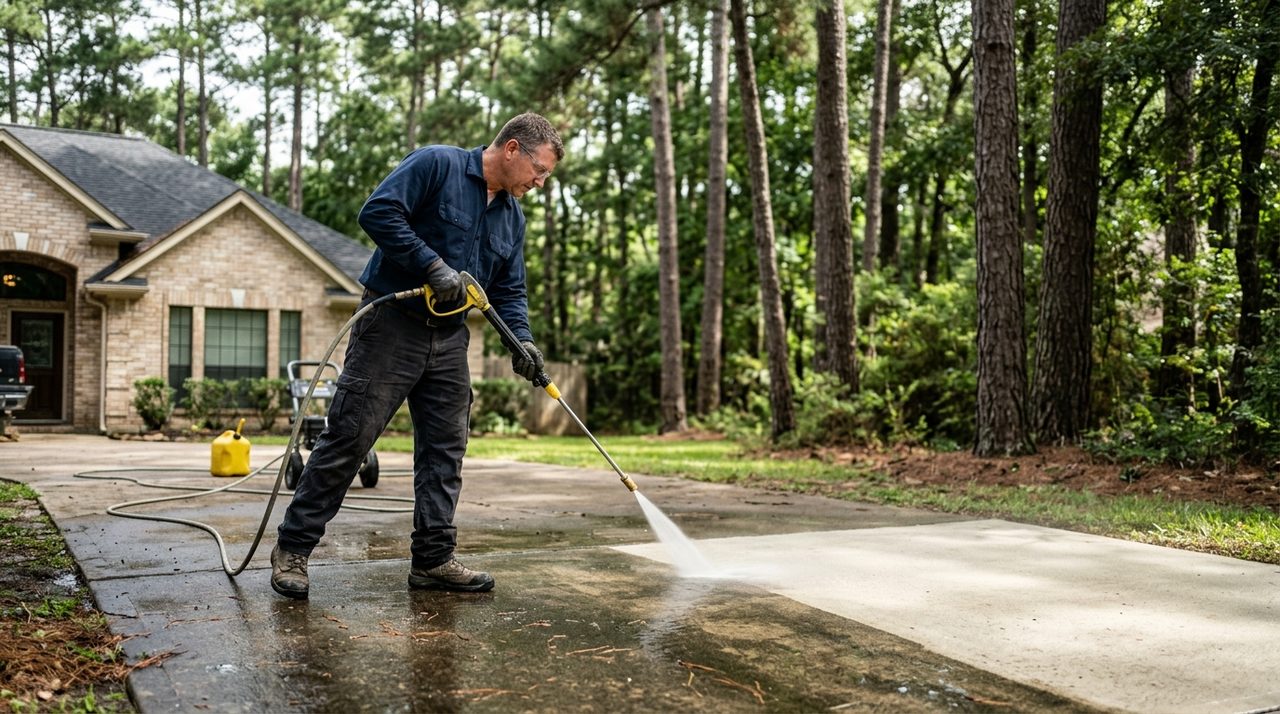
- Median home built
- 1988
- Median home value
- $189,541
- FEMA flood zone
- X (low)
- Typical cost (est.)
- $150–$900 depending on scope
- Most common local issue
- Black algae & clay-salt efflorescence on aging slab-era driveways and brick exteriors
Ranked by verified Google rating × review volume × verification tier. How we rank →
Some highly-rated pros serve NE Houston from nearby and may not keep a NE Houston street address. Those are listed under "Also serving NE Houston" with their real city and distance, so you always know where each business is based.
Min rating:
6 resultsBased in NE Houston
Also serving NE Houston
Highly-rated pros based nearby who cover NE Houston. Distance shown from the NE Houston area.
Open Now
Serving NE Houston Based in Galena Park · 3.8 mi away
Open Now
Serving NE Houston Based in Independence Heights · 6 mi away
Closed
Serving NE Houston Based in EaDo · 6.1 mi away
Closed
Serving NE Houston Based in EaDo · 6.9 mi away
Serving NE Houston Based in South Houston · 9.5 mi away
Pressure Washing in NE Houston: What You Should Know
Clay Soil Efflorescence on 1960s–1980s Slab Driveways and Brick
Why it matters to you
The original slab-on-grade homes concentrated in NE Houston's older sections were poured directly over Houston Black clay — the same expansive soil that has driven foundation repair demand across the area for decades. As this clay cycles through wet and dry seasons, mineral salts wick upward through the concrete and brick, leaving chalky white efflorescence deposits and rust-orange clay mud staining that won't budge under a standard cold-water rinse. On homes built in the 1960s through 1980s — which represent a large share of NE Houston's median 1988 build year — this staining is compounded by decades of accumulated surface oxidation.
What a good pro does
A qualified operator will apply a low-pH efflorescence remover or diluted muriatic acid solution as a pre-treatment, dwell it appropriately, then wash at controlled pressure — typically 2,500–3,000 PSI on aged concrete flatwork — rather than relying on raw pressure alone. Post-wash sealing is strongly advisable to slow the next mineral migration cycle. Texas does not require a state license for pressure washing as a standalone trade, though operators applying chemical cleaners classified as pesticides (such as certain algaecides) should hold a Texas Department of Agriculture (TDA) pesticide applicator credential.
Sources: Texas Commission on Environmental Quality, City of Houston Permitting Center
Year-Round Mold and Black Algae on Siding and Fencing Across All Housing Eras
Why it matters to you
NE Houston's Gulf humidity — annually above 75% — keeps Gloeocapsa magma (black algae) and green mold actively colonizing every porous exterior surface regardless of whether the home is a 1970s brick ranch or a 2010s Hardie-sided two-story in a master-planned community. Homes in older sections near Greens Bayou or with mature hardwood canopy are especially vulnerable, as shaded surfaces stay damp long after rain events. Organic staining commonly returns within 6–12 months of cleaning if no post-treatment biocide is applied.
What a good pro does
Soft-wash — low pressure (under 500 PSI at the nozzle) combined with a sodium hypochlorite-based cleaning solution — is the correct method for both Hardie board and older wood-sided or brick exteriors in this area; high pressure on weathered postwar brick can open mortar joints. The cleaning solution must not be allowed to sheet directly into storm drains, as TCEQ rules prohibit detergent-laden wash water from entering stormwater systems that flow to Greens Bayou and eventually Galveston Bay. Responsible operators pre-wet landscaping and direct runoff away from curb drains.
Sources: Texas Commission on Environmental Quality, FEMA National Flood Hazard Layer (NFHL)
HOA Appearance Compliance in Master-Planned Subdivisions
Why it matters to you
Newer master-planned communities in NE Houston — including Summerwood (built primarily 2000s–2010s) and Woodforest — carry mandatory HOAs with active architectural review committees that issue written violation notices for algae-stained driveways, discolored wood fences, and green roof streaks. Cure windows can be as short as 30 days, and some CC&Rs specifically restrict high-pressure washing on certain roofing materials. For the 66.5% of NE Houston residents who are owner-occupants, an unresolved HOA notice creates both a cost deadline and a potential resale complication.
What a good pro does
Before booking a wash, pull your specific subdivision's deed restrictions from the Harris County Clerk's records to confirm whether the HOA designates approved methods or materials — some prohibit bleach-based solutions near community ponds. A good operator will document work with before-and-after photos, which you can submit directly to the architectural review committee as proof of cure. Because HOA rules are deed-level instruments rather than city ordinances, neither the Houston Permitting Center nor Harris County Engineering has jurisdiction over them — compliance is purely between the homeowner and the HOA.
Sources: Local HOA / deed restrictions (see area profile), City of Houston Permitting Center
Oil and Tire Staining on Aged Driveways Worsened by Winter Storm Uri Spalling
Why it matters to you
NE Houston's oldest driveways — many still original pours from the 1960s and 1970s — were already showing surface spalling before Winter Storm Uri hit in February 2021; the freeze-thaw cycle accelerated micro-cracking across the metro, opening the porous concrete surface to deeper oil and tire-rubber penetration. Once motor oil bakes into spalled concrete under Houston's 100°F+ summer UV, standard cold-water pressure washing at any safe pressure level cannot fully lift the stain. With census median home values in NE Houston around $189,500, a heavily stained or pitted driveway is a visible drag on curb appeal and resale positioning.
What a good pro does
Effective treatment requires a hot-water pressure washer (water temperature 180–200°F) combined with a commercial alkaline degreaser applied as a pre-soak of at least 5–10 minutes before washing. The degreaser-laden runoff must be contained or neutralized before it reaches curb inlets, consistent with TCEQ stormwater discharge rules — this is non-negotiable on streets with storm drain inlets flowing toward Greens Bayou tributaries. Operators handling degreasers on commercial-grade staining jobs should carry general liability insurance and be aware of TCEQ's Texas Pollutant Discharge Elimination System (TPDES) requirements even for residential work.
Sources: Texas Commission on Environmental Quality, International Residential Code (as adopted by City of Houston)
Pressure Washing in NE Houston: What You Should Know
Hiring pressure washing in NE Houston? NE Houston encompasses a broad swath of Harris County with housing ranging from mid-century postwar builds to modern master-planned subdivisions. Homeowners here face a wide spectrum of maintenance challenges driven by aging infrastructure in older sections and rapid-growth construction quality concerns in newer developments. Foundation movement, outdated plumbing, and storm hardening are recurring service themes across the area.
- Housing era
- 1950s through 2020s, with concentrations in the 1960s–1980s in older sections and 2000s–2020s in…
- Foundation
- Predominantly slab-on-grade
- Flood zone
- FEMA Zone X (low flood risk) per official NFHL data
- Permits
- Houston Permitting Center for areas within City of Houston limits
Housing stock & systems
Building era
1950s through 2020s, with concentrations in the 1960s–1980s in older sections and 2000s–2020s in newer master-planned communities.
Typical style
Mix of modest ranch-style and minimal traditional homes in older areas; newer subdivisions feature traditional and transitional two-story production homes.
Foundations
Predominantly slab-on-grade; some older pier-and-beam homes exist in the most established sections.
Common systems
Older homes may have galvanized or cast-iron plumbing, original electrical panels (60–100 amp), and aging HVAC units. Newer subdivisions typically feature PEX plumbing, 200-amp panels, and high-efficiency HVAC systems.
What that means for repairs
Older sections see significant plumbing re-pipes, electrical panel upgrades, and kitchen/bath modernizations. Newer subdivisions often require warranty-related repairs and cosmetic upgrades within the first decade.
Permits & restrictions
Permit jurisdiction
Houston Permitting Center for areas within City of Houston limits. Some unincorporated pockets fall under Harris County Engineering. Homeowners should verify ETJ and annexation status for their specific address.
HOA & deed restrictions
HOA presence varies significantly by subdivision. Newer master-planned communities such as Summerwood and Woodforest have mandatory HOAs with architectural review committees. Older established neighborhoods may have voluntary civic clubs or no organized HOA. Not confirmed at a macro-area level - check specific subdivision deed records with the Harris County Clerk.
Historic districts
No City of Houston historic district designation confirmed for the general NE Houston area.
Contractor note
Contractors should verify whether a specific address is within Houston city limits or unincorporated Harris County, as permitting requirements and inspection processes differ. HOA-governed subdivisions may require architectural approval before exterior work begins.
Flood & weather
FEMA flood zone
FEMA Zone X (low flood risk) per official NFHL data. However, NE Houston is traversed by Greens Bayou, Halls Bayou, and Hunting Bayou, and localized flooding can occur near these waterways even in Zone X areas. Proximity to specific bayous and drainage channels should be evaluated on a property-by-property basis.
Hurricane Harvey impact
Hurricane Harvey (2017) caused significant flooding across many parts of NE Houston, particularly in areas near Greens Bayou and Halls Bayou corridors. Neighborhoods such as Northshore, Cloverleaf, and areas along Tidwell Road experienced substantial inundation. Specific impact for any given address should be verified through Harris County Flood Control District records, as damage varied block by block.
Heat & humidity load
Houston's extreme summer heat and humidity place heavy demands on HVAC systems, especially in older homes with inadequate insulation and single-pane windows. Slab foundations in expansive clay soils are prone to movement during prolonged dry spells, making foundation watering and monitoring essential. Aging roofing materials in older sections are vulnerable to storm damage during hurricane season.
Working with contractors here
NE Houston's wide range of housing eras creates demand for both modernization and maintenance-focused contractors. In older sections, whole-house re-pipes replacing galvanized and cast-iron plumbing are among the most common major projects, alongside electrical panel upgrades from 60-amp to 200-amp service. Foundation repair is a recurring need due to expansive clay soils and mature tree root systems. In newer master-planned communities, contractors more commonly handle warranty-era issues, fence and patio additions, and HVAC optimization. Job scoping should account for the specific subdivision's age, HOA requirements, and flood history, as post-Harvey remediation work may have altered original systems in unpredictable ways.
Local Tip
Always ask for a written estimate before work begins. Texas contractors are required to provide one on jobs over $1,000.
About NE Houston
NE Houston encompasses a broad swath of Harris County with housing ranging from mid-century postwar builds to modern master-planned subdivisions. Homeowners here face a wide spectrum of maintenance challenges driven by aging infrastructure in older sections and rapid-growth construction quality concerns in newer developments. Foundation movement, outdated plumbing, and storm hardening are recurring service themes across the area.
- Median year built
- 1988
- Median home value
- $189,541
- Owner-occupied
- 66.5%
- Population
- 164,537
- Housing units
- 56,577
- Median income
- $64,094
Source: U.S. Census Bureau, ACS 5-Year 2023
Flood & storm risk
FEMA Zone XLow flood riskMost of NE Houston maps to FEMA Zone X (low mapped flood risk), but Houston's flash-flood reality means even low-risk blocks benefit from smart drainage and storm-hardened installs; risk climbs sharply on blocks nearest Greens Bayou and the San Jacinto River, where it varies parcel to parcel.
Source: FEMA National Flood Hazard Layer (NFHL). Flood zones vary by parcel — verify your individual FIRM panel.
Frequently Asked Questions
Do I need a permit from the Houston Permitting Center or Harris County to pressure wash my house in NE Houston?
Routine residential pressure washing does not require a permit from the Houston Permitting Center or Harris County Engineering regardless of which jurisdiction your NE Houston address falls under. However, if your address is in unincorporated Harris County rather than within City of Houston limits, you should confirm with Harris County Engineering before any work that involves structural surface prep tied to a larger permitted project. For a standalone wash job, no permit filing is needed either way.
Sources: City of Houston Permitting Center
My NE Houston home was built in the late 1960s and has original brick and a poured slab — will high-pressure washing damage the mortar joints?
Yes, this is a real concern on postwar-era NE Houston brick: mortar from the 1960s and 1970s is often softer lime-based mix that erodes under high-pressure (above roughly 1,200 PSI) directed at joints, and slab edges near grade can chip where Uri-era freeze cycling already stressed the surface. A reputable operator should drop to low-pressure or soft-wash mode on the brick face and mortar lines, then use a surface cleaner attachment on flat slab areas. Ask specifically what PSI they use on masonry before booking.
I'm in Summerwood and just got an HOA violation notice about my fence and driveway — how quickly can pressure washing realistically resolve it, and is 30 days enough time?
For typical green algae or clay-stain buildup on a wood fence and concrete driveway, a single professional visit is usually enough to satisfy the visible-condition standard, and most operators serving NE Houston master-planned communities can schedule within one to two weeks during non-peak periods. The 30-day cure window is tight but workable as long as you book promptly and request a written completion invoice you can submit to the architectural review committee. If the fence also needs staining or sealing after washing, factor that as a separate appointment that may extend your timeline.
Sources: Local HOA / deed restrictions (see area profile)
Does the wash water from a driveway degreaser job at my NE Houston property need to be contained so it doesn't reach the storm drain?
Yes — TCEQ rules under the Texas Pollutant Discharge Elimination System prohibit wastewater containing degreasers, detergents, or chemical cleaners from entering storm drains, which in Harris County flow directly into Greens Bayou and the San Jacinto watershed. For a standard residential rinse with no chemical additives the risk is low, but if your driveway job involves a petroleum-degreaser pre-treatment for oil stains, a compliant operator should use absorbent berms or a reclaim setup to prevent discharge. Ask the company directly whether they use containment on chemical jobs — it is not universal among smaller operators in the area.
What time of year is best to schedule pressure washing in NE Houston, and does the rainy season make it pointless to wash in spring?
Late fall — October through November — is generally the most efficient window in NE Houston because humidity pulls back slightly, mold growth slows, and surfaces stay dry long enough for post-wash biocide sealers to cure properly. Spring washing is not pointless, but washing just before the peak May–June storm season means organic regrowth can restart within weeks without a biocide application. If you are washing to meet an HOA deadline or pre-sell the home, schedule at least two weeks before any inspection date to let surfaces fully dry and show their cleaned appearance.
My NE Houston address is near Greens Bayou — does the slightly elevated flood risk on those blocks affect what a pressure wash company will or won't do?
Proximity to Greens Bayou puts some parcels in or near FEMA Zone AE rather than the broader Zone X that covers most of NE Houston, and post-storm flood-line staining on brick or stucco at the watermark height is a common request in those blocks after heavy rain events. This staining — a tan or brown mineral ring left by receding water — typically requires a chemical dwell treatment before pressure rinsing and carries a 20–40 percent cost premium over a standard house wash (estimate). When quoting, describe the stain height and material to the operator so they bring the correct cleaner; standard soft-wash solution alone usually won't lift flood-line mineral deposits.