6035 East Sam Houston Pkwy N, Houston, TX 77049
Best Roofers in NE Houston
NE Houston's housing stock spans seven decades — from 1960s ranch-style slabs in established sections like Cloverleaf and Galena Park to 2000s-era two-story production homes in master-planned Summerwood — and each era carries its own roofing liability under Harris County's brutal storm cycle. The May 2024 derecho tore through this corridor with 100-plus mph straight-line winds, exposing aging 3-tab shingles on older homes and testing the wind-nailing patterns on newer builds alike. Whether your address falls under the Houston Permitting Center or unincorporated Harris County Engineering, understanding what your roof actually needs — not just what the storm-chaser knocking on your door claims — is the point of this page.
Verified against Google Business data
Updated 2026
See the 10 Roofers Serving NE Houston 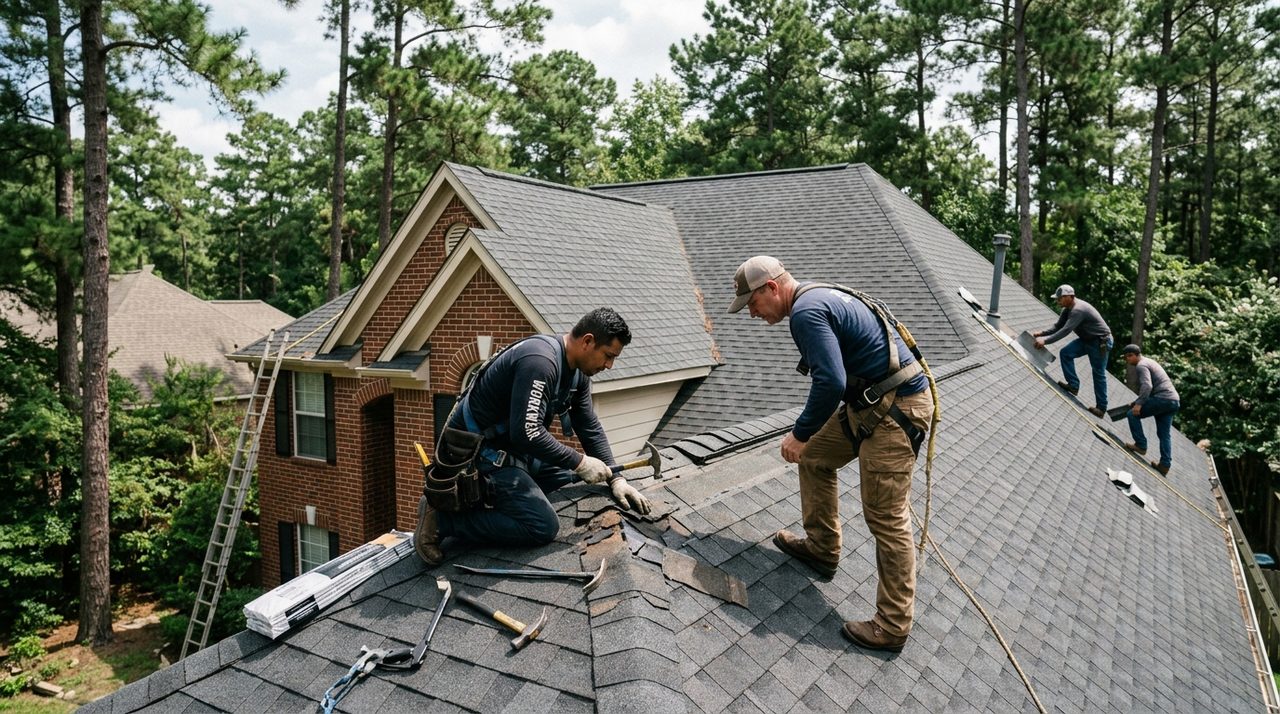
- Median home built
- 1988
- Median home value
- $189,541
- FEMA flood zone
- X (low)
- Typical re-roof cost (est.)
- $9,000–$16,000
- Most common local issue
- Wind-uplift damage on 1960s–1980s low-slope ranch roofs with under-nailed shingles
Ranked by verified Google rating × review volume × verification tier. How we rank →
Some highly-rated pros serve NE Houston from nearby and may not keep a NE Houston street address. Those are listed under "Also serving NE Houston" with their real city and distance, so you always know where each business is based.
Min rating:
10 resultsBased in NE Houston
15414 Amber Manor Ln, Houston, TX 77044
10206 Hirsch Rd, Houston, TX 77016
Open Now
9417d Mesa Dr, Houston, TX 77028
Open Now
8923 Ley Rd, Houston, TX 77078
Also serving NE Houston
Highly-rated pros based nearby who cover NE Houston. Distance shown from the NE Houston area.
Open Now
Serving NE Houston Based in EaDo · 2.8 mi away
Open Now
Serving NE Houston Based in Independence Heights · 4.5 mi away
Serving NE Houston Based in EaDo · 4.5 mi away
Open Now
Serving NE Houston Based in Galena Park · 4.6 mi away
Serving NE Houston Based in Galena Park · 4.7 mi away
Roofers in NE Houston: What You Should Know
Derecho & Hurricane Wind Uplift on Aging Ranch-Style Roofs
Why it matters to you
NE Houston's concentration of 1960s–1980s slab-on-grade ranch homes means a significant share of the area's roofs predate the 2006 IRC wind-resistance nail-pattern upgrades that require 6-nail fastening on shingles in high-wind zones. The May 2024 derecho produced documented straight-line winds above 100 mph across Harris County, and older homes in established NE Houston sections — many still carrying original or first-replacement 3-tab shingles — were disproportionately hit with ridge-cap loss and lifted field sections. Low-slope ranch geometry gives wind more surface area to grip compared to steeper suburban pitches.
What a good pro does
A qualified roofer should pull the existing shingle layer to inspect decking nail patterns and upgrade to a six-nail or ring-shank fastening schedule on the new installation, which aligns with current IRC R905 requirements. Because many NE Houston addresses sit within City of Houston limits, the contractor must be registered with the Houston Permitting Center before pulling a building permit for structural repairs — confirm that registration number before signing a contract. Texas has no state roofing license, so general liability and workers' compensation certificates are the only documented protection a homeowner has.
Sources: International Residential Code (as adopted by City of Houston), City of Houston Permitting Center, Texas Windstorm Insurance Association (TWIA)
Hidden Hail Bruising on 10-to-30-Year-Old Architectural Shingles
Why it matters to you
The census median year built for NE Houston is 1988, which means a substantial portion of the area's homes are now carrying shingles that are 15–35 years old — precisely the age range where cumulative hail hits from Harris County's recurring spring storm seasons cause fiberglass mat bruising that is invisible from the street but voids manufacturer warranties and accelerates UV breakdown in Houston's intense summer heat. Homeowners in newer Summerwood-era subdivisions are not exempt: many 2005–2015 production homes were built with Class 3 shingles that show mat damage after repeated events even if they still look intact from the curb.
What a good pro does
Request a documented drone or close-contact inspection that photographs granule loss patterns and mat bruising rather than a verbal walk-around estimate — bruising only shows up under direct raking light at close range. If a full replacement is warranted, upgrading to a Class 4 impact-resistant shingle adds an estimated $1,500–$3,500 to a standard re-roof but can qualify for homeowner insurance premium discounts; confirm eligibility with your insurer before selecting a product. Keep a copy of the manufacturer's product data sheet showing impact classification, because TWIA-eligible products have specific approval requirements.
Sources: Texas Windstorm Insurance Association (TWIA), International Residential Code (as adopted by City of Houston)
Attic Ventilation Failure and Silent Deck Rot in a High-Humidity Corridor
Why it matters to you
NE Houston's older sections — particularly homes built between 1965 and 1990 — were commonly constructed with box or gable vents only, lacking the ridge-and-soffit balanced ventilation systems that IRC R806 now requires. Houston's annual average relative humidity exceeds 75%, and without proper airflow, OSB and plywood decking on these slab-on-grade homes absorbs moisture year-round, delaminates from the inside out, and goes undetected until a re-roof tears off the shingles. Because slab construction eliminates any under-floor buffer, all of the building's moisture load moves upward — making attic ventilation the only relief valve.
What a good pro does
A thorough roofer should probe decking for soft spots during tear-off and document square footage of delaminated panels before pricing the job — deck replacement at $2–$4 per square foot installed is a known add-on cost on homes from this era and should be in the written scope, not a surprise line item. Insist that the ventilation plan meet the 1:150 net free area ratio (or 1:300 with a balanced ridge/soffit system) per IRC R806 before the new underlayment goes down, because installing new shingles over an unventilated deck on a 1970s NE Houston home simply restarts the rot clock.
Sources: International Residential Code (as adopted by City of Houston), FEMA National Flood Hazard Layer (NFHL)
HOA Architectural Review Delays in Newer Master-Planned Sections
Why it matters to you
Newer NE Houston subdivisions — including Summerwood, which sits in the Lake Houston area, and portions of Woodforest to the north — operate under mandatory HOAs with Architectural Review Committees that require written approval before any roofing material change, including color shifts or an upgrade from standard architectural shingles to metal. After storm damage, homeowners under time pressure sometimes skip ARC submission, only to face fines or a forced re-roof at their own expense when the HOA flags the non-compliant material. This layer of approval sits on top of whatever permit the Houston Permitting Center or Harris County Engineering requires.
What a good pro does
Before signing a roofing contract in any post-2000 NE Houston subdivision, pull your deed restrictions through the Harris County Clerk's office and confirm whether an ARC application is required and what the typical turnaround is — common windows are 10 to 30 days, which matters when a tarp is on your roof. A roofer experienced in this area should be able to provide a product data sheet, shingle color sample, and a completed ARC packet as part of their standard storm-repair process, not as an afterthought. If you need to proceed before ARC approval due to active leaking, document the emergency with photos and submit the ARC application simultaneously to establish good-faith compliance.
Sources: Local HOA / deed restrictions (see area profile), City of Houston Permitting Center
Roofers in NE Houston: What You Should Know
Hiring roofers in NE Houston? NE Houston encompasses a broad swath of Harris County with housing ranging from mid-century postwar builds to modern master-planned subdivisions. Homeowners here face a wide spectrum of maintenance challenges driven by aging infrastructure in older sections and rapid-growth construction quality concerns in newer developments. Foundation movement, outdated plumbing, and storm hardening are recurring service themes across the area.
- Housing era
- 1950s through 2020s, with concentrations in the 1960s–1980s in older sections and 2000s–2020s in…
- Foundation
- Predominantly slab-on-grade
- Flood zone
- FEMA Zone X (low flood risk) per official NFHL data
- Permits
- Houston Permitting Center for areas within City of Houston limits
Housing stock & systems
Building era
1950s through 2020s, with concentrations in the 1960s–1980s in older sections and 2000s–2020s in newer master-planned communities.
Typical style
Mix of modest ranch-style and minimal traditional homes in older areas; newer subdivisions feature traditional and transitional two-story production homes.
Foundations
Predominantly slab-on-grade; some older pier-and-beam homes exist in the most established sections.
Common systems
Older homes may have galvanized or cast-iron plumbing, original electrical panels (60–100 amp), and aging HVAC units. Newer subdivisions typically feature PEX plumbing, 200-amp panels, and high-efficiency HVAC systems.
What that means for repairs
Older sections see significant plumbing re-pipes, electrical panel upgrades, and kitchen/bath modernizations. Newer subdivisions often require warranty-related repairs and cosmetic upgrades within the first decade.
Permits & restrictions
Permit jurisdiction
Houston Permitting Center for areas within City of Houston limits. Some unincorporated pockets fall under Harris County Engineering. Homeowners should verify ETJ and annexation status for their specific address.
HOA & deed restrictions
HOA presence varies significantly by subdivision. Newer master-planned communities such as Summerwood and Woodforest have mandatory HOAs with architectural review committees. Older established neighborhoods may have voluntary civic clubs or no organized HOA. Not confirmed at a macro-area level - check specific subdivision deed records with the Harris County Clerk.
Historic districts
No City of Houston historic district designation confirmed for the general NE Houston area.
Contractor note
Contractors should verify whether a specific address is within Houston city limits or unincorporated Harris County, as permitting requirements and inspection processes differ. HOA-governed subdivisions may require architectural approval before exterior work begins.
Flood & weather
FEMA flood zone
FEMA Zone X (low flood risk) per official NFHL data. However, NE Houston is traversed by Greens Bayou, Halls Bayou, and Hunting Bayou, and localized flooding can occur near these waterways even in Zone X areas. Proximity to specific bayous and drainage channels should be evaluated on a property-by-property basis.
Hurricane Harvey impact
Hurricane Harvey (2017) caused significant flooding across many parts of NE Houston, particularly in areas near Greens Bayou and Halls Bayou corridors. Neighborhoods such as Northshore, Cloverleaf, and areas along Tidwell Road experienced substantial inundation. Specific impact for any given address should be verified through Harris County Flood Control District records, as damage varied block by block.
Heat & humidity load
Houston's extreme summer heat and humidity place heavy demands on HVAC systems, especially in older homes with inadequate insulation and single-pane windows. Slab foundations in expansive clay soils are prone to movement during prolonged dry spells, making foundation watering and monitoring essential. Aging roofing materials in older sections are vulnerable to storm damage during hurricane season.
Working with contractors here
NE Houston's wide range of housing eras creates demand for both modernization and maintenance-focused contractors. In older sections, whole-house re-pipes replacing galvanized and cast-iron plumbing are among the most common major projects, alongside electrical panel upgrades from 60-amp to 200-amp service. Foundation repair is a recurring need due to expansive clay soils and mature tree root systems. In newer master-planned communities, contractors more commonly handle warranty-era issues, fence and patio additions, and HVAC optimization. Job scoping should account for the specific subdivision's age, HOA requirements, and flood history, as post-Harvey remediation work may have altered original systems in unpredictable ways.
Local Tip
Always ask for a written estimate before work begins. Texas contractors are required to provide one on jobs over $1,000.
About NE Houston
NE Houston encompasses a broad swath of Harris County with housing ranging from mid-century postwar builds to modern master-planned subdivisions. Homeowners here face a wide spectrum of maintenance challenges driven by aging infrastructure in older sections and rapid-growth construction quality concerns in newer developments. Foundation movement, outdated plumbing, and storm hardening are recurring service themes across the area.
- Median year built
- 1988
- Median home value
- $189,541
- Owner-occupied
- 66.5%
- Population
- 164,537
- Housing units
- 56,577
- Median income
- $64,094
Source: U.S. Census Bureau, ACS 5-Year 2023
Flood & storm risk
FEMA Zone XLow flood riskMost of NE Houston maps to FEMA Zone X (low mapped flood risk), but Houston's flash-flood reality means even low-risk blocks benefit from smart drainage and storm-hardened installs; risk climbs sharply on blocks nearest Greens Bayou and the San Jacinto River, where it varies parcel to parcel.
Source: FEMA National Flood Hazard Layer (NFHL). Flood zones vary by parcel — verify your individual FIRM panel.
Houston Storm Readiness in NE Houston
Hurricane & flooding
For homeowners in NE Houston: beryl 2024 stripped unsealed ridge vents and attic ventilators off roofs across low-flood-risk Houston neighborhoods, creating interior soaking before homeowners even knew there was an opening. Have a roofer install hurricane-rated ridge vent covers or temporarily cap off-ridge ventilators if a storm is within 72 hours of landfall. In-city NE Houston work falls under City of Houston floodplain and permitting rules.
Severe storms & hail
After a severe thunderstorm, the first thing a roofer should check in NE Houston is whether wind-driven rain has pushed up under any low-slope transition sections—areas where a steep roof meets a flatter porch or addition—because these joints separate under gust pressure and rarely reseal on their own. Sealing those transitions with a peel-and-stick modified bitumen patch costs far less than replacing the framing they protect. In-city NE Houston work falls under City of Houston floodplain and permitting rules.
Ice storms & freezes
Winter Storm Uri 2021 showed that ice-covered roofs across the Houston metro lost shingles when the freeze-thaw cycle broke the adhesion seal on standard three-tab and architectural shingles never designed for sustained below-freezing temperatures. Have a TDLR-licensed roofer inspect your shingle tab adhesion in NE Houston each autumn and apply supplemental roofing cement to any tabs that no longer lie flat. In-city NE Houston work falls under City of Houston floodplain and permitting rules.
Sources: FEMA National Flood Hazard Layer (NFHL), Ready.gov -- Hurricanes, CenterPoint Energy -- Storm Center, City of Houston -- Emergency Preparedness, Ready.gov -- Winter Weather, Harris County Flood Control District
Free NE Houston Tools & Calculators
Houston-specific estimators to plan your project before you call a pro. All results are planning estimates — a licensed local pro confirms the details on site.
Hurricane Roof Wind-Load & TDI/WPI-8 Estimator
Open full tool & FAQ →115–120 mph
Estimated design wind speed for your zone
Outside the TDI catastrophe area, so a WPI-8 is generally not mandated — but Houston still sees hurricane-force gusts (Beryl, 2024). Insist on properly rated shingles installed to the manufacturer's high-wind nailing pattern (6 nails) and starter strips, or a wind claim can be denied for improper installation.
Find a Houston roofer →This is a planning estimate only — actual requirements depend on an on-site assessment by a licensed Houston pro. Wind-speed zones are approximate; your exact TDI/WPI-8 obligation depends on your address's designation. Verify with the Texas Department of Insurance before contracting.
Houston Freeze Prep & Pipe Insulation Checklist
Open full tool & FAQ →Your freeze checklist — 4 tasks
- 1
Disconnect & drain every outdoor hose bib
Remove hoses, drain the spigots, and cover each with an insulated faucet sock. Un-drained hose bibs are the #1 burst point in a Houston freeze.
- 2
Insulate exposed pipes in the attic & garage
Wrap any pipe in an unconditioned space (attic runs, garage walls) with foam sleeves. Houston homes rarely insulate these because they only matter a few nights a year — which is exactly why they burst.
- 3
Open cabinet doors & keep a pencil-width drip
On hard-freeze nights, open kitchen/bath cabinets so warm air reaches the pipes and let faucets on exterior walls drip to relieve pressure.
- 4
Protect the attic/garage water heater & its lines
An attic or garage tank sits in unconditioned space. Insulate the cold-inlet and hot-outlet lines and confirm the emergency drain pan is clear so a leak doesn't reach the ceiling.
This is a planning estimate only — actual requirements depend on an on-site assessment by a licensed Houston pro. If a pipe has already burst, shut off your main water supply and call a licensed Houston plumber immediately — freeze bursts flood fast.
Frequently Asked Questions
Does my NE Houston address need a permit for a full roof replacement, and how do I know if I'm under the Houston Permitting Center or Harris County?
Full re-roofs requiring structural repairs need a permit from whichever jurisdiction covers your parcel, but like-for-like shingle replacement without structural work falls in a gray zone under City of Houston rules — a nuance worth clarifying before you sign a contract. The tricky part in NE Houston is that some addresses in Cloverleaf, Galena Park, and unincorporated pockets east of Beltway 8 fall under Harris County Engineering rather than the Houston Permitting Center, so your neighbor's experience may not match yours. Look up your address on the Harris County Appraisal District site or call the Houston Permitting Center to confirm jurisdiction before your contractor pulls any permit.
Sources: City of Houston Permitting CenterMunicipal permit office (see area profile)
My 1970s ranch-style home in NE Houston has original 3-tab shingles with what looks like a low-pitch roof — what roofing systems actually hold up here?
Low-slope ranch roofs common to NE Houston's 1960s–1980s stock (pitches at or below 2:12 on rear sections) are not rated for standard asphalt shingles, which require at least a 2:12 pitch with double underlayment per IRC R905 minimums — anything flatter should use a modified bitumen or TPO membrane system instead. If your contractor proposes shingles on a genuinely flat section, that's a red flag. For the steeper main field, upgrading from 3-tab to Class 4 impact-resistant architectural shingles adds an estimated $1,500–$3,500 to a re-roof but meaningfully extends life in Houston's hail corridor.
Sources: International Residential Code (as adopted by City of Houston)
Summerwood has an HOA — do I need ARC approval before emergency storm repairs after a derecho or hurricane?
Most ARC rules in master-planned communities like Summerwood distinguish between emergency tarping or like-for-like shingle repairs — which are typically allowed to begin immediately for safety — and full material or color changes, which do require written ARC approval that can take 10–30 days. Read your specific CC&Rs carefully, because proceeding with a full re-roof in a new material or color without ARC sign-off can result in fines or a forced redo at your cost. Get any emergency-repair verbal approval from your HOA in writing, even a text or email, before your roofer starts tearing off.
Sources: Local HOA / deed restrictions (see area profile)
How long does a re-roof typically take in NE Houston, and does spring storm season affect scheduling?
A straightforward single-story re-roof in NE Houston — tear-off, deck inspection, new underlayment, and architectural shingles — typically runs two to three days for a crew under normal conditions, though permit inspection scheduling with the Houston Permitting Center or Harris County can add several business days to final sign-off. Spring (March through June) is both peak storm season and peak demand season here, so contractor backlogs after a significant hail or wind event can push your start date out four to eight weeks and push estimated prices 15–25% above baseline for months afterward. Booking a roof inspection in late winter — January or February — is the most reliable way to get ahead of the surge.
Sources: City of Houston Permitting Center
My NE Houston home was built in 1988 — should I be worried about lead paint on the old roofline trim or fascia boards when reroofing?
Homes built before 1978 are the primary lead-paint concern under EPA RRP rules, so a 1988 build is below that threshold and not subject to the federal renovation rules for lead-safe work practices. However, some NE Houston ranch-style homes in the oldest established sections — those built in the late 1950s through mid-1970s — do fall under EPA RRP, and any roofer disturbing painted fascia, soffits, or wood trim on those homes must be EPA RRP-certified. If your home predates 1978, ask your contractor directly for their RRP certification number before work begins.
Sources: EPA Lead Renovation, Repair and Painting (RRP) Rule
NE Houston is mapped FEMA Zone X — does that mean I can skip TWIA wind coverage and just rely on standard homeowners insurance for roof storm damage?
FEMA Zone X addresses your flood risk classification, not your wind exposure — and NE Houston's position in Harris County puts it squarely in the path of Gulf-driven storms and derechos regardless of flood zone. Standard homeowners insurance covers wind damage in most of NE Houston, but if your insurer cancels or non-renews wind coverage, TWIA (the Texas Windstorm Insurance Association) is the backstop, and TWIA requires that any roof replacement use products on their approved list to maintain eligibility. Before signing a roofing contract, confirm the proposed shingle product is TWIA-eligible if you carry or may need TWIA wind coverage.
Sources: Texas Windstorm Insurance Association (TWIA)FEMA National Flood Hazard Layer (NFHL)