Closed
2620 W Tidwell Rd, Houston, TX 77091
Acres Homes sits squarely within the City of Houston's permit jurisdiction, where a median build year of 1979 means the majority of housing stock — pier-and-beam wood-frame cottages alongside newer slab-on-grade infill — carries decades of Houston humidity, clay-soil mineral staining, and green mold on every porous exterior surface. With no mandatory HOA imposing cure-window deadlines, homeowners here have the latitude to schedule cleaning on their own timeline, but Houston's 75%-plus average humidity means mold and mildew will reclaim untreated surfaces within a single season. This page explains the specific pressure-washing realities that come with Acres Homes's mixed housing stock and Harris County clay soil.
Ranked by verified Google rating × review volume × verification tier. How we rank →
Some highly-rated pros serve Acres Homes from nearby and may not keep a Acres Homes street address. Those are listed under "Also serving Acres Homes" with their real city and distance, so you always know where each business is based.
2620 W Tidwell Rd, Houston, TX 77091
255 Blue Bell Rd B, Houston, TX 77037
Highly-rated pros based nearby who cover Acres Homes. Distance shown from the Acres Homes area.
Serving Acres Homes Based in Brookhollow · 2.3 mi away
Serving Acres Homes Based in Lazybrook / Timbergrove · 2.7 mi away
Serving Acres Homes Based in Brookhollow · 3.3 mi away
Serving Acres Homes Based in Lazybrook / Timbergrove · 3.5 mi away
Serving Acres Homes Based in Brookhollow · 3.7 mi away
Serving Acres Homes Based in Brookhollow · 3.8 mi away
Serving Acres Homes Based in Brookhollow · 4.1 mi away
Serving Acres Homes Based in Lazybrook / Timbergrove · 4.3 mi away
Why it matters to you
The older wood-frame cottages and bungalows that make up much of Acres Homes's pre-1980 stock are especially vulnerable to Gloeocapsa magma black algae and green mold. Unventilated pier-and-beam crawl spaces trap ground moisture against the siding year-round, and Houston's consistent humidity above 75% means mold reappears within 6–12 months of any cleaning that doesn't include a post-treatment biocide. On blocks near Vogel Creek tributaries, where drainage is slower, the problem is measurably worse.
What a good pro does
A qualified operator should apply a low-pressure soft-wash (under 500 PSI on aged wood) combined with a diluted sodium hypochlorite or equivalent biocide solution, then follow with a neutralizing rinse to halt regrowth. High-pressure rinsing alone on weathered pine or fiber-cement cottage siding will open grain and accelerate future moisture intrusion — ask specifically for a soft-wash protocol on any pre-1980 wood exterior. Texas does not require a state license for pressure washing, but if the operator is applying an EPA-registered algaecide at label concentration, confirm they carry a Texas Department of Agriculture (TDA) pesticide applicator credential.
Sources: Texas Commission on Environmental Quality, City of Houston Permitting Center
Why it matters to you
The post-2015 infill homes that now sit on concrete slabs throughout Acres Homes are poured directly over Houston's expansive Beaumont/Houston Black clay. As that clay wets and dries through Houston's heavy rain cycles, it wicks mineral salts upward through the slab, depositing white efflorescence bloom and rust-red clay mud on driveway edges and foundation-level surfaces. Standard cold-water rinsing moves the surface mud but does not break the mineral bond of true efflorescence.
What a good pro does
Effective treatment requires a mild acidic pre-soak — typically a diluted muriatic or phosphoric acid solution — applied dwell-time before hot-water or high-pressure (1,200–2,000 PSI) rinsing on concrete. The operator must then contain and properly dispose of the wash water: TCEQ rules prohibit acidic or chemically loaded wastewater from entering Houston's storm drains, which flow directly to bayous. Confirm the operator uses a wet-vac or berm-containment setup on jobs involving chemical pre-treatment near the street-level drain inlets common throughout this neighborhood.
Sources: Texas Commission on Environmental Quality, International Residential Code (as adopted by City of Houston)
Why it matters to you
The May 2024 derecho swept through NW Houston with 100-mph-plus gusts, plastering tannic leaf tannins, wind-driven dirt, and green organic debris into the porous brick, Hardie siding, and wood trim surfaces found throughout Acres Homes. Because this neighborhood's housing stock ranges from bare wood cottages to newer brick-and-Hardie infill on the same block, a single storm event leaves dramatically different stain types depending on the material — and the wrong PSI setting for one material will damage the other. Acres Homes sits in FEMA Zone X (low mapped flood risk), so bathtub-ring flood-line staining is rarely the problem here, but surface debris saturation from heavy rainfall events is common.
What a good pro does
An experienced operator scopes each surface material before setting pressure: Hardie fiber-cement siding tolerates 1,200–1,500 PSI with a 25-degree tip, while original wood-frame siding on a 1960s cottage should stay under 500 PSI with a wide fan. Tannic staining from leaves and bark typically requires an oxalic-acid pre-treatment rather than pressure alone. No City of Houston permit is required for the washing work itself, but the contractor should confirm with the homeowner whether the specific infill lot carries any private deed restrictions from its subdivision plat — a small number of newer Acres Homes plats include exterior maintenance standards.
Sources: FEMA National Flood Hazard Layer (NFHL), City of Houston Permitting Center, Local HOA / deed restrictions (see area profile)
Why it matters to you
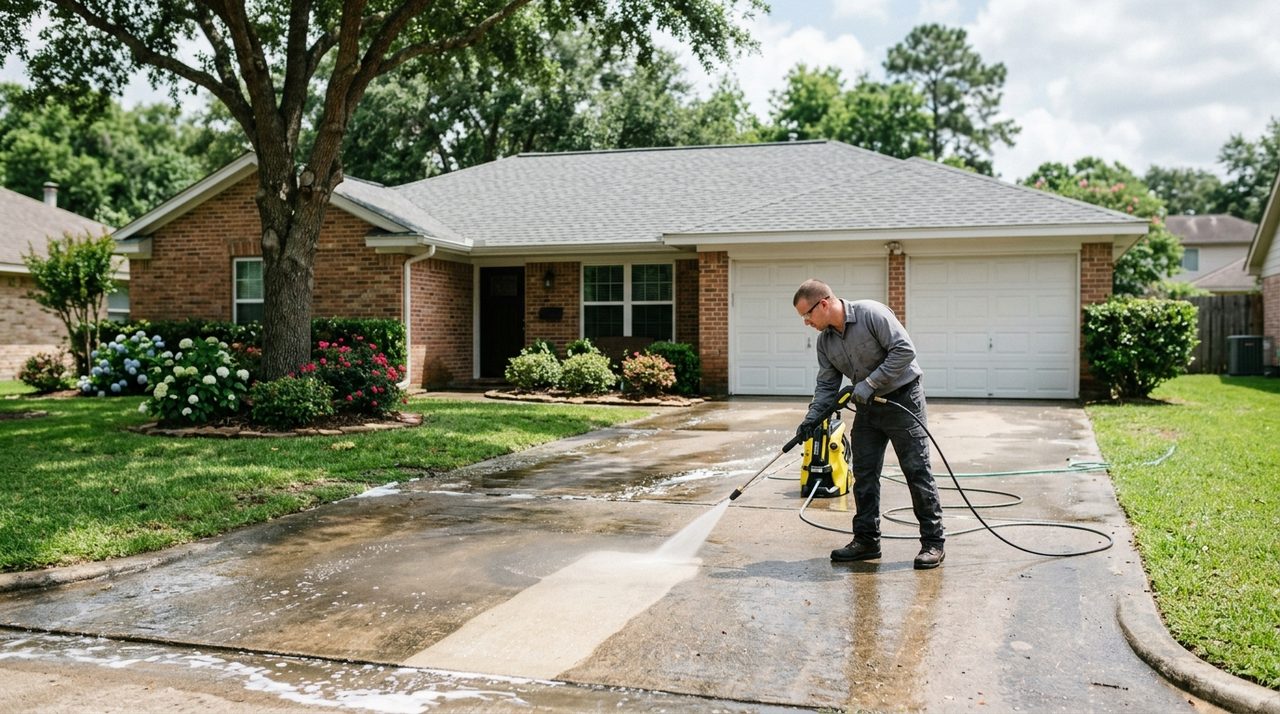
Many of the original concrete driveways in Acres Homes's 1950s–1970s housing stock are now 40–60 years old and were never sealed. Winter Storm Uri's 2021 freeze-thaw cycle accelerated surface spalling on these slabs, opening micro-pores that now absorb vehicle oil and baked-on oxidation under Houston's summer UV with no resistance. At an estimated median home value of $189,084, replacement is often not cost-effective, making chemical treatment the practical first step before deciding whether a slab section needs patching.
What a good pro does
Hot-water pressure washing (water temperature above 180°F) combined with a commercial degreaser pre-soak is the minimum effective approach for oil-contaminated porous concrete — cold water alone emulsifies surface oil but does not lift what has penetrated. After cleaning, the homeowner should budget a penetrating concrete sealer to reduce future absorption. The operator must follow TCEQ stormwater rules: degreasers cannot be washed into the street-level storm drain; containment mats or a wet-vac recovery system is required before rinsing into the gutter.
Sources: Texas Commission on Environmental Quality, International Residential Code (as adopted by City of Houston)
Hiring pressure washing in Acres Homes? Acres Homes presents a uniquely diverse housing stock ranging from mid-century pier-and-beam cottages to post-2015 slab-on-grade infill homes, often on the same block. Most of the area has no mandatory HOA or formal deed restrictions, giving homeowners wide latitude on repairs and renovations but also creating a patchwork of building conditions. Contractors working here must be comfortable with both legacy wood-frame structural repairs and modern systems found in newer affordable construction.
Building era
1950s–1970s (legacy stock) with significant post-2015 infill construction; secondary wave from 1990s–2000s.
Typical style
Older homes are one-story wood-frame cottages, bungalows, and modest ranch-style houses; newer infill is contemporary traditional single-family with Hardie siding or brick-and-Hardie exteriors.
Foundations
Mixed — older homes are commonly pier-and-beam; newer infill construction is predominantly concrete slab-on-grade.
Common systems
Older homes often have galvanized or cast-iron plumbing, older electrical panels (60–100 amp), and window-unit or aging central HVAC systems. Newer infill homes typically have PEX or CPVC plumbing, 200-amp electrical panels, and modern split-system HVAC with SEER 14+ ratings.
What that means for repairs
Extensive infill and revitalization activity driven by the City of Houston's New Home Development Program (NHDP) and private developers replacing or renovating aging frame houses. Common renovation work includes pier-and-beam leveling, plumbing repipes on older homes, electrical panel upgrades, and full gut-rehabs of mid-century cottages.
Permit jurisdiction
City of Houston — Houston Permitting Center (Acres Homes is within Houston city limits).
HOA & deed restrictions
No mandatory master HOA for most of Acres Homes. Voluntary civic clubs and community organizations exist (e.g., Acres Home Super Neighborhood #6) but do not impose dues or design controls. Some newer small infill plats may carry private deed restrictions governing minimum square footage and use, but these vary lot by lot.
Historic districts
No City of Houston historic district designation confirmed.
Contractor note
With no overarching HOA design review, contractors typically need only City of Houston permits. However, some newer infill plats may have private deed restrictions with architectural standards — confirm with the property owner and check Harris County Clerk records before beginning exterior work.
FEMA flood zone
FEMA Zone X (low flood risk) per official NFHL data. However, portions of Acres Homes adjacent to Vogel Creek and its tributary channels fall within 100-year and 500-year floodplains per Harris County Flood Control District mapping. Flood risk varies significantly by proximity to these waterways and local low points along drainage ditches.
Hurricane Harvey impact
Acres Homes experienced structural flooding during Hurricane Harvey (2017), but it was not among the highest-profile disaster zones like Meyerland or Greenspoint. Areas near Vogel Creek and low-lying drainage channels were most affected. The exact extent of damage is not clearly quantified in public summaries. Harris County Flood Control District has undertaken channel improvement and detention projects along Vogel Creek in this area, indicating recognized recurring drainage issues.
Heat & humidity load
Older pier-and-beam cottages with aging HVAC systems and limited insulation are especially vulnerable to Houston's extreme summer heat and humidity. Condensation under pier-and-beam homes can accelerate subfloor rot and encourage mold growth. Newer slab-on-grade infill homes perform better thermally but still demand regular HVAC maintenance during peak cooling season.
Working with contractors here
The most common contractor work in Acres Homes includes foundation leveling and pier-and-beam repair on mid-century frame houses, full plumbing repipes replacing galvanized lines, and electrical panel upgrades from 60-amp to 200-amp service. The active infill development market also generates steady demand for new construction trades, demolition, and site prep. Because housing stock varies dramatically from block to block — a 1950s cottage may sit next to a 2020 build — contractors must scope each job individually and cannot assume uniform conditions. Drainage and grading work is important near Vogel Creek tributaries, and properties in low-lying areas may need additional moisture mitigation measures.
Local Tip
Always ask for a written estimate before work begins. Texas contractors are required to provide one on jobs over $1,000.
Acres Homes presents a uniquely diverse housing stock ranging from mid-century pier-and-beam cottages to post-2015 slab-on-grade infill homes, often on the same block. Most of the area has no mandatory HOA or formal deed restrictions, giving homeowners wide latitude on repairs and renovations but also creating a patchwork of building conditions. Contractors working here must be comfortable with both legacy wood-frame structural repairs and modern systems found in newer affordable construction.
Source: U.S. Census Bureau, ACS 5-Year 2023
Most of Acres Homes maps to FEMA Zone X (low mapped flood risk), but Houston's flash-flood reality means even low-risk blocks benefit from smart drainage and storm-hardened installs.
Source: FEMA National Flood Hazard Layer (NFHL). Flood zones vary by parcel — verify your individual FIRM panel.
Sources: City of Houston Permitting CenterTexas Commission on Environmental Quality
Sources: Local HOA / deed restrictions (see area profile)
Sources: FEMA National Flood Hazard Layer (NFHL)Texas Commission on Environmental Quality