Closed
Serving Garden Oaks Based in Lazybrook / Timbergrove · 0.3 mi away
Garden Oaks is a neighborhood of two eras on the same block: 1930s–1950s Craftsman bungalows with wood siding, pier-and-beam foundations, and mature live oaks casting near-constant shade, sitting beside contemporary custom rebuilds with stucco, concrete driveways, and fresh cedar fencing. That split housing stock creates two entirely different pressure-washing problems — aged wood surfaces that splinter under excess pressure, and newer concrete and composite materials already accumulating black algae in Houston's 75%-plus average humidity. Understanding which era you're dealing with, and what the Garden Oaks Civic Club's deed restrictions permit on exterior finishes, is the starting point for any exterior cleaning job here.
Ranked by verified Google rating × review volume × verification tier. How we rank →
Some highly-rated pros serve Garden Oaks from nearby and may not keep a Garden Oaks street address. Those are listed under "Also serving Garden Oaks" with their real city and distance, so you always know where each business is based.
Highly-rated pros based nearby who cover Garden Oaks. Distance shown from the Garden Oaks area.
Serving Garden Oaks Based in Lazybrook / Timbergrove · 0.3 mi away
Serving Garden Oaks Based in Independence Heights · 2.1 mi away
Serving Garden Oaks Based in Lazybrook / Timbergrove · 2.5 mi away
Serving Garden Oaks Based in Acres Homes · 2.9 mi away
Serving Garden Oaks Based in Lazybrook / Timbergrove · 3.4 mi away
Serving Garden Oaks Based in Brookhollow · 3.6 mi away
Serving Garden Oaks Based in Brookhollow · 3.7 mi away
Serving Garden Oaks Based in Lazybrook / Timbergrove · 3.7 mi away
Serving Garden Oaks Based in Lazybrook / Timbergrove · 3.8 mi away
Serving Garden Oaks Based in Brookhollow · 3.9 mi away
Why it matters to you
Garden Oaks's original bungalows sit beneath a dense canopy of mature live oaks and pecans that keeps siding, painted brick, and porch ceilings damp for days after rain. Houston's annual humidity averaging above 75% means Gloeocapsa magma black algae and green mold routinely colonize these surfaces within 6–12 months of cleaning, staining wood siding and the soft mortar joints common on 1930s-era brick in ways that simple rinsing cannot reverse. On a cottage that the Garden Oaks Civic Club's deed restrictions already scrutinize for exterior appearance, visible biological staining is both an aesthetic and compliance concern.
What a good pro does
A qualified soft-wash operator uses low-pressure (under 500 PSI on wood, under 800 PSI on painted brick) delivery of a sodium hypochlorite-based biocide solution to kill the organism at its root rather than just blast surface discoloration. Post-wash application of a mildewcide or zinc-based treatment extends the clean window to 18–24 months on shaded surfaces. No City of Houston permit is required for residential soft-washing, but the wash operator should confirm the proposed cleaning agent does not conflict with any civic club deed restriction language on exterior chemical treatments before starting.
Sources: Local HOA / deed restrictions (see area profile), City of Houston Permitting Center
Why it matters to you
The post-2000s wave of contemporary custom builds in Garden Oaks almost universally went up with cedar or pine privacy fencing around large lots — and Houston's combination of 100°F-plus summers, frequent heavy rain, and high termite pressure causes untreated pine to gray, crack, and develop surface mold within 12–18 months. Homeowners on these infill lots who want to restain or reseal a fence must pressure-wash first, but over-pressure above 1,200 PSI on weathered pine splinters the grain and opens pathways for moisture infiltration, accelerating the very decay they're trying to prevent. The mix of old and new construction on the same Garden Oaks street means a contractor who calibrates for one era's surfaces may cause damage on the other.
What a good pro does
A competent fence-washing pro will walk the fence line first, testing board hardness in several spots before selecting a tip and pressure setting — typically 800–1,100 PSI with a 25- to 40-degree fan tip on weathered pine. Chemical pre-treatment with a wood brightener loosens biological staining without requiring pressure high enough to damage grain. Estimates for fence washing in the Houston metro run approximately $0.35–$0.65 per linear foot, and larger Garden Oaks lots with 200-plus linear feet of fencing should factor that range into project budgets.
Sources: Local HOA / deed restrictions (see area profile)
Why it matters to you
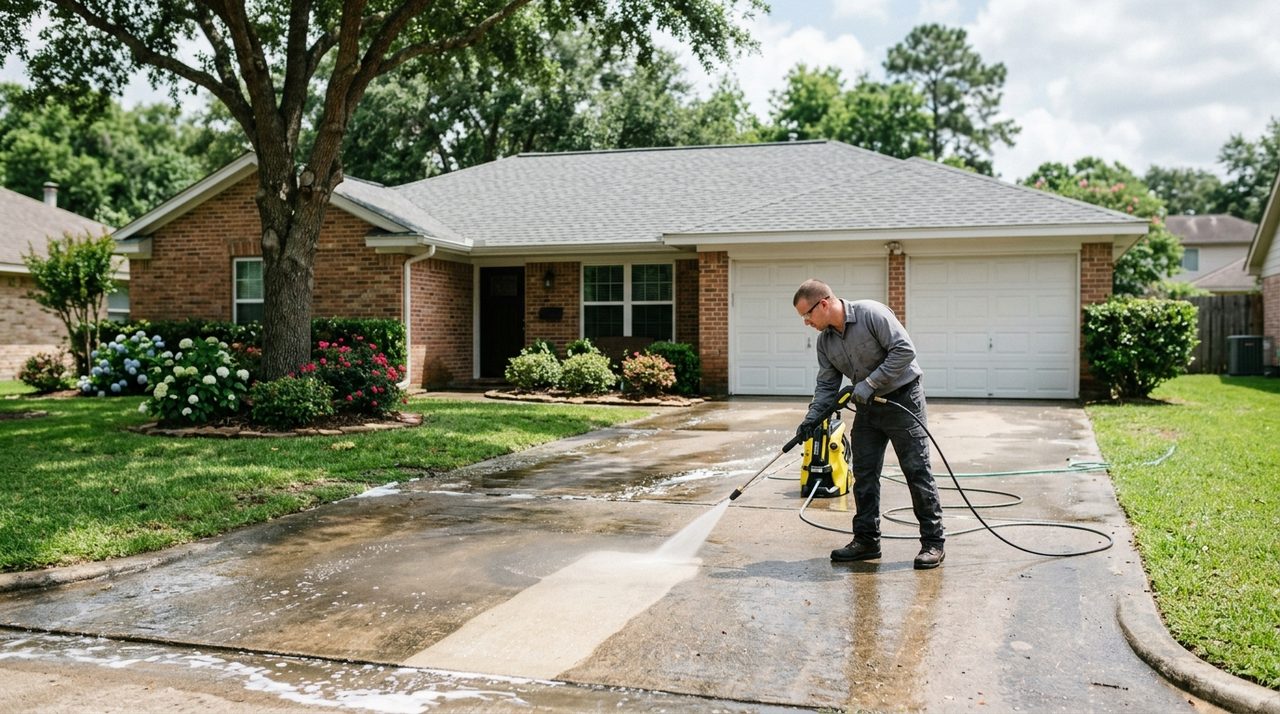
On Garden Oaks's original bungalows, the foundation is most likely pier-and-beam rather than a continuous concrete slab, meaning the driveways and sidewalks poured in the 1940s–1960s are narrow, thin-section, and have been accumulating decades of oil drip, tire rubber, and mineral salt deposits through porous aged concrete. Winter Storm Uri's 2021 freeze-thaw cycles accelerated surface spalling on many of these driveways, opening more pores for oils and clay-borne mineral salts to penetrate. Standard cold-water rinsing cannot lift baked-in oil from concrete that has been absorbing it for 60-plus years.
What a good pro does
Effective treatment on aged Garden Oaks driveways requires a hot-water pressure washer (180°F-plus) combined with a degreasing pre-soak timed to dwell 10–15 minutes before rinsing — plan for a 20–40% cost premium over standard cold-water jobs, pushing a 400–600 sq ft driveway job toward the $200–$450 estimated range. Operators must not allow degreaser runoff to enter City of Houston storm drains, which discharge directly to bayous; TCEQ and city ordinance both prohibit detergent-laden wastewater from reaching the storm system, so berms or wet-vac containment are standard practice on driveway degreasing jobs near curb inlets.
Sources: Texas Commission on Environmental Quality, City of Houston Permitting Center
Why it matters to you
The Garden Oaks Civic Club and the Garden Oaks Maintenance Organization enforce deed restrictions that govern exterior materials and modifications — and while those restrictions are primarily aimed at structural changes, homeowners undertaking comprehensive exterior cleaning on a 1940s bungalow as part of a pre-sale renovation or re-staining project should confirm that the proposed chemical treatments and any resulting finish changes (bleaching of wood, alteration of brick color) are consistent with what the civic club expects. Three registered mandatory HOAs also operate within Garden Oaks boundaries per Texas Real Estate Commission filings, and their covenants may have additional or distinct appearance standards. A 30-day cure notice from a civic club is a real complication for a homeowner who already scheduled a painting crew to follow the wash.
What a good pro does
Before booking a full exterior soft-wash plus fence-wash package, pull the deed restrictions for your specific section of Garden Oaks and confirm there are no material-specific clauses; the Garden Oaks Civic Club is reachable directly and deed restriction documents are recordable with Harris County. For the pressure-washing contractor, no City of Houston permit is required for the washing work itself, but the contractor should carry general liability insurance and be prepared to document that wash chemicals will not permanently alter the surface appearance in ways that trigger a deed-restriction complaint.
Sources: Local HOA / deed restrictions (see area profile), City of Houston Permitting Center
Hiring pressure washing in Garden Oaks? Garden Oaks presents a split housing stock of original 1930s–1950s bungalows and modern custom homes, creating two distinct home-service profiles on the same streets. Deed restrictions enforced by the Garden Oaks Civic Club govern exterior modifications, so contractors should verify compliance before starting work. The neighborhood sits in FEMA Zone X with low flood risk, but aging plumbing and electrical in vintage homes drive steady renovation demand.
Building era
1930s–1950s (original stock), with significant contemporary infill from 2000s–present.
Typical style
Craftsman-style bungalows and cottages (original); contemporary and transitional custom builds (newer).
Foundations
Not confirmed from available sources — likely mixed pier-and-beam (older bungalows) and slab-on-grade (newer construction). Verify on a per-property basis.
Common systems
Original homes may have galvanized or cast-iron drain lines, older copper supply lines, 60–100 amp electrical panels, and aging forced-air or window-unit HVAC. Newer builds typically have PEX plumbing, 200-amp panels, and modern high-efficiency HVAC systems.
What that means for repairs
Teardown-and-rebuild activity is very common due to the large lot sizes and high land values. Older bungalows undergo kitchen and bath remodels, electrical panel upgrades, and re-plumbing. Foundation repair on pier-and-beam vintage homes is a recurring need.
Permit jurisdiction
City of Houston — Houston Permitting Center (HPW).
HOA & deed restrictions
Most of Garden Oaks operates under the Garden Oaks Civic Club / Garden Oaks Maintenance Organization (GOMO), which enforces deed restrictions but does not charge a mandatory annual HOA fee. Section 4 specifically has no transfer fee. However, three mandatory HOAs are registered in the Garden Oaks area per Texas Real Estate Commission filings — exact names and boundaries not confirmed.
Historic districts
No City of Houston historic district designation confirmed. No references to HAHC review or Certificates of Appropriateness were found for Garden Oaks, though a formal city historic-district list was not available in research — verify with Houston Planning & Development if exterior changes are planned.
Contractor note
Deed restrictions enforced by the civic club may regulate exterior materials, setbacks, and accessory structures. Contractors should review the applicable section's deed restrictions before beginning exterior work, and confirm whether the specific property falls under one of the three registered mandatory HOAs.
FEMA flood zone
FEMA Zone X (low flood risk) per official NFHL data. Garden Oaks is not immediately adjacent to a major bayou, though Little White Oak Bayou runs to the neighborhood's general south/southeast.
Hurricane Harvey impact
No source in the available research directly addresses Hurricane Harvey flooding specific to Garden Oaks. No quantified damage figures, flooded-street lists, or recurring flood problem areas were identified. Not confirmed — check Harris County Flood Control District records and FEMA claims data for property-level Harvey impact.
Heat & humidity load
Original 1930s bungalows with limited insulation and older HVAC systems face heavy cooling loads during Houston summers, driving frequent AC repair and duct-sealing calls. Mature tree canopy helps shade but produces debris that clogs gutters and stresses roofing. Newer builds with modern insulation and high-efficiency systems fare better but still demand annual HVAC maintenance.
Working with contractors here
Garden Oaks generates two parallel workstreams: full teardown-and-rebuild projects replacing aging bungalows with contemporary custom homes, and deep renovations of vintage 1930s–1950s cottages. Older homes frequently need foundation leveling on pier-and-beam systems, full re-plumbing to replace galvanized lines, and electrical panel upgrades from 60-amp to 200-amp service. The civic club's deed restriction enforcement means exterior remodels — roofing material changes, fence styles, and additions — should be reviewed for compliance before permitting. Large lot sizes and mature landscaping often complicate equipment access and staging, so job scoping should account for tree protection and limited driveway widths on older properties.
Local Tip
Always ask for a written estimate before work begins. Texas contractors are required to provide one on jobs over $1,000.
Garden Oaks presents a split housing stock of original 1930s–1950s bungalows and modern custom homes, creating two distinct home-service profiles on the same streets. Deed restrictions enforced by the Garden Oaks Civic Club govern exterior modifications, so contractors should verify compliance before starting work. The neighborhood sits in FEMA Zone X with low flood risk, but aging plumbing and electrical in vintage homes drive steady renovation demand.
Source: U.S. Census Bureau, ACS 5-Year 2023
Most of Garden Oaks maps to FEMA Zone X (low mapped flood risk), but Houston's flash-flood reality means even low-risk blocks benefit from smart drainage and storm-hardened installs.
Source: FEMA National Flood Hazard Layer (NFHL). Flood zones vary by parcel — verify your individual FIRM panel.
Sources: City of Houston Permitting Center
Sources: Local HOA / deed restrictions (see area profile)
Sources: Texas Commission on Environmental QualityFEMA National Flood Hazard Layer (NFHL)