Open Now
301 Bennington St, Houston, TX 77022
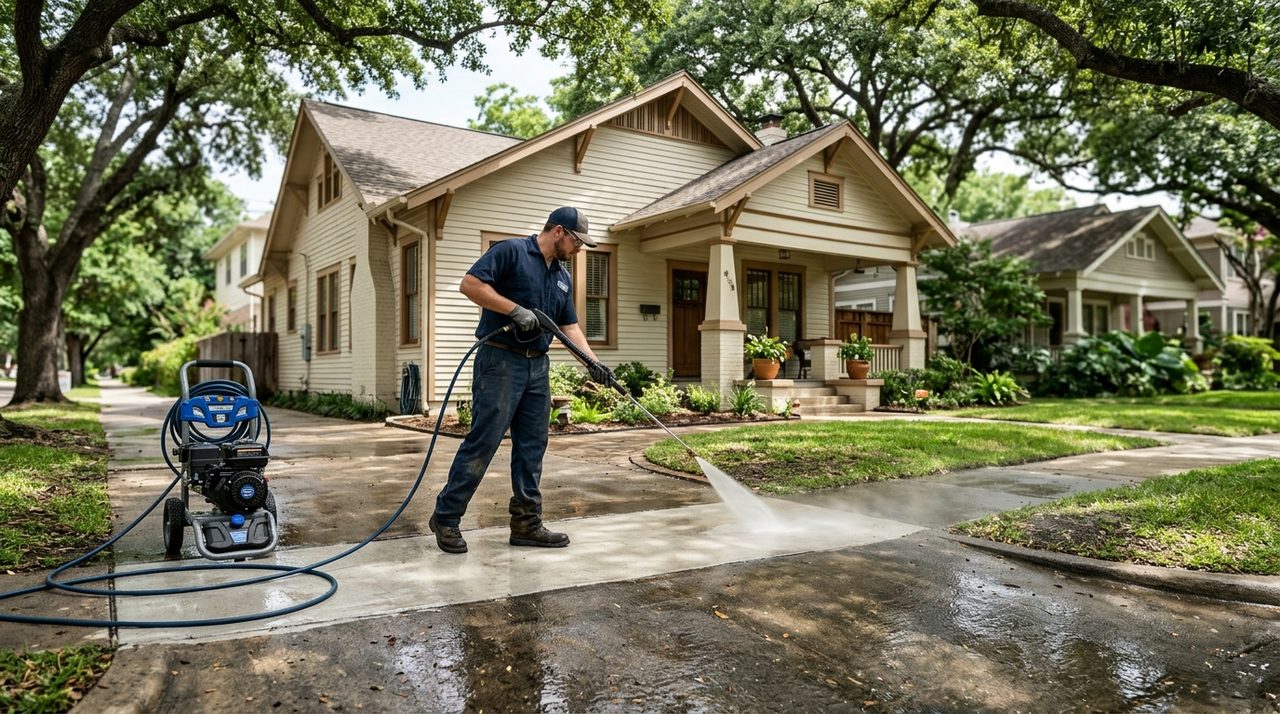
Independence Heights's century-plus of construction layers — 1910s Craftsman bungalows, 1950s ranch homes, and 2020s infill townhomes — means virtually every exterior surface material and condition appears on the same block, and Houston's 75%-plus average annual humidity keeps mold, algae, and clay-mineral staining active on all of them year-round. Sitting in FEMA Zone X500, the neighborhood sees enough heavy-rain infiltration that flood-line mud staining and organic buildup on low-course brick and wood siding are recurring realities, not one-time events. This page focuses on what pressure-washing work in Independence Heights actually looks like across that mixed housing stock and what homeowners should ask before anyone picks up a wand.
Ranked by verified Google rating × review volume × verification tier. How we rank →
Some highly-rated pros serve Independence Heights from nearby and may not keep a Independence Heights street address. Those are listed under "Also serving Independence Heights" with their real city and distance, so you always know where each business is based.
301 Bennington St, Houston, TX 77022
Highly-rated pros based nearby who cover Independence Heights. Distance shown from the Independence Heights area.
Serving Independence Heights Based in Lazybrook / Timbergrove · 0.9 mi away
Serving Independence Heights Based in Lazybrook / Timbergrove · 2.9 mi away
Serving Independence Heights Based in Lazybrook / Timbergrove · 3.1 mi away
Serving Independence Heights Based in Lazybrook / Timbergrove · 3.3 mi away
Serving Independence Heights Based in Lazybrook / Timbergrove · 3.3 mi away
Serving Independence Heights Based in Lazybrook / Timbergrove · 3.7 mi away
Serving Independence Heights Based in Lazybrook / Timbergrove · 3.7 mi away
Serving Independence Heights Based in Acres Homes · 3.7 mi away
Serving Independence Heights Based in Brookhollow · 4.1 mi away
Why it matters to you
Independence Heights's 1910s Craftsman bungalows and 1950s ranch homes were built with wood clapboard siding and exposed brick that has absorbed decades of Houston's 60-plus inches of annual rainfall. North-facing walls and any surface shaded by the mature tree canopy common to original platted lots in the 77018 ZIP stay damp long enough for Gloeocapsa magma black algae and green mold to establish colonies within a single humid season. Once rooted in aged, unsealed wood or soft historic brick mortar, these organisms require more than a rinse — they return within six to twelve months without a post-treatment biocide.
What a good pro does
A qualified operator in Independence Heights will differentiate between the soft-wash chemical application appropriate for 100-year-old wood siding (low pressure, 100 PSI or below, sodium hypochlorite-based solution) and the moderate pressure acceptable on mid-century brick. After cleaning, application of an algaecide or mildewcide formulated for porous masonry extends the clean dramatically. Texas does not license pressure washing as a standalone trade, but operators applying algaecide products at concentrations that classify them as pesticides under Texas Department of Agriculture rules should carry a TDA pesticide applicator credential — ask to see it before work begins.
Why it matters to you
While the neighborhood's pre-1960s housing stock sits on pier-and-beam foundations, the wave of 2000s–2020s infill townhomes and modern single-family homes is built slab-on-grade directly over Harris County's expansive Beaumont clay. That clay wicks mineral salts upward through fresh concrete flatwork, leaving white efflorescence deposits on driveway aprons and patio slabs — staining that looks like residue but is actually crystallized minerals pushed out by moisture movement beneath the slab. After heavy rains, red-clay mud also tracks in and bakes onto these light-colored poured surfaces under summer UV.
What a good pro does
Standard cold-water rinsing disperses the mud surface layer but does not dissolve efflorescence crystals or lift baked-in clay pigment from porous concrete. A properly equipped operator applies a dilute acid-based or alkaline detergent pre-treatment, allows appropriate dwell time, then pressure-washes at 2,500–3,000 PSI on sound concrete flatwork — substantially higher than wall surfaces but appropriate for driveway-grade concrete. For newer infill townhomes whose HOA-governed clusters have architectural covenants on driveway appearance, getting this right on the first visit matters because cure windows can run as short as 30 days.
Sources: Local HOA / deed restrictions (see area profile), FEMA National Flood Hazard Layer (NFHL)
Why it matters to you
Independence Heights carries FEMA Zone X500 status — outside the 100-year floodplain but inside the 500-year — which means major rain events like Harvey (2017) and Beryl (2024) still push water into street-level and yard-level surfaces and leave the characteristic 'bathtub ring' of mud and tannic debris on foundation-level brick, pier skirts, and stucco at the waterline height. On 1910s cottages and 1950s ranch homes where brick sits directly on grade with no raised foundation surround, that staining line is visible from the street and accumulates year over year if not chemically treated.
What a good pro does
Flood-line staining on aged brick requires a two-step approach: a trisodium phosphate (TSP) or oxygen-bleach solution applied to the stain to break down the organic tannin and clay mineral compounds, followed by low-to-moderate pressure washing (600–1,200 PSI on brick, lower on stucco) to clear the residue without eroding mortar joints in older masonry. Operators working near Independence Heights's storm-drain inlets — which feed directly into the bayou system — are required under TCEQ stormwater rules to prevent detergent-laden wash water from entering the storm drain; professional operators should use berms or vacuuming equipment to contain runoff on stained-surface jobs.
Sources: FEMA National Flood Hazard Layer (NFHL), Texas Commission on Environmental Quality
Why it matters to you
The 1950s–1960s ranch homes that make up a significant portion of Independence Heights's housing stock — median year built 1966 per Census data — have roofs that, if not recently replaced, may carry original or one-generation-old 3-tab or early architectural asphalt shingles already in the late phase of their service life. Houston humidity means black Gloeocapsa magma streaks appear on these roofs within two to three years of any cleaning, and the staining is visible enough that infill-cluster HOAs have cited it in appearance notices. But these aging shingles lose granules rapidly under any spray above 500 PSI, voiding manufacturer warranties and accelerating their deterioration.
What a good pro does
Roof cleaning on Independence Heights ranch homes must be delivered exclusively via soft-wash: a low-pressure (under 100 PSI at the surface) application of a sodium hypochlorite and surfactant solution that kills the algae organism chemically rather than blasting it off mechanically. The soft-wash rinse-down that follows uses roof-safe pressure, not a pressure washer in the conventional sense. Texas has no state license for pressure washing, but because the biocide solutions used in soft-wash may qualify as regulated pesticide products under TDA definitions, confirm the operator's applicator status before signing any contract for roof work specifically.
Sources: Local HOA / deed restrictions (see area profile), Texas Commission on Environmental Quality, City of Houston Permitting Center
Hiring pressure washing in Independence Heights? Independence Heights spans over a century of construction, from 1910s bungalows and 1950s ranch homes to 2020s contemporary townhomes. Homeowners here face a wide range of service needs driven by aging pier-and-beam foundations, outdated plumbing and electrical in mid-century homes, and newer infill properties with their own HOA requirements. The neighborhood's moderate flood risk and mixed housing stock make contractor experience with both historic rehabilitation and modern code compliance essential.
Building era
1910s–1920s (original platted lots), 1950s–1960s (major mid-century build-out, median year built 1958), 2000s–2020s (infill townhomes and new single-family).
Typical style
Craftsman bungalows and vernacular cottages (1910s–1920s), one-story ranch and minimal-traditional (1950s–1960s), contemporary two- and three-story townhomes and modern single-family (2000s–2020s).
Foundations
Mixed — pier-and-beam dominates pre-1960s housing; slab-on-grade common in newer infill construction.
Common systems
Older homes often have galvanized or cast-iron plumbing, outdated 60–100 amp electrical panels, and window-unit or older central HVAC. Mid-century homes typically have early central HVAC with ductwork in unconditioned spaces. Newer infill features modern PEX or CPVC plumbing, 200-amp panels, and high-efficiency HVAC systems.
What that means for repairs
Significant renovation activity driven by new infill development replacing or updating older lots. Historic bungalows and mid-century ranch homes are frequently gut-renovated with foundation repair, full re-plumbing, electrical panel upgrades, and HVAC modernization. Townhome clusters are also emerging on previously single-family lots.
Permit jurisdiction
Houston Permitting Center (City of Houston jurisdiction — neighborhood annexed in 1929).
HOA & deed restrictions
No single mandatory HOA for all of Independence Heights. The area operates under the City of Houston Super Neighborhood 13 council (voluntary civic/advocacy structure). Pocket developments and newer townhome clusters have their own mandatory HOAs, such as Independence Heights Homes Community Association, Inc. (registered POA in Harris County, ZIP 77018). Many legacy lots have no HOA.
Historic districts
No City of Houston historic district designation confirmed, despite the neighborhood's significant cultural history as an early 20th-century planned Black community (incorporated 1915, annexed by Houston 1929).
Contractor note
Contractors must navigate varying deed restrictions that are lot- and subdivision-specific rather than uniform across the neighborhood. New infill projects in HOA-governed clusters may have additional architectural review requirements beyond standard city permitting.
FEMA flood zone
FEMA Zone X500 (moderate flood risk) — source: fema_nfhl. The neighborhood sits just north of Loop 610 and west of I-45 in a lower-elevation area of Houston's near northside. No specific bayou or creek adjacency was confirmed in research, but the I-45 corridor location places it in a drainage-sensitive area.
Hurricane Harvey impact
Specific street-by-street Harvey flood data was not confirmed in available research. The neighborhood's near-northside, lower-elevation location along the I-45 corridor suggests it was likely affected by significant street and structural flooding during Harvey, consistent with broader news coverage of nearby areas. Homeowners should verify parcel-level flood history through Harris County Flood Control District records and FEMA repetitive loss databases.
Heat & humidity load
Older pier-and-beam homes with minimal insulation and aging HVAC systems face extreme summer stress, leading to high energy bills and frequent HVAC service calls. Pier-and-beam crawlspaces are vulnerable to moisture buildup and pest intrusion in Houston's humid summers. Newer infill townhomes with modern insulation and sealed envelopes perform better but may experience condensation issues at transitions between conditioned and unconditioned spaces.
Working with contractors here
Foundation repair is one of the most common service needs, particularly for pier-and-beam homes built in the 1910s–1960s that have experienced decades of Houston's expansive clay soil movement. Re-plumbing is frequently required in mid-century homes still running galvanized or cast-iron drain lines. Electrical panel upgrades from 60-amp to 200-amp service are common as homeowners modernize older homes or add square footage. The active infill market means general contractors regularly handle teardown-and-rebuild projects, often requiring lot-specific deed restriction review. Contractors should be prepared for wide variation in job scope — from historic cottage restoration on one lot to modern townhome punch-list work on the next.
Local Tip
Always ask for a written estimate before work begins. Texas contractors are required to provide one on jobs over $1,000.
Independence Heights spans over a century of construction, from 1910s bungalows and 1950s ranch homes to 2020s contemporary townhomes. Homeowners here face a wide range of service needs driven by aging pier-and-beam foundations, outdated plumbing and electrical in mid-century homes, and newer infill properties with their own HOA requirements. The neighborhood's moderate flood risk and mixed housing stock make contractor experience with both historic rehabilitation and modern code compliance essential.
Source: U.S. Census Bureau, ACS 5-Year 2023
Independence Heights carries FEMA Zone X500 (moderate flood risk): outside the 100-year floodplain but inside the 500-year, so heavy-rain events still reach homes and flood-aware work pays off.
Source: FEMA National Flood Hazard Layer (NFHL). Flood zones vary by parcel — verify your individual FIRM panel.
Sources: City of Houston Permitting Center
Sources: Local HOA / deed restrictions (see area profile)