Closed
Serving Montrose Based in Midtown · 1.3 mi away
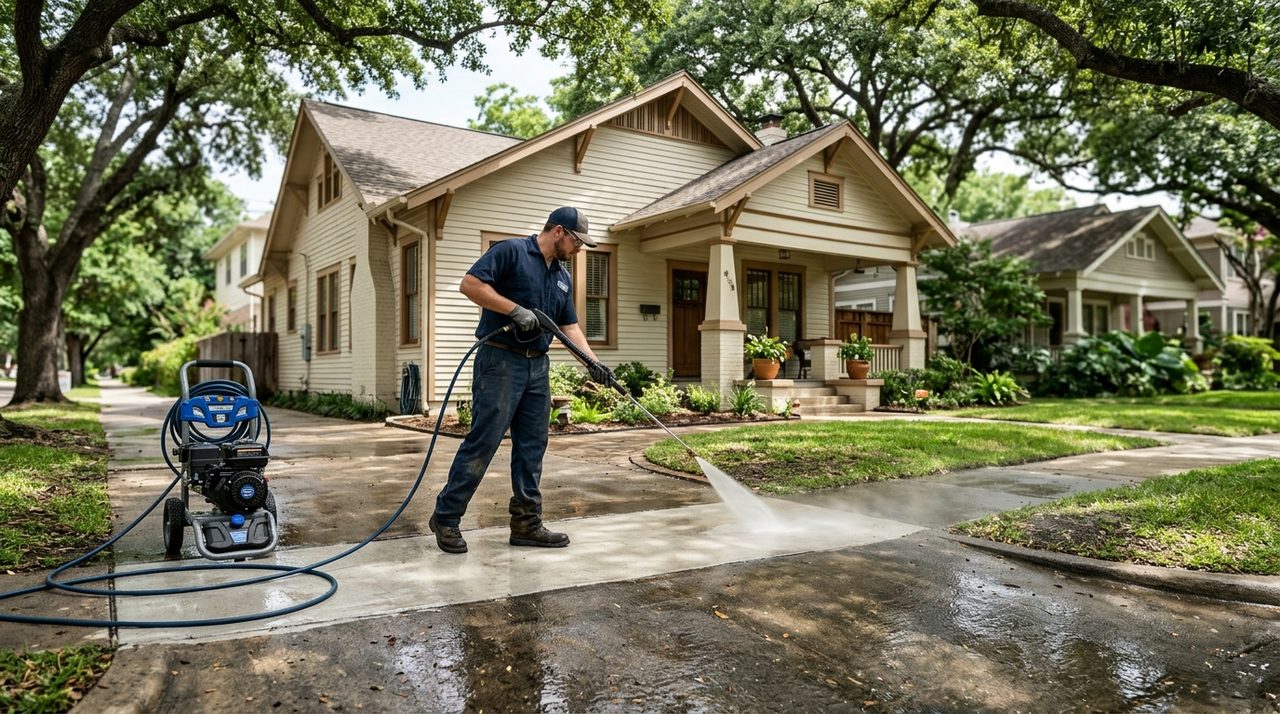
Montrose's housing stock spans a century of construction — from 1920s Craftsman bungalows with brick chimneys and aged wood siding to 2000s-era infill townhomes clad in cement-board and stucco — and each surface type demands a different pressure-washing approach to avoid irreversible damage. With a census median year built of 1996 masking the true age spread, and a patchwork of plat-level deed restrictions and potential Houston Archaeological and Historical Commission (HAHC) design-review obligations on exterior work, Montrose homeowners need more than a generic wash quote. This page covers the specific staining patterns, surface vulnerabilities, and regulatory realities that shape pressure-washing decisions block by block in this inner-loop neighborhood.
Ranked by verified Google rating × review volume × verification tier. How we rank →
Some highly-rated pros serve Montrose from nearby and may not keep a Montrose street address. Those are listed under "Also serving Montrose" with their real city and distance, so you always know where each business is based.
Highly-rated pros based nearby who cover Montrose. Distance shown from the Montrose area.
Serving Montrose Based in Midtown · 1.3 mi away
Serving Montrose Based in River Oaks · 1.4 mi away
Serving Montrose Based in Midtown · 1.5 mi away
Serving Montrose Based in Midtown · 1.6 mi away
Serving Montrose Based in Lazybrook / Timbergrove · 1.8 mi away
Serving Montrose Based in Upper Kirby · 1.8 mi away
Serving Montrose Based in Midtown · 2 mi away
Serving Montrose Based in West University · 2.1 mi away
Serving Montrose Based in Upper Kirby · 2.1 mi away
Serving Montrose Based in West University · 2.2 mi away
Why it matters to you
Montrose's oldest bungalows — many built between the 1920s and 1940s — sit under mature live oak and pecan canopy that keeps exterior surfaces in near-constant shade and moisture. Houston's annual average humidity above 75 percent means Gloeocapsa magma (black algae) and green mold colonize painted wood siding, mortar joints, and brick faces within a single season; on a pier-and-beam home where the first floor sits close to grade, that biological growth can reach sill plates and door frames. Without a post-wash biocide treatment, the same surfaces typically re-colonize within 6–12 months.
What a good pro does
A qualified operator will use a low-pressure soft-wash approach — typically under 500 PSI — with a sodium hypochlorite or quaternary-ammonium biocide solution on painted wood and historic brick rather than blasting with high pressure that strips paint or erodes mortar. Because Montrose properties in locally designated historic districts may fall under HAHC review for exterior alterations, the homeowner should confirm with the City of Houston Historic Preservation Office whether a proposed cleaning chemical or method constitutes a regulated exterior change before work begins. Texas does not require a state license for pressure washing itself, but operators applying algaecide products classified as pesticides may need a Texas Department of Agriculture (TDA) pesticide applicator credential.
Sources: City of Houston Permitting Center, Local HOA / deed restrictions (see area profile)
Why it matters to you
The wave of 2000s-to-present townhome infill that now lines many Montrose blocks introduced cement-board (HardiePlank) and synthetic stucco (EIFS) exteriors that are moisture-sensitive in ways that older brick bungalows are not. High-pressure washing above roughly 1,200 PSI can force water behind cement-board lap joints or into EIFS finish coats, seeding hidden mold in wall cavities — a particular concern in Houston's humid climate where trapped moisture does not dry quickly. Montrose's 34.9 percent owner-occupancy rate means a significant share of these townhomes are tenant-occupied and maintenance decisions may be delayed, allowing green mold streaks to become deeply embedded.
What a good pro does
On cement-board and EIFS surfaces, a competent pressure-washing pro adjusts to a wide-fan, low-pressure rinse — typically 600–900 PSI at the surface — combined with a pre-applied mildewcide dwell treatment rather than relying on mechanical force. The operator should inspect all penetrations (hose bibs, window flanges, dryer vents) before washing to confirm caulk seals are intact, because high humidity means any breach found after the fact will be colonized quickly. No municipal permit is required from the City of Houston Permitting Center for standard residential exterior washing, but work on any property within a locally designated Montrose historic district that involves chemical application to a character-defining facade material should be reviewed against HAHC guidelines.
Sources: City of Houston Permitting Center, International Residential Code (as adopted by City of Houston)
Why it matters to you
Newer slab-on-grade townhomes and mid-century infill in Montrose sit directly on Harris County's expansive Beaumont/Houston Black clay, which wicks mineral salts upward through concrete as moisture cycles with the seasons — depositing white efflorescence deposits and rust-tinged clay staining on driveways, rear patios, and foundation-level stucco bands. Winter Storm Uri in 2021 accelerated surface spalling on driveways across the inner loop, opening the pores that now trap oil, tire marks, and clay sediment. Standard cold-water rinsing will not lift baked-in mineral deposits or post-Uri spall staining; they require chemical pre-treatment.
What a good pro does
Effective treatment starts with a dilute muriatic or phosphoric acid pre-soak to dissolve efflorescence before any pressure is applied, followed by a hot-water or high-temperature pressure wash (180°F+ where equipment allows) for oil and tire staining. The operator must contain wash water containing acid or degreaser and prevent it from entering Houston's storm-drain system, which flows directly to local bayous — discharge of chemically treated wash water into storm drains violates TCEQ stormwater rules and, within Houston city limits, city ordinance. Driveway and walkway washing in Montrose runs roughly $150–$350 for up to 1,000 square feet as an estimate, with a 20–40 percent premium for chemical pre-treatment on heavily stained or spalled surfaces.
Sources: Texas Commission on Environmental Quality, City of Houston Permitting Center
Why it matters to you
Unlike Sugar Land or The Woodlands master-planned communities, Montrose has no single mandatory HOA issuing violation notices — but individual plat covenants recorded at the Harris County Clerk's office and condo-regime documents (such as those governing Montrose Place Townhomes Owners Association properties) do impose exterior maintenance obligations that can include keeping siding, driveways, and fences free of visible biological growth. For a neighbor-disputed or pre-sale cleaning, a homeowner who cannot produce evidence of routine exterior maintenance may face a deed-restriction enforcement action filed through district court, the mechanism available in the absence of a traditional HOA board.
What a good pro does
Before scheduling a wash, the homeowner should pull the recorded deed restrictions for their specific plat through the Harris County Clerk's real-property records to understand whether any appearance standards or approved-material restrictions apply — particularly relevant on historic Montrose lots where covenants may predate the modern construction era. For properties in condo regimes, check the association's CC&Rs for any prohibition on high-pressure washing on shared roof or facade surfaces, which mirrors the best-practice prohibition on high-PSI work on asphalt shingles anyway. The City of Houston Permitting Center does not require a permit for routine residential pressure washing, so regulatory complexity here is in private covenant law, not the municipal permit process.
Sources: Local HOA / deed restrictions (see area profile), City of Houston Permitting Center
Hiring pressure washing in Montrose? Montrose is one of Houston's most architecturally diverse inner-loop neighborhoods, with housing stock ranging from early-20th-century bungalows to modern townhomes and mid-rise condos. Homeowners and contractors must navigate a complex overlay of deed restrictions, possible historic district review, and varied foundation types that change block by block. The absence of a single mandatory HOA means individual plat covenants and city codes are the primary regulatory framework.
Building era
Mixed — ranging from 1920s–1940s original bungalows and cottages to 1970s–1980s apartment conversions and 2000s–present new-construction townhomes.
Typical style
Highly heterogeneous: Craftsman bungalows, mid-century ranch, Victorian-era homes, contemporary townhomes, and multi-family conversions coexist within the same blocks.
Foundations
Mixed — older homes are frequently pier-and-beam; newer townhomes and infill construction are typically slab-on-grade.
Common systems
Older pier-and-beam homes often have galvanized or cast-iron plumbing, outdated electrical panels, and window-unit or older central HVAC systems. Newer townhomes feature modern HVAC, PEX plumbing, and updated electrical. The wide era range means system conditions vary dramatically by property.
What that means for repairs
Renovation activity is extremely common due to the prevalence of aging bungalows on high-value lots. Whole-home gut renovations, kitchen and bath modernizations, and foundation leveling on pier-and-beam structures are frequent. New-construction townhome infill on subdivided lots is also a major activity driver.
Permit jurisdiction
City of Houston Permitting Center (Montrose is within Houston city limits).
HOA & deed restrictions
No single mandatory HOA governs all of Montrose. Specific sub-areas and condo regimes (e.g., Montrose Place Townhomes Owners Association, Montrose Place Homeowners Association) have mandatory membership. Deed restrictions are common and vary by plat — buyers and contractors should review recorded covenants at the Harris County Clerk's office.
Historic districts
Parts of Montrose fall within City of Houston locally designated historic districts, requiring HAHC design review and approval for exterior changes, demolitions, and new construction. Specific district names not confirmed in available research — check the City of Houston Historic Preservation Office for parcel-level status.
Contractor note
Contractors must verify whether a property sits within a locally designated historic district before beginning exterior work or demolition, as HAHC approval may be required. Additionally, individual deed restrictions may impose setback, height, or use limitations that differ from adjacent properties on the same street.
FEMA flood zone
FEMA Zone X (low flood risk) per official NFHL data. However, Montrose's proximity to Buffalo Bayou and various drainage channels means flood risk can vary sharply by block and lot elevation. Property-level flood zone verification is strongly recommended.
Hurricane Harvey impact
Neighborhood-wide Harvey flood impact could not be confirmed from available research. Montrose is an inner-loop area where flooding during Harvey varied significantly by block and proximity to bayous and drainage infrastructure. Homeowners should check individual property flood history through Harris County Flood Control District records and FEMA claim databases.
Heat & humidity load
Older pier-and-beam homes in Montrose are prone to moisture intrusion, subfloor mildew, and HVAC strain during Houston's extreme summer humidity. Aging galvanized plumbing in pre-war homes is susceptible to condensation-related corrosion. Modern townhomes with tight building envelopes benefit from efficient HVAC but may require dehumidification support.
Working with contractors here
Montrose's extreme housing diversity means contractors encounter everything from 1920s pier-and-beam bungalow foundation repair to cutting-edge townhome warranty work. Plumbing repiping is common in pre-war homes still running galvanized or cast-iron lines. Electrical panel upgrades are frequently needed in older homes not designed for modern load demands. Historic district properties require HAHC coordination, which can add weeks to project timelines for exterior work. Contractors should always pull deed restrictions before scoping additions or accessory structures, as setback and height limits vary from lot to lot even on the same block.
Local Tip
Always ask for a written estimate before work begins. Texas contractors are required to provide one on jobs over $1,000.
Montrose is one of Houston's most architecturally diverse inner-loop neighborhoods, with housing stock ranging from early-20th-century bungalows to modern townhomes and mid-rise condos. Homeowners and contractors must navigate a complex overlay of deed restrictions, possible historic district review, and varied foundation types that change block by block. The absence of a single mandatory HOA means individual plat covenants and city codes are the primary regulatory framework.
Source: U.S. Census Bureau, ACS 5-Year 2023
Most of Montrose maps to FEMA Zone X (low mapped flood risk), but Houston's flash-flood reality means even low-risk blocks benefit from smart drainage and storm-hardened installs.
Source: FEMA National Flood Hazard Layer (NFHL). Flood zones vary by parcel — verify your individual FIRM panel.
Sources: City of Houston Permitting Center
Sources: Local HOA / deed restrictions (see area profile)
Sources: Texas Commission on Environmental QualityFEMA National Flood Hazard Layer (NFHL)
Sources: City of Houston Permitting Center