Closed
6110 W 34th St, Houston, TX 77092
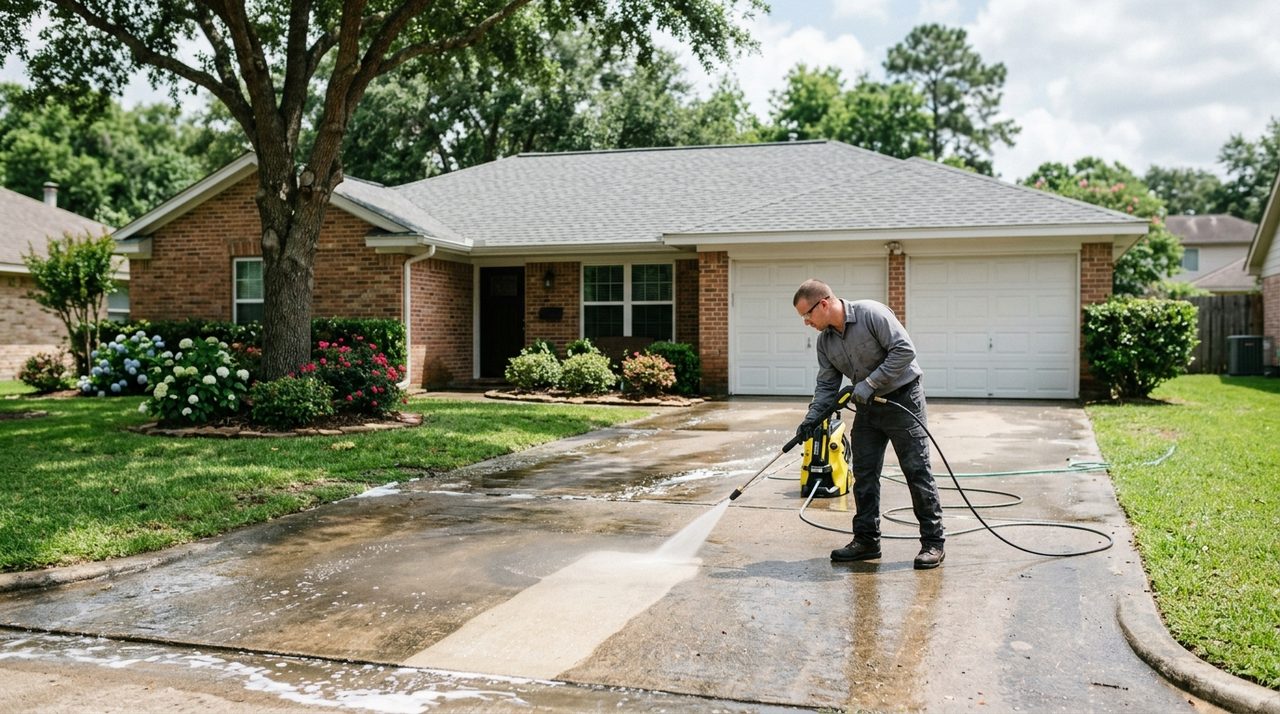
Brookhollow's 1960s–1980s ranch homes along the US-290 corridor sit on concrete slab-on-grade over Houston's expansive Beaumont clay, which wicks mineral salts upward through aging driveways and brick facades while the area's high humidity sustains near-constant mold and algae growth on every porous exterior surface. With a median year built of 1975, most homes here have original concrete flatwork that has absorbed decades of vehicle oil and clay-red staining — and with no confirmed active HOA enforcement to force the issue, deferred exterior cleaning tends to compound until the damage is deeply embedded. This page explains the three pressure-washing challenges that matter most for mid-century Brookhollow homes and what a well-equipped local operator actually does to address them.
Ranked by verified Google rating × review volume × verification tier. How we rank →
Some highly-rated pros serve Brookhollow from nearby and may not keep a Brookhollow street address. Those are listed under "Also serving Brookhollow" with their real city and distance, so you always know where each business is based.
6110 W 34th St, Houston, TX 77092
4934 Acorn St unit B, Houston, TX 77092
7025 W Tidwell Rd suite h111, Houston, TX 77092
10200 Hempstead Rd Suite 2E, Houston, TX 77092
11500 Northwest Fwy Suite 345, Houston, TX 77092
Highly-rated pros based nearby who cover Brookhollow. Distance shown from the Brookhollow area.
Serving Brookhollow Based in Lazybrook / Timbergrove · 0.7 mi away
Serving Brookhollow Based in Lazybrook / Timbergrove · 1.5 mi away
Serving Brookhollow Based in Spring Branch · 2.2 mi away
Serving Brookhollow Based in Acres Homes · 2.6 mi away
Serving Brookhollow Based in Lazybrook / Timbergrove · 3.4 mi away
Why it matters to you
Brookhollow homes poured their slabs directly over Houston Black clay in the 1960s through 1980s, and after 40–60 years of Houston's wet-dry moisture cycles, that clay is actively wicking mineral salts up through driveway and patio concrete — depositing chalky white efflorescence and rust-red mud staining that a garden hose or standard cold-water rinse cannot lift. Winter Storm Uri's 2021 freeze-thaw cycle accelerated surface spalling on the oldest slabs in the neighborhood, opening new pores that trap staining even faster. Left untreated, efflorescence signals ongoing moisture migration that eventually undermines surface sealers and contributes to the foundation monitoring already common in this housing stock.
What a good pro does
A capable operator will apply a diluted acid pre-treatment (typically muriatic or phosphoric acid solution) to neutralize the mineral deposits before pressure washing, then follow with hot-water equipment — not cold — at 2,500–3,500 PSI on the concrete flatwork to clear embedded oil from decades of vehicle use. Because Brookhollow falls under City of Houston permitting jurisdiction, the operator must also contain and properly dispose of any chemically treated wash water rather than letting it sheet into the street and storm drain, in compliance with TCEQ stormwater rules. No municipal permit is required for the wash job itself, but chemical-runoff compliance is a legal obligation, not optional.
Sources: Texas Commission on Environmental Quality, City of Houston Permitting Center
Why it matters to you
Houston's average annual humidity exceeds 75%, and Brookhollow's ranch-style homes — many with mature live oak or pine canopy planted when the subdivision was new in the 1970s — sit under shade conditions that keep siding, brick mortar joints, and fascia boards damp enough to sustain black algae (Gloeocapsa magma) and green mildew year-round. At a census median home value of roughly $222,800, these are working-equity assets where unchecked biological staining accelerates mortar joint deterioration on older brick and discolors wood trim that would cost significantly more to replace than to clean. Without a post-treatment biocide, the same surfaces typically re-green within six to twelve months.
What a good pro does
The correct approach on 1960s–1980s brick is a low-pressure soft-wash — typically 100–500 PSI — using a sodium hypochlorite-based algaecide solution that kills the organism at the root rather than simply blasting the surface discoloration off. Operators applying algaecide products at commercial concentrations should carry a Texas Department of Agriculture (TDA) pesticide applicator license if the product qualifies as a regulated pesticide under TDA rules. The City of Houston does not require a separate municipal permit for this exterior cleaning work, but homeowners should ask any operator specifically about their TDA compliance before work begins.
Sources: Texas Commission on Environmental Quality, City of Houston Permitting Center
Why it matters to you
The dominant roofing material on Brookhollow's original ranch homes is 3-tab or early architectural asphalt shingle, and given the neighborhood's 1975 median build year, a meaningful share of these roofs have seen at least one re-roof cycle with shingles now 15–25 years old and granule-depleted from Houston's intense UV summers. Black algae streaks from Gloeocapsa magma are visible from the street within two to three years of a clean roof in this humidity, but hitting those granule-thin shingles with high-pressure washing above 500 PSI strips the remaining protective granules and can void the manufacturer warranty on any relatively recent shingle replacement. Because Brookhollow's HOA landscape is unconfirmed, roof appearance enforcement pressure varies by block — but the physical damage from improper cleaning is the same regardless.
What a good pro does
Roof cleaning on these homes must be delivered as a true soft-wash: a low-pressure chemical application (sodium hypochlorite solution at appropriate dilution), allowed to dwell and kill the algae organism, then rinsed at no more than 100–200 PSI — essentially a strong garden-hose-level rinse. Estimates for a single-story Brookhollow home typically run $300–$600 for a roof soft-wash and are considered estimates that vary with pitch, access, and stain severity. Because no City of Houston permit is required for roof washing, the homeowner's main protection is verifying that the operator does not subcontract the job to someone using a high-pressure wand, and asking to see proof of general liability insurance before work starts.
Sources: City of Houston Permitting Center, Local HOA / deed restrictions (see area profile)
Why it matters to you
Brookhollow sits within the City of Houston's incorporated limits and drains through Harris County's extensive storm-sewer network, which flows directly to Cypress Creek, Buffalo Bayou, and ultimately Galveston Bay without treatment. When a pressure-washing operator uses chemical degreasers or biocide detergents on Brookhollow driveways — a common and often necessary step on 40–60-year-old oil-saturated concrete — that wash water cannot legally sheet into the curb inlet at the street's edge; TCEQ's Texas Pollutant Discharge Elimination System (TPDES) rules and City of Houston ordinance both prohibit detergent-laden wash water from entering the storm drain system. Homeowners who are unaware of this requirement sometimes hire the cheapest bidder, who runs wash water freely into the gutter, creating potential liability.
What a good pro does
A compliant operator working on a Brookhollow driveway uses a containment berm or wet vacuum system to capture chemically treated wash water, and either hauls it off-site to a sanitary sewer discharge point or uses only biodegradable, low-suds products with documented approval for storm-drain release — and even then should verify compliance with current TCEQ guidance. Homeowners should ask any prospective operator how they handle wash-water containment before signing a contract; a responsible answer is a green flag, and a blank stare is a red flag for a potential violation notice that TCEQ has issued to Houston-area wash operators in the past.
Sources: Texas Commission on Environmental Quality, City of Houston Permitting Center
Hiring pressure washing in Brookhollow? Brookhollow is a northwest Houston neighborhood along the US-290 corridor with housing stock generally dating to the 1960s–1980s. Homeowners here should expect maintenance patterns typical of aging slab-on-grade ranch homes, including HVAC system replacements, cast-iron drain line issues, and periodic foundation monitoring. The neighborhood falls within City of Houston permitting jurisdiction with no historic district restrictions limiting exterior modifications.
Building era
1960s–1980s (area-wide pattern; not confirmed for this specific subdivision).
Typical style
One- and two-story ranch, traditional brick, and contemporary traditional homes — based on area-wide NW Houston/US-290 corridor patterns.
Foundations
Concrete slab-on-grade (predominant for post-1960 NW Houston subdivisions; not independently confirmed for this specific neighborhood).
Common systems
Original homes likely have central A/C units nearing or past useful life, galvanized or cast-iron plumbing transitioning to PVC/PEX in renovated units, and older electrical panels (100–150 amp) that may need upgrading for modern loads.
What that means for repairs
Kitchen and bathroom remodels are common in homes of this era, along with re-piping from original galvanized or cast-iron lines, HVAC replacements, and foundation repair due to Houston's expansive clay soils.
Permit jurisdiction
City of Houston Permitting Center (neighborhood is within Houston city limits).
HOA & deed restrictions
Not confirmed — multiple 'Brookhollow' associations exist in Harris County (including Brookhollow Crossing Association, Inc. and Brookhollow Court HOA), but none could be reliably matched to the NW Houston Brookhollow area near US-290. Check Harris County Clerk records for recorded deed restrictions or management certificates tied to specific plat names.
Historic districts
No City of Houston historic district designation confirmed. Brookhollow does not appear on the HAHC list of designated historic districts, and no Certificate of Appropriateness is required for exterior work.
Contractor note
Contractors should verify lot-specific deed restrictions through Harris County Clerk records before planning exterior modifications, as HOA/POA governance for this specific Brookhollow area could not be confirmed. Standard City of Houston building permits apply.
FEMA flood zone
FEMA Zone X (low flood risk) — source: fema_nfhl. Specific bayou or creek proximity for this neighborhood could not be confirmed from available research; homeowners should verify drainage patterns at the parcel level using Harris County Flood Control District tools.
Hurricane Harvey impact
Harvey impact for the specific Brookhollow neighborhood near US-290 could not be confirmed from available sources. Harvey flood mapping in Harris County is organized by watershed rather than neighborhood name, and no news articles or HCFCD documents explicitly identified Brookhollow (NW Houston) for neighborhood-level Harvey inundation. The FEMA Zone X designation suggests lower overall flood risk, but parcel-level verification is recommended.
Heat & humidity load
Houston's extreme summer heat and humidity place heavy demand on aging HVAC systems common in 1960s–1980s homes. Slab-on-grade foundations in expansive clay soils may experience seasonal movement during drought-to-rain cycles, making foundation monitoring important. Attic insulation upgrades and proper roof ventilation are common service needs to manage cooling costs.
Working with contractors here
Contractors working in Brookhollow most commonly handle HVAC replacements, re-piping from original galvanized or cast-iron drain lines, and foundation repair — all driven by the aging mid-century housing stock typical of the US-290 corridor. Roof replacements on homes 30–50+ years old are frequent, and electrical panel upgrades are common as homeowners add modern loads. Because the HOA landscape is unclear, contractors should verify any exterior modification restrictions with the homeowner and Harris County deed records before scoping jobs. The City of Houston permitting process applies to all structural, electrical, plumbing, and mechanical work requiring permits.
Local Tip
Always ask for a written estimate before work begins. Texas contractors are required to provide one on jobs over $1,000.
Brookhollow is a northwest Houston neighborhood along the US-290 corridor with housing stock generally dating to the 1960s–1980s. Homeowners here should expect maintenance patterns typical of aging slab-on-grade ranch homes, including HVAC system replacements, cast-iron drain line issues, and periodic foundation monitoring. The neighborhood falls within City of Houston permitting jurisdiction with no historic district restrictions limiting exterior modifications.
Source: U.S. Census Bureau, ACS 5-Year 2023
Most of Brookhollow maps to FEMA Zone X (low mapped flood risk), but Houston's flash-flood reality means even low-risk blocks benefit from smart drainage and storm-hardened installs.
Source: FEMA National Flood Hazard Layer (NFHL). Flood zones vary by parcel — verify your individual FIRM panel.
Sources: City of Houston Permitting CenterTexas Commission on Environmental Quality
Sources: Local HOA / deed restrictions (see area profile)