Closed
2900 N Braeswood Blvd, Houston, TX 77025
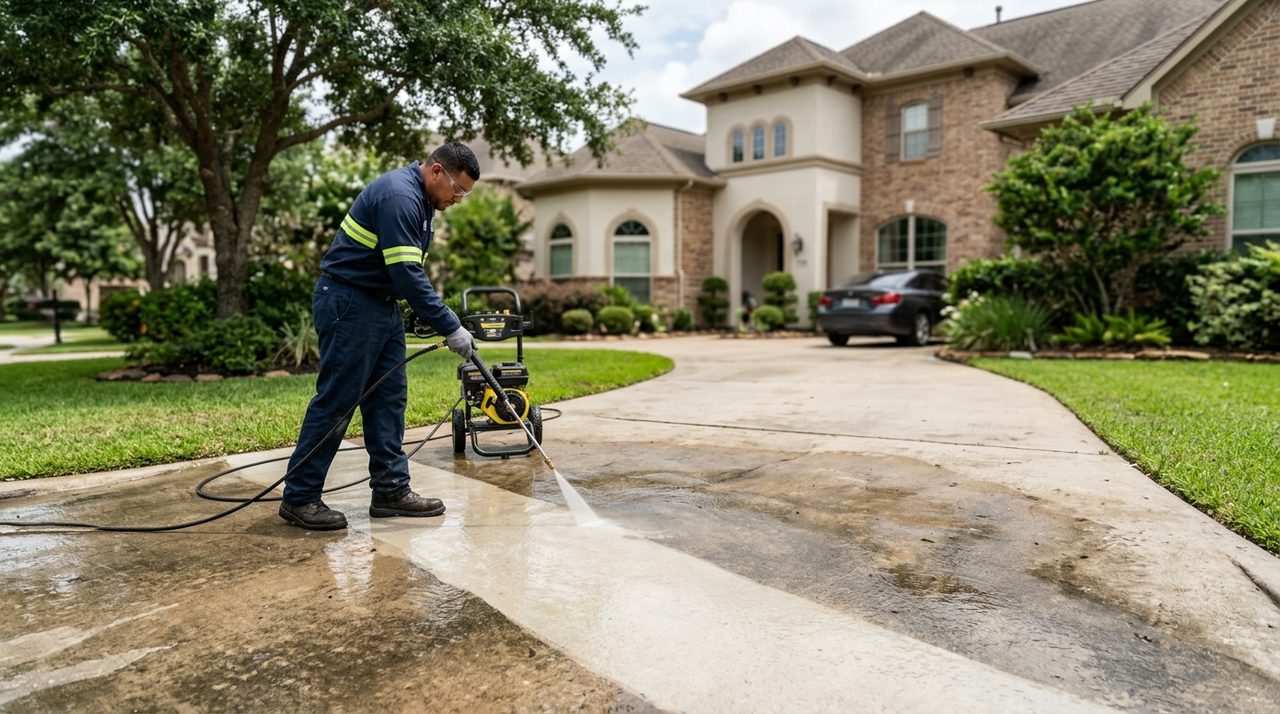
Braeswood sits in FEMA Zone AE along Brays Bayou, and its exterior surfaces bear the evidence: flood-line staining at brick and stucco courses, tannic mud deposits from Harvey (2017) and Beryl (2024), and the relentless mold load that comes with a bayou-corridor microclimate where shade from mature live oaks rarely dries out between rain events. On a single block you may find an original 1950s ranch on pier-and-beam next to a post-flood custom rebuild on elevated slab, meaning every pressure-washing scope requires a surface-by-surface assessment before a nozzle is ever pointed at the house.
Ranked by verified Google rating × review volume × verification tier. How we rank →
Some highly-rated pros serve Braeswood from nearby and may not keep a Braeswood street address. Those are listed under "Also serving Braeswood" with their real city and distance, so you always know where each business is based.
2900 N Braeswood Blvd, Houston, TX 77025
Highly-rated pros based nearby who cover Braeswood. Distance shown from the Braeswood area.
Serving Braeswood Based in Bellaire · 2 mi away
Serving Braeswood Based in Medical Center · 2.1 mi away
Serving Braeswood Based in Meyerland · 2.3 mi away
Serving Braeswood Based in Bellaire · 2.4 mi away
Serving Braeswood Based in West University · 2.8 mi away
Serving Braeswood Based in West University · 3 mi away
Serving Braeswood Based in Galleria · 3.2 mi away
Serving Braeswood Based in Westbury · 3.4 mi away
Serving Braeswood Based in Upper Kirby · 3.4 mi away
Why it matters to you
Homes in Braeswood's FEMA Zone AE blocks nearest Brays Bayou — including many of the surviving 1950s–1960s ranch homes — show horizontal mud and mineral staining at the exact height floodwater reached during Harvey and Beryl. Because brick is porous and Houston's clay-laden floodwater carries dissolved mineral salts, these marks do not rinse off with a garden hose and will not respond to cold-water pressure washing alone.
What a good pro does
A qualified operator pre-treats flood-line staining with an alkaline or oxalic-acid wash appropriate to the surface (brick vs. painted stucco) before applying pressure, keeping PSI below 1,200 on soft mortar joints common in 1950s construction. Texas does not license pressure washing as a trade, but operators applying chemical cleaners that qualify as pesticides — such as sodium hypochlorite algaecide blends — may need a Texas Department of Agriculture pesticide applicator credential; verify before hiring.
Sources: FEMA National Flood Hazard Layer (NFHL), Texas Commission on Environmental Quality
Why it matters to you
Braeswood's dense live-oak canopy and proximity to Brays Bayou keep exterior surfaces shaded and damp well beyond what Houston's already-high average annual humidity produces on open suburban lots. Driveways, fences, and the north-facing walls of the neighborhood's original ranch homes develop visible Gloeocapsa magma black algae and green mold within months of cleaning — a particular concern on the aging wood and painted brick exteriors common to pre-1970s construction that hasn't yet been torn down and rebuilt.
What a good pro does
Effective treatment means a post-wash biocide application (typically a diluted sodium hypochlorite or quaternary ammonium solution), not just rinsing, to suppress regrowth for 12 months or more. On original pier-and-beam homes, the operator should also address the underside soffit and fascia boards where moisture wicks from ground-level saturation. Because Braeswood falls under City of Houston jurisdiction, no municipal permit is required for routine residential washing, but wastewater containing chemical cleaners cannot legally discharge into street storm drains that flow to Brays Bayou.
Sources: Texas Commission on Environmental Quality, City of Houston Permitting Center
Why it matters to you
Braeswood is not governed by a single HOA — Braeswood Place Homeowners Association (BPHA), multiple smaller mandatory HOAs like Seventy-Six Fifty-Five South Braeswood HOA, and individually restricted plats each set their own exterior-maintenance standards. A homeowner who ignores an algae-stained driveway or green-streaked fence may receive a written violation notice with a cure window as short as 30 days, and which association governs your specific lot is a lot-by-lot determination, not a block-wide assumption.
What a good pro does
Before scheduling a full-property wash, confirm which HOA or POA holds deed-restriction authority for your parcel — the section-by-section reconstitution effort underway in Braeswood Place means the answer may have changed since your last renewal. Once confirmed, a full-property package (house soft-wash plus driveway plus fence) typically runs $500–$900 estimated in the Houston market, and completing the work before a compliance deadline avoids re-inspection fees; keep dated before-and-after photos as documentation for the architectural review committee.
Sources: Local HOA / deed restrictions (see area profile)
Why it matters to you
Braeswood's native Houston Black clay soil cycles between saturation during flood events and the hard shrink of dry summers, wicking mineral salts upward through older slab-on-grade driveways to leave white efflorescence deposits. On blocks with original 1950s–1960s homes whose driveways have never been replaced, this combines with decades of oil and tire staining on porous, UV-oxidized concrete — a surface that cold-water rinsing alone will not restore, and that Winter Storm Uri's (2021) freeze-thaw cycles have further spalled.
What a good pro does
Stubborn oil staining requires a hot-water pressure washer (140°F+) or a chemical degreaser pre-soak, and efflorescence calls for a mild acid wash before rinsing; expect a 20–40% cost premium over a standard driveway clean on these conditions, estimated $180–$490 for a typical Braeswood driveway. Wastewater from degreaser jobs must be contained and cannot enter the storm drain system per TCEQ rules — a point of real enforcement risk on Braeswood streets where inlets drain directly toward Brays Bayou.
Sources: Texas Commission on Environmental Quality, FEMA National Flood Hazard Layer (NFHL)
Hiring pressure washing in Braeswood? Braeswood straddles Brays Bayou in southwest Houston, placing flood mitigation at the center of virtually every home service decision. The neighborhood's mix of original 1950s–1960s ranch homes and post-flood teardown rebuilds means contractors encounter widely varying foundation types, electrical panels, and plumbing systems on a single block. Multiple mandatory HOAs and recorded deed restrictions add a layer of compliance review before exterior modifications.
Building era
1950s–1960s original construction with significant teardown/infill waves in the late 1990s–2010s, accelerating after repeated flood events.
Typical style
Original one-story ranch and mid-century traditional homes alongside newer two-story traditional, transitional, and soft Mediterranean custom infill.
Foundations
Mixed — older homes include both pier-and-beam and slab-on-grade; virtually all post-1990s infill and rebuilds are slab-on-grade (not explicitly documented for this neighborhood; based on typical Houston-area patterns).
Common systems
Original homes may have galvanized or cast-iron drain lines, R-22 HVAC systems, and Federal Pacific or Zinsco electrical panels. Rebuilt homes typically feature PEX or copper plumbing, modern high-SEER HVAC, and 200-amp panels. Mixed vintage makes system audits essential.
What that means for repairs
Post-flood teardown-and-rebuild is the dominant renovation activity, often involving full elevation of new structures. Remaining original ranch homes frequently undergo foundation repair, re-plumbing with PEX, HVAC replacement, and flood-damage remediation including mold abatement and drywall replacement.
Permit jurisdiction
City of Houston — Houston Permitting Center.
HOA & deed restrictions
Braeswood Place Homeowners Association (BPHA) operates as a mandatory-membership POA for certain sections of Braeswood Place, with a section-by-section reconstitution effort underway. Additional smaller mandatory HOAs exist (e.g., Seventy-Six Fifty-Five South Braeswood HOA). The broader Braeswood corridor is a patchwork of multiple associations, condo/townhome HOAs, and some individually restricted plats with no single umbrella organization.
Historic districts
No City of Houston historic district designation confirmed.
Contractor note
Contractors must verify which HOA or POA governs a specific lot before exterior work, as deed restrictions vary section by section. Elevation and flood-proofing projects may trigger additional City of Houston floodplain development permits and FEMA Substantial Improvement/Substantial Damage reviews.
FEMA flood zone
FEMA Zone AE (high flood risk) — source: fema_nfhl. The neighborhood is situated along Brays Bayou, one of Houston's most flood-prone waterways, with direct exposure to bayou overflow during major rain events.
Hurricane Harvey impact
Braeswood and the adjacent Braeswood Place area along Brays Bayou were among the hardest-hit neighborhoods during Hurricane Harvey (2017), consistent with severe flooding also experienced during the Memorial Day 2015 and Tax Day 2016 flood events. Widespread home inundation triggered a major wave of teardowns, elevations, and full rebuilds throughout the corridor. Specific block-level inundation depths were not confirmed in available research but are well-documented in FEMA and Harris County Flood Control District records.
Heat & humidity load
High heat and humidity stress aging HVAC systems in original 1950s–1960s homes, many of which still run undersized or outdated units. Mold recurrence is a persistent concern in previously flooded structures, particularly in pier-and-beam crawl spaces and behind repaired drywall. Summer storms can re-saturate soils near the bayou, exacerbating foundation movement on clay soils.
Working with contractors here
Flood remediation and prevention dominate the contractor workload in Braeswood — from mold abatement and drywall replacement in previously inundated homes to full structural elevation of new builds. Foundation repair is common on original 1950s–1960s slab and pier-and-beam homes settling on expansive clay soils worsened by repeated saturation cycles. Re-plumbing from galvanized or cast-iron to PEX and upgrading electrical panels from original 100-amp service are frequent companion scopes on older homes. Contractors should scope every project with flood history in mind: verify whether a property has triggered FEMA Substantial Improvement thresholds, which can mandate elevation or floodproofing for any renovation exceeding 50% of the structure's market value. The section-by-section HOA and deed restriction landscape means exterior modification approvals — fencing, roofing material, paint colors — require lot-specific verification before work begins.
Local Tip
Always ask for a written estimate before work begins. Texas contractors are required to provide one on jobs over $1,000.
Braeswood straddles Brays Bayou in southwest Houston, placing flood mitigation at the center of virtually every home service decision. The neighborhood's mix of original 1950s–1960s ranch homes and post-flood teardown rebuilds means contractors encounter widely varying foundation types, electrical panels, and plumbing systems on a single block. Multiple mandatory HOAs and recorded deed restrictions add a layer of compliance review before exterior modifications.
Source: U.S. Census Bureau, ACS 5-Year 2023
Much of Braeswood maps to FEMA Zone AE (high flood risk), so flood-resilient detailing -- elevated equipment, water-tolerant materials, and drainage-first thinking -- is essential here, not optional; risk climbs sharply on blocks nearest Brays Bayou, where it varies parcel to parcel.
Source: FEMA National Flood Hazard Layer (NFHL). Flood zones vary by parcel — verify your individual FIRM panel.
Sources: City of Houston Permitting Center
Sources: Local HOA / deed restrictions (see area profile)
Sources: Texas Commission on Environmental QualityFEMA National Flood Hazard Layer (NFHL)