Best Gutter Cleaning in Spring Branch
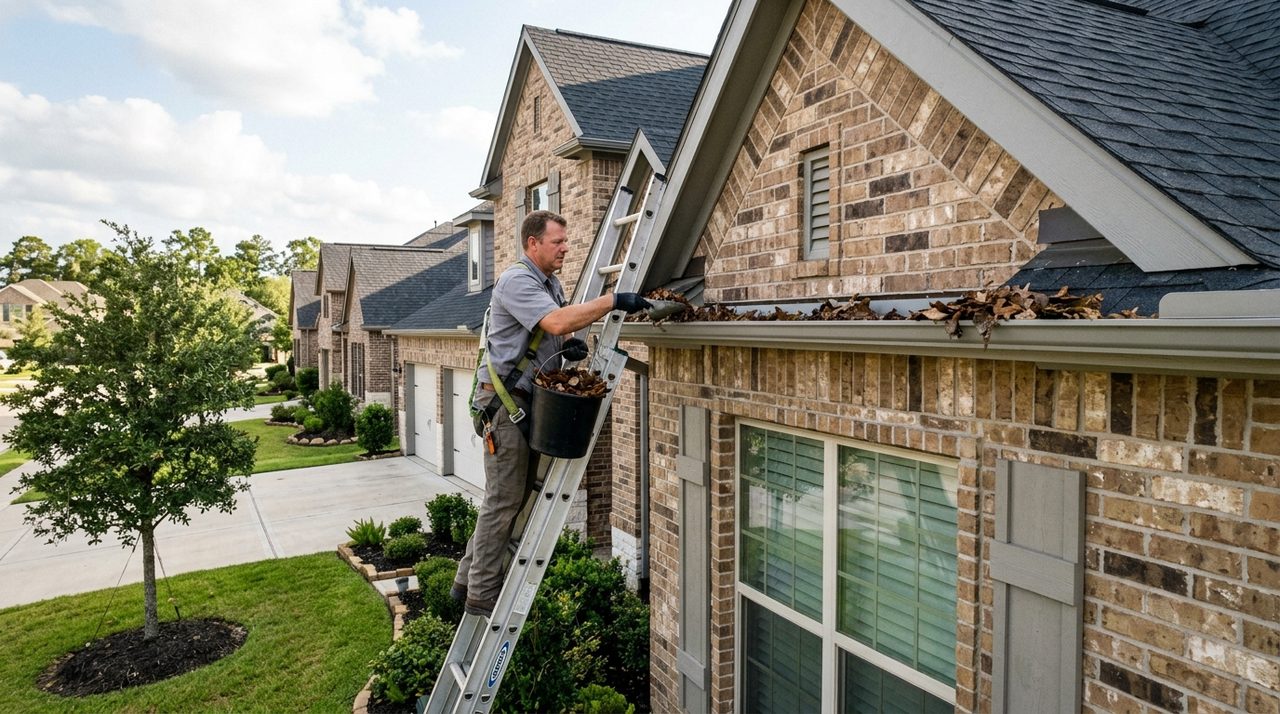
Spring Branch's 1950s–1960s brick ranch homes sit on concrete slab-on-grade foundations over Houston's expansive Beaumont clay — meaning a clogged gutter that spills water against the perimeter isn't just a nuisance, it's a direct threat to the slab. Add the neighborhood's aging asphalt shingles (many original roofs have been replaced once or twice since the Eisenhower era, but plenty of 20-year-old dimensional shingle re-roofs are now shedding granules), a mix of mature live oaks and planted pines on established lots, and you have a gutter-cleaning situation that's more consequential here than in a newer suburb.
- Median home built
- 1978
- Median home value
- $640,789
- FEMA flood zone
- X (low)
- Typical cost (est.)
- $100–$175 (one-story ranch); $175–$275 (two-story infill/townhome)
- Most common local issue
- Granule-packed downspout elbows on aging 2000s-era re-roofs over 1950s ranch homes
Ranked by verified Google rating × review volume × verification tier. How we rank →
Some highly-rated pros serve Spring Branch from nearby and may not keep a Spring Branch street address. Those are listed under "Also serving Spring Branch" with their real city and distance, so you always know where each business is based.
Based in Spring Branch
4333 W Sam Houston Pkwy N #120, Houston, TX 77043
12645 Memorial Dr Ste F1 - 705, Houston, TX 77024
12645 Memorial Dr Ste F1 - 747, Houston, TX 77024
9402-A, 9402 Hammerly Blvd, Houston, TX 77080
Also serving Spring Branch
Highly-rated pros based nearby who cover Spring Branch. Distance shown from the Spring Branch area.
Serving Spring Branch Based in Brookhollow · 2.7 mi away
Serving Spring Branch Based in Brookhollow · 2.7 mi away
Serving Spring Branch Based in Brookhollow · 3.4 mi away
Serving Spring Branch Based in Brookhollow · 3.7 mi away
Serving Spring Branch Based in NW Houston · 4 mi away
Gutter Cleaning in Spring Branch: What You Should Know
Aging Shingle Granules Packing Downspout Elbows on Ranch Roofs
Why it matters to you
Spring Branch's original ranch homes typically carry their second or third asphalt shingle roof — many of those re-roofs from the late 1990s and 2000s are now 15–25 years old and shedding granules aggressively. The low-slope geometry common on 1950s ranches means granules travel slowly down the roof plane and accumulate heavily at gutter seams and the top elbow of each downspout, forming compacted plugs that a leaf blower can't dislodge. When those elbows block, water backs up and overflows directly at the foundation perimeter — a serious concern on slab-on-grade homes over Houston's expansive clay soil.
What a good pro does
A thorough pro will hand-scoop the elbow and run a flush test with a garden hose at each downspout before calling the job complete — a simple leaf-blow-and-go pass misses these plugs entirely. Ask the crew to note granule volume as a rough proxy for remaining shingle life; heavy accumulation after a routine clean (not following a storm) is a signal worth passing to a roofer. No City of Houston permit is required for cleaning or minor gutter repairs, so there is no paperwork overhead for this service.
Sources: City of Houston Permitting Center, Harris County Flood Control District
Overflowing Gutters Saturating Clay Soil at the Slab Perimeter
Why it matters to you
Virtually every original Spring Branch ranch sits on a concrete slab over Beaumont/Houston Black clay — soil that expands dramatically when wet and contracts when dry. A clogged gutter that spills water at the same corner of the house every rainstorm repeatedly saturates a narrow band of soil right at the foundation edge, promoting differential heave and the corner cracks and door-frame racking that are a perennial complaint in this neighborhood. Foundation leveling is already a recurring expense here; deferred gutter cleaning accelerates the cycle.
What a good pro does
Good gutter pros should confirm that downspout discharge is directed at least three to four feet away from the slab, either through intact splash blocks or flexible extensions — both are inexpensive add-ons at cleaning time. Homeowners on blocks with flat grade (common in Spring Branch's interior streets) should ask whether a downspout extension or buried drain line is advisable, since even clean gutters drain poorly if the outlet pools against the house. This is a maintenance call, not a permitted scope, so no Houston Permitting Center filing is involved.
Sources: Harris County Flood Control District, International Residential Code (as adopted by City of Houston)
Post-Storm Debris Surge After Beryl (2024) and the May 2024 Derecho
Why it matters to you
Spring Branch took a significant hit from both the May 2024 derecho and Hurricane Beryl in July 2024, with widespread tree damage across the neighborhood's mature live oak and pine canopy. Both events deposited large volumes of bark, small branches, torn Spanish moss, and wind-stripped shingle granules into gutters in a matter of hours — and because Spring Branch is inside Houston city limits, homeowners competed for gutter-cleaning appointments alongside the entire west Houston market, creating multi-week backlogs. Homes with older aluminum gutters and spike-and-ferrule hangers (standard on 1950s ranch construction) were especially vulnerable to hanger pull-out from the added debris weight.
What a good pro does
After any named storm or derecho, schedule a gutter inspection within two weeks rather than waiting for the next rain cycle to reveal a problem — by then, standing water may have already stressed the slab perimeter or spawned a mosquito brood. A competent crew will flush every downspout, check hanger spacing and re-drive or replace loose spikes, and document any sections where the gutter run has shifted out of pitch. Because gutter replacement tied to storm damage may be covered under homeowners' insurance, keep a photo record of conditions before cleaning begins.
Sources: Harris County Flood Control District, City of Houston Permitting Center
Standing Water in Gutters Feeding Mosquito Populations Near Spring Branch Creek
Why it matters to you
Harris County Mosquito Control District identifies clogged residential gutters as a primary Aedes aegypti breeding site across the metro, and Spring Branch's proximity to Spring Branch Creek and its tributary drainage network means standing water finds the neighborhood quickly after rain. Even a modest debris dam holding two to three inches of water inside a gutter channel can produce a full mosquito brood in seven to ten days during Houston's long warm season — which in Spring Branch effectively runs from March through November. The neighborhood's mix of owner-occupied ranches and rental properties (owner-occupancy runs about 52 percent per ACS data) means some gutters on adjacent lots go unserviced for extended periods, compounding the local mosquito pressure.
What a good pro does
Cleaning frequency matters as much as thoroughness: a single annual clean is rarely adequate for Spring Branch lots with mature trees overhanging gutters. Two cleans per year — once in late spring before peak mosquito season and once in late fall after live oak pollen and early leaf drop — is a practical minimum. Ask your gutter pro whether any downspout or low-point section retains standing water between rains, which can sometimes be corrected by adjusting gutter pitch or adding a downspout at a new location without a permit from the City of Houston.
Sources: Harris County Flood Control District, City of Houston Permitting Center
Gutter Cleaning in Spring Branch: What You Should Know
Hiring gutter cleaning in Spring Branch? Spring Branch's housing stock is dominated by 1950s–1960s single-family brick ranch homes on slab foundations, creating consistent demand for foundation repair, re-plumbing, and electrical upgrades. Ongoing teardown-and-rebuild activity means contractors regularly encounter both vintage systems and modern infill construction side by side. Deed restrictions and HOA rules vary subdivision by subdivision, so contractors should verify requirements on a per-project basis.
- Housing era
- Primarily 1950s–1960s, with significant infill and townhome construction from the 2000s onward
- Foundation
- Predominantly concrete slab-on-grade for original 1950s–1960s homes
- Flood zone
- FEMA Zone X (low flood risk) per the official NFHL API
- Permits
- City of Houston — Houston Permitting Center (Spring Branch is within Houston city limits)
Housing stock & systems
Building era
Primarily 1950s–1960s, with significant infill and townhome construction from the 2000s onward.
Typical style
One-story brick ranch houses (original stock); two-story contemporary/transitional homes and townhomes (infill).
Foundations
Predominantly concrete slab-on-grade for original 1950s–1960s homes; some pier-and-beam in earlier or custom structures. Confirm per-property via inspection or appraisal records.
Common systems
Original homes often have galvanized steel or cast-iron drain plumbing, older electrical panels (60–100 amp), and aging central HVAC units. Many properties have been partially updated but may still have legacy piping and wiring. Newer infill homes feature modern PEX plumbing, 200-amp panels, and high-efficiency HVAC systems.
What that means for repairs
Teardown-and-rebuild activity is very common as lot values support new construction. Remaining original homes frequently undergo whole-house renovations including re-plumbing (replacing galvanized lines), electrical panel upgrades, HVAC replacement, and kitchen/bath remodels. Foundation leveling is a recurring need on slab homes due to expansive clay soils.
Permits & restrictions
Permit jurisdiction
City of Houston — Houston Permitting Center (Spring Branch is within Houston city limits).
HOA & deed restrictions
No single area-wide mandatory HOA. Voluntary civic associations (e.g., Spring Branch Civic Association, Spring Branch Oaks Civic Association) cover much of the older residential area. Some platted subdivisions have mandatory HOAs with recorded deed restrictions and mandatory assessments (e.g., Spring Branch Estates, Spring Branch Estates II). At least six mandatory HOAs are registered in the broader Spring Branch area. Deed restrictions are common at the subdivision level but vary by plat—check Harris County Clerk records for each property.
Historic districts
No City of Houston historic district designation confirmed.
Contractor note
Because deed restrictions and HOA requirements vary by subdivision, contractors should confirm any architectural review, fence/accessory structure, and material restrictions before beginning work. The City of Houston permitting process applies to all structural, electrical, plumbing, and mechanical work.
Flood & weather
FEMA flood zone
FEMA Zone X (low flood risk) per the official NFHL API. However, Spring Branch is bisected by several tributaries of White Oak Bayou and Spring Branch Creek, and localized street flooding can still occur during heavy rain events. Property-level flood risk should be verified, especially for lots near drainage channels.
Hurricane Harvey impact
Research did not return specific Harvey damage documentation for this civic-association-defined area of Spring Branch. Broader media and City of Houston reporting indicate that portions of the Spring Branch area experienced significant flooding during Harvey, particularly near bayou tributaries and low-lying streets. Homeowners and contractors should check individual property flood claims history through FEMA and the Harris County Flood Control District for site-specific impact data.
Heat & humidity load
Extended Houston summers with sustained 95°F+ temperatures and high humidity stress aging HVAC systems and accelerate attic insulation degradation in 1950s–1960s ranch homes. Slab-on-grade foundations on expansive clay soils are vulnerable to differential settlement during summer drought cycles. Exterior paint and caulking on older brick veneer homes deteriorate quickly in UV-intense conditions.
Working with contractors here
The most common work in Spring Branch involves updating the mechanical and plumbing systems in 1950s–1960s ranch homes—re-plumbing galvanized supply lines, replacing cast-iron drains, upgrading electrical panels, and installing modern HVAC systems. Foundation repair is a perennial need due to expansive clay soils and slab-on-grade construction. Teardown-and-rebuild projects are frequent, requiring contractors familiar with City of Houston new-construction permitting and lot-specific deed restriction compliance. For renovation jobs on older homes, contractors should budget for potential asbestos abatement (siding, flooring, duct insulation) and lead paint remediation. Scoping should account for the wide variation between unrenovated originals and partially updated homes on the same block.
Local Tip
Always ask for a written estimate before work begins. Texas contractors are required to provide one on jobs over $1,000.
About Spring Branch
Spring Branch's housing stock is dominated by 1950s–1960s single-family brick ranch homes on slab foundations, creating consistent demand for foundation repair, re-plumbing, and electrical upgrades. Ongoing teardown-and-rebuild activity means contractors regularly encounter both vintage systems and modern infill construction side by side. Deed restrictions and HOA rules vary subdivision by subdivision, so contractors should verify requirements on a per-project basis.
- Median year built
- 1978
- Median home value
- $640,789
- Owner-occupied
- 52.3%
- Population
- 157,142
- Housing units
- 65,035
- Median income
- $90,513
Source: U.S. Census Bureau, ACS 5-Year 2023
Flood & storm risk
FEMA Zone XLow flood riskMost of Spring Branch maps to FEMA Zone X (low mapped flood risk), but Houston's flash-flood reality means even low-risk blocks benefit from smart drainage and storm-hardened installs.
Source: FEMA National Flood Hazard Layer (NFHL). Flood zones vary by parcel — verify your individual FIRM panel.
Houston Storm Readiness in Spring Branch
Hurricane & flooding
Wind-driven rain during a hurricane pushes water horizontally into trough seams and end caps — have a gutter technician reseal any open joints and clear debris before storm season so the system functions as designed. In Spring Branch, the bigger post-storm threat is often structural damage from overflowing gutters undermining window sills and door frames rather than direct flooding. In-city Spring Branch work falls under City of Houston floodplain and permitting rules.
Severe storms & hail
In Spring Branch, keep gutters clear through spring and fall severe seasons so that even a 3-inch-per-hour thunderstorm cell drains cleanly off the roof without backing up behind the gutter lip. A trained technician can also reattach any sections that show movement after high-wind events, preventing the progressive hanger failure that lets entire runs sag and separate. Confirm the current FEMA panel for your Spring Branch parcel — the area maps to Zone X, but adjacent lots can differ.
Ice storms & freezes
Downspout leaders are particularly vulnerable to ice cracking at the elbow joint during a hard freeze — a gutter technician can replace brittle sections and clear any frozen debris plugs in Spring Branch before the next rain event. Addressing this promptly keeps meltwater and winter rain routed away from the foundation rather than pooling at the base of the exterior wall. With a median build year of 1978, the older building stock here is more exposed to hard-freeze damage than newer construction. Confirm the current FEMA panel for your Spring Branch parcel — the area maps to Zone X, but adjacent lots can differ.
Sources: FEMA National Flood Hazard Layer (NFHL), Ready.gov -- Hurricanes, CenterPoint Energy -- Storm Center, City of Houston -- Emergency Preparedness, Ready.gov -- Winter Weather, Harris County Flood Control District
Free Spring Branch Tools & Calculators
Houston-specific estimators to plan your project before you call a pro. All results are planning estimates — a licensed local pro confirms the details on site.
Houston Freeze Prep & Pipe Insulation Checklist
Open full tool & FAQ →Your freeze checklist — 4 tasks
- 1
Disconnect & drain every outdoor hose bib
Remove hoses, drain the spigots, and cover each with an insulated faucet sock. Un-drained hose bibs are the #1 burst point in a Houston freeze.
- 2
Insulate exposed pipes in the attic & garage
Wrap any pipe in an unconditioned space (attic runs, garage walls) with foam sleeves. Houston homes rarely insulate these because they only matter a few nights a year — which is exactly why they burst.
- 3
Open cabinet doors & keep a pencil-width drip
On hard-freeze nights, open kitchen/bath cabinets so warm air reaches the pipes and let faucets on exterior walls drip to relieve pressure.
- 4
Protect the attic/garage water heater & its lines
An attic or garage tank sits in unconditioned space. Insulate the cold-inlet and hot-outlet lines and confirm the emergency drain pan is clear so a leak doesn't reach the ceiling.
This is a planning estimate only — actual requirements depend on an on-site assessment by a licensed Houston pro. If a pipe has already burst, shut off your main water supply and call a licensed Houston plumber immediately — freeze bursts flood fast.
Frequently Asked Questions
Do I need a permit from the City of Houston to have my gutters cleaned or repaired on my Spring Branch ranch home?
Sources: City of Houston Permitting Center
My Spring Branch ranch house was built in the late 1950s and still has original spike-and-ferrule gutter hangers — should a cleaning crew be checking those during a visit?
Spring Branch is mapped mostly in FEMA Zone X, so is gutter cleaning really that urgent here compared to flood-prone neighborhoods?
Sources: FEMA National Flood Hazard Layer (NFHL)Harris County Flood Control District
How far out should I expect to book a gutter cleaning appointment in Spring Branch after a major storm like Beryl, and what does that kind of clean typically cost?
My Spring Branch subdivision has a voluntary civic association — can they fine me for debris overflowing my gutters, or do I only need to worry about that in HOA-governed communities?
Sources: Local HOA / deed restrictions (see area profile)