6205 Brookhill Dr Suite 5, Houston, TX 77087
Best Gutter Cleaning in South Houston, TX
South Houston's 1950s–1970s slab-on-grade ranch homes sit in FEMA Zone AE, meaning every clogged gutter that spills water against a foundation perimeter is directly worsening the differential heave cycle that already plagues expansive Harris County clay beneath these aging slabs. With the City of South Houston running its own permitting operation — separate from Houston's permitting center — homeowners also need to confirm contractor jurisdiction before any repair work beyond a routine clean escalates into a permit scope. This page explains the three gutter-cleaning challenges that actually matter in this corner of southeast Harris County and what a competent crew should do about each.
Verified against Google Business data
Updated 2026
See the 10 Gutter Cleaning Serving South Houston 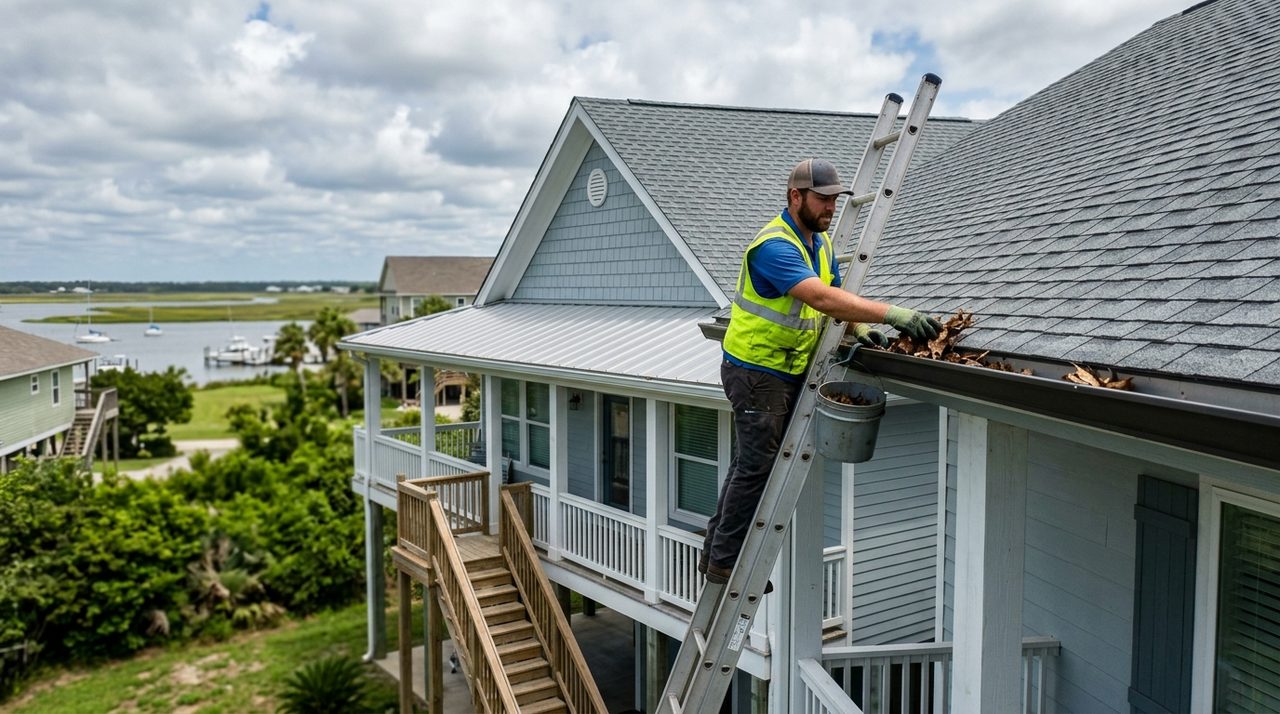
- Median home built
- 1969
- Median home value
- $176,100
- FEMA flood zone
- AE (high)
- Typical cost (est.)
- $100–$275
- Most common local issue
- Overflow-driven clay-soil saturation threatening AE-zone slab foundations
Ranked by verified Google rating × review volume × verification tier. How we rank →
Some highly-rated pros serve South Houston from nearby and may not keep a South Houston street address. Those are listed under "Also serving South Houston" with their real city and distance, so you always know where each business is based.
Min rating:
10 resultsBased in South Houston
831 Old Genoa Red Bluff Rd, Houston, TX 77034
Closed
7811 Santa Elena St, Houston, TX 77061
Also serving South Houston
Highly-rated pros based nearby who cover South Houston. Distance shown from the South Houston area.
Closed
Serving South Houston Based in Pasadena · 0.7 mi away
Closed
Serving South Houston Based in Pasadena · 2.9 mi away
Serving South Houston Based in Deer Park · 3.9 mi away
Open Now
Serving South Houston Based in Deer Park · 4.2 mi away
Closed
Serving South Houston Based in Deer Park · 4.3 mi away
Closed
Serving South Houston Based in Pearland · 6.8 mi away
Closed
Serving South Houston Based in Galena Park · 6.9 mi away
Gutter Cleaning in South Houston: What You Should Know
Clogged Gutters Saturating Clay Soil Along Aging Slab Perimeters
Why it matters to you
South Houston's housing stock was built predominantly between 1950 and 1975 on slab-on-grade foundations underlain by Beaumont and Houston Black expansive clay — the same soil series that shrinks aggressively during dry spells and swells when wet. Homes here are already in FEMA Zone AE, meaning the surrounding soil experiences elevated moisture events regularly. When a gutter overflows and pours water in a concentrated stream directly against the foundation stem wall, it creates localized saturation that accelerates differential heave and settlement — foundation repair and re-leveling are already among the most common contractor scopes in South Houston for exactly this reason.
What a good pro does
A thorough cleaning crew should not just clear the channel but also flush every downspout to confirm water is discharging at least four feet from the foundation and inspect downspout extensions or splash blocks for displacement. On these older ranch-style homes, downspouts are frequently short or missing extensions entirely; redirecting discharge away from the slab perimeter is a direct slab-protection measure, not an upsell. Quotes for a standard single-story South Houston ranch (typically 1,500–2,000 sq ft) should run $100–$175 as an estimate for a clean-and-flush with downspout check.
Sources: FEMA National Flood Hazard Layer (NFHL), Harris County Flood Control District
Post-Harvey and Post-Beryl Debris Surges Compounding Granule Buildup in Aging Gutters
Why it matters to you
Harvey (2017) and Hurricane Beryl (July 2024) both left South Houston — a low-lying AE-zone city — with significant roof and tree debris loads deposited in a single event: bark strips, Spanish moss carried on surge winds, small branches, and large volumes of shingle granules shaken loose from aging 3-tab roofs. Many South Houston homes were built in the 1960s and received post-Harvey re-roofs that are now approaching the 15–20 year mark where granule shedding accelerates; a major storm event compounds that shedding dramatically. Granules migrate to downspout top elbows and compact into near-solid plugs that a leaf blower pass cannot dislodge.
What a good pro does
After any named storm, homeowners should schedule a clean within two to three weeks — before the next heavy rain pushes compacted debris deeper into downspout elbows. A competent crew on post-storm work will hand-clear compacted granule plugs at each elbow and perform a flush test to confirm flow rate, not just declare the channel visually clear. Post-storm cleans with heavy debris loads and downspout clearing on a two-story South Houston home typically run $300–$450 as an estimate. Demand spikes within days of a storm, so booking early avoids multi-week backlogs.
Sources: FEMA National Flood Hazard Layer (NFHL), Harris County Flood Control District
Standing Water in Gutters Creating Mosquito Breeding Habitat in a Bayou-Adjacent Flood Zone
Why it matters to you
Harris County Mosquito Control District identifies clogged residential gutters as a primary Aedes aegypti and Culex quinquefasciatus breeding site across the metro, and South Houston's geography amplifies that risk: the city borders Vince Bayou and sits within a high-frequency flood zone where standing water in yards, swales, and drainage channels is common after rain events from May through October. A debris dam holding even two to four inches of water in a gutter channel can produce a mosquito brood within seven to ten days at Houston temperatures, adding a direct public-health dimension to what is otherwise a maintenance task.
What a good pro does
Year-round cleaning — not just a fall pass — is warranted in South Houston. At minimum, scheduling two cleans annually (late spring before peak mosquito season and late fall after any remaining tree debris accumulates) keeps gutter channels dry between rain events. Crews should confirm that no standing water is trapped behind seam joints or at low spots caused by bracket sag, which is common on the older spike-and-ferrule hangers found on 1960s and 1970s aluminum gutter runs in this housing stock. Bracket re-securing or minor re-pitching to eliminate low spots is typically a small add-on to a standard clean.
Sources: Harris County Flood Control District, FEMA National Flood Hazard Layer (NFHL)
Permit Jurisdiction Confusion When Cleaning Leads to Gutter Repair or Replacement
Why it matters to you
South Houston is its own incorporated municipality, and its building department operates entirely separately from the City of Houston Permitting Center — a fact many contractors and homeowners overlook when assuming Houston's rules apply. Routine gutter cleaning does not require a permit anywhere in the Houston metro, but if a cleaning visit reveals gutters that need full replacement (common on 50-to-70-year-old homes with corroded aluminum or damaged fascia boards), that scope can trigger a building department review in South Houston. Fascia board replacement tied to a gutter re-hang can also intersect with the city's own inspection requirements, which differ from Houston's.
What a good pro does
Before authorizing any scope beyond cleaning — particularly full gutter replacement or fascia repair — confirm with the contractor whether City of South Houston permits apply to the specific work. The city's building department, not the Houston Permitting Center, is the correct authority; adjacent parcels near the city boundary may actually fall under Harris County Engineering jurisdiction, so confirm at the parcel level. For cleaning-only work, no permit is required, but ask any operator to carry general liability insurance (commonly $1M per occurrence) and workers' compensation coverage given the roof-access nature of the work.
Sources: City of Houston Permitting Center, Local HOA / deed restrictions (see area profile)
Gutter Cleaning in South Houston: What You Should Know
Hiring gutter cleaning in South Houston? South Houston is a small incorporated city surrounded by southeast Harris County, with a housing stock dominated by 1950s–1970s slab-on-grade homes that face persistent flood risk and foundation movement on expansive clay soils. Homeowners here must prioritize drainage improvements, flood damage mitigation, and aging system upgrades. The patchwork of deed-restricted subdivisions and non-HOA blocks means contractor permitting runs through the City of South Houston rather than Houston's permitting center.
- Housing era
- Primarily 1950s–1970s with some pre-war stock and later infill
- Foundation
- Predominantly slab-on-grade
- Flood zone
- FEMA Zone AE (high flood risk) per official NFHL data
- Permits
- City of South Houston Permitting (separate incorporated city — not Houston Permitting Center)
Housing stock & systems
Building era
Primarily 1950s–1970s with some pre-war stock and later infill.
Typical style
Ranch-style and traditional suburban detached single-family homes; some smaller post-war cottages and bungalows in older plats.
Foundations
Predominantly slab-on-grade; limited pier-and-beam in pre-1950 structures.
Common systems
Original galvanized or early copper plumbing in older homes; aging central AC systems often undersized by modern standards; 100-amp electrical panels common in 1950s–1960s builds, many needing upgrade to 200-amp service.
What that means for repairs
Foundation repair and re-leveling are frequent due to expansive clay soils. Post-Harvey flood remediation drove significant interior gut-and-rebuild activity. Electrical panel upgrades and re-plumbing with PEX or copper are common as original systems age out.
Permits & restrictions
Permit jurisdiction
City of South Houston Permitting (separate incorporated city — not Houston Permitting Center). Unincorporated parcels in surrounding SE Harris County fall under Harris County Engineering.
HOA & deed restrictions
No city-wide mandatory HOA identified. The area is a patchwork of deed-restricted subdivisions and non-HOA blocks with some voluntary civic clubs. Specific HOA status must be confirmed through Harris County Clerk deed restriction records or the Texas HOA registry at hoa.texas.gov.
Historic districts
No City of Houston historic district designation confirmed. South Houston is a separate incorporated municipality with no known local historic district overlay.
Contractor note
Contractors must obtain permits through the City of South Houston's own building department, not the City of Houston. Confirm municipal jurisdiction at the parcel level, as adjacent properties may fall under Harris County or Pasadena ETJ depending on exact location.
Flood & weather
FEMA flood zone
FEMA Zone AE (high flood risk) per official NFHL data. The area sits in low-lying southeast Harris County near major drainage channels and bayous, contributing to elevated flood exposure during heavy rain events.
Hurricane Harvey impact
Southeast Harris County, including the South Houston and Pasadena corridor, experienced significant street and structure flooding during Hurricane Harvey (2017). Harris County Flood Control District sources confirm widespread inundation in the area, though a detailed street-by-street damage summary specific to the City of South Houston was not located in public records. Given the AE flood zone designation and regional flood patterns, substantial residential flood damage is strongly indicated.
Heat & humidity load
High heat and humidity stress aging HVAC systems in 1950s–1970s homes, many of which have inadequate insulation and single-pane windows. Standing water from summer thunderstorms exacerbates foundation movement on clay soils and creates conditions for mold growth in flood-damaged or poorly ventilated structures.
Working with contractors here
The most common contractor work in South Houston involves foundation repair, flood damage restoration, and drainage improvement — all driven by the AE flood zone designation and expansive clay soils beneath aging slab foundations. HVAC replacement is frequent as original systems in 1950s–1970s homes reach end of life, and many homeowners simultaneously upgrade insulation and ductwork. Electrical panel upgrades from 100-amp to 200-amp service are a routine scope item on renovation projects. Contractors should budget for potential mold remediation discovery during interior remodels, especially in homes that took Harvey flooding. Because South Houston is its own municipality, job scoping should confirm permit jurisdiction before bidding — the city's building department has its own inspection requirements separate from Houston or Harris County.
Local Tip
Always ask for a written estimate before work begins. Texas contractors are required to provide one on jobs over $1,000.
About South Houston
South Houston is a small incorporated city surrounded by southeast Harris County, with a housing stock dominated by 1950s–1970s slab-on-grade homes that face persistent flood risk and foundation movement on expansive clay soils. Homeowners here must prioritize drainage improvements, flood damage mitigation, and aging system upgrades. The patchwork of deed-restricted subdivisions and non-HOA blocks means contractor permitting runs through the City of South Houston rather than Houston's permitting center.
- Median year built
- 1969
- Median home value
- $176,100
- Owner-occupied
- 54.1%
- Population
- 16,017
- Housing units
- 5,529
- Median income
- $52,611
Source: U.S. Census Bureau, ACS 5-Year 2023
Flood & storm risk
FEMA Zone AEHigh flood riskMuch of South Houston maps to FEMA Zone AE (high flood risk), so flood-resilient detailing -- elevated equipment, water-tolerant materials, and drainage-first thinking -- is essential here, not optional.
Source: FEMA National Flood Hazard Layer (NFHL). Flood zones vary by parcel — verify your individual FIRM panel.
Houston Storm Readiness in South Houston
Hurricane & flooding
Schedule a full gutter flush and downspout flow-test before any named storm enters the Gulf, because in South Houston, TX even a partially clogged system can sheet water directly toward your slab during FEMA Zone AE inside the 100-year floodplain. Harvey 2017 showed that homes with clear downspout extensions kept foundation soils more stable than those channeling overflow against the grade. Much of the housing stock predates modern wind codes (median build year 1969), so retrofits matter more here. As a Harris County community, South Houston may follow county rather than City of Houston storm rebuild rules.
Severe storms & hail
The May 2024 derecho hit South Houston, TX with 80-plus-mph straight-line winds that ripped gutter sections from homes in minutes — check hanger spacing and re-fasten any loose runs before severe season peaks in spring. In FEMA Zone AE inside the 100-year floodplain areas, a dislodged downspout during a storm immediately sends concentrated roof runoff against the foundation, so attachment quality is as important as cleanliness. Confirm the current FEMA panel for your South Houston parcel — the area maps to Zone AE, but adjacent lots can differ.
Ice storms & freezes
In South Houston, TX, where FEMA Zone AE inside the 100-year floodplain already stresses drainage infrastructure, a post-freeze gutter inspection should confirm that no sections shifted or sagged under Uri-style ice loading. A technician can re-pitch and refasten any run that now holds standing water, restoring drainage capacity before the spring severe storm season begins. With a median build year of 1969, the older building stock here is more exposed to hard-freeze damage than newer construction. Confirm the current FEMA panel for your South Houston parcel — the area maps to Zone AE, but adjacent lots can differ.
Sources: FEMA National Flood Hazard Layer (NFHL), Ready.gov -- Hurricanes, CenterPoint Energy -- Storm Center, City of Houston -- Emergency Preparedness, Ready.gov -- Winter Weather, Harris County Flood Control District
Free South Houston Tools & Calculators
Houston-specific estimators to plan your project before you call a pro. All results are planning estimates — a licensed local pro confirms the details on site.
Houston Freeze Prep & Pipe Insulation Checklist
Open full tool & FAQ →Your freeze checklist — 4 tasks
- 1
Disconnect & drain every outdoor hose bib
Remove hoses, drain the spigots, and cover each with an insulated faucet sock. Un-drained hose bibs are the #1 burst point in a Houston freeze.
- 2
Insulate exposed pipes in the attic & garage
Wrap any pipe in an unconditioned space (attic runs, garage walls) with foam sleeves. Houston homes rarely insulate these because they only matter a few nights a year — which is exactly why they burst.
- 3
Open cabinet doors & keep a pencil-width drip
On hard-freeze nights, open kitchen/bath cabinets so warm air reaches the pipes and let faucets on exterior walls drip to relieve pressure.
- 4
Protect the attic/garage water heater & its lines
An attic or garage tank sits in unconditioned space. Insulate the cold-inlet and hot-outlet lines and confirm the emergency drain pan is clear so a leak doesn't reach the ceiling.
This is a planning estimate only — actual requirements depend on an on-site assessment by a licensed Houston pro. If a pipe has already burst, shut off your main water supply and call a licensed Houston plumber immediately — freeze bursts flood fast.
Frequently Asked Questions
Do I need a permit from the City of South Houston just to have my gutters cleaned, or does a permit only kick in if the contractor replaces sections?
Routine gutter cleaning in South Houston requires no permit from the City of South Houston's building department. A permit becomes relevant only when work escalates to replacing gutter runs, re-securing fascia boards, or tying into roofing repairs — at that point you must go through the City of South Houston's own building department, not the City of Houston Permitting Center, since South Houston is a separate incorporated municipality. If your contractor mentions pulling any permit, confirm they are filing with South Houston and not defaulting to Houston's system, which does not cover parcels inside South Houston's city limits.
Sources: City of Houston Permitting Center
My 1960s ranch in South Houston has the original aluminum gutters with spike-and-ferrule hangers. Will a standard cleaning crew even flag if those hangers are pulling away from the fascia?
Reputable crews working on 1950s–1970s South Houston homes should walk the gutter line after cleaning and note any hangers that have backed out or tilted the gutter channel, because a misaligned pitch on a home this age causes chronic pooling even after a thorough clean. Ask the crew specifically whether they check gutter pitch and hanger condition as part of their visit — not all operators do this as standard practice. If hangers are pulling from the fascia, the fix may involve screwing through softened wood, which can escalate the scope and potentially require a permit through the City of South Houston if fascia boards need replacement.
How soon after a heavy rain event should I schedule gutter cleaning on my South Houston home, given it's already in FEMA Zone AE?
Because much of South Houston maps to FEMA Zone AE high flood risk, you do not want to wait out a weeks-long post-storm backlog when your gutters are actively spilling water against a slab perimeter sitting on expansive Harris County clay. After major events like Beryl in July 2024, cleaning demand across SE Harris County surged and backlogs ran two to four weeks, so booking within two to three days of a storm rather than waiting until you see overflow is the practical approach for AE-zone properties. If you cannot get a crew immediately, temporarily clearing visible debris from downspout openings by hand can reduce the overflow load on your foundation perimeter until a professional clean is scheduled.
Sources: FEMA National Flood Hazard Layer (NFHL)Harris County Flood Control District
What should I expect to pay for a gutter cleaning on a typical South Houston ranch home, and are post-storm prices higher?
For a standard single-story ranch of 1,500 to 2,500 square feet — the predominant home size in South Houston's 1950s–1970s stock — a routine clean-and-flush runs an estimated $100 to $175; if you have a two-story addition or a larger footprint with 150-plus linear feet of gutter, expect an estimated $175 to $275. After a named storm like Harvey or Beryl, when crews are clearing bark, Spanish moss, shingle granules, and compacted debris, prices for a thorough clean with downspout flushing on larger homes can run an estimated $300 to $450. These are estimates and should be confirmed with at least two local bids, as SE Harris County has a dense pool of independent operators that keeps pricing competitive.
South Houston homes took Harvey flooding in 2017. Could the gutters on a home that was gut-and-rebuilt after Harvey have different specs I should know about before scheduling a cleaning?
Post-Harvey rebuilds in South Houston sometimes included upgraded 5-inch or 6-inch K-style gutters with heavier-gauge aluminum to better handle SE Harris County's intense rain rates, which means the gutter system may differ from the original 3-inch or 4-inch runs a cleaning crew might assume. When you book, mention that the home was rebuilt post-Harvey and confirm the crew has the right flush equipment and downspout adapters for larger-profile gutters. Also ask whether the crew will check downspout discharge routing, since flood-remediated homes sometimes had drainage re-graded and a clogged or misaligned downspout can undermine that remediation work on a Zone AE slab.
Is there a worst season for gutter clogs in South Houston, or do I really need to clean more than once a year given the bayou-adjacent location?
South Houston's location near SE Harris County bayou corridors and its FEMA Zone AE designation mean clog risk is genuinely year-round rather than concentrated in a single fall season: late spring brings pollen catkins and early hurricane-season debris, summer brings storm surges and peak mosquito season when standing water in blocked gutters can produce a brood in seven to ten days, and winter can leave slow-draining biological film in shaded gutter channels. Most South Houston homeowners with mature tree canopy or properties near bayou corridors are best served by two cleanings per year — one in late spring before peak hurricane season and one in late fall — with an additional post-storm inspection any time a named storm makes landfall in the Houston area. Single-story homes on open lots with minimal tree cover may manage with one annual clean, but AE-zone slab protection makes skipping years a real foundation risk.
Sources: Harris County Flood Control DistrictFEMA National Flood Hazard Layer (NFHL)