Closed
104 Twin Oaks Blvd Ste 110, Kemah, TX 77565
Kemah's bayfront location on Galveston Bay puts its gutters at the intersection of coastal storm surge exposure, relentless salt-air corrosion, and a FEMA Zone AE floodplain where even minor drainage failures carry outsized consequences for slab and pier-supported foundations alike. Homes here range from pre-1960s bay cottages with decades-old gutter hardware to 1990s–2000s elevated waterfront redevelopments whose downspout discharge must route water away from structures governed by strict FEMA substantial-improvement rules. Understanding what clogs, corrodes, and overflows in Kemah specifically — and what it costs the foundation, the fascia, and the flood-insurance record — is what this page is about.
Ranked by verified Google rating × review volume × verification tier. How we rank →
Some highly-rated pros serve Kemah from nearby and may not keep a Kemah street address. Those are listed under "Also serving Kemah" with their real city and distance, so you always know where each business is based.
104 Twin Oaks Blvd Ste 110, Kemah, TX 77565
Highly-rated pros based nearby who cover Kemah. Distance shown from the Kemah area.
Serving Kemah Based in League City · 2.5 mi away
Serving Kemah Based in League City · 2.7 mi away
Serving Kemah Based in League City · 2.7 mi away
Serving Kemah Based in Seabrook · 4 mi away
Serving Kemah Based in League City · 4.6 mi away
Serving Kemah Based in La Porte · 5.4 mi away
Serving Kemah Based in Clear Lake · 5.7 mi away
Serving Kemah Based in League City · 5.9 mi away
Why it matters to you
Kemah sits squarely inside the documented damage footprints of both Hurricane Harvey (2017) and Hurricane Beryl (July 2024), and its Galveston Bay exposure means storm-deposited bark, Spanish moss, small branches, and shingle granules can fill gutters entirely in a single named event. For homes in FEMA Zone AE — which covers much of Kemah's bayfront and canal-adjacent blocks — a clogged gutter that spills water against the structure during the next rain event can contribute to moisture intrusion documentation that complicates a National Flood Insurance Program claim or triggers a substantial-improvement review.
What a good pro does
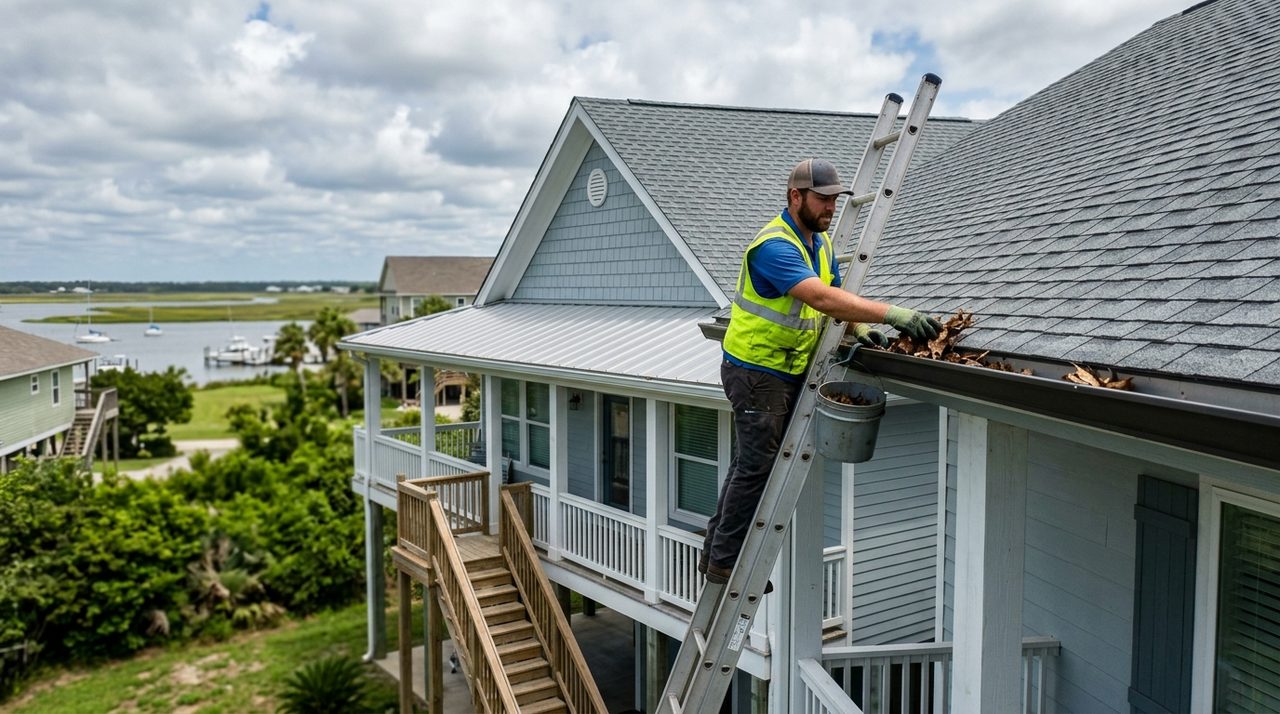
A thorough post-storm clean-and-flush goes beyond leaf blowing: the crew should hand-clear debris mats, flush downspouts from the top to confirm unobstructed discharge, and visually inspect fascia boards for storm damage that may have loosened hanger brackets. Expect estimates for post-hurricane cleans on larger two-story elevated Kemah homes to run $300–$450 (estimate) given access complexity on pier-supported structures with elevated living areas. No City of Kemah permit is required for routine cleaning, but any gutter replacement tied to storm damage repair should be confirmed with Kemah's building department.
Sources: FEMA National Flood Hazard Layer (NFHL), Harris County Flood Control District
Why it matters to you
Kemah's position directly on Galveston Bay means salt-laden humid air — the same environment that accelerates HVAC condenser corrosion and exterior electrical fixture failure — attacks unpainted aluminum gutter seams, steel hanger brackets, and downspout straps year-round. On the pre-1960s and 1970s–1980s-era cottages that still populate older Kemah Townsite blocks, original spike-and-ferrule hangers or sectional gutters with caulked seams are particularly vulnerable: a corroded seam that has separated even a quarter-inch allows water to bypass the channel entirely and saturate the fascia board beneath, accelerating wood rot on structures that may already be managing elevated-foundation moisture dynamics.
What a good pro does
When scheduling a gutter cleaning in Kemah, ask the crew to document every seam gap, rust blister, and hanger failure — not just debris volume — since salt-coast gutter systems degrade faster between cleanings than inland Houston equivalents. Reseal open seams with gutter-specific polyurethane sealant rated for coastal exposure, and replace spike-and-ferrule hangers with hidden screw-type brackets that resist pull-out. Gutter guard installation ($6–$18 per linear foot, estimate) using non-ferrous mesh can reduce how often debris bridges corroding seams, but seam repair must precede guard installation to avoid trapping moisture.
Sources: International Residential Code (as adopted by City of Houston)
Why it matters to you
While bayfront and canal-adjacent Kemah properties typically sit on pier-and-beam or elevated pile foundations, the interior and newer suburban pockets of the city — particularly post-2000 infill — are built on slab-on-grade over the same Houston Black clay soil that causes differential heave across the metro. In these blocks, a debris-plugged gutter that spills water in a concentrated band along the foundation perimeter repeatedly saturates the adjacent clay, worsening the shrink-swell cycle that drives slab movement. Kemah's high-frequency flood risk (FEMA Zone AE) means these soils cycle between saturated and dry more aggressively than inland suburbs, compounding the effect.
What a good pro does
For slab-on-grade homes in Kemah, gutter cleaning is a direct foundation-protection measure: downspout extensions should discharge at least four feet from the slab edge, and the crew should verify that splash blocks or piped extensions are directing water toward the street or swale rather than pooling against the foundation. Standard single-story clean-and-flush jobs on typical 1,500–2,500 sq ft Kemah slab ranches run $100–$175 (estimate); if downspout extensions are damaged or missing, budget separately for hardware. No permit is required for this work through the City of Kemah.
Sources: FEMA National Flood Hazard Layer (NFHL), Harris County Flood Control District, International Residential Code (as adopted by City of Houston)
Why it matters to you
Harris County Mosquito Control District (Kemah falls in Galveston County, with similar regional vector pressure) identifies clogged residential gutters as a primary Aedes aegypti and Culex quinquefasciatus breeding site in the Gulf Coast metro. Kemah's year-round warmth, bay-sourced humidity, and proximity to tidal wetlands and retention features mean a debris dam holding even two to three inches of standing water in a gutter channel can produce a full mosquito brood in seven to ten days — a timeline that can be reached multiple times between spring and fall without regular cleaning. Elevated homes with gutters at second-story height are harder to self-inspect, making the problem easy to overlook until infestation is noticeable at ground level.
What a good pro does
Scheduling gutter cleaning at minimum twice per year in Kemah — before peak mosquito season in May and again after the height of tropical storm season in October — directly reduces breeding habitat on your property. A crew servicing elevated pier-supported homes should use ladder standoffs rated for the working height and confirm that all horizontal gutter runs drain to pitch without low spots after cleaning; flat sections that retain even a shallow puddle after rain restart the breeding cycle quickly. This work falls entirely outside City of Kemah permit requirements and does not require any TDLR trade license, but confirm the operator carries general liability insurance before they access your roof plane.
Sources: Harris County Flood Control District, FEMA National Flood Hazard Layer (NFHL)
Hiring gutter cleaning in Kemah? Kemah is a small incorporated city on Galveston Bay with a mix of original bay cottages, 1990s–2000s waterfront redevelopment, and newer elevated townhome/marina communities. Homeowners here face persistent challenges from storm surge exposure, salt-air corrosion, and FEMA floodplain compliance requirements. Contractors working in Kemah must be familiar with elevated foundation systems, coastal building codes, and the City of Kemah's own permitting process.
Building era
Mixed: pre-1960s original cottages, 1970s–1980s infill, significant 1990s–2000s waterfront redevelopment, and post-2008 elevated infill.
Typical style
Coastal raised beach-house style (pier-supported with elevated living areas), traditional suburban SFRs (brick veneer or siding), and townhome/condo marina-oriented developments with stucco or fiber-cement siding.
Foundations
Mixed — pier-and-beam/elevated pile foundations dominate along the bayfront and canal-adjacent properties; slab-on-grade more common in interior and newer suburban pockets.
Common systems
Older cottages may have original copper or galvanized plumbing and outdated electrical panels; 1990s–2000s homes typically feature central HVAC, PVC/CPVC plumbing, and 200-amp electrical service. Salt-air exposure accelerates corrosion on HVAC condensers, metal roofing components, and exterior electrical fixtures across all eras.
What that means for repairs
Most common renovation activity includes elevating older homes to meet current FEMA BFE requirements, replacing storm-damaged structures with new elevated construction, upgrading HVAC and exterior materials to salt-air-resistant alternatives, and converting or remodeling ground-level areas beneath raised homes for parking or storage.
Permit jurisdiction
City of Kemah (independent incorporated city with its own municipal government and building department).
HOA & deed restrictions
No city-wide mandatory HOA or master association. HOAs are present in specific newer townhome, condo, and marina developments on a project-by-project basis. Older platted areas (e.g., original Kemah Townsite) generally have no organized HOA. Voluntary civic clubs may exist in some pockets but are not confirmed. Deed restrictions vary by subdivision — check Galveston County Clerk records for specific parcels.
Historic districts
No City of Houston historic district designation confirmed. Kemah is an independent incorporated city; no HAHC jurisdiction applies. No locally designated historic districts confirmed in current city records.
Contractor note
Contractors must pull permits through the City of Kemah, not Houston or Galveston County. Coastal AE zone requirements often mandate elevation certificates, flood-resistant materials below BFE, and compliance with FEMA substantial improvement/damage rules for renovations exceeding 50% of the structure's market value.
FEMA flood zone
FEMA Zone AE (high flood risk) — source: fema_nfhl. Kemah sits directly on Galveston Bay and is exposed to both storm surge and tidal flooding. Much of the city falls within AE and potentially VE (velocity) zones along the immediate shoreline. Proximity to Clear Creek and Galveston Bay amplifies flood risk during tropical weather events.
Hurricane Harvey impact
Kemah experienced flooding during Hurricane Harvey (2017) from a combination of extreme rainfall and storm surge/tidal influence from Galveston Bay. Specific damage data for Kemah was not itemized separately from broader Galveston County FEMA reports, but the bayfront location and low elevation made the area vulnerable to both surge-driven and rain-driven flooding. Many older, non-elevated homes in the area sustained water damage. Post-Harvey, elevated construction and stricter floodplain compliance have become more prevalent.
Heat & humidity load
Extreme humidity and sustained heat along Galveston Bay push HVAC systems hard from May through October. Salt-laden coastal air accelerates corrosion on condenser coils, ductwork fasteners, and exterior metal components. Pier-and-beam homes benefit from under-house ventilation but require regular inspection for moisture damage, mold, and pest intrusion during the humid season.
Working with contractors here
Contractors in Kemah most frequently handle foundation elevation projects, HVAC replacement with salt-air-resistant units, and exterior envelope repairs caused by coastal weather exposure. Roof replacements are common after storm events, with wind-rated materials and proper tie-downs critical given the bayfront exposure. Plumbing work in older cottages often involves full re-pipes from galvanized to modern materials. Job scoping must account for FEMA elevation requirements — any substantial improvement to a structure in the AE zone requires bringing the entire building into current floodplain compliance, which can dramatically expand project scope and cost. Access can be tight on narrow waterfront lots, and contractors should verify whether the specific property falls under a project-level HOA with architectural review requirements before beginning exterior work.
Local Tip
Always ask for a written estimate before work begins. Texas contractors are required to provide one on jobs over $1,000.
Kemah is a small incorporated city on Galveston Bay with a mix of original bay cottages, 1990s–2000s waterfront redevelopment, and newer elevated townhome/marina communities. Homeowners here face persistent challenges from storm surge exposure, salt-air corrosion, and FEMA floodplain compliance requirements. Contractors working in Kemah must be familiar with elevated foundation systems, coastal building codes, and the City of Kemah's own permitting process.
Source: U.S. Census Bureau, ACS 5-Year 2023
Much of Kemah maps to FEMA Zone AE (high flood risk), so flood-resilient detailing -- elevated equipment, water-tolerant materials, and drainage-first thinking -- is essential here, not optional; risk climbs sharply on blocks nearest Galveston Bay, where it varies parcel to parcel.
Source: FEMA National Flood Hazard Layer (NFHL). Flood zones vary by parcel — verify your individual FIRM panel.
Coastal exposure near Galveston Bay means gutter systems in Kemah, TX must handle both surge spray and concentrated rainfall simultaneously — have all hangers replaced with stainless or coated screws rated for salt-air corrosion before hurricane season begins. Downspouts should discharge well clear of the structure because FEMA Zone AE inside the 100-year floodplain and proximity to Galveston Bay can back up street drains and reverse surface flow toward the foundation. Confirm the current FEMA panel for your Kemah parcel — the area maps to Zone AE, but adjacent lots can differ.
The May 2024 derecho produced wind gusts that detached gutter runs from coastal homes where bracket corrosion had been quietly progressing for months. Have a technician inspect every hanger point for rust or pull-through damage in Kemah, TX, and replace any that show white oxidation, before the next round of severe weather. As a Galveston County community, Kemah may follow county rather than City of Houston storm rebuild rules.
In Kemah, TX, the combination of salt-air corrosion and freeze-thaw cycling can reduce gutter lifespan significantly — after any hard freeze, have a technician inspect all sealant joints and re-apply gutter sealant where cracking is visible before FEMA Zone AE inside the 100-year floodplain and proximity to Galveston Bay season returns in the spring. Keeping downspout outlets free of ice and debris ensures meltwater doesn't pond against coastal foundation elements that are already managing tidal moisture. Because Kemah drains toward Galveston Bay, block-level runoff can differ sharply from the mapped zone.
Sources: FEMA National Flood Hazard Layer (NFHL), Ready.gov -- Hurricanes, CenterPoint Energy -- Storm Center, City of Houston -- Emergency Preparedness, Ready.gov -- Winter Weather, Harris County Flood Control District
Houston-specific estimators to plan your project before you call a pro. All results are planning estimates — a licensed local pro confirms the details on site.
Disconnect & drain every outdoor hose bib
Remove hoses, drain the spigots, and cover each with an insulated faucet sock. Un-drained hose bibs are the #1 burst point in a Houston freeze.
Insulate exposed pipes in the attic & garage
Wrap any pipe in an unconditioned space (attic runs, garage walls) with foam sleeves. Houston homes rarely insulate these because they only matter a few nights a year — which is exactly why they burst.
Open cabinet doors & keep a pencil-width drip
On hard-freeze nights, open kitchen/bath cabinets so warm air reaches the pipes and let faucets on exterior walls drip to relieve pressure.
Protect the attic/garage water heater & its lines
An attic or garage tank sits in unconditioned space. Insulate the cold-inlet and hot-outlet lines and confirm the emergency drain pan is clear so a leak doesn't reach the ceiling.
This is a planning estimate only — actual requirements depend on an on-site assessment by a licensed Houston pro. If a pipe has already burst, shut off your main water supply and call a licensed Houston plumber immediately — freeze bursts flood fast.
Sources: Local HOA / deed restrictions (see area profile)