Closed
6124 Spindle Dr, Houston, TX 77086
NW Houston's sprawl of 1980s–1990s production-built slab homes sits directly on Beaumont and Houston Black clay — soils that swell and shrink dramatically with every wet-dry cycle, making foundation movement one of the most common and recurring repair costs in the area. Permit jurisdiction here is genuinely split: homes inside Houston city limits go through the Houston Permitting Center, while the many unincorporated parcels in this part of Harris County use the Harris County Engineering Department — a distinction that catches homeowners and contractors alike off guard. If your brick veneer is cracking at the corners or interior doors are sticking seasonally, this page will help you understand exactly what's happening under that slab and what a credible repair actually looks like.
Ranked by verified Google rating × review volume × verification tier. How we rank →
Some highly-rated pros serve NW Houston from nearby and may not keep a NW Houston street address. Those are listed under "Also serving NW Houston" with their real city and distance, so you always know where each business is based.
6124 Spindle Dr, Houston, TX 77086
8807 Emmott Rd #2000, Houston, TX 77040
14620 Hempstead Rd F, Houston, TX 77040
10914 Dove Creek Cir, Houston, TX 77086
Highly-rated pros based nearby who cover NW Houston. Distance shown from the NW Houston area.
Serving NW Houston Based in Jersey Village · 2 mi away
Serving NW Houston Based in Jersey Village · 2.5 mi away
Serving NW Houston Based in Jersey Village · 3.1 mi away
Serving NW Houston Based in Jersey Village · 3.1 mi away
Serving NW Houston Based in Spring Branch · 4.1 mi away
Serving NW Houston Based in Jersey Village · 4.2 mi away
Why it matters to you
The bulk of NW Houston's housing stock was built between 1985 and 1999 on Beaumont clay — among the most expansive soils in North America. Decades of wet-dry cycling cause these soils to swell after heavy rains and contract sharply during summer drought, producing differential movement that lifts one corner of a slab while another settles. Homeowners in subdivisions like Memorial Northwest and Meadows of Northwest Park routinely see brick mortar cracks that open in July and partially close by January, repeating every year until the underlying void is corrected.
What a good pro does
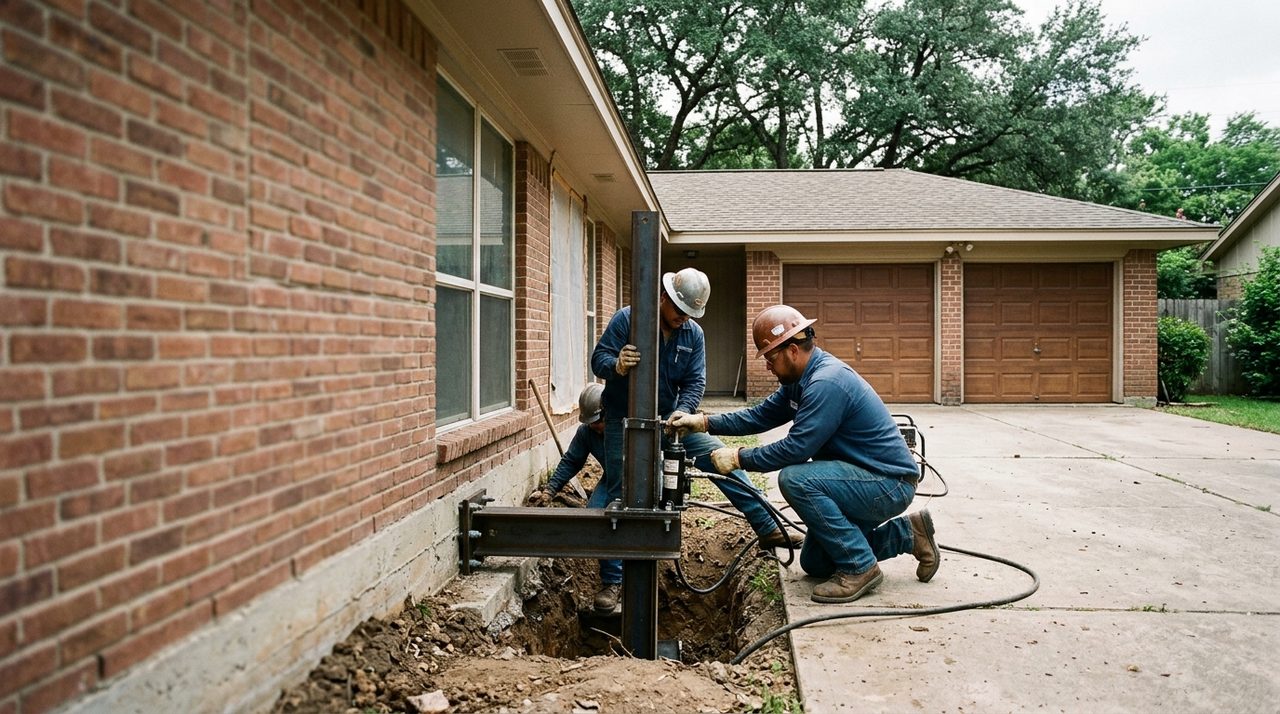
A qualified contractor will take elevation readings at multiple interior and perimeter points before proposing any pier plan — do not accept a proposal that skips this step. For active differential movement on a 1980s-era NW Houston slab, steel push piers or helical piers (not legacy pressed concrete pilings) are generally preferred because they transfer load past the unstable clay layer to deeper bearing soil. Any pier underpinning on a parcel inside Houston city limits requires a permit through the Houston Permitting Center; unincorporated Harris County addresses must permit through the Harris County Engineering Department — confirm which applies to your specific address before signing a contract.
Sources: City of Houston Permitting Center, Municipal permit office (see area profile), International Residential Code (as adopted by City of Houston)
Why it matters to you
The 2022–2023 La Niña drought baked NW Houston's clay soils hard, pulling them away from slab edges and leaving perimeter voids — gaps where the soil has separated from the foundation beam. When Hurricane Beryl's rains arrived in July 2024, water funneled directly into those gaps rather than soaking in gradually, accelerating erosion under the perimeter beam. Suburban lots in NW Houston's subdivisions — many with open lawn grades and spray-irrigation systems calibrated for turf, not foundation perimeters — are particularly prone to this pattern.
What a good pro does
Before any repair, a credible contractor will probe and measure perimeter voids to distinguish active erosion from simple seasonal shrinkage. Mudjacking or polyurethane foam injection ($800–$2,500 per section and $2,000–$5,000 respectively, estimated) can fill voids under the perimeter beam where piers alone won't restore bearing contact. Equally important: after repair, recalibrating your sprinkler system so it runs drip or soaker output along the foundation line during dry months is the primary prevention — most spray heads throw water too far from the slab edge to be effective.
Sources: Harris County Flood Control District, International Residential Code (as adopted by City of Houston)
Why it matters to you
Winter Storm Uri (February 2021) froze and fractured cast-iron under-slab drain lines in an enormous share of NW Houston's 1970s–1990s housing stock — the very era that dominates this area's median build year of 1985. Many homeowners patched wall penetrations and moved on, unaware that hairline cracks in the buried drain lines continued saturating the clay directly beneath the slab. That localized, chronic saturation creates a heave-then-settlement cycle that mimics — and compounds — expansive clay movement, making the true cause easy to misdiagnose.
What a good pro does
Insist on a hydrostatic plumbing test ($250–$400, estimated) before signing any foundation repair contract. This test pressurizes the drain system to identify active leaks under the slab; if leaks exist, a licensed plumber (credentialed through TSBPE) must repair them first, or any pier work will address symptoms rather than causes. Foundation contractors in NW Houston who skip this step on pre-1990 homes should be disqualified from consideration.
Sources: Texas State Board of Plumbing Examiners, International Residential Code (as adopted by City of Houston), City of Houston Permitting Center
Why it matters to you
NW Houston is one of the few parts of the metro where a homeowner truly cannot assume which permit office governs their address. Parcels on one block may fall inside Houston city limits (Houston Permitting Center), while parcels one street over are unincorporated Harris County (Harris County Engineering Department) — each with different application forms, inspection protocols, and fees. Layer on top of that the mandatory architectural committee review required by HOAs like Memorial Northwest Homeowners Association, which can take two to six weeks, and a repair that seems straightforward can sit in administrative limbo before a pier is ever driven.
What a good pro does
Before soliciting bids, confirm your parcel's municipal status using the Harris County Appraisal District property search, then contact the correct permit office to get current fee schedules and inspection requirements. Submit your HOA architectural review application simultaneously — not sequentially — with the permit application, since the two processes run in parallel. Contractors unfamiliar with this dual-jurisdiction reality or who promise to 'handle permits' without specifying which office should be pressed to show prior job permits pulled under the correct jurisdiction for your address.
Sources: City of Houston Permitting Center, Municipal permit office (see area profile), Local HOA / deed restrictions (see area profile)
Hiring foundation repair in NW Houston? NW Houston encompasses dozens of separate subdivisions spanning construction eras from the 1960s through the 2010s, each with its own HOA and deed restrictions. Homeowners here typically manage aging slab-on-grade foundations on expansive clay soils, production-era HVAC systems, and roofing exposed to severe summer heat. Permit jurisdiction varies between the City of Houston and Harris County depending on whether the specific parcel falls inside or outside city limits.
Building era
1970s–2000s, with the largest concentration in the 1980s–1990s.
Typical style
Traditional suburban brick or brick-and-siding one- and two-story homes, Texas traditional with gables and attached garages.
Foundations
Concrete slab-on-grade (predominant for post-1960 tract housing in Harris County).
Common systems
Central A/C with forced-air gas furnaces typical of 1980s–1990s production builds; copper or CPVC supply lines with cast iron or PVC drains; 200-amp electrical panels in newer sections, 100-amp in older 1970s-era homes.
What that means for repairs
Kitchen and bath remodels are common in 1970s–1980s homes reaching 40+ years. Foundation repair due to expansive clay soils is frequent. Roof replacements cycle every 15–20 years due to hail and heat exposure. HOA architectural review is typically required before exterior modifications.
Permit jurisdiction
Mixed — parcels within Houston city limits use the Houston Permitting Center; unincorporated Harris County parcels (common in NW Houston) use Harris County Engineering Department. Verify annexation status per address.
HOA & deed restrictions
Most platted subdivisions have mandatory HOAs or POAs. Notable examples include Memorial Northwest Homeowners Association (mandatory for all property owners) and Meadows of Northwest Park HOA (mandatory). Older unplatted acreage tracts may lack formal HOAs. Confirm HOA status per property via deed records and the TREC HOA Management Certificate Database.
Historic districts
No City of Houston historic district designation confirmed.
Contractor note
Contractors must verify whether a specific address is inside Houston city limits or unincorporated Harris County, as permit requirements and inspection processes differ. Most subdivision HOAs require architectural committee approval before exterior work begins.
FEMA flood zone
FEMA Zone X500 (moderate flood risk) — source: fema_nfhl. Portions of NW Houston near Cypress Creek, White Oak Bayou tributaries, and low-lying creek corridors may carry higher localized flood risk; confirm zone by specific address.
Hurricane Harvey impact
Harvey impact varied significantly across NW Houston. Areas near Cypress Creek and low-lying bayou tributaries experienced serious structural flooding, while higher-ground subdivisions saw little to no flooding. No single characterization applies area-wide. Some NW Houston subdivisions faced post-Harvey HOA disputes including foreclosure actions over unpaid dues and legal costs.
Heat & humidity load
Prolonged 95°F+ heat and high humidity stress aging HVAC systems in 1980s–1990s homes, accelerating compressor failures and ductwork degradation in unconditioned attic spaces. Slab movement peaks during summer drought cycles on expansive clay soils, causing doors to stick and drywall cracks to appear.
Working with contractors here
The most common service calls in NW Houston involve foundation leveling and pier installation on expansive clay soils, HVAC system replacement in 1980s–1990s production homes, and composition shingle roof replacements after hail events. Plumbing repiping is increasingly common as original polybutylene and CPVC lines in 1980s–1990s homes reach end of life. Contractors should plan for HOA architectural review timelines before scheduling exterior work—approval can take two to six weeks depending on the subdivision. Because permit jurisdiction is split between Houston and Harris County, job scoping must begin with confirming the property's municipal status to ensure correct permits and inspections.
Local Tip
Always ask for a written estimate before work begins. Texas contractors are required to provide one on jobs over $1,000.
NW Houston encompasses dozens of separate subdivisions spanning construction eras from the 1960s through the 2010s, each with its own HOA and deed restrictions. Homeowners here typically manage aging slab-on-grade foundations on expansive clay soils, production-era HVAC systems, and roofing exposed to severe summer heat. Permit jurisdiction varies between the City of Houston and Harris County depending on whether the specific parcel falls inside or outside city limits.
Source: U.S. Census Bureau, ACS 5-Year 2023
NW Houston carries FEMA Zone X500 (moderate flood risk): outside the 100-year floodplain but inside the 500-year, so heavy-rain events still reach homes and flood-aware work pays off.
Source: FEMA National Flood Hazard Layer (NFHL). Flood zones vary by parcel — verify your individual FIRM panel.
Post-hurricane inspections in NW Houston should include checking your weep screed and brick mortar joints for new horizontal cracking, which signals foundation movement driven by FEMA Zone X500 in the 500-year floodplain saturation rather than roof or wall damage alone. Catching pier settlement early — before a subsequent dry summer causes further shrinkage — is significantly less expensive than full mudjacking or complete pier replacement. In-city NW Houston work falls under City of Houston floodplain and permitting rules.
Straight-line derecho winds stress a home's structural frame from the top down, but the moment forces reach your mudsill and anchor bolts, any foundation pier that has partially separated from the slab becomes a weak link — especially in NW Houston where moderate rainfall keeps subgrade clays in a variable moisture state. Book a post-derecho foundation inspection that specifically checks interior pier caps and any shimmed connections before you assume the structure is undamaged. In-city NW Houston work falls under City of Houston floodplain and permitting rules.
During Winter Storm Uri, days of below-freezing temperatures caused the top layer of Houston's clay soils to stiffen and then consolidate unevenly as the thaw progressed, and NW Houston properties with previous marginal foundation settlement saw measurable new movement. A pre-winter foundation inspection that confirms interior piers are fully loaded and shimmed correctly helps ensure your structure enters freeze season without pre-existing vulnerability. With a median build year of 1985, the older building stock here is more exposed to hard-freeze damage than newer construction. Confirm the current FEMA panel for your NW Houston parcel — the area maps to Zone X500, but adjacent lots can differ.
Sources: FEMA National Flood Hazard Layer (NFHL), Ready.gov -- Hurricanes, CenterPoint Energy -- Storm Center, City of Houston -- Emergency Preparedness, Ready.gov -- Winter Weather, Harris County Flood Control District
Houston-specific estimators to plan your project before you call a pro. All results are planning estimates — a licensed local pro confirms the details on site.
Grouped by mature root aggression & water demand.
Trunk center to the nearest exterior wall.
The root zone likely reaches your foundation's soil during Houston's dry summers, when clay shrinks most. Watch for sticking doors and diagonal cracks, keep soil moisture even with a soaker hose during drought, and have a foundation pro evaluate if you see any movement.
Find a Houston foundation pro →This is a planning estimate only — actual requirements depend on an on-site assessment by a licensed Houston pro. Guidance is based on general species root behavior in expansive clay, not a soil test.
Disconnect & drain every outdoor hose bib
Remove hoses, drain the spigots, and cover each with an insulated faucet sock. Un-drained hose bibs are the #1 burst point in a Houston freeze.
Insulate exposed pipes in the attic & garage
Wrap any pipe in an unconditioned space (attic runs, garage walls) with foam sleeves. Houston homes rarely insulate these because they only matter a few nights a year — which is exactly why they burst.
Open cabinet doors & keep a pencil-width drip
On hard-freeze nights, open kitchen/bath cabinets so warm air reaches the pipes and let faucets on exterior walls drip to relieve pressure.
Protect the attic/garage water heater & its lines
An attic or garage tank sits in unconditioned space. Insulate the cold-inlet and hot-outlet lines and confirm the emergency drain pan is clear so a leak doesn't reach the ceiling.
This is a planning estimate only — actual requirements depend on an on-site assessment by a licensed Houston pro. If a pipe has already burst, shut off your main water supply and call a licensed Houston plumber immediately — freeze bursts flood fast.
Sources: Municipal permit office (see area profile)City of Houston Permitting Center
Sources: Local HOA / deed restrictions (see area profile)