Closed
11242 Dalebrook Dr, Houston, TX 77016
NE Houston's slab-on-grade homes — many built between the 1960s and 1980s on Harris County's Beaumont and Houston Black clay formations — sit at the intersection of aging infrastructure and some of the most expansive soils in North America. Cast-iron under-slab drain lines damaged during Winter Storm Uri (2021), mature water-oak and Chinese tallow root systems, and decades of wet-dry clay cycling create a foundation-repair environment that rewards homeowners who understand what they're actually dealing with before signing a contract. Whether your address falls inside City of Houston limits or in one of NE Houston's unincorporated Harris County pockets determines who issues your permit and who inspects the work.
Ranked by verified Google rating × review volume × verification tier. How we rank →
Some highly-rated pros serve NE Houston from nearby and may not keep a NE Houston street address. Those are listed under "Also serving NE Houston" with their real city and distance, so you always know where each business is based.
11242 Dalebrook Dr, Houston, TX 77016
12705 Unison Rd, Houston, TX 77044
Highly-rated pros based nearby who cover NE Houston. Distance shown from the NE Houston area.
Serving NE Houston Based in Independence Heights · 4.4 mi away
Serving NE Houston Based in The Heights · 5.5 mi away
Serving NE Houston Based in Independence Heights · 5.6 mi away
Serving NE Houston Based in Independence Heights · 5.8 mi away
Serving NE Houston Based in EaDo · 6.3 mi away
Serving NE Houston Based in Independence Heights · 7.2 mi away
Serving NE Houston Based in Midtown · 7.3 mi away
Why it matters to you
The bulk of older NE Houston was built in the 1960s through 1980s directly on Beaumont and Houston Black clay — formations known for extreme volume change between wet and dry seasons. With the area's census-median build year sitting at 1988, a large share of local slabs have already endured 35-plus years of this cycle. Homeowners commonly see stair-step cracks in brick veneer, doors that stick seasonally, and diagonal drywall cracks above window corners — all signs that one section of the slab is moving independently from another.
What a good pro does
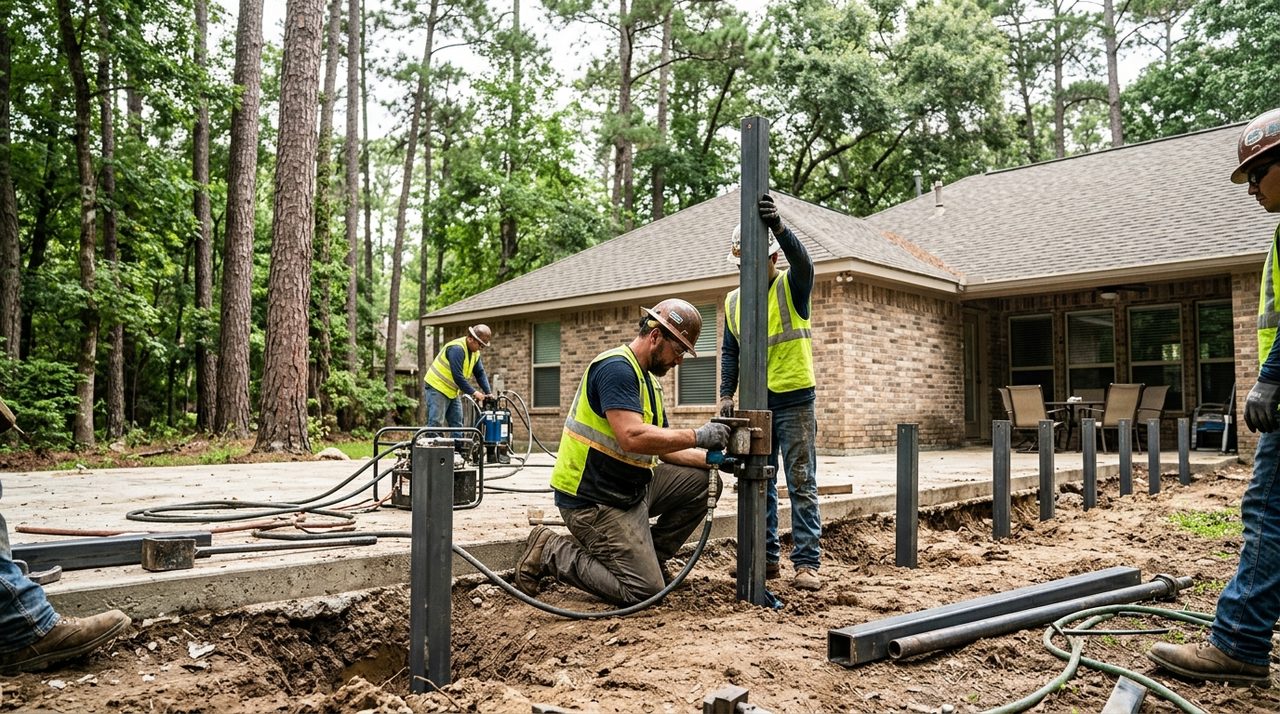
A credible foundation contractor will map crack patterns, measure differential elevation across the slab with a zip-level or optical survey, and distinguish active movement from old settled cracks before recommending any repair. For NE Houston's older slabs, steel push piers driven to a load-bearing stratum (typically 30–60 feet in this part of Harris County) offer a more durable long-term fix than the pressed concrete pilings common in 1980s-era repairs, though costs run $1,200–$1,800 per pier installed (estimate). Require a written report with pier count, depth specification, and load-transfer details before agreeing to any scope.
Sources: International Residential Code (as adopted by City of Houston), City of Houston Permitting Center
Why it matters to you
NE Houston's older sections — particularly ranch-style and minimal-traditional homes built before 1990 — were commonly plumbed with cast-iron drain lines run beneath the slab. Winter Storm Uri in February 2021 froze and cracked thousands of these lines across Harris County. Many owners patched interior walls and moved on, but left under-slab segments intact and leaking. A slow, continuous leak beneath a clay slab creates localized heave as the soil swells, followed by settlement as the soil structure breaks down — mimicking drought-cycle damage but with a completely different cause and fix.
What a good pro does
Before attributing any settlement or interior cracking on a pre-1990 NE Houston home to soil movement alone, insist on a hydrostatic plumbing test — typically $250–$400 (estimate) — performed or overseen by a plumber licensed through the Texas State Board of Plumbing Examiners. If a leak is confirmed, under-slab re-routing or full re-pipe must be completed before foundation lifting begins; lifting over a wet leak will re-settle. The foundation contractor and plumber need to sequence their work, and any plumbing scope within City of Houston limits requires a separate plumbing permit from the Houston Permitting Center.
Sources: Texas State Board of Plumbing Examiners, City of Houston Permitting Center
Why it matters to you
NE Houston's established neighborhoods carry decades-old water oaks, live oaks, and Chinese tallow trees — many with root systems extending 20–40 feet from the trunk and well beneath adjacent slabs. On expansive clay, these roots aggressively extract soil moisture during dry months, causing the clay on the tree side of a slab to shrink and drop while the shaded, moister opposite side remains stable. The result is a tilting slab that can look identical to perimeter void settlement but requires a different primary intervention. Post-Harvey and post-Beryl (2024) replanting has added younger trees to many lots that will become a foundation liability within a decade.
What a good pro does
A thorough site assessment should document every large tree within 30 feet of the foundation, note canopy radius, and correlate tree position with the low corners identified in the elevation survey. Root barriers installed during a repair can slow future moisture depletion, though they are not a permanent solution on lots with multiple mature trees. Maintaining consistent soil moisture with a soaker hose along the drip line during dry spells — especially during La Niña drought years like 2022–2023 — is the most cost-effective long-term strategy. Homeowners in NE Houston's newer master-planned communities such as Summerwood should check HOA architectural guidelines before installing any root barriers or altering landscaping near the foundation perimeter.
Sources: Local HOA / deed restrictions (see area profile), Harris County Flood Control District
Why it matters to you
NE Houston is not a single permit jurisdiction. Homes inside City of Houston limits file for a foundation repair permit through the Houston Permitting Center; properties in unincorporated Harris County pockets follow Harris County Engineering Department rules, which differ in fee structure, required documentation, and inspection scheduling. Some parcels near the Greens Bayou corridor sit in ETJ (extraterritorial jurisdiction) areas where annexation status is murky. Homeowners who assume their contractor knows the right permit office — without verifying the address themselves — risk unpermitted work that surfaces on a TREC seller's disclosure form at resale and exposes them to liability.
What a good pro does
Before signing any repair contract, look up your property's jurisdiction using the Harris County Appraisal District's address search and confirm separately with Houston's Development Services online portal whether your address is inside city limits. Require that your contractor name the specific permit office and provide a permit number before work begins on pier underpinning or any excavation around the perimeter. Texas does not issue a standalone state license for foundation repair contractors through TDLR, so permit compliance and insurance verification — general liability plus workers' compensation — are the primary homeowner protections available.
Sources: City of Houston Permitting Center, Texas Department of Licensing & Regulation, Municipal permit office (see area profile)
Hiring foundation repair in NE Houston? NE Houston encompasses a broad swath of Harris County with housing ranging from mid-century postwar builds to modern master-planned subdivisions. Homeowners here face a wide spectrum of maintenance challenges driven by aging infrastructure in older sections and rapid-growth construction quality concerns in newer developments. Foundation movement, outdated plumbing, and storm hardening are recurring service themes across the area.
Building era
1950s through 2020s, with concentrations in the 1960s–1980s in older sections and 2000s–2020s in newer master-planned communities.
Typical style
Mix of modest ranch-style and minimal traditional homes in older areas; newer subdivisions feature traditional and transitional two-story production homes.
Foundations
Predominantly slab-on-grade; some older pier-and-beam homes exist in the most established sections.
Common systems
Older homes may have galvanized or cast-iron plumbing, original electrical panels (60–100 amp), and aging HVAC units. Newer subdivisions typically feature PEX plumbing, 200-amp panels, and high-efficiency HVAC systems.
What that means for repairs
Older sections see significant plumbing re-pipes, electrical panel upgrades, and kitchen/bath modernizations. Newer subdivisions often require warranty-related repairs and cosmetic upgrades within the first decade.
Permit jurisdiction
Houston Permitting Center for areas within City of Houston limits. Some unincorporated pockets fall under Harris County Engineering. Homeowners should verify ETJ and annexation status for their specific address.
HOA & deed restrictions
HOA presence varies significantly by subdivision. Newer master-planned communities such as Summerwood and Woodforest have mandatory HOAs with architectural review committees. Older established neighborhoods may have voluntary civic clubs or no organized HOA. Not confirmed at a macro-area level - check specific subdivision deed records with the Harris County Clerk.
Historic districts
No City of Houston historic district designation confirmed for the general NE Houston area.
Contractor note
Contractors should verify whether a specific address is within Houston city limits or unincorporated Harris County, as permitting requirements and inspection processes differ. HOA-governed subdivisions may require architectural approval before exterior work begins.
FEMA flood zone
FEMA Zone X (low flood risk) per official NFHL data. However, NE Houston is traversed by Greens Bayou, Halls Bayou, and Hunting Bayou, and localized flooding can occur near these waterways even in Zone X areas. Proximity to specific bayous and drainage channels should be evaluated on a property-by-property basis.
Hurricane Harvey impact
Hurricane Harvey (2017) caused significant flooding across many parts of NE Houston, particularly in areas near Greens Bayou and Halls Bayou corridors. Neighborhoods such as Northshore, Cloverleaf, and areas along Tidwell Road experienced substantial inundation. Specific impact for any given address should be verified through Harris County Flood Control District records, as damage varied block by block.
Heat & humidity load
Houston's extreme summer heat and humidity place heavy demands on HVAC systems, especially in older homes with inadequate insulation and single-pane windows. Slab foundations in expansive clay soils are prone to movement during prolonged dry spells, making foundation watering and monitoring essential. Aging roofing materials in older sections are vulnerable to storm damage during hurricane season.
Working with contractors here
NE Houston's wide range of housing eras creates demand for both modernization and maintenance-focused contractors. In older sections, whole-house re-pipes replacing galvanized and cast-iron plumbing are among the most common major projects, alongside electrical panel upgrades from 60-amp to 200-amp service. Foundation repair is a recurring need due to expansive clay soils and mature tree root systems. In newer master-planned communities, contractors more commonly handle warranty-era issues, fence and patio additions, and HVAC optimization. Job scoping should account for the specific subdivision's age, HOA requirements, and flood history, as post-Harvey remediation work may have altered original systems in unpredictable ways.
Local Tip
Always ask for a written estimate before work begins. Texas contractors are required to provide one on jobs over $1,000.
NE Houston encompasses a broad swath of Harris County with housing ranging from mid-century postwar builds to modern master-planned subdivisions. Homeowners here face a wide spectrum of maintenance challenges driven by aging infrastructure in older sections and rapid-growth construction quality concerns in newer developments. Foundation movement, outdated plumbing, and storm hardening are recurring service themes across the area.
Source: U.S. Census Bureau, ACS 5-Year 2023
Most of NE Houston maps to FEMA Zone X (low mapped flood risk), but Houston's flash-flood reality means even low-risk blocks benefit from smart drainage and storm-hardened installs; risk climbs sharply on blocks nearest Greens Bayou and the San Jacinto River, where it varies parcel to parcel.
Source: FEMA National Flood Hazard Layer (NFHL). Flood zones vary by parcel — verify your individual FIRM panel.
Wind-driven rain during a hurricane can saturate soil on the windward side of your home while the leeward side stays dry, creating differential moisture conditions beneath your slab that show up as sticking doors weeks later in NE Houston. Schedule a Zip-Level elevation reading after any named storm passes so a foundation professional can distinguish normal seasonal movement from storm-induced settlement requiring pier work. In-city NE Houston work falls under City of Houston floodplain and permitting rules.
The May 2024 derecho caused structural racking in thousands of Houston homes, and racking places diagonal tension on slab corners that can widen existing hairline cracks into visible gaps in NE Houston over the following weeks. Schedule a foundation survey within 30 days of any severe wind event to establish a post-storm baseline before summer drying compounds any movement. In-city NE Houston work falls under City of Houston floodplain and permitting rules.
Ice loading from roof accumulation during a hard freeze transfers compressive stress to your foundation corners, and in NE Houston that added load on clay subgrade that has stiffened from cold can create corner settlement that persists after the thaw. A TDLR-licensed foundation contractor should inspect visible brick-to-foundation transitions and interior door frames after any multi-day freeze event, even if no pipe damage occurred. In-city NE Houston work falls under City of Houston floodplain and permitting rules.
Sources: FEMA National Flood Hazard Layer (NFHL), Ready.gov -- Hurricanes, CenterPoint Energy -- Storm Center, City of Houston -- Emergency Preparedness, Ready.gov -- Winter Weather, Harris County Flood Control District
Houston-specific estimators to plan your project before you call a pro. All results are planning estimates — a licensed local pro confirms the details on site.
Grouped by mature root aggression & water demand.
Trunk center to the nearest exterior wall.
The root zone likely reaches your foundation's soil during Houston's dry summers, when clay shrinks most. Watch for sticking doors and diagonal cracks, keep soil moisture even with a soaker hose during drought, and have a foundation pro evaluate if you see any movement.
Find a Houston foundation pro →This is a planning estimate only — actual requirements depend on an on-site assessment by a licensed Houston pro. Guidance is based on general species root behavior in expansive clay, not a soil test.
Disconnect & drain every outdoor hose bib
Remove hoses, drain the spigots, and cover each with an insulated faucet sock. Un-drained hose bibs are the #1 burst point in a Houston freeze.
Insulate exposed pipes in the attic & garage
Wrap any pipe in an unconditioned space (attic runs, garage walls) with foam sleeves. Houston homes rarely insulate these because they only matter a few nights a year — which is exactly why they burst.
Open cabinet doors & keep a pencil-width drip
On hard-freeze nights, open kitchen/bath cabinets so warm air reaches the pipes and let faucets on exterior walls drip to relieve pressure.
Protect the attic/garage water heater & its lines
An attic or garage tank sits in unconditioned space. Insulate the cold-inlet and hot-outlet lines and confirm the emergency drain pan is clear so a leak doesn't reach the ceiling.
This is a planning estimate only — actual requirements depend on an on-site assessment by a licensed Houston pro. If a pipe has already burst, shut off your main water supply and call a licensed Houston plumber immediately — freeze bursts flood fast.
Sources: City of Houston Permitting CenterMunicipal permit office (see area profile)
Sources: Local HOA / deed restrictions (see area profile)
Sources: FEMA National Flood Hazard Layer (NFHL)Texas State Board of Plumbing Examiners