550 Greens Pkwy Suite 290B, Houston, TX 77067
Best Foundation Repair in Greenspoint
Greenspoint's 1970s–1990s slab-on-grade homes sit on Houston Black clay soils that have been through 50 years of wet-dry cycles, and the neighborhood's median build year of 1985 places most of the housing stock squarely in the era of pressed concrete pilings — a repair method now considered controversial and frequently failing. Add Greens Bayou running along the area's eastern edge, cast-iron under-slab drain lines common in pre-1990 construction, and a fragmented POA landscape where exterior-work rules vary subdivision by subdivision, and Greenspoint homeowners face a more layered foundation picture than the repair estimate on their door might suggest.
Verified against Google Business data
Updated 2026
See the 10 Foundation Repair Serving Greenspoint 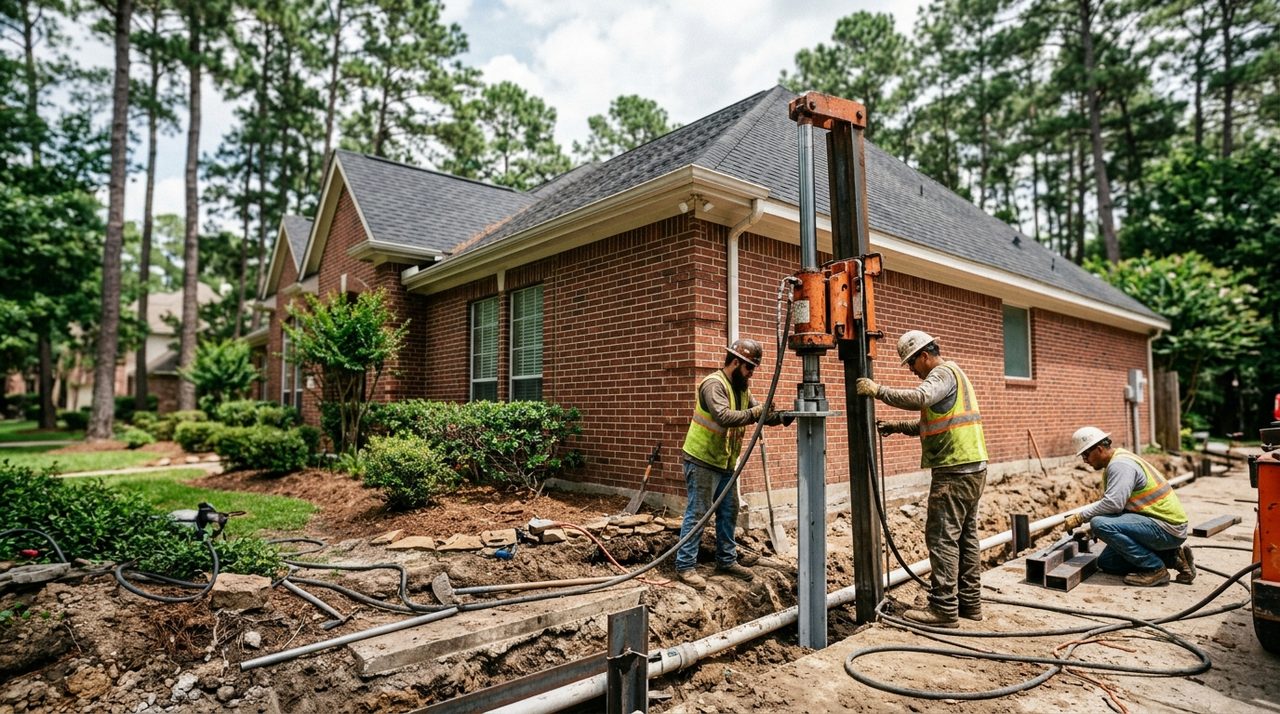
- Median home built
- 1985
- Median home value
- $167,179
- FEMA flood zone
- X (low)
- Typical repair cost (est.)
- $3,500–$25,000 depending on method and pier count
- Most common local issue
- Failing pressed-piling repairs from 1980s–90s original work on clay soils
Ranked by verified Google rating × review volume × verification tier. How we rank →
Some highly-rated pros serve Greenspoint from nearby and may not keep a Greenspoint street address. Those are listed under "Also serving Greenspoint" with their real city and distance, so you always know where each business is based.
Min rating:
10 resultsBased in Greenspoint
550 Greens Pkwy Suite# 244, Houston, TX 77067
Closed
340 N Sam Houston Pkwy E 165 U, Houston, TX 77060
Closed
340 N Sam Houston Pkwy E, Houston, TX 77060
Closed
11747 Birch Run Ln, Houston, TX 77067
13511 Greenlow Dr, Houston, TX 77067
Also serving Greenspoint
Highly-rated pros based nearby who cover Greenspoint. Distance shown from the Greenspoint area.
Serving Greenspoint Based in Acres Homes · 4 mi away
Closed
Serving Greenspoint Based in Spring · 4.2 mi away
Closed
Serving Greenspoint Based in NW Houston · 4.6 mi away
Closed
Serving Greenspoint Based in NW Houston · 5 mi away
Foundation Repair in Greenspoint: What You Should Know
Decades of Clay-Soil Cycling Are Reopening Cracks in 1970s–1990s Slabs
Why it matters to you
The median Greenspoint home was built in 1985 on Houston Black clay — one of the most expansive soil formations in North America — and has absorbed roughly 40 years of seasonal swelling and shrinking. That repeated movement cracks brick veneer at the corners, drags door frames out of square, and opens hairline gaps in interior drywall that widen a little more each drought-and-rain cycle. Homes in this price range (median value approximately $167,000 per ACS 2023) rarely received proactive perimeter irrigation, so voids along the slab edge have been accumulating for years.
What a good pro does
A thorough pre-repair evaluation should include measuring differential elevation across the slab at multiple interior points — not just a visual walk-around — to map which sections have settled versus which have heaved. Before signing any repair contract, get at least three written proposals that each specify pier count, depth to load-bearing soil, and method; estimates for an 1,800–2,400 sq ft Greenspoint slab using steel push piers typically run $10,000–$25,000 (est.), while pressed concrete piling jobs range roughly $3,500–$9,000 (est.). The City of Houston requires a foundation repair permit for underpinning work, so confirm the contractor pulls one through the Houston Permitting Center before any work begins.
Sources: City of Houston Permitting Center, Municipal permit office (see area profile)
Cast-Iron Under-Slab Drains From the Uri Era Are Quietly Saturating Your Foundation
Why it matters to you
Greenspoint homes built before 1990 — the majority of the stock, given a census median build year of 1985 — commonly have cast-iron under-slab drain lines that are now 35–50 years old and were further stressed by Winter Storm Uri's freeze-thaw cycles in February 2021. Many homeowners repaired interior walls after Uri but never tested the buried drain lines. A slow leak under the slab saturates the clay in a localized zone, causing that section to heave while the rest of the slab continues its normal dry-season shrinkage — a pattern that mimics classic differential settlement and can lead to the wrong repair.
What a good pro does
Before attributing movement to soil alone, a reputable foundation contractor should recommend — or at minimum not discourage — a hydrostatic plumbing test, which typically costs $250–$400 (est.) and is performed by a licensed plumber. Under Texas law, any repair or rerouting of under-slab plumbing must be performed or directly supervised by a plumber licensed through the Texas State Board of Plumbing Examiners. Fixing an active leak before underpinning prevents the new piers from working against a soil profile that keeps changing.
Sources: Texas State Board of Plumbing Examiners, City of Houston Permitting Center
Greens Bayou Proximity Means Post-Storm Settlement Can Surface Weeks After the Rain Ends
Why it matters to you
Most of Greenspoint maps to FEMA Zone X, but the zone boundary shifts block by block near Greens Bayou's eastern corridor, and large rain events — including Hurricane Beryl in 2024 and the May 2024 derecho that dropped extreme rainfall totals across North Houston — push bayou-adjacent blocks into prolonged saturation even when they don't officially flood. Extended saturation reconsolidates clay under the slab, and the resulting settlement often doesn't appear as visible cracking until four to eight weeks after the water recedes, well after most homeowners have stopped watching for storm damage.
What a good pro does
If your home is within several blocks of Greens Bayou and you notice new door-sticking or drywall cracking in late summer or fall following a major rain event, schedule a slab elevation survey before winter — not the following spring — so the contractor captures the settled state rather than a partially rebounded reading. Ask specifically whether the company uses a zip-level or optical level (not just a visual inspection) and whether the report will document the readings at each measurement point; that documentation also protects you on the TREC seller's disclosure form if you sell within the next few years.
Sources: FEMA National Flood Hazard Layer (NFHL), Harris County Flood Control District
Fragmented POA Rules Mean a Permit Alone Isn't Enough Approval to Start Digging
Why it matters to you
Greenspoint has no single area-wide HOA; instead, at least eight separate Property Owners Associations — including Greenspoint Landing POA, Northborough POA, Northpoint POA, and Greens Crossing POA among others — govern specific subdivisions, and some lots have no deed restrictions at all while the adjacent property does. Foundation underpinning requires perimeter trenching that is visible from the street, and multiple Greenspoint POAs include architectural review requirements for exterior modifications. A contractor who pulls the City of Houston permit correctly but skips POA notice can leave the homeowner facing a stop-work order or a demand to restore landscaping at their own cost.
What a good pro does
Before signing a repair contract, identify which POA (if any) governs your specific lot — not just your street — by checking the deed at the Harris County Clerk's office or asking your title company. If architectural review is required, get written POA approval before the contractor schedules the crew, because the City of Houston permit and the POA approval are independent processes that run on different timelines. The permit itself is issued through the Houston Permitting Center; confirm the permit number is on file and the inspection is scheduled before the contractor pours any concrete collar or caps any pier.
Sources: Local HOA / deed restrictions (see area profile), City of Houston Permitting Center, Municipal permit office (see area profile)
Foundation Repair in Greenspoint: What You Should Know
Hiring foundation repair in Greenspoint? Greenspoint is a sprawling North Houston area with a mix of single-family subdivisions, multifamily complexes, and commercial properties developed primarily from the 1970s through the 1990s. Homeowners face aging infrastructure concerns typical of that era—original HVAC systems, galvanized or polybutylene plumbing, and slab foundation movement—compounded by proximity to Greens Bayou and associated flood risk. The fragmented POA landscape means deed restrictions and exterior modification rules vary subdivision by subdivision, so contractors should verify requirements before starting work.
- Housing era
- 1970s–1990s, with some later infill
- Foundation
- Predominantly slab-on-grade (inferred from Houston-area building practices for this era
- Flood zone
- FEMA Zone X (low flood risk) per official NFHL data
- Permits
- Houston Permitting Center (City of Houston jurisdiction)
Housing stock & systems
Building era
1970s–1990s, with some later infill.
Typical style
One- and two-story ranch and contemporary suburban tract homes with brick veneer and attached garages (inferred from broader Houston north-side patterns; no Greenspoint-specific architectural survey located).
Foundations
Predominantly slab-on-grade (inferred from Houston-area building practices for this era; not confirmed by a Greenspoint-specific source).
Common systems
Original homes likely have central AC with R-22 refrigerant systems nearing or past end of life, galvanized steel or polybutylene supply lines, copper or cast-iron waste lines, and 100–150 amp electrical panels. Many systems are 30–50 years old and due for replacement.
What that means for repairs
HVAC replacement, re-plumbing to PEX or CPVC, and electrical panel upgrades are common due to system age. Foundation repair is frequent given expansive clay soils and slab-on-grade construction. Kitchen and bath remodels are typical value-add projects in this price-accessible market.
Permits & restrictions
Permit jurisdiction
Houston Permitting Center (City of Houston jurisdiction).
HOA & deed restrictions
No single area-wide HOA. Multiple mandatory Property Owners Associations govern specific subdivisions, including Greenspoint Property Owners' Association Inc., Greenspoint Landing POA, Greenbriar North POA, Northborough POA, Northpoint POA, Town Center POA, Greens Crossing POA, and Rankin Park POA. Some properties in the broader area have no HOA at all. Deed restrictions are subdivision-specific; no unified set exists for 'Greenspoint' as a whole.
Historic districts
No City of Houston historic district designation confirmed.
Contractor note
Because POA governance is fragmented, contractors should confirm which POA (if any) governs a specific property and whether exterior work requires POA architectural review before commencing. Some lots have no HOA restrictions at all, while adjacent ones may have strict covenants.
Flood & weather
FEMA flood zone
FEMA Zone X (low flood risk) per official NFHL data. However, the Greenspoint area sits along Greens Bayou and its tributaries, and properties closer to the bayou channel may carry higher-risk designations. Homeowners should verify individual lot flood zone status, as Zone X designation may not apply uniformly across all parcels in the area.
Hurricane Harvey impact
Research sources did not include Harvey-specific damage reports or high-water-mark data for Greenspoint. The area's proximity to Greens Bayou makes it plausible that sections near the bayou and its tributaries experienced flooding during Harvey, but street-level impact cannot be confirmed from available sources. Homeowners should check Harris County Flood Control District records and FEMA repetitive loss data for their specific address.
Heat & humidity load
Aging 1970s–1990s HVAC systems in this area are heavily stressed during Houston's extreme summer heat and humidity. Original insulation levels are often inadequate by modern standards, driving up cooling costs and accelerating compressor failure. Slab-on-grade foundations on expansive clay soils are vulnerable to differential settlement during summer drought cycles, making foundation monitoring essential.
Working with contractors here
Contractors in Greenspoint most commonly handle HVAC replacement, foundation repair, and whole-house re-plumbing—all driven by the 30–50 year age of the housing stock. Slab foundation leveling with pressed piers is a frequent job given the clay-heavy soils and decades of seasonal moisture cycling. Electrical panel upgrades from original 100-amp service to 200-amp are common as homeowners modernize. Because the area includes a wide range of property conditions and price points, thorough scoping and upfront material cost discussions are important. Contractors should also verify whether the property falls under a POA with architectural review requirements before beginning any exterior work.
Local Tip
Always ask for a written estimate before work begins. Texas contractors are required to provide one on jobs over $1,000.
About Greenspoint
Greenspoint is a sprawling North Houston area with a mix of single-family subdivisions, multifamily complexes, and commercial properties developed primarily from the 1970s through the 1990s. Homeowners face aging infrastructure concerns typical of that era—original HVAC systems, galvanized or polybutylene plumbing, and slab foundation movement—compounded by proximity to Greens Bayou and associated flood risk. The fragmented POA landscape means deed restrictions and exterior modification rules vary subdivision by subdivision, so contractors should verify requirements before starting work.
- Median year built
- 1985
- Median home value
- $167,179
- Owner-occupied
- 43.3%
- Population
- 186,176
- Housing units
- 63,567
- Median income
- $46,300
Source: U.S. Census Bureau, ACS 5-Year 2023
Flood & storm risk
FEMA Zone XLow flood riskMost of Greenspoint maps to FEMA Zone X (low mapped flood risk), but Houston's flash-flood reality means even low-risk blocks benefit from smart drainage and storm-hardened installs; risk climbs sharply on blocks nearest Greens Bayou, where it varies parcel to parcel.
Source: FEMA National Flood Hazard Layer (NFHL). Flood zones vary by parcel — verify your individual FIRM panel.
Houston Storm Readiness in Greenspoint
Hurricane & flooding
Beryl 2024 reminded Houston homeowners that even neighborhoods with low FEMA flood designations experience localized ponding when storm-sewer inlets back up, and that standing water against a foundation for even 12 hours can trigger clay heave in Greenspoint. Before the season, confirm your gutters discharge at least five feet from the foundation and that splash blocks direct water toward the street, keeping clay moisture content consistent beneath the slab. Confirm the current FEMA panel for your Greenspoint parcel — the area maps to Zone X, but adjacent lots can differ.
Severe storms & hail
Hail itself does not crack a concrete foundation, but the insurance repair process — contractors dropping equipment, vibrating compactors near the structure — can disturb marginally stable piers in Greenspoint. Coordinate a brief foundation check with a TDLR-licensed contractor before and after any major roof or exterior repair project that involves heavy equipment operating near your home. Confirm the current FEMA panel for your Greenspoint parcel — the area maps to Zone X, but adjacent lots can differ.
Ice storms & freezes
In Greenspoint, where mapped flood risk is low, the primary post-freeze foundation threat is not surface water but slab-leak-driven soil saturation — Uri 2021 caused widespread pipe failures that fed water silently under slabs for days before homeowners noticed. After any hard freeze, have a plumber pressure-test your lines first, then schedule a foundation elevation check if any under-slab leak is confirmed. With a median build year of 1985, the older building stock here is more exposed to hard-freeze damage than newer construction. Confirm the current FEMA panel for your Greenspoint parcel — the area maps to Zone X, but adjacent lots can differ.
Sources: FEMA National Flood Hazard Layer (NFHL), Ready.gov -- Hurricanes, CenterPoint Energy -- Storm Center, City of Houston -- Emergency Preparedness, Ready.gov -- Winter Weather, Harris County Flood Control District
Free Greenspoint Tools & Calculators
Houston-specific estimators to plan your project before you call a pro. All results are planning estimates — a licensed local pro confirms the details on site.
Houston Soil & Tree Proximity Risk Calculator
Open full tool & FAQ →Grouped by mature root aggression & water demand.
Trunk center to the nearest exterior wall.
Moderate risk
The root zone likely reaches your foundation's soil during Houston's dry summers, when clay shrinks most. Watch for sticking doors and diagonal cracks, keep soil moisture even with a soaker hose during drought, and have a foundation pro evaluate if you see any movement.
Find a Houston foundation pro →This is a planning estimate only — actual requirements depend on an on-site assessment by a licensed Houston pro. Guidance is based on general species root behavior in expansive clay, not a soil test.
Houston Freeze Prep & Pipe Insulation Checklist
Open full tool & FAQ →Your freeze checklist — 4 tasks
- 1
Disconnect & drain every outdoor hose bib
Remove hoses, drain the spigots, and cover each with an insulated faucet sock. Un-drained hose bibs are the #1 burst point in a Houston freeze.
- 2
Insulate exposed pipes in the attic & garage
Wrap any pipe in an unconditioned space (attic runs, garage walls) with foam sleeves. Houston homes rarely insulate these because they only matter a few nights a year — which is exactly why they burst.
- 3
Open cabinet doors & keep a pencil-width drip
On hard-freeze nights, open kitchen/bath cabinets so warm air reaches the pipes and let faucets on exterior walls drip to relieve pressure.
- 4
Protect the attic/garage water heater & its lines
An attic or garage tank sits in unconditioned space. Insulate the cold-inlet and hot-outlet lines and confirm the emergency drain pan is clear so a leak doesn't reach the ceiling.
This is a planning estimate only — actual requirements depend on an on-site assessment by a licensed Houston pro. If a pipe has already burst, shut off your main water supply and call a licensed Houston plumber immediately — freeze bursts flood fast.
Frequently Asked Questions
Do I need a permit from the Houston Permitting Center to have steel push piers installed under my Greenspoint slab?
Yes — because Greenspoint falls entirely within City of Houston jurisdiction, foundation underpinning work including steel push piers or helical piers requires a permit pulled through the Houston Permitting Center, not a suburban municipal office. Your contractor must apply before breaking ground, and an inspection is typically required after pier installation and before backfill. Ask your contractor for the permit number and verify it yourself on the city's online portal rather than taking their word for it.
Sources: City of Houston Permitting CenterMunicipal permit office (see area profile)
My Greenspoint home was built in 1979 and the previous owner had pressed concrete pilings installed sometime in the 1980s — should I redo the whole repair or can the old pilings be reused?
Pressed concrete pilings installed in the 1980s on Houston Black clay have a poor long-term track record: the short pilings (typically 6–7 feet) rarely reach stable bearing soil, and decades of clay movement can cause them to tip or separate. If a new evaluation finds the existing pilings have shifted or the slab has moved again, the most common resolution is to supplement or replace them with steel push piers drilled to refusal on competent soil — a meaningfully different scope and cost (estimated $1,200–$1,800 per steel pier installed). Get proposals from at least three contractors specifying pier depth and count before committing, since recommendations vary widely.
My house is in FEMA Zone X, so does flood risk even matter for my foundation repair planning in Greenspoint?
Zone X means the parcel isn't in a mapped high-risk flood plain, but blocks nearest Greens Bayou can carry significantly higher actual flood exposure than the zone designation suggests, and even Zone X properties absorbed standing water during storms like Harvey (2017) and Beryl (2024). Long-duration saturation after those events reconsolidated the clay beneath slabs and caused settlement that appeared weeks after water receded — a pattern that can affect Zone X homes just as it does AE-zone properties. Ask your foundation contractor whether the soil under your specific slab shows signs of post-flood reconsolidation before attributing all movement to seasonal dry cycles.
Sources: FEMA National Flood Hazard Layer (NFHL)Harris County Flood Control District
My Greenspoint subdivision has a Property Owners Association — do I need their sign-off before the foundation contractor starts digging around my perimeter?
Possibly yes, and you need to check your specific subdivision's rules because Greenspoint has at least eight separate POAs — including Greenspoint Landing, Northborough, Northpoint, and Rankin Park, among others — each with its own deed restrictions, and some lots have no POA at all. Many POAs require an architectural review committee approval before any exterior trenching or ground disturbance, which is a separate step from the Houston Permitting Center permit. Confirm in writing which POA (if any) governs your address and whether they require an application before your contractor mobilizes.
Sources: Local HOA / deed restrictions (see area profile)
What time of year is worst to delay foundation repairs on a 1985 Greenspoint home, and does seasonality affect how long the job takes?
Late summer into early fall — roughly July through October — is when Houston's clay soils are at peak shrinkage after months of heat and low rainfall, which is exactly when perimeter voids are largest and slab stress is highest; waiting through another dry season typically means more slab travel and a larger repair scope. The repair work itself usually takes one to three days once permits are in hand, but City of Houston inspection scheduling can add a week or more to the total timeline. Starting the permitting process in spring, before soils dry out and crack, generally gets you a shorter wait and a more stable baseline measurement during the contractor's elevation survey.
Sources: City of Houston Permitting Center
Should I get a hydrostatic plumbing test before signing a foundation repair contract on my pre-1990 Greenspoint home?
Yes — homes built before 1990 in Greenspoint are likely to have cast-iron under-slab drain lines, and Winter Storm Uri (February 2021) cracked many of these pipes across North Houston; slow leaks from unrepaired cracks saturate clay directly beneath the slab and can cause localized heave that mimics or accelerates soil-movement settlement. A hydrostatic test costs an estimated $250–$400 and must be performed by a plumber licensed through the Texas State Board of Plumbing Examiners (TSBPE). If a leak is found, repair it before any pier work — otherwise you're stabilizing a slab that will continue to shift from a water source the piers can't address.