Closed
2008 N Fry Rd, Houston, TX 77084
The Energy Corridor's housing stock — concentrated in the 1960s through 1980s across dozens of independent subdivisions — sits on Houston's Beaumont Black clay, where seasonal shrink-swell cycles have been stressing slab-on-grade foundations for decades. Add the post-Harvey and post-Beryl saturation history near Buffalo Bayou and the Addicks Reservoir influence zone, along with older under-slab cast-iron drain lines that took a hard hit during Winter Storm Uri, and foundation repair here involves more diagnostic layers than most Houston neighborhoods. This page tells you what's actually driving movement in Energy Corridor homes, which repair methods make sense on local soil conditions, and how to navigate the City of Houston permit process before a contractor breaks ground.
Ranked by verified Google rating × review volume × verification tier. How we rank →
Some highly-rated pros serve Energy Corridor from nearby and may not keep a Energy Corridor street address. Those are listed under "Also serving Energy Corridor" with their real city and distance, so you always know where each business is based.
2008 N Fry Rd, Houston, TX 77084
13501 Katy Fwy, Houston, TX 77079
Highly-rated pros based nearby who cover Energy Corridor. Distance shown from the Energy Corridor area.
Serving Energy Corridor Based in Westchase · 4.3 mi away
Serving Energy Corridor Based in Alief · 4.5 mi away
Serving Energy Corridor Based in Westchase · 4.5 mi away
Serving Energy Corridor Based in Alief · 4.6 mi away
Serving Energy Corridor Based in Westchase · 4.7 mi away
Serving Energy Corridor Based in Cinco Ranch · 5.1 mi away
Serving Energy Corridor Based in Spring Branch · 5.3 mi away
Serving Energy Corridor Based in Katy · 5.3 mi away
Why it matters to you
Energy Corridor ranch and traditional homes built between 1965 and 1985 have experienced 40-plus years of Houston's Beaumont Black clay expanding in wet winters and contracting in dry summers. Each cycle adds a little more stress to the slab, and by the time homeowners notice stair-step brick cracks, sticking interior doors, or drywall gaps at ceiling lines, the differential movement may already span several inches. At a median build year of 1990 and significant 1960s–1980s inventory, a large share of Energy Corridor homes are past the threshold where routine maintenance can substitute for actual underpinning.
What a good pro does
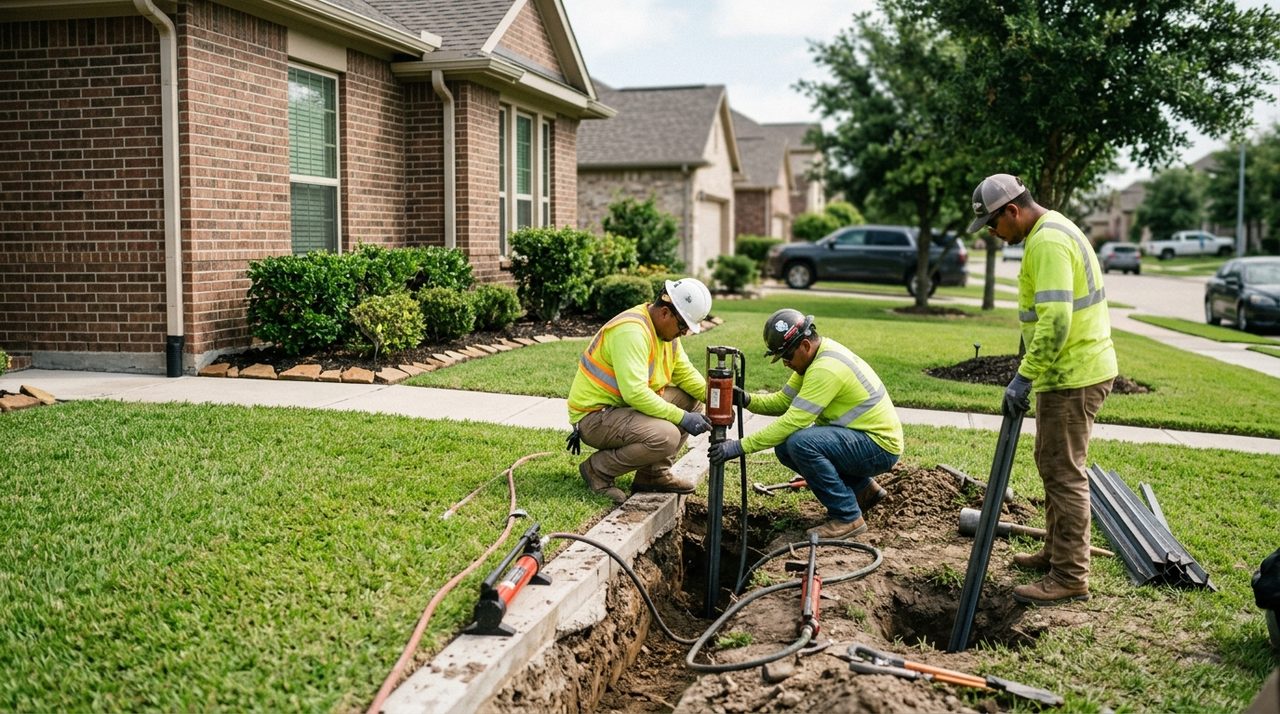
A qualified contractor should provide a written report documenting floor-elevation readings at multiple interior points — not just a visual walk-through — before proposing a pier count or method. Steel push piers are generally preferred over legacy pressed concrete pilings on local clay because they can reach deeper load-bearing strata; pressed piling bids should raise questions given their documented failure rate in Houston's clay. Repair work within Houston city limits requires a foundation repair permit from the City of Houston Permitting Center before work begins.
Sources: City of Houston Permitting Center, Municipal permit office (see area profile), International Residential Code (as adopted by City of Houston)
Why it matters to you
Many Energy Corridor homes in the 1970s–1980s vintage were built with cast-iron under-slab drain lines — the same pipe material that cracked at high rates across West Houston during Winter Storm Uri in February 2021. Cosmetic interior repairs often left the under-slab runs in place. Three-plus years later, slow leaks from those lines are saturating clay directly beneath the slab, causing localized soft spots that first heave as the clay absorbs water, then settle as soil structure deteriorates — a pattern that mimics drought-cycle perimeter void damage but requires a completely different fix.
What a good pro does
Before attributing any settlement to soil movement alone, a responsible Energy Corridor contractor should recommend a hydrostatic plumbing test — typically $250–$400 — to confirm under-slab drain integrity. If a leak is found, a TSBPE-licensed plumber must perform or directly supervise the under-slab pipe repair; that scope cannot be bundled into a general foundation contractor's work without a licensed plumber on the permit. Addressing the plumbing leak first prevents re-saturation from undoing a pier repair within just a few years.
Sources: Texas State Board of Plumbing Examiners, City of Houston Permitting Center, Municipal permit office (see area profile)
Why it matters to you
Most of the Energy Corridor maps to FEMA Zone X, which sounds reassuring, but Harvey's 2017 reservoir releases and Beryl's 2024 flooding demonstrated that parcel-level flood risk in this district is highly variable — blocks nearest the Addicks Reservoir pool boundary and Buffalo Bayou's drainage corridor saw standing water for days to weeks even when official flood maps showed low risk. Prolonged saturation reconsolidates Beaumont clay and can trigger post-event settlement weeks after water recedes, particularly in homes whose slabs were already stressed by prior drought cycles. A foundation company should always cross-reference the specific lot's flood history, not just the FEMA zone designation on the neighborhood level.
What a good pro does
Request that any contractor pull the HCFCD flood inundation data for the specific parcel address rather than relying on the general Zone X designation. For homes in or near the Addicks influence corridor, helical piers — which can be torqued to verified load capacity in variable soil — may outperform push piers where soil bearing capacity is inconsistent after repeated saturation cycles. Cost estimates for helical piers run $1,500–$2,200 per pier installed; a typical Energy Corridor job requiring 10–14 piers falls in the $15,000–$30,000 range (estimate). Permit documentation from the City of Houston Permitting Center should capture post-repair elevation data for any future flood-zone review.
Sources: FEMA National Flood Hazard Layer (NFHL), Harris County Flood Control District, City of Houston Permitting Center
Why it matters to you
Unlike master-planned communities such as Cinco Ranch or Bridgeland that operate under a single umbrella HOA, the Energy Corridor is a patchwork of individual subdivision POAs, deed-restriction regimes, and unaffiliated streets — the Energy Corridor District itself is a commercial management district with no residential architectural authority. A homeowner in Memorial Drive Acres Section I faces a mandatory POA review process for exterior work; a homeowner three streets away may face only recorded deed restrictions with no active enforcement body. Getting this wrong means trenching around a perimeter, exposing piers, and staging equipment in a front yard without the approval that a specific subdivision's covenants actually require — creating a resale disclosure problem and potential covenant-violation liability.
What a good pro does
Before signing a foundation repair contract, confirm in writing which subdivision plat your address falls under and whether that plat's recorded restrictions or an active POA require architectural committee approval for exterior structural work. Texas law requires sellers to disclose known foundation movement and repairs on the TREC disclosure form, so complete documentation — including the City of Houston permit, inspection sign-offs, and any HOA approval letters — protects your resale position. Contractors who operate across multiple Energy Corridor subdivisions regularly should be able to identify the relevant approval process for your specific block before submitting a proposal.
Sources: Local HOA / deed restrictions (see area profile), City of Houston Permitting Center, Municipal permit office (see area profile)
Hiring foundation repair in Energy Corridor? The Energy Corridor is a broad West Houston district encompassing multiple subdivisions rather than a single platted neighborhood, so home service needs vary significantly by block. Housing stock ranges from mid-century to newer infill construction, and homeowners must navigate a patchwork of deed restrictions and HOA requirements that differ by subdivision. Proximity to Addicks Reservoir and Buffalo Bayou drainage basins makes flood awareness essential even in lower-risk zones.
Building era
Mixed, primarily 1960s–1980s with newer infill and townhome development continuing through present.
Typical style
Heterogeneous — ranch, traditional, contemporary, and townhome styles all present across the district's many subdivisions.
Foundations
Predominantly slab-on-grade, consistent with broader Houston construction norms; some older homes near Memorial may have pier-and-beam.
Common systems
Older homes likely have original or first-generation replacement central HVAC, copper or galvanized plumbing depending on era, and electrical panels ranging from 100-amp to 200-amp. Newer construction typically features high-efficiency HVAC and PEX plumbing.
What that means for repairs
Older 1960s–1980s homes frequently undergo HVAC replacement, kitchen and bath remodeling, and plumbing repipes. Post-Harvey flood remediation and hardening drove significant renovation activity in flood-affected pockets. Newer townhome communities tend to require less structural renovation but may need cosmetic updates.
Permit jurisdiction
City of Houston Permitting Center for properties within Houston city limits, which covers most of the Energy Corridor. Properties outside city limits would fall under Harris County Engineering.
HOA & deed restrictions
Mixed HOA landscape — no single umbrella HOA governs the entire Energy Corridor. Individual subdivisions such as Memorial Drive Acres Section I have mandatory POAs/HOAs, while other areas operate under deed restrictions without an active mandatory association. The Energy Corridor District is a business/management district, not a residential HOA.
Historic districts
No City of Houston historic district designation confirmed for the Energy Corridor area.
Contractor note
Contractors must verify which specific subdivision's deed restrictions or HOA architectural review process applies before beginning exterior work, as rules vary significantly across the district. Always confirm the property is within Houston city limits for correct permit jurisdiction.
FEMA flood zone
FEMA Zone X (low flood risk) per official NFHL data. However, portions of the Energy Corridor sit near Buffalo Bayou and within the Addicks Reservoir influence zone, so flood risk can vary significantly by parcel. Homeowners should verify individual property flood status through HCFCD and FEMA maps.
Hurricane Harvey impact
District-wide Harvey flooding severity could not be confirmed from available research. Given proximity to Addicks Reservoir controlled-release zones and Buffalo Bayou drainage basins, some pockets within the Energy Corridor likely experienced significant flooding, but specific streets and depths require parcel-level flood documentation to verify.
Heat & humidity load
Houston's extreme summer heat and humidity stress aging HVAC systems common in 1970s–1980s housing stock. Older units may struggle with efficiency, driving high energy costs. Slab foundations are susceptible to soil movement during drought-to-rain cycles, and heavy summer storms can expose drainage deficiencies in older subdivisions.
Working with contractors here
Contractors in the Energy Corridor most commonly handle HVAC replacement and repair in aging 1970s–1980s homes, plumbing repipes from galvanized to PEX, and foundation repair driven by Houston's expansive clay soils. Post-Harvey flood remediation — including drywall replacement, mold remediation, and flood-proofing upgrades — has been a significant category of work in affected pockets near reservoir influence zones. Because the district encompasses many different subdivisions with varying deed restrictions and HOA requirements, contractors should confirm architectural review and approval processes before beginning any exterior modifications. Job scoping should account for the wide variation in housing age and condition across the district.
Local Tip
Always ask for a written estimate before work begins. Texas contractors are required to provide one on jobs over $1,000.
The Energy Corridor is a broad West Houston district encompassing multiple subdivisions rather than a single platted neighborhood, so home service needs vary significantly by block. Housing stock ranges from mid-century to newer infill construction, and homeowners must navigate a patchwork of deed restrictions and HOA requirements that differ by subdivision. Proximity to Addicks Reservoir and Buffalo Bayou drainage basins makes flood awareness essential even in lower-risk zones.
Source: U.S. Census Bureau, ACS 5-Year 2023
Most of Energy Corridor maps to FEMA Zone X (low mapped flood risk), but Houston's flash-flood reality means even low-risk blocks benefit from smart drainage and storm-hardened installs; risk climbs sharply on blocks nearest Buffalo Bayou and the Addicks/Barker reservoirs, where it varies parcel to parcel.
Source: FEMA National Flood Hazard Layer (NFHL). Flood zones vary by parcel — verify your individual FIRM panel.
Beryl 2024 reminded Houston homeowners that even neighborhoods with low FEMA flood designations experience localized ponding when storm-sewer inlets back up, and that standing water against a foundation for even 12 hours can trigger clay heave in Energy Corridor. Before the season, confirm your gutters discharge at least five feet from the foundation and that splash blocks direct water toward the street, keeping clay moisture content consistent beneath the slab. Because Energy Corridor drains toward Buffalo Bayou and the Addicks/Barker reservoirs, block-level runoff can differ sharply from the mapped zone.
Even with low mapped flood risk, Energy Corridor is not immune to the localized sheet flow that accompanies a Houston severe thunderstorm, and repeated minor inundation at the foundation perimeter sustains the clay moisture that drives slow heave cycles. A pre-storm season inspection confirming that soil grade, splash blocks, and downspout extensions all direct water away from the slab is the most cost-effective foundation repair step you can take. Because Energy Corridor drains toward Buffalo Bayou and the Addicks/Barker reservoirs, block-level runoff can differ sharply from the mapped zone.
Winter Storm Uri's multi-day freeze caused Houston clay soils to go through freeze-thaw cycling not common in the region, and even low-flood-risk neighborhoods in Energy Corridor saw new door-sticking and brick-step cracking appear in the spring following the storm. A post-winter Zip-Level survey establishes whether that movement is seasonal and self-correcting or progressive and in need of pier work before summer drying amplifies the differential. In-city Energy Corridor work falls under City of Houston floodplain and permitting rules.
Sources: FEMA National Flood Hazard Layer (NFHL), Ready.gov -- Hurricanes, CenterPoint Energy -- Storm Center, City of Houston -- Emergency Preparedness, Ready.gov -- Winter Weather, Harris County Flood Control District
Houston-specific estimators to plan your project before you call a pro. All results are planning estimates — a licensed local pro confirms the details on site.
Grouped by mature root aggression & water demand.
Trunk center to the nearest exterior wall.
The root zone likely reaches your foundation's soil during Houston's dry summers, when clay shrinks most. Watch for sticking doors and diagonal cracks, keep soil moisture even with a soaker hose during drought, and have a foundation pro evaluate if you see any movement.
Find a Houston foundation pro →This is a planning estimate only — actual requirements depend on an on-site assessment by a licensed Houston pro. Guidance is based on general species root behavior in expansive clay, not a soil test.
Disconnect & drain every outdoor hose bib
Remove hoses, drain the spigots, and cover each with an insulated faucet sock. Un-drained hose bibs are the #1 burst point in a Houston freeze.
Insulate exposed pipes in the attic & garage
Wrap any pipe in an unconditioned space (attic runs, garage walls) with foam sleeves. Houston homes rarely insulate these because they only matter a few nights a year — which is exactly why they burst.
Open cabinet doors & keep a pencil-width drip
On hard-freeze nights, open kitchen/bath cabinets so warm air reaches the pipes and let faucets on exterior walls drip to relieve pressure.
Protect the attic/garage water heater & its lines
An attic or garage tank sits in unconditioned space. Insulate the cold-inlet and hot-outlet lines and confirm the emergency drain pan is clear so a leak doesn't reach the ceiling.
This is a planning estimate only — actual requirements depend on an on-site assessment by a licensed Houston pro. If a pipe has already burst, shut off your main water supply and call a licensed Houston plumber immediately — freeze bursts flood fast.
Sources: City of Houston Permitting CenterMunicipal permit office (see area profile)
Sources: FEMA National Flood Hazard Layer (NFHL)Harris County Flood Control District
Sources: Local HOA / deed restrictions (see area profile)