11111 Katy Fwy Suite 910-928, Houston, TX 77079
Best AC Repair in Energy Corridor
The Energy Corridor's broad swath of West Houston real estate — much of it built during the 1960s through 1980s oil-boom years — means a large share of homeowners are wrestling with aging first-generation or deferred-replacement HVAC systems sitting on Houston's high-plasticity Black clay soil, where seasonal ground movement quietly stresses refrigerant line sets and condenser pads with each wet-dry cycle. Layer on top of that the district's subdivision-by-subdivision patchwork of deed restrictions and the City of Houston's mechanical permit requirements, and an AC replacement or major repair here involves more coordination than in a single master-planned suburb. This page cuts through that complexity with Energy Corridor-specific guidance on what actually goes wrong, what it costs, and how to get the work done correctly.
Verified against Google Business data
Updated 2026
See the 10 AC Repair Serving Energy Corridor 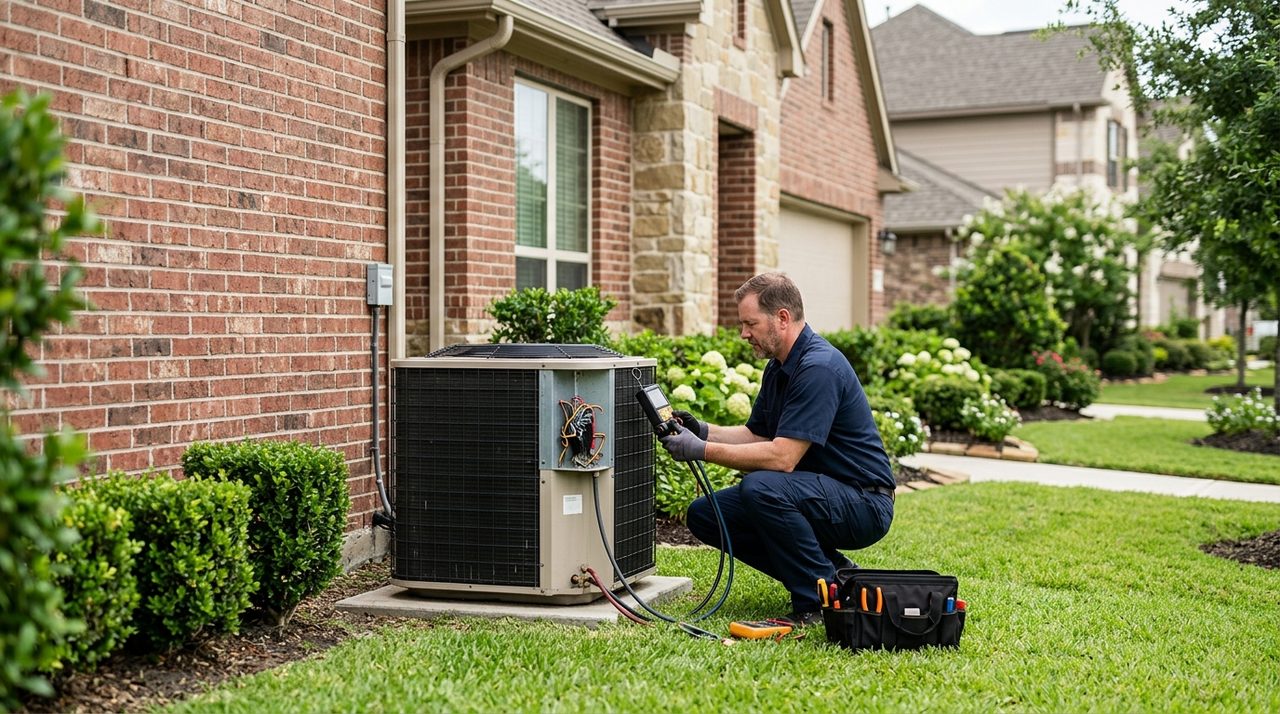
- Median home built
- 1990
- Median home value
- $350,910
- FEMA flood zone
- X (low)
- Typical system replacement (est.)
- $5,500–$9,500
- Most common local issue
- Aging 1970s–80s R-22 equipment at refrigerant end-of-life
Ranked by verified Google rating × review volume × verification tier. How we rank →
Some highly-rated pros serve Energy Corridor from nearby and may not keep a Energy Corridor street address. Those are listed under "Also serving Energy Corridor" with their real city and distance, so you always know where each business is based.
Min rating:
10 resultsBased in Energy Corridor
Closed
14511 Old Katy Rd Suite 330, Houston, TX 77079
Closed
430 S Texas 6, Houston, TX 77079
Also serving Energy Corridor
Highly-rated pros based nearby who cover Energy Corridor. Distance shown from the Energy Corridor area.
Open Now
Serving Energy Corridor Based in Westchase · 0.5 mi away
Serving Energy Corridor Based in Westchase · 1.3 mi away
Serving Energy Corridor Based in Westchase · 1.4 mi away
Closed
Serving Energy Corridor Based in Westchase · 1.4 mi away
Open Now
Serving Energy Corridor Based in Westchase · 2.2 mi away
Closed
Serving Energy Corridor Based in Westchase · 2.7 mi away
Closed
Serving Energy Corridor Based in Alief · 3.2 mi away
AC Repair in Energy Corridor: What You Should Know
1970s–80s R-22 Systems Hitting a Refrigerant Dead End in Aging Energy Corridor Homes
Why it matters to you
A substantial portion of the Energy Corridor's owner-occupied housing stock — the area's median year built is 1990, but much of the corridor's core residential sections date to the 1960s–1980s — still runs original or first-generation replacement systems charged with R-22 refrigerant. Since January 2020, the EPA has banned new R-22 production, and reclaimed stock on the Houston market now commands $80–$150 per pound, making even a modest leak repair a $600–$1,500+ proposition that rarely pencils out economically relative to full replacement.
What a good pro does
A qualified technician should perform a thorough leak-detection check before recommending any refrigerant top-off on a pre-2010 system; if a leak is found, full system replacement is almost always the financially sound path. All replacement work in the City of Houston requires a mechanical permit pulled by a TDLR-licensed contractor through the COH One-Stop portal — homeowner self-pull is not allowed — and the permit triggers a City inspection that protects you if you ever sell.
Sources: Texas Department of Licensing & Regulation, City of Houston Permitting Center
Clay Soil Movement Kinking Line Sets Under and Around Energy Corridor Slabs
Why it matters to you
West Houston sits squarely on Houston's high-plasticity Beaumont/Houston Black clay, and the Energy Corridor's many slab-on-grade homes from the 1970s and 1980s are old enough that their original refrigerant line sets have ridden through decades of seasonal clay swell and shrink. Each wet-dry cycle can shift the slab a fraction of an inch, progressively stressing copper line sets where they exit the foundation or run through pad penetrations; hairline kinks and micro-fractures produce slow refrigerant leaks that present as mysteriously poor cooling rather than an obvious failure.
What a good pro does
When diagnosing a slow refrigerant loss on an Energy Corridor home built before 2000, a good technician will trace the line set from the air handler to the condenser pad and probe for stress points at slab penetrations, not just check the coil and service valves. If line-set replacement is needed, the work requires a City of Houston mechanical permit; confirm the permit is pulled before work begins, since unpermitted line-set work can surface as a defect during a future home sale.
Sources: City of Houston Permitting Center, Texas Department of Licensing & Regulation
Slab-on-Grade Condensate Drain Overflows Feeding Moisture Into Energy Corridor Interiors
Why it matters to you
Houston's Gulf humidity regularly pushes relative humidity above 90 percent, and the Energy Corridor's interior air handlers — many installed in tight closet configurations in 1970s–1980s ranch and traditional homes — generate heavy condensate loads all summer. On slab-on-grade construction, an overflowing secondary drain pan has nowhere to drain gravity-to-floor-drain; the water instead tracks beneath drywall or under flooring, creating the ideal conditions for mold in air handlers and sub-slab moisture intrusion that can be expensive to remediate.
What a good pro does
Annual condensate drain flushing with a biocide treatment (typically $95–$225 per visit) is the single highest-return preventive HVAC service call in this climate. For homes where the air handler closet lacks a proper floor drain or secondary pan float switch, a good contractor will retrofit a float switch that kills the system before overflow rather than waiting for water damage to appear — a straightforward add-on during any service visit that City of Houston mechanical work covers under the same permit.
Sources: City of Houston Permitting Center, Texas Department of Licensing & Regulation
Subdivision-by-Subdivision HOA Rules Adding a Second Approval Track to Condenser Replacement
Why it matters to you
Unlike a single master-planned suburb governed by one HOA, the Energy Corridor is an assemblage of individual subdivisions — Memorial Drive Acres and others — each carrying its own deed restrictions on exterior modifications including condenser unit placement, screening requirements, and sometimes fence or lattice materials around mechanical equipment. The Energy Corridor District itself is a business and management district, not a residential HOA, so homeowners cannot look to one umbrella body for answers; they need to pull their specific subdivision's CC&Rs before any exterior condenser work begins.
What a good pro does
Before a contractor schedules a condenser replacement, request your subdivision's deed restrictions from the Harris County Clerk's recorded plat records or your title documents and check for any language referencing 'mechanical equipment,' 'screening,' or 'architectural review.' City of Houston mechanical permit approval and subdivision HOA/POA approval are parallel tracks — you need both, and HOA approval does not substitute for a City permit. A contractor who skips the deed-restriction check can leave you with a compliant permit and a neighbor-filed deed-restriction complaint.
Sources: Local HOA / deed restrictions (see area profile), City of Houston Permitting Center
AC Repair in Energy Corridor: What You Should Know
Hiring ac repair in Energy Corridor? The Energy Corridor is a broad West Houston district encompassing multiple subdivisions rather than a single platted neighborhood, so home service needs vary significantly by block. Housing stock ranges from mid-century to newer infill construction, and homeowners must navigate a patchwork of deed restrictions and HOA requirements that differ by subdivision. Proximity to Addicks Reservoir and Buffalo Bayou drainage basins makes flood awareness essential even in lower-risk zones.
- Housing era
- Mixed, primarily 1960s–1980s with newer infill and townhome development continuing through present
- Foundation
- Predominantly slab-on-grade, consistent with broader Houston construction norms
- Flood zone
- FEMA Zone X (low flood risk) per official NFHL data
- Permits
- City of Houston Permitting Center for properties within Houston city limits, which covers most…
Housing stock & systems
Building era
Mixed, primarily 1960s–1980s with newer infill and townhome development continuing through present.
Typical style
Heterogeneous — ranch, traditional, contemporary, and townhome styles all present across the district's many subdivisions.
Foundations
Predominantly slab-on-grade, consistent with broader Houston construction norms; some older homes near Memorial may have pier-and-beam.
Common systems
Older homes likely have original or first-generation replacement central HVAC, copper or galvanized plumbing depending on era, and electrical panels ranging from 100-amp to 200-amp. Newer construction typically features high-efficiency HVAC and PEX plumbing.
What that means for repairs
Older 1960s–1980s homes frequently undergo HVAC replacement, kitchen and bath remodeling, and plumbing repipes. Post-Harvey flood remediation and hardening drove significant renovation activity in flood-affected pockets. Newer townhome communities tend to require less structural renovation but may need cosmetic updates.
Permits & restrictions
Permit jurisdiction
City of Houston Permitting Center for properties within Houston city limits, which covers most of the Energy Corridor. Properties outside city limits would fall under Harris County Engineering.
HOA & deed restrictions
Mixed HOA landscape — no single umbrella HOA governs the entire Energy Corridor. Individual subdivisions such as Memorial Drive Acres Section I have mandatory POAs/HOAs, while other areas operate under deed restrictions without an active mandatory association. The Energy Corridor District is a business/management district, not a residential HOA.
Historic districts
No City of Houston historic district designation confirmed for the Energy Corridor area.
Contractor note
Contractors must verify which specific subdivision's deed restrictions or HOA architectural review process applies before beginning exterior work, as rules vary significantly across the district. Always confirm the property is within Houston city limits for correct permit jurisdiction.
Flood & weather
FEMA flood zone
FEMA Zone X (low flood risk) per official NFHL data. However, portions of the Energy Corridor sit near Buffalo Bayou and within the Addicks Reservoir influence zone, so flood risk can vary significantly by parcel. Homeowners should verify individual property flood status through HCFCD and FEMA maps.
Hurricane Harvey impact
District-wide Harvey flooding severity could not be confirmed from available research. Given proximity to Addicks Reservoir controlled-release zones and Buffalo Bayou drainage basins, some pockets within the Energy Corridor likely experienced significant flooding, but specific streets and depths require parcel-level flood documentation to verify.
Heat & humidity load
Houston's extreme summer heat and humidity stress aging HVAC systems common in 1970s–1980s housing stock. Older units may struggle with efficiency, driving high energy costs. Slab foundations are susceptible to soil movement during drought-to-rain cycles, and heavy summer storms can expose drainage deficiencies in older subdivisions.
Working with contractors here
Contractors in the Energy Corridor most commonly handle HVAC replacement and repair in aging 1970s–1980s homes, plumbing repipes from galvanized to PEX, and foundation repair driven by Houston's expansive clay soils. Post-Harvey flood remediation — including drywall replacement, mold remediation, and flood-proofing upgrades — has been a significant category of work in affected pockets near reservoir influence zones. Because the district encompasses many different subdivisions with varying deed restrictions and HOA requirements, contractors should confirm architectural review and approval processes before beginning any exterior modifications. Job scoping should account for the wide variation in housing age and condition across the district.
Local Tip
Always ask for a written estimate before work begins. Texas contractors are required to provide one on jobs over $1,000.
About Energy Corridor
The Energy Corridor is a broad West Houston district encompassing multiple subdivisions rather than a single platted neighborhood, so home service needs vary significantly by block. Housing stock ranges from mid-century to newer infill construction, and homeowners must navigate a patchwork of deed restrictions and HOA requirements that differ by subdivision. Proximity to Addicks Reservoir and Buffalo Bayou drainage basins makes flood awareness essential even in lower-risk zones.
- Median year built
- 1990
- Median home value
- $350,910
- Owner-occupied
- 57.4%
- Population
- 144,655
- Housing units
- 55,302
- Median income
- $84,174
Source: U.S. Census Bureau, ACS 5-Year 2023
Flood & storm risk
FEMA Zone XLow flood riskMost of Energy Corridor maps to FEMA Zone X (low mapped flood risk), but Houston's flash-flood reality means even low-risk blocks benefit from smart drainage and storm-hardened installs; risk climbs sharply on blocks nearest Buffalo Bayou and the Addicks/Barker reservoirs, where it varies parcel to parcel.
Source: FEMA National Flood Hazard Layer (NFHL). Flood zones vary by parcel — verify your individual FIRM panel.
Houston Storm Readiness in Energy Corridor
Hurricane & flooding
After a hurricane passes through Energy Corridor, clear debris from condenser coil fins with a gentle water rinse before restoring power — compressed leaf litter and shingle granules restrict airflow and can overheat the compressor on a first cooling call during the post-storm heat spike. A TDLR-licensed technician can also inspect the refrigerant charge, which can shift if the unit was significantly jostled. Because Energy Corridor drains toward Buffalo Bayou and the Addicks/Barker reservoirs, block-level runoff can differ sharply from the mapped zone.
Severe storms & hail
Wind-driven rain during a severe thunderstorm can overwhelm attic ventilation in Energy Corridor and soak fiberglass duct insulation, reducing system efficiency for weeks until the insulation dries — a post-storm attic check for wet duct wrap costs far less than the efficiency loss on your summer CenterPoint bill. A TDLR-licensed HVAC technician can re-wrap and seal affected sections during a single service visit. Because Energy Corridor drains toward Buffalo Bayou and the Addicks/Barker reservoirs, block-level runoff can differ sharply from the mapped zone.
Ice storms & freezes
Hard freezes in Energy Corridor can crack condensate trap fittings in attic air handlers, flooding the secondary pan and ceiling drywall the moment temperatures rise — replace plastic condensate traps with PVC cemented fittings and confirm float-switch operation before winter as a direct freeze-prep step. This ten-minute inspection by a licensed HVAC technician prevents the water-damage call that follows the thaw. In-city Energy Corridor work falls under City of Houston floodplain and permitting rules.
Sources: FEMA National Flood Hazard Layer (NFHL), Ready.gov -- Hurricanes, CenterPoint Energy -- Storm Center, City of Houston -- Emergency Preparedness, Ready.gov -- Winter Weather, Harris County Flood Control District
Free Energy Corridor Tools & Calculators
Houston-specific estimators to plan your project before you call a pro. All results are planning estimates — a licensed local pro confirms the details on site.
Houston AC Tonnage & Sizing Estimator
Open full tool & FAQ →Living space you want cooled (400–10,000 sq ft).
5.0tons
Recommended nominal size
60,000 BTU/hr
Estimated cooling load
This is a planning estimate only — actual requirements depend on an on-site assessment by a licensed Houston pro. Houston's humidity and long cooling season make an oversized unit a common, costly mistake — it short-cycles and never dehumidifies. A licensed contractor confirms sizing with a full Manual J calculation.
Houston Freeze Prep & Pipe Insulation Checklist
Open full tool & FAQ →Your freeze checklist — 4 tasks
- 1
Disconnect & drain every outdoor hose bib
Remove hoses, drain the spigots, and cover each with an insulated faucet sock. Un-drained hose bibs are the #1 burst point in a Houston freeze.
- 2
Insulate exposed pipes in the attic & garage
Wrap any pipe in an unconditioned space (attic runs, garage walls) with foam sleeves. Houston homes rarely insulate these because they only matter a few nights a year — which is exactly why they burst.
- 3
Open cabinet doors & keep a pencil-width drip
On hard-freeze nights, open kitchen/bath cabinets so warm air reaches the pipes and let faucets on exterior walls drip to relieve pressure.
- 4
Protect the attic/garage water heater & its lines
An attic or garage tank sits in unconditioned space. Insulate the cold-inlet and hot-outlet lines and confirm the emergency drain pan is clear so a leak doesn't reach the ceiling.
This is a planning estimate only — actual requirements depend on an on-site assessment by a licensed Houston pro. If a pipe has already burst, shut off your main water supply and call a licensed Houston plumber immediately — freeze bursts flood fast.
Frequently Asked Questions
Do I need a City of Houston mechanical permit for AC replacement in the Energy Corridor, or does it depend on my subdivision?
For most Energy Corridor addresses, the permitting authority is the City of Houston Permitting Center, since the majority of the district falls within Houston city limits — not a separate suburban municipality with its own permit office. Your licensed HVAC contractor must pull a mechanical permit through the city's One-Stop portal before replacing equipment; homeowners cannot self-pull for HVAC work. If your property sits in an unincorporated pocket outside city limits, Harris County Engineering handles the permit instead, so confirm your parcel's jurisdiction before scheduling work.
Sources: City of Houston Permitting CenterTexas Department of Licensing & Regulation
My Energy Corridor home was built in 1974 and survived Harvey and the 2021 freeze — should I expect the original line sets to still be intact?
A 50-year-old copper line set on West Houston's high-plasticity clay soil has endured decades of seasonal shrink-swell cycles, plus the thermal shock of Uri's 2021 freeze, which cracked refrigerant lines and split drain pans in tens of thousands of Harris County homes — making latent leaks a real possibility even if the system still runs. When a technician opens the system, ask them to pressure-test the line set separately from the equipment, not just check operating pressures, so a slow refrigerant leak from a micro-fracture doesn't get missed. If original copper lines run beneath or through your slab, replacement may require routing new lines externally — budget that into any full-system estimate.
My Energy Corridor block is FEMA Zone X, so am I okay to install a standard ground-level condenser pad without any elevation or flood-hardening?
Zone X means your parcel carries low mapped flood risk, but Energy Corridor's proximity to Addicks Reservoir and Buffalo Bayou drainage basins means localized flash flooding can reach blocks that never appear on FEMA flood maps — a dynamic Houston homeowners learned acutely during Harvey. Elevating a condenser unit on a raised concrete pad or equipment stand (typically 4–8 inches) is a low-cost precaution that can prevent corrosive flood contact during intense rain events, even in Zone X. Ask your contractor whether the specific side of your property drains toward or away from the nearest bayou tributary before finalizing placement.
My subdivision in the Energy Corridor has an HOA — will they need to approve my condenser unit replacement before the city permit inspection happens?
The Energy Corridor has no single governing HOA: each subdivision — Memorial Drive Acres, Eldridge Park, and others — runs its own deed restrictions, and some require architectural committee sign-off on exterior equipment changes while others only restrict screening and placement. HOA approval and the City of Houston mechanical permit run on completely separate tracks, and an HOA can reject a placement even after the city approves the permit, so confirm your subdivision's specific CC&Rs before your contractor schedules the install. The Energy Corridor District itself is a business management district and has no authority over residential equipment decisions.
Sources: Local HOA / deed restrictions (see area profile)City of Houston Permitting Center
How long does a typical AC replacement take start to finish in the Energy Corridor once I've decided to move forward, including permits?
Equipment procurement is currently the main variable: standard 16 SEER2 split systems from major brands are generally available within a few days to two weeks from Houston-area distributors, though less common tonnage or high-efficiency units can extend that. The City of Houston mechanical permit is typically processed within one to three business days when submitted through the One-Stop portal, and inspection scheduling usually adds another one to three days after installation. As an estimate, most straightforward single-system replacements in Energy Corridor homes complete from signed contract to passed inspection in seven to fourteen calendar days, assuming no structural ductwork surprises in the attic of the home's older 1970s–1980s framing.
Sources: City of Houston Permitting Center
Is summer really the worst time to schedule a non-emergency AC repair or replacement in the Energy Corridor, and when should I plan ahead?
Yes — Houston HVAC contractors are heavily booked from late May through September because the region logs hundreds of hours above 95°F annually, and every system failure during that window becomes urgent for the homeowner. Energy Corridor's 57% owner-occupancy rate means a significant share of homeowners are managing the same aging 1960s–1980s equipment and tend to call at the same time. For planned replacements, late February through early April and October through November typically offer shorter lead times and more flexibility on scheduling; some contractors also offer better pricing during shoulder months when demand drops. If your system is showing early signs — short cycling, refrigerant-low symptoms, or a cracked drain pan — scheduling a diagnostic in March rather than July will save you both money and misery.