Closed
9801 Westheimer Rd Suite 1000, Houston, TX 77042
Westchase's housing stock — mostly slab-on-grade homes built between the 1970s and 1990s on Harris County's expansive Beaumont and Houston Black clay — makes foundation movement a recurring cost of ownership, not a rare emergency. The district's patchwork of individually platted subdivisions means there is no single HOA rulebook: before any perimeter trenching or pier work begins, homeowners must verify their specific subdivision's deed restrictions through Harris County deed records. All underpinning and structural repair work requires a permit through the City of Houston's Houston Permitting Center, so confirming permit status — not just taking a contractor's word — is essential.
Ranked by verified Google rating × review volume × verification tier. How we rank →
Some highly-rated pros serve Westchase from nearby and may not keep a Westchase street address. Those are listed under "Also serving Westchase" with their real city and distance, so you always know where each business is based.
9801 Westheimer Rd Suite 1000, Houston, TX 77042
2825 Wilcrest Dr Ste 621, Houston, TX 77042
888 W Sam Houston Pkwy S #200, Houston, TX 77042
11152 Westheimer Rd #830, Houston, TX 77042
Highly-rated pros based nearby who cover Westchase. Distance shown from the Westchase area.
Serving Westchase Based in Alief · 0.5 mi away
Serving Westchase Based in Sharpstown · 4 mi away
Serving Westchase Based in Sharpstown · 4.1 mi away
Serving Westchase Based in Alief · 4.5 mi away
Serving Westchase Based in Tanglewood · 4.6 mi away
Serving Westchase Based in Energy Corridor · 4.6 mi away
Why it matters to you
Westchase's slab-on-grade homes sit directly on Houston Black clay, one of the most expansive soil formations in North America. The repeated drought-to-rain cycles common to Harris County cause the clay to swell and contract seasonally, and homes built in the 1970s through 1990s — the heart of Westchase's housing stock — were designed to older standards that didn't fully account for this movement. You may see diagonal cracks at door corners, sticking doors, or brick veneer separating at mortar joints; these patterns often repeat every wet and dry season rather than resolving on their own.
What a good pro does
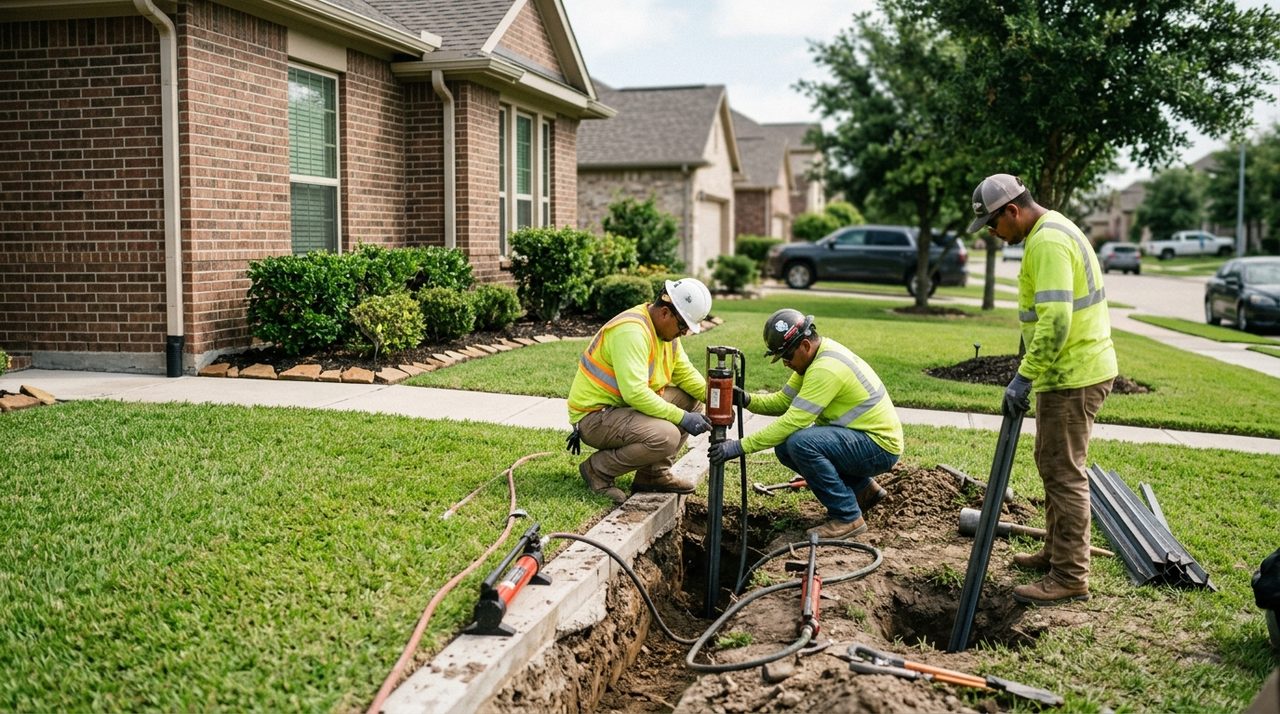
A thorough foundation contractor will take floor-level elevation readings at multiple interior points to map differential movement across the slab before recommending any repair method. For Westchase's older homes, steel push piers — installed to load-bearing soil below the active clay layer — typically outperform the pressed concrete pilings common in 1980s and 1990s repairs, which have a higher failure rate in Houston's clay. Expect estimates in the $10,000–$25,000 range for a typical 8–16 pier job (cost estimates only); get at least three written proposals specifying pier count and target depth.
Sources: City of Houston Permitting Center, International Residential Code (as adopted by City of Houston)
Why it matters to you
Westchase's 1970s and 1980s homes were built with cast-iron under-slab drain lines that were prime candidates for cracking during Winter Storm Uri in February 2021. Many owners repaired visible interior damage — drywall, flooring — without confirming whether the under-slab lines were intact. A slow ongoing leak from a cracked cast-iron drain directly saturates the clay beneath your slab, causing localized heave and then settlement as the soil structure breaks down; the resulting crack patterns are virtually indistinguishable from pure soil-movement damage unless you test for it.
What a good pro does
Before signing any foundation repair contract, insist on a hydrostatic plumbing test — a licensed plumber (required to be licensed through TSBPE) pressurizes the under-slab drain system with water to identify active leaks. This test typically runs $250–$400 (cost estimate) and can prevent you from spending $15,000 on piers when the underlying cause is a $3,000 pipe repair. The City of Houston requires separate permits for any under-slab plumbing work distinct from the foundation repair permit issued through the Houston Permitting Center.
Sources: Texas State Board of Plumbing Examiners, City of Houston Permitting Center, Municipal permit office (see area profile)
Why it matters to you
During the 2022–2023 La Niña drought cycle, Westchase's clay soils pulled away from slab perimeters on lots with little shade canopy — common on the area's smaller suburban lots developed in the 1970s and 1980s where mature tree cover is uneven. These perimeter voids leave the slab beam unsupported at the edge; when seasonal rains return, water channels into the gap rather than soaking in gradually, accelerating erosion under the beam and worsening the differential settlement that the original void started. Subdivision-to-subdivision variation in lot grading — a consequence of Westchase's separately platted developments — means some blocks drain better than others.
What a good pro does
A qualified contractor will probe the perimeter for void depth and may recommend mudjacking or polyurethane foam injection ($800–$5,000 estimated range depending on section and method) to fill voids before or alongside pier work. Equally important is a post-repair moisture-management plan: a soaker-hose loop run 18 inches from the foundation edge during dry months maintains soil moisture evenly and dramatically reduces reoccurrence. This is a maintenance step you can implement yourself, but the void assessment must come first.
Sources: International Residential Code (as adopted by City of Houston), Harris County Flood Control District
Why it matters to you
Because Westchase is composed of many separately platted subdivisions — not a single master-planned community — there is no uniform HOA architectural review process. Your neighbor two blocks away may face entirely different deed-restriction rules about exterior trenching, visible concrete work, or fence disruption during a foundation repair than you do. Unpermitted foundation work, or work done without required deed-restriction approval, can surface as a material defect on a Texas TREC seller's disclosure form and create liability at resale — a real concern given Westchase's median home value of roughly $362,000 and high renter turnover rate (only about 32% owner-occupied, per U.S. Census Bureau ACS 5-Year 2023 data).
What a good pro does
Before work begins, pull your subdivision's deed restrictions from Harris County deed records to identify any architectural review requirement — do not rely on the Westchase District or the Super Neighborhood Council, neither of which governs individual residential lots. The foundation repair permit itself must be obtained through the City of Houston's Houston Permitting Center; confirm the permit number and scheduled inspection with the city directly, not solely through your contractor. Texas does not issue a standalone state license for foundation repair contractors (TDLR does not separately credential this scope), so verifying general liability and workers' compensation insurance is the primary homeowner safeguard.
Sources: City of Houston Permitting Center, Texas Department of Licensing & Regulation, Local HOA / deed restrictions (see area profile), Municipal permit office (see area profile)
Hiring foundation repair in Westchase? Westchase is a large, mixed-use district near Beltway 8 composed of multiple separately platted subdivisions, each with its own potential HOA and deed restrictions. Housing stock ranges from 1970s–1990s single-family homes to newer multifamily and townhome developments, nearly all built on slab-on-grade foundations. Contractors must verify deed restrictions and HOA rules on a per-subdivision basis, as there is no single umbrella association governing the entire area.
Building era
Primarily 1970s through 1990s, with continued multifamily and townhome development into the 2000s and 2010s.
Typical style
Contemporary suburban: traditional-to-transitional single-family homes, brick or stucco façade garden-style apartments, and townhomes.
Foundations
Slab-on-grade (nearly universal for post-1960s suburban Harris County construction).
Common systems
Central A/C with gas furnace, copper or CPVC plumbing transitioning to PEX in renovations, standard residential electrical panels (100–200 amp). Older 1970s–1980s homes may still have original galvanized supply lines or polybutylene piping requiring replacement.
What that means for repairs
Kitchen and bath remodels are common in aging 1970s–1980s homes. Plumbing re-pipes (replacing galvanized or polybutylene), HVAC system replacements on units past their 20-year lifespan, and slab foundation repair driven by Houston's expansive clay soils are frequent project types.
Permit jurisdiction
City of Houston — Houston Permitting Center.
HOA & deed restrictions
No single area-wide mandatory HOA exists. The Westchase District is a Texas Legislature-created management district focused on commercial improvements, not residential lot governance. The Westchase Super Neighborhood Council is a City of Houston advisory body. A Westchase Community Association (501(c)(4), formed 1974) exists, but its authority over individual residential lots is not clearly documented. Individual subdivisions within the Westchase area may have their own mandatory HOAs — must be verified per subdivision via Harris County deed records.
Historic districts
No City of Houston historic district designation confirmed.
Contractor note
Contractors must confirm which subdivision a property belongs to and check for active deed restrictions and HOA architectural review requirements before beginning exterior work, fencing, or additions. The lack of a single governing HOA means rules vary block by block.
FEMA flood zone
FEMA Zone X (low flood risk) per official NFHL data. Drainage is influenced by local bayous and channels within the Harris County Flood Control system; proximity to specific drainage channels should be verified on a per-property basis.
Hurricane Harvey impact
No Westchase-specific street-level Harvey flood impact documentation was found in available sources. The area is east of the Addicks and Barker Reservoir watersheds and experienced varying levels of impact during Harvey. Flood history should be verified through Harris County Flood Control District records and individual property disclosure for any specific address.
Heat & humidity load
Sustained summer heat puts heavy strain on aging HVAC systems in 1970s–1980s homes; capacitor failures, refrigerant leaks, and compressor burnout are common seasonal calls. Slab-on-grade foundations on Houston's expansive clay soils experience movement during summer drought cycles, leading to door/window sticking and drywall cracks that trigger foundation inspection and repair demand.
Working with contractors here
Westchase keeps contractors busy with the bread-and-butter maintenance demands of aging 1970s–1990s suburban homes: HVAC replacements, whole-house plumbing re-pipes, and slab foundation repair. The area's slab-on-grade construction on expansive clay means foundation work is a recurring need, especially after drought-to-rain cycles. Roof replacements on 20–30-year-old composition shingle roofs are common, and many homeowners are upgrading aging electrical panels to support modern loads. Because Westchase comprises many separate subdivisions, contractors must scope each job with attention to the specific subdivision's deed restrictions and any HOA architectural review — exterior modifications, fence styles, and material choices may vary significantly from one block to the next.
Local Tip
Always ask for a written estimate before work begins. Texas contractors are required to provide one on jobs over $1,000.
Westchase is a large, mixed-use district near Beltway 8 composed of multiple separately platted subdivisions, each with its own potential HOA and deed restrictions. Housing stock ranges from 1970s–1990s single-family homes to newer multifamily and townhome developments, nearly all built on slab-on-grade foundations. Contractors must verify deed restrictions and HOA rules on a per-subdivision basis, as there is no single umbrella association governing the entire area.
Source: U.S. Census Bureau, ACS 5-Year 2023
Most of Westchase maps to FEMA Zone X (low mapped flood risk), but Houston's flash-flood reality means even low-risk blocks benefit from smart drainage and storm-hardened installs.
Source: FEMA National Flood Hazard Layer (NFHL). Flood zones vary by parcel — verify your individual FIRM panel.
Houston's flash-flood reality means even low-mapped-risk areas like Westchase can see sheet flow accumulate against a foundation during a slow-moving Gulf system, so verify that your perimeter drainage is clear and properly sloped before hurricane season opens. A TDLR-licensed foundation contractor can add or reposition surface drains to intercept runoff before it softens the clay bearing layer beneath your slab. Confirm the current FEMA panel for your Westchase parcel — the area maps to Zone X, but adjacent lots can differ.
Hail itself does not crack a concrete foundation, but the insurance repair process — contractors dropping equipment, vibrating compactors near the structure — can disturb marginally stable piers in Westchase. Coordinate a brief foundation check with a TDLR-licensed contractor before and after any major roof or exterior repair project that involves heavy equipment operating near your home. In-city Westchase work falls under City of Houston floodplain and permitting rules.
Ice loading from roof accumulation during a hard freeze transfers compressive stress to your foundation corners, and in Westchase that added load on clay subgrade that has stiffened from cold can create corner settlement that persists after the thaw. A TDLR-licensed foundation contractor should inspect visible brick-to-foundation transitions and interior door frames after any multi-day freeze event, even if no pipe damage occurred. In-city Westchase work falls under City of Houston floodplain and permitting rules.
Sources: FEMA National Flood Hazard Layer (NFHL), Ready.gov -- Hurricanes, CenterPoint Energy -- Storm Center, City of Houston -- Emergency Preparedness, Ready.gov -- Winter Weather, Harris County Flood Control District
Houston-specific estimators to plan your project before you call a pro. All results are planning estimates — a licensed local pro confirms the details on site.
Grouped by mature root aggression & water demand.
Trunk center to the nearest exterior wall.
The root zone likely reaches your foundation's soil during Houston's dry summers, when clay shrinks most. Watch for sticking doors and diagonal cracks, keep soil moisture even with a soaker hose during drought, and have a foundation pro evaluate if you see any movement.
Find a Houston foundation pro →This is a planning estimate only — actual requirements depend on an on-site assessment by a licensed Houston pro. Guidance is based on general species root behavior in expansive clay, not a soil test.
Disconnect & drain every outdoor hose bib
Remove hoses, drain the spigots, and cover each with an insulated faucet sock. Un-drained hose bibs are the #1 burst point in a Houston freeze.
Insulate exposed pipes in the attic & garage
Wrap any pipe in an unconditioned space (attic runs, garage walls) with foam sleeves. Houston homes rarely insulate these because they only matter a few nights a year — which is exactly why they burst.
Open cabinet doors & keep a pencil-width drip
On hard-freeze nights, open kitchen/bath cabinets so warm air reaches the pipes and let faucets on exterior walls drip to relieve pressure.
Protect the attic/garage water heater & its lines
An attic or garage tank sits in unconditioned space. Insulate the cold-inlet and hot-outlet lines and confirm the emergency drain pan is clear so a leak doesn't reach the ceiling.
This is a planning estimate only — actual requirements depend on an on-site assessment by a licensed Houston pro. If a pipe has already burst, shut off your main water supply and call a licensed Houston plumber immediately — freeze bursts flood fast.
Sources: City of Houston Permitting CenterMunicipal permit office (see area profile)
Sources: Local HOA / deed restrictions (see area profile)City of Houston Permitting Center