Closed
930 W Little York Rd, Houston, TX 77091
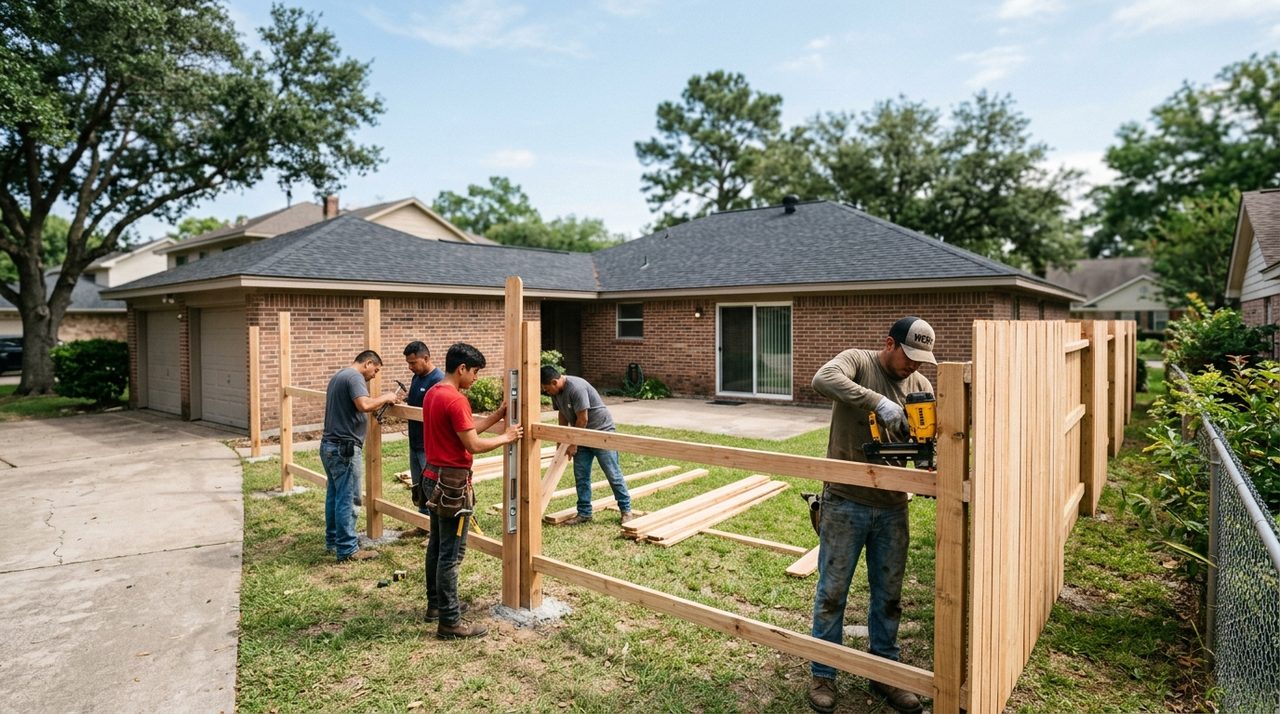
Acres Homes sits on native Houston Black clay inside Houston city limits — no HOA design controls, no historic-district overlay, just the Houston Permitting Center and the soil itself governing what you build. Whether you're protecting a 1950s pier-and-beam cottage on Wheatley Street or a 2021 infill slab-on-grade on the same block, the same heavy clay that causes foundation movement will work on your fence posts too, and the area's open lots give wood privacy fencing a full run against Gulf wind loads. Read this before you dig a single hole.
Ranked by verified Google rating × review volume × verification tier. How we rank →
Some highly-rated pros serve Acres Homes from nearby and may not keep a Acres Homes street address. Those are listed under "Also serving Acres Homes" with their real city and distance, so you always know where each business is based.
930 W Little York Rd, Houston, TX 77091
Highly-rated pros based nearby who cover Acres Homes. Distance shown from the Acres Homes area.
Serving Acres Homes Based in Lazybrook / Timbergrove · 2.2 mi away
Serving Acres Homes Based in Garden Oaks · 3.3 mi away
Serving Acres Homes Based in Lazybrook / Timbergrove · 3.3 mi away
Serving Acres Homes Based in Brookhollow · 3.7 mi away
Serving Acres Homes Based in Brookhollow · 3.7 mi away
Serving Acres Homes Based in Brookhollow · 3.7 mi away
Serving Acres Homes Based in Independence Heights · 4.3 mi away
Serving Acres Homes Based in NW Houston · 4.3 mi away
Serving Acres Homes Based in Independence Heights · 4.4 mi away
Why it matters to you
Most of Acres Homes sits on native Beaumont and Houston Black clay, the same expansive soil that lifts pier-and-beam foundations on the neighborhood's mid-century cottages. That clay shrinks away from posts during dry summers — Houston routinely records weeks of 95°F-plus heat with no rain — then swells hard against concrete footings when fall rains return, rocking posts out of plumb. In a neighborhood with census-median construction from 1979, many original fence posts are already on borrowed time.
What a good pro does
A competent contractor in Acres Homes sizes footings for clay movement: deeper-than-standard embedment (36 inches minimum rather than the common 24-inch Houston shortcut), a wider bell-bottom at the base to resist uplift, and dry-pack or fast-set concrete rather than wet-pour that stays saturated. Asking your contractor to show you their footing depth before backfilling is reasonable and costs nothing.
Sources: International Residential Code (as adopted by City of Houston)
Why it matters to you
Acres Homes occupies large, relatively open lots with limited mature-tree windbreaks in many sections — conditions that give Gulf wind events a clean run at privacy fencing. The May 2024 derecho produced 100-plus mph gusts across NW Harris County, and Beryl 2024 followed within weeks, knocking down board-on-board panels across the neighborhood. A standard 6-ft panel with no wind-relief gaps acts like a sail; undersized post embedment makes it worse.
What a good pro does
For new fence runs on exposed Acres Homes lots, a quality builder spaces posts at 6 feet on center rather than 8, back-sets nails or uses structural screws rather than staples on pickets, and leaves a quarter-inch gap between pickets so wind pressure can bleed through rather than build against the panel. Full storm-replacement estimates in the Houston metro typically run $3,000–$8,000 for an average suburban lot — upfront quality cuts the chance of a second replacement.
Why it matters to you
Because most of Acres Homes has no mandatory HOA and no historic district overlay, homeowners sometimes assume permits aren't necessary for fence work. In fact, Acres Homes is fully within Houston city limits and subject to City of Houston permitting: any fence exceeding 6 feet in height requires a permit through the Houston Permitting Center. Texas has no state-level fence contractor license requirement, which means anyone can hang a sign as a fence builder — the permit process is one of your few checkpoints on quality.
What a good pro does
Before work starts, confirm with your contractor whether the planned fence height triggers a permit and ask to see proof the permit was pulled if it does. For standard 6-foot-or-under privacy fences, no City of Houston permit is required, but setbacks from property lines still apply and must match your survey. Additionally, newer infill plats within Acres Homes may carry private deed restrictions on use or minimum lot standards — check Harris County Clerk records if your lot was subdivided or platted after 2010.
Sources: City of Houston Permitting Center, Local HOA / deed restrictions (see area profile)
Why it matters to you
Acres Homes' older lots — particularly those near Vogel Creek tributaries and in lower-lying sections — tend to drain slowly because the clay soil resists percolation and decades of infill activity have altered local grades. Standing water around wood post bases after rain events, combined with Houston's year-round humidity averaging above 70%, creates near-ideal conditions for fungal rot. Untreated or under-treated pine posts on these lots routinely fail within three to five years, well before the fence boards themselves wear out.
What a good pro does
Specify pressure-treated posts rated for ground contact (UC4B or better, not the lighter UC3B common at big-box stores) and ask your contractor to set posts in concrete that crowns slightly above grade so water sheds away from the post base. On lots that show standing water after rain, adding a gravel collar around each post or switching to steel-sleeve composite posts eliminates the wood-rot failure point entirely. Wood post replacement in Houston typically runs $150–$300 per post including new concrete — getting the material spec right the first time avoids that cost.
Sources: International Residential Code (as adopted by City of Houston), Harris County Flood Control District
Hiring fence builders in Acres Homes? Acres Homes presents a uniquely diverse housing stock ranging from mid-century pier-and-beam cottages to post-2015 slab-on-grade infill homes, often on the same block. Most of the area has no mandatory HOA or formal deed restrictions, giving homeowners wide latitude on repairs and renovations but also creating a patchwork of building conditions. Contractors working here must be comfortable with both legacy wood-frame structural repairs and modern systems found in newer affordable construction.
Building era
1950s–1970s (legacy stock) with significant post-2015 infill construction; secondary wave from 1990s–2000s.
Typical style
Older homes are one-story wood-frame cottages, bungalows, and modest ranch-style houses; newer infill is contemporary traditional single-family with Hardie siding or brick-and-Hardie exteriors.
Foundations
Mixed — older homes are commonly pier-and-beam; newer infill construction is predominantly concrete slab-on-grade.
Common systems
Older homes often have galvanized or cast-iron plumbing, older electrical panels (60–100 amp), and window-unit or aging central HVAC systems. Newer infill homes typically have PEX or CPVC plumbing, 200-amp electrical panels, and modern split-system HVAC with SEER 14+ ratings.
What that means for repairs
Extensive infill and revitalization activity driven by the City of Houston's New Home Development Program (NHDP) and private developers replacing or renovating aging frame houses. Common renovation work includes pier-and-beam leveling, plumbing repipes on older homes, electrical panel upgrades, and full gut-rehabs of mid-century cottages.
Permit jurisdiction
City of Houston — Houston Permitting Center (Acres Homes is within Houston city limits).
HOA & deed restrictions
No mandatory master HOA for most of Acres Homes. Voluntary civic clubs and community organizations exist (e.g., Acres Home Super Neighborhood #6) but do not impose dues or design controls. Some newer small infill plats may carry private deed restrictions governing minimum square footage and use, but these vary lot by lot.
Historic districts
No City of Houston historic district designation confirmed.
Contractor note
With no overarching HOA design review, contractors typically need only City of Houston permits. However, some newer infill plats may have private deed restrictions with architectural standards — confirm with the property owner and check Harris County Clerk records before beginning exterior work.
FEMA flood zone
FEMA Zone X (low flood risk) per official NFHL data. However, portions of Acres Homes adjacent to Vogel Creek and its tributary channels fall within 100-year and 500-year floodplains per Harris County Flood Control District mapping. Flood risk varies significantly by proximity to these waterways and local low points along drainage ditches.
Hurricane Harvey impact
Acres Homes experienced structural flooding during Hurricane Harvey (2017), but it was not among the highest-profile disaster zones like Meyerland or Greenspoint. Areas near Vogel Creek and low-lying drainage channels were most affected. The exact extent of damage is not clearly quantified in public summaries. Harris County Flood Control District has undertaken channel improvement and detention projects along Vogel Creek in this area, indicating recognized recurring drainage issues.
Heat & humidity load
Older pier-and-beam cottages with aging HVAC systems and limited insulation are especially vulnerable to Houston's extreme summer heat and humidity. Condensation under pier-and-beam homes can accelerate subfloor rot and encourage mold growth. Newer slab-on-grade infill homes perform better thermally but still demand regular HVAC maintenance during peak cooling season.
Working with contractors here
The most common contractor work in Acres Homes includes foundation leveling and pier-and-beam repair on mid-century frame houses, full plumbing repipes replacing galvanized lines, and electrical panel upgrades from 60-amp to 200-amp service. The active infill development market also generates steady demand for new construction trades, demolition, and site prep. Because housing stock varies dramatically from block to block — a 1950s cottage may sit next to a 2020 build — contractors must scope each job individually and cannot assume uniform conditions. Drainage and grading work is important near Vogel Creek tributaries, and properties in low-lying areas may need additional moisture mitigation measures.
Local Tip
Always ask for a written estimate before work begins. Texas contractors are required to provide one on jobs over $1,000.
Acres Homes presents a uniquely diverse housing stock ranging from mid-century pier-and-beam cottages to post-2015 slab-on-grade infill homes, often on the same block. Most of the area has no mandatory HOA or formal deed restrictions, giving homeowners wide latitude on repairs and renovations but also creating a patchwork of building conditions. Contractors working here must be comfortable with both legacy wood-frame structural repairs and modern systems found in newer affordable construction.
Source: U.S. Census Bureau, ACS 5-Year 2023
Most of Acres Homes maps to FEMA Zone X (low mapped flood risk), but Houston's flash-flood reality means even low-risk blocks benefit from smart drainage and storm-hardened installs.
Source: FEMA National Flood Hazard Layer (NFHL). Flood zones vary by parcel — verify your individual FIRM panel.
Sources: City of Houston Permitting Center
Sources: FEMA National Flood Hazard Layer (NFHL)Harris County Flood Control District
Sources: Local HOA / deed restrictions (see area profile)City of Houston Permitting Center
Sources: International Residential Code (as adopted by City of Houston)