Closed
11255 Eastex Fwy, Houston, TX 77093
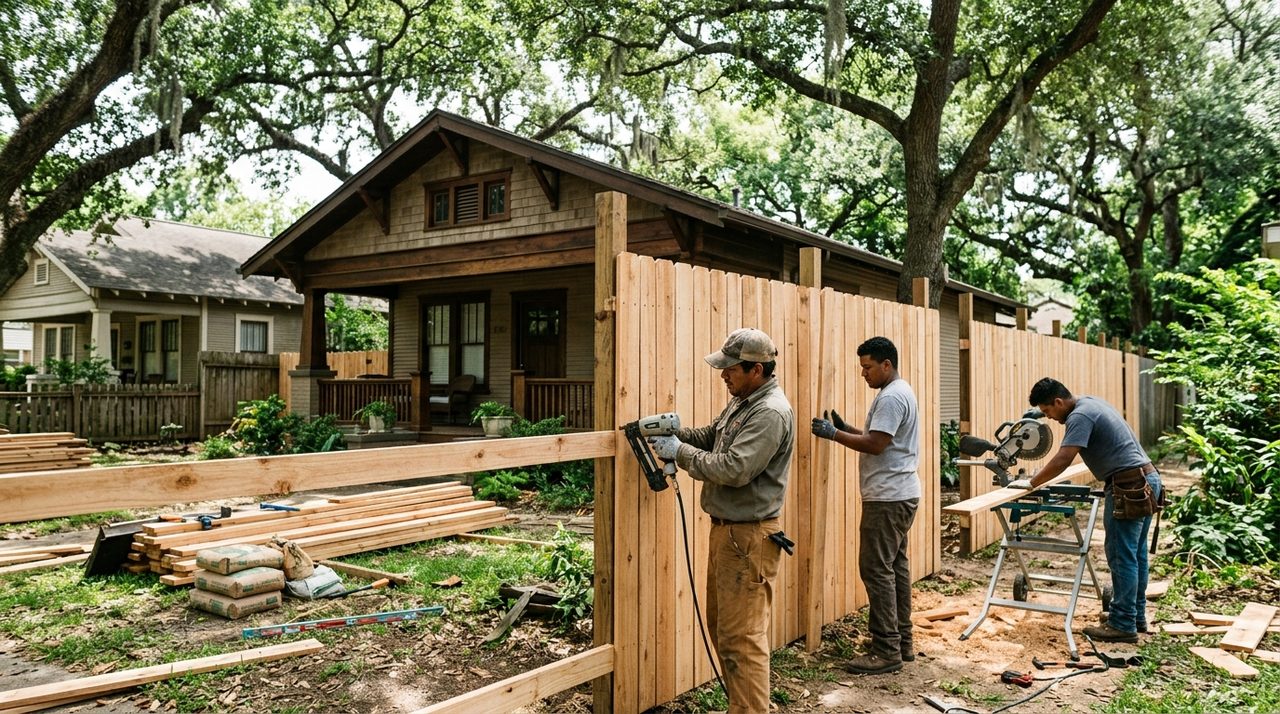
Independence Heights is a century-deep patchwork of 1910s Craftsman bungalows, 1950s ranch homes, and 2020s townhome clusters — all sitting on Houston's native Beaumont clay under City of Houston permit jurisdiction — which means a fence project here can look completely different depending on whether you're on a legacy lot with no HOA, a mid-century slab, or a brand-new infill development with a pocket POA and its own architectural rules. Getting a fence right in this neighborhood requires understanding expansive clay movement, the Houston Permitting Center's height rules, and the lot-specific deed restrictions that can vary from one address to the next.
Ranked by verified Google rating × review volume × verification tier. How we rank →
Some highly-rated pros serve Independence Heights from nearby and may not keep a Independence Heights street address. Those are listed under "Also serving Independence Heights" with their real city and distance, so you always know where each business is based.
11255 Eastex Fwy, Houston, TX 77093
10214 E Hardy Rd, Houston, TX 77093
10814 E Hardy Rd, Houston, TX 77093
Highly-rated pros based nearby who cover Independence Heights. Distance shown from the Independence Heights area.
Serving Independence Heights Based in The Heights · 1 mi away
Serving Independence Heights Based in Lazybrook / Timbergrove · 1.4 mi away
Serving Independence Heights Based in Lazybrook / Timbergrove · 1.8 mi away
Serving Independence Heights Based in The Heights · 2.5 mi away
Serving Independence Heights Based in Garden Oaks · 2.8 mi away
Serving Independence Heights Based in Lazybrook / Timbergrove · 3.5 mi away
Why it matters to you
The native Houston Black clay under Independence Heights — the same expansive soil that has been shifting the neighborhood's pier-and-beam bungalows since the 1910s — shrinks in dry summers and swells dramatically after Gulf rains, a cycle that progressively heaves, tilts, and cracks standard concrete post footings. On legacy lots where the median year built is 1958, it's common to find fence posts installed a generation ago that are now leaning several inches off vertical or sitting in cracked, hollow collars of concrete the clay has pushed aside.
What a good pro does
A knowledgeable installer will remove the failed footing entirely rather than patching around it, excavate to at least 36 inches below grade to get below the active clay zone, and backfill with a concrete mix sized to the post diameter — not the minimal pours that were standard practice in mid-century Houston construction. For replacement posts on low-lying lots that hold standing water after heavy rains, specifying pressure-treated lumber rated for ground contact (UC4B) rather than standard #2 pine adds meaningful service life on this soil. Expect wood post replacement with new concrete to run roughly $150–$300 per post as a standalone repair, per Houston-market estimates.
Sources: International Residential Code (as adopted by City of Houston), Harris County Flood Control District
Why it matters to you
Houston averages over 70% relative humidity year-round, and the clay-heavy soils common throughout Independence Heights drain slowly, meaning fence boards and posts on older lots routinely sit in damp ground-contact conditions for extended periods after each rainstorm. For the significant share of mid-century ranch homes here that still have original or minimally maintained fencing, this combination of persistent moisture and fungal pressure can reduce untreated pine posts to soft, punky wood within three to five years — far faster than homeowners expect.
What a good pro does
A quality fence contractor working in this neighborhood should specify UC4B pressure-treated posts for any ground-contact installation and recommend cedar or composite boards rather than standard SPF dimensional lumber for horizontal rails and pickets exposed to the humidity. On lots with identifiable drainage issues — a common finding on the flat, clay-dense terrain here — experienced installers will grade the immediate fence line to direct surface runoff away from post bases before pouring footings, which meaningfully extends the life of the fence without a major grading project.
Sources: International Residential Code (as adopted by City of Houston)
Why it matters to you
Because Independence Heights was annexed by the City of Houston in 1929, all fence work falls under City of Houston permit jurisdiction: fences taller than six feet require a permit from the Houston Permitting Center, and work done without required permits can result in forced removal at the homeowner's expense. But the permit process is only one layer — the neighborhood's mix of legacy lots and newer infill means some parcels carry recorded deed restrictions or are governed by small pocket POAs such as Independence Heights Homes Community Association, Inc. (a registered Harris County POA in ZIP 77018), each with their own material or height mandates that are legally binding regardless of what the city allows.
What a good pro does
Before any post is set, a thorough contractor will pull the homeowner's current plat and deed from Harris County Appraisal District records to check for recorded restrictions on fence materials or height, and separately confirm whether the parcel falls within a POA boundary. If the project requires a city permit — most full privacy fence replacements along property lines do not exceed six feet, but any gate structure or decorative topper can push past the threshold — the Houston Permitting Center is the correct filing authority. Homeowners in townhome clusters should expect an additional HOA architectural review submission before any work begins.
Sources: City of Houston Permitting Center, Local HOA / deed restrictions (see area profile), Municipal permit office (see area profile)
Why it matters to you
The active infill development that has been reshaping Independence Heights — with two- and three-story townhome clusters replacing older single-family lots throughout the neighborhood — frequently involves replat surveys that carry new drainage and utility easements running exactly where a shared-boundary fence would naturally land. Older 1910s and 1920s plats in this area also commonly recorded alley utility easements along rear lot lines that remain in force even when the alley is no longer used, meaning a post dug in the wrong spot can encroach on a legally protected easement.
What a good pro does
Texas law requires any excavation to begin with an 811 call-before-you-dig request — a non-negotiable step on infill lots served by MUD or CenterPoint buried infrastructure. A competent fence contractor will also ask the homeowner to provide a current survey (not just a Google Maps screenshot) showing recorded easement lines before finalizing the fence layout, and will adjust post spacing or relocate the fence line inward if needed to stay clear of platted easements. On rear lines adjacent to alley easements, a gravel-base or surface-mounted post system can sometimes avoid encroachment issues that a traditional concrete footing would trigger.
Sources: City of Houston Permitting Center, Harris County Flood Control District
Hiring fence builders in Independence Heights? Independence Heights spans over a century of construction, from 1910s bungalows and 1950s ranch homes to 2020s contemporary townhomes. Homeowners here face a wide range of service needs driven by aging pier-and-beam foundations, outdated plumbing and electrical in mid-century homes, and newer infill properties with their own HOA requirements. The neighborhood's moderate flood risk and mixed housing stock make contractor experience with both historic rehabilitation and modern code compliance essential.
Building era
1910s–1920s (original platted lots), 1950s–1960s (major mid-century build-out, median year built 1958), 2000s–2020s (infill townhomes and new single-family).
Typical style
Craftsman bungalows and vernacular cottages (1910s–1920s), one-story ranch and minimal-traditional (1950s–1960s), contemporary two- and three-story townhomes and modern single-family (2000s–2020s).
Foundations
Mixed — pier-and-beam dominates pre-1960s housing; slab-on-grade common in newer infill construction.
Common systems
Older homes often have galvanized or cast-iron plumbing, outdated 60–100 amp electrical panels, and window-unit or older central HVAC. Mid-century homes typically have early central HVAC with ductwork in unconditioned spaces. Newer infill features modern PEX or CPVC plumbing, 200-amp panels, and high-efficiency HVAC systems.
What that means for repairs
Significant renovation activity driven by new infill development replacing or updating older lots. Historic bungalows and mid-century ranch homes are frequently gut-renovated with foundation repair, full re-plumbing, electrical panel upgrades, and HVAC modernization. Townhome clusters are also emerging on previously single-family lots.
Permit jurisdiction
Houston Permitting Center (City of Houston jurisdiction — neighborhood annexed in 1929).
HOA & deed restrictions
No single mandatory HOA for all of Independence Heights. The area operates under the City of Houston Super Neighborhood 13 council (voluntary civic/advocacy structure). Pocket developments and newer townhome clusters have their own mandatory HOAs, such as Independence Heights Homes Community Association, Inc. (registered POA in Harris County, ZIP 77018). Many legacy lots have no HOA.
Historic districts
No City of Houston historic district designation confirmed, despite the neighborhood's significant cultural history as an early 20th-century planned Black community (incorporated 1915, annexed by Houston 1929).
Contractor note
Contractors must navigate varying deed restrictions that are lot- and subdivision-specific rather than uniform across the neighborhood. New infill projects in HOA-governed clusters may have additional architectural review requirements beyond standard city permitting.
FEMA flood zone
FEMA Zone X500 (moderate flood risk) — source: fema_nfhl. The neighborhood sits just north of Loop 610 and west of I-45 in a lower-elevation area of Houston's near northside. No specific bayou or creek adjacency was confirmed in research, but the I-45 corridor location places it in a drainage-sensitive area.
Hurricane Harvey impact
Specific street-by-street Harvey flood data was not confirmed in available research. The neighborhood's near-northside, lower-elevation location along the I-45 corridor suggests it was likely affected by significant street and structural flooding during Harvey, consistent with broader news coverage of nearby areas. Homeowners should verify parcel-level flood history through Harris County Flood Control District records and FEMA repetitive loss databases.
Heat & humidity load
Older pier-and-beam homes with minimal insulation and aging HVAC systems face extreme summer stress, leading to high energy bills and frequent HVAC service calls. Pier-and-beam crawlspaces are vulnerable to moisture buildup and pest intrusion in Houston's humid summers. Newer infill townhomes with modern insulation and sealed envelopes perform better but may experience condensation issues at transitions between conditioned and unconditioned spaces.
Working with contractors here
Foundation repair is one of the most common service needs, particularly for pier-and-beam homes built in the 1910s–1960s that have experienced decades of Houston's expansive clay soil movement. Re-plumbing is frequently required in mid-century homes still running galvanized or cast-iron drain lines. Electrical panel upgrades from 60-amp to 200-amp service are common as homeowners modernize older homes or add square footage. The active infill market means general contractors regularly handle teardown-and-rebuild projects, often requiring lot-specific deed restriction review. Contractors should be prepared for wide variation in job scope — from historic cottage restoration on one lot to modern townhome punch-list work on the next.
Local Tip
Always ask for a written estimate before work begins. Texas contractors are required to provide one on jobs over $1,000.
Independence Heights spans over a century of construction, from 1910s bungalows and 1950s ranch homes to 2020s contemporary townhomes. Homeowners here face a wide range of service needs driven by aging pier-and-beam foundations, outdated plumbing and electrical in mid-century homes, and newer infill properties with their own HOA requirements. The neighborhood's moderate flood risk and mixed housing stock make contractor experience with both historic rehabilitation and modern code compliance essential.
Source: U.S. Census Bureau, ACS 5-Year 2023
Independence Heights carries FEMA Zone X500 (moderate flood risk): outside the 100-year floodplain but inside the 500-year, so heavy-rain events still reach homes and flood-aware work pays off.
Source: FEMA National Flood Hazard Layer (NFHL). Flood zones vary by parcel — verify your individual FIRM panel.
Sources: City of Houston Permitting CenterLocal HOA / deed restrictions (see area profile)
Sources: FEMA National Flood Hazard Layer (NFHL)Harris County Flood Control District
Sources: Local HOA / deed restrictions (see area profile)City of Houston Permitting Center