Closed
30407 Valley Oaks Dr, Magnolia, TX 77355
Magnolia, TX sits on Montgomery County's expansive clay soils and hosts a housing stock that swings from 1970s–1990s ranch homes on acreage tracts to brand-new master-planned builds in NorthGrove and Magnolia Reserve — two very different carpet-cleaning challenges under the same zip code. Because the area maps predominantly to FEMA Zone X, flooding is a lower driver here than in Harris County, but the red-brown Katy Prairie clay that dominates the county's soil profile tracks relentlessly onto carpet, and HOA move-out deadlines in the newer subdivisions create real scheduling pressure. This page explains exactly which problems show up in Magnolia homes and what a competent technician should do about each one.
Ranked by verified Google rating × review volume × verification tier. How we rank →
Some highly-rated pros serve Magnolia from nearby and may not keep a Magnolia street address. Those are listed under "Also serving Magnolia" with their real city and distance, so you always know where each business is based.
30407 Valley Oaks Dr, Magnolia, TX 77355
Highly-rated pros based nearby who cover Magnolia. Distance shown from the Magnolia area.
Serving Magnolia Based in The Woodlands · 0.6 mi away
Serving Magnolia Based in Waller · 3.8 mi away
Why it matters to you
The iron-rich Katy Prairie clay that underlies most of Montgomery County (Munsell hues running 5YR–10YR, reddish-brown to dark gray) bonds tenaciously to synthetic carpet fibers and, on Magnolia's older 1970s–1990s ranch homes with open acreage, there is often no paved walkway buffer between a muddy yard and a carpeted living room. Repeated wet-dry cycles from Houston's storm pattern grind clay particles past the fiber tips and into the backing, where a single pass of hot-water extraction cannot fully lift them. If your home sits on an unrestricted acreage parcel off FM 1488 or FM 1774, this is almost certainly the dominant carpet-wear issue you are facing.
What a good pro does
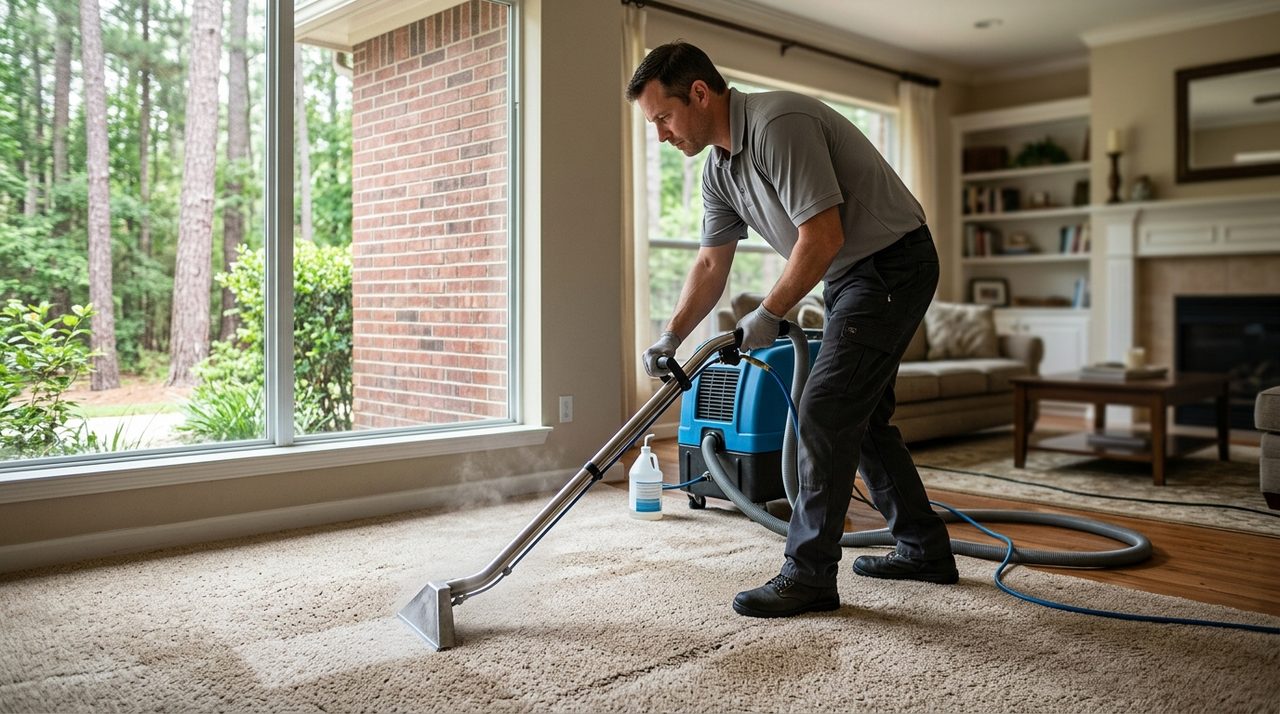
A qualified technician should apply a high-alkalinity pre-spray, allow adequate dwell time, and use a rotary agitation tool before hot-water extraction — not go straight to the wand. Heavily soiled traffic lanes in older ranch homes typically require a second extraction pass. Texas does not require a state occupational license for carpet cleaning, so the differentiator is IICRC Carpet Cleaning Technician (CCT) certification, which signals training in proper fiber identification and pre-spray chemistry matched to clay-type soils.
Why it matters to you
Virtually every post-1980 subdivision home in Magnolia is slab-on-grade, and the expansive Houston-series clay underneath Montgomery County can push moisture vapor through the concrete at rates exceeding 3 lbs per 1,000 square feet per 24 hours. In the original town-area stock built between the 1970s and early 1990s, the polyethylene vapor retarder under the slab — if it was installed at all — is thin and may have degraded, meaning your carpet pad can be measurably damp from below even before a technician introduces extraction water from above. Homeowners in these older homes often notice a persistent musty smell that returns within days of cleaning, not because the technician did a poor job on the carpet surface, but because the moisture source is below the slab.
What a good pro does
Before extracting, a thorough technician should probe the carpet and pad with a moisture meter to establish a baseline and identify whether sub-slab vapor transmission is contributing to the problem. If pad moisture reads high independent of any surface spill, cleaning alone will not solve the odor; the pad may need replacement and the vapor barrier situation should be evaluated separately. Cost estimates for standard hot-water extraction run $0.20–$0.40 per square foot, but pad replacement and antimicrobial treatment add to that total and should be itemized in writing before work begins.
Sources: IICRC (water/mold restoration standards), Texas Commission on Environmental Quality
Why it matters to you
Magnolia has no area-wide HOA, but the newer master-planned subdivisions — NorthGrove, Magnolia Reserve, and Magnolia Ridge among them — each carry their own mandatory HOA deed restrictions that frequently include clauses requiring professional carpet cleaning certification within 24–72 hours of a move-out. With the area's census-reported owner-occupancy rate at 52.3 percent, a meaningful share of homes are renter-occupied, and lease turnover in these subdivisions drives concentrated demand for same-day or next-day certified cleaning with written documentation. Montgomery County's permit jurisdiction (unincorporated areas) and the City of Magnolia's permit office are not involved in carpet cleaning itself, but the HOA's architectural review process is separate and can add confusion for homeowners assuming all approvals run through a single office.
What a good pro does
When booking cleaning to satisfy an HOA or lease clause, ask the company explicitly whether they provide IICRC-compliant written certification of the work performed, including the technician's certification number. IICRC certification is voluntary under Texas law but is the standard insurers and HOA managers recognize. Budget for the possibility that an HOA clause specifying a particular cleaning method (such as hot-water extraction only, not dry cleaning) will exclude lower-cost foam or encapsulation services, which may not satisfy the deed restriction language.
Sources: IICRC (water/mold restoration standards), Local HOA / deed restrictions (see area profile)
Why it matters to you
Montgomery County water supply blends from the Lone Star Groundwater Conservation District sources, producing water hardness commonly in the 130–180 mg/L as CaCO₃ range — moderately hard. When a hot-water extraction machine uses this mineral-laden water, the alkaline residue left behind reactivates dried pet urine salt crystals, and the ammonia odor actually intensifies in the days after cleaning rather than fading. In Magnolia's older ranch homes, where original carpet from the late 1990s or early 2000s may still be in place (the area's Census median year built is 2002), the pad beneath that carpet has likely absorbed years of urine that no surface extraction can fully address.
What a good pro does
Effective pet-urine treatment requires a two-step process: enzymatic pretreatment applied at volume to penetrate the pad, allowed to dwell 15–30 minutes, followed by hot-water extraction with an acidic rinse step to neutralize alkaline mineral residue and urine salts together. Sub-surface pad flushing tools that inject and extract beneath the fiber level are the industry standard for severe cases. Per-room specialty treatment is typically quoted at $50–$120 above the base cleaning rate and should be itemized separately; if a technician does not mention the rinse pH step when you ask about their pet-urine process, that is a signal to ask a follow-up question.
Hiring carpet cleaning in Magnolia? Magnolia spans a wide range of housing types, from newer master-planned communities like NorthGrove and Magnolia Reserve to older ranch homes and custom builds on rural acreage. Homeowners here face a split landscape: HOA-governed subdivisions with strict approval processes alongside unrestricted parcels where homeowners have broad latitude. Contractors must be comfortable working with both Montgomery County permitting and varied subdivision-specific deed restrictions.
Building era
Mixed — older stock from the 1970s–1990s in the original town area, significant 2000s infill, and heavy new construction concentration in the 2010s–2020s in master-planned communities.
Typical style
Texas traditional with brick and stone veneers in newer subdivisions; Craftsman-influenced and modern farmhouse elements in recent builds; ranch-style brick or siding homes on older acreage tracts.
Foundations
Predominantly slab-on-grade in post-1980 subdivisions; pier-and-beam may be found in older or custom acreage homes.
Common systems
Newer homes feature high-efficiency HVAC systems, PEX plumbing, and modern electrical panels; older 1970s–1990s stock may have original HVAC units, copper or CPVC plumbing, and smaller electrical panels that may need upgrades.
What that means for repairs
Older ranch-style homes on acreage are common renovation targets for kitchen and bathroom modernization, HVAC replacement, and electrical panel upgrades. Newer master-planned homes see less renovation but frequent cosmetic upgrades and outdoor living additions.
Permit jurisdiction
City of Magnolia for properties within city limits; Montgomery County Engineering for unincorporated areas and ETJ parcels.
HOA & deed restrictions
No single area-wide HOA. Platted subdivisions each have their own mandatory HOA (e.g., Magnolia Reserve HOA, Magnolia Ridge HOA, NorthGrove HOA). Many acreage parcels and older subdivisions have no HOA. Deed restrictions may still apply on non-HOA lots — check Montgomery County Clerk records for specific parcels.
Historic districts
No historic district designation confirmed. Magnolia is not within the City of Houston and has no known HAHC-designated districts.
Contractor note
Contractors must verify whether a property falls within Magnolia city limits or unincorporated Montgomery County, as permitting requirements and inspections differ. HOA-governed subdivisions often require architectural review committee approval before exterior work begins.
FEMA flood zone
FEMA Zone X (low flood risk) per official NFHL data. Much of the Magnolia area sits at higher elevations in upstream Montgomery County, away from major bayou floodplains.
Hurricane Harvey impact
No documented widespread structural flooding in the Magnolia area during Hurricane Harvey. None of the major Magnolia HOA or community sources reference Harvey-related rebuilding or large-scale flood damage. Central Montgomery County generally fared better than downstream Harris County bayou corridors, though localized drainage issues on individual properties cannot be ruled out — check specific property history for any claims.
Heat & humidity load
Extended Houston-area summers with high heat and humidity stress HVAC systems year-round. Newer homes with high-efficiency units handle the load well, but older 1970s–1990s stock may need HVAC replacement or duct sealing. Slab foundations on expansive clay soils can shift during summer drought cycles, making foundation monitoring and proper drainage critical.
Working with contractors here
Magnolia's diverse housing stock creates demand for a wide range of services. In newer master-planned communities, contractors frequently handle warranty-related repairs, outdoor living additions (patios, pools, outdoor kitchens), and fence installations that must meet HOA specifications. Older ranch-style homes on acreage generate steady demand for HVAC replacement, roof replacement, electrical panel upgrades, and kitchen/bath remodels. Foundation work is common across all eras due to the expansive clay soils in Montgomery County. Contractors working in HOA subdivisions should budget time for architectural review committee approvals and plan for potentially longer driveways and access considerations on rural acreage properties.
Local Tip
Always ask for a written estimate before work begins. Texas contractors are required to provide one on jobs over $1,000.
Magnolia spans a wide range of housing types, from newer master-planned communities like NorthGrove and Magnolia Reserve to older ranch homes and custom builds on rural acreage. Homeowners here face a split landscape: HOA-governed subdivisions with strict approval processes alongside unrestricted parcels where homeowners have broad latitude. Contractors must be comfortable working with both Montgomery County permitting and varied subdivision-specific deed restrictions.
Source: U.S. Census Bureau, ACS 5-Year 2023
Most of Magnolia maps to FEMA Zone X (low mapped flood risk), but Houston's flash-flood reality means even low-risk blocks benefit from smart drainage and storm-hardened installs.
Source: FEMA National Flood Hazard Layer (NFHL). Flood zones vary by parcel — verify your individual FIRM panel.
Sources: Local HOA / deed restrictions (see area profile)
Sources: IICRC (water/mold restoration standards)FEMA National Flood Hazard Layer (NFHL)
Sources: IICRC (water/mold restoration standards)Texas Commission on Environmental Quality