Open Now
747 W 18th St, Houston, TX 77008
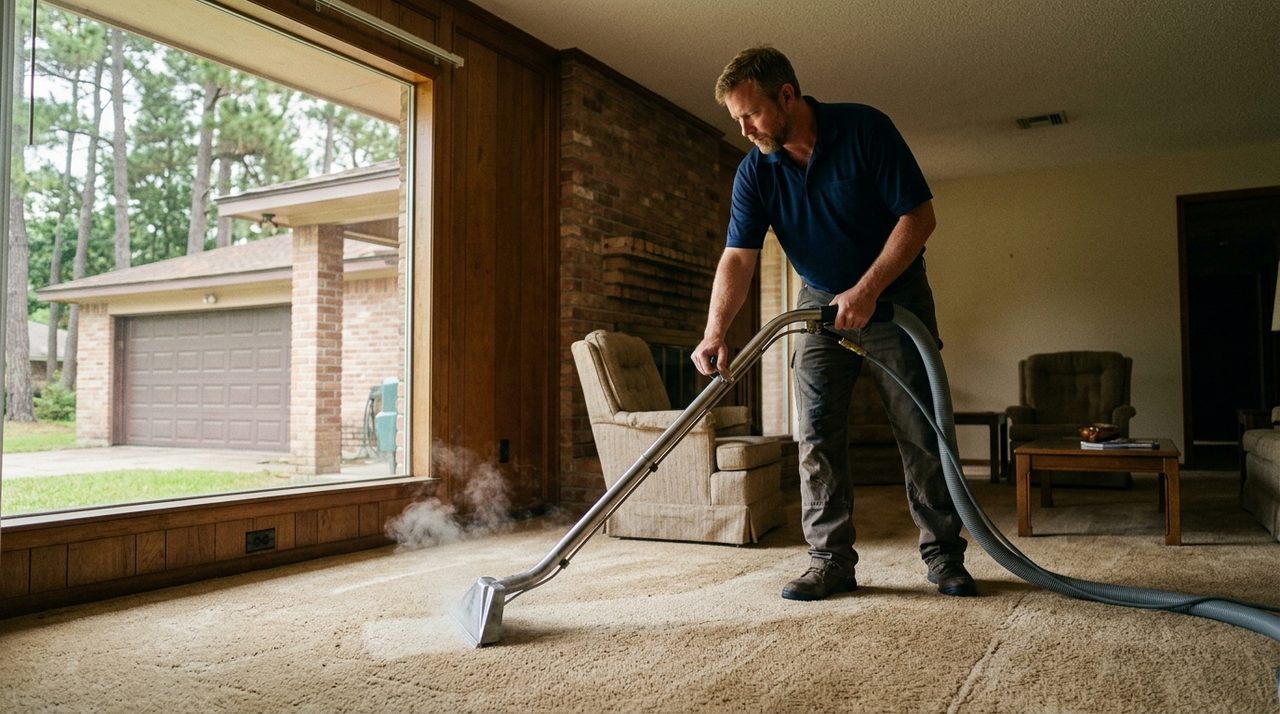
Lazybrook and Timbergrove's 1950s–1960s ranch-style brick homes sit on Harris County's Houston series black clay soil, a combination that means carpet pads are subject to moisture vapor rising through aging concrete slabs year-round — often invisible until a cleaning job stirs up the musty evidence. With roughly half the neighborhood renter-occupied (53.8% owner-occupied per ACS 2023) and White Oak Bayou running just south, carpet in these homes takes on humidity, clay tracking, and the long-tail consequences of decades of partial renovations. Understanding those specific pressures will help you get a cleaning result that actually lasts.
Ranked by verified Google rating × review volume × verification tier. How we rank →
747 W 18th St, Houston, TX 77008
4444 W 12th St, Houston, TX 77055
7807 Long Point Rd #415, Houston, TX 77055
1345 Martin St, Houston, TX 77018
1959 W T C Jester Blvd A, Houston, TX 77008
4001 N Shepherd Dr suite #100, Houston, TX 77018
4104 Schuler St, Houston, TX 77007
9034 Long Point Rd Bldg. B, Houston, TX 77055
2121 Pech Rd, Houston, TX 77055
2525 N Loop W Suite 510, Houston, TX 77008
Why it matters to you
The one-story ranch homes in Lazybrook and Timbergrove were built in the 1950s and 1960s, when vapor barrier standards were minimal or nonexistent beneath concrete slabs poured on Houston's expansive black clay. As the clay swells and contracts with Houston's seasonal wet-dry cycles, concrete moisture vapor transmission can exceed 3 lbs per 1,000 sq ft per 24 hours, soaking the pad from underneath — a problem that no amount of hot-water extraction on the carpet surface can fix, and one that causes cleaned carpet to smell musty again within days.
What a good pro does
A thorough technician will use a probe-type moisture meter on the pad and slab before cleaning, not just after. If sub-slab vapor transmission is the culprit, hot-water extraction should be paired with high-velocity air movers positioned to pull moisture upward and out; in severe cases the pad may need replacement rather than cleaning alone. No City of Houston trade permit is required for carpet cleaning, but this diagnostic step is the difference between a lasting result and a recurring odor problem.
Why it matters to you
Lazybrook and Timbergrove sit adjacent to NW Houston corridors where infill teardowns and nearby development constantly churn up the iron-rich Katy Prairie and Beaumont clay series — reddish-brown to dark gray soils that bond stubbornly with synthetic carpet fibers. The wet-dry storm pattern typical of Houston's Gulf weather grinds these clay particles below the fiber tips into the carpet backing with each cycle, creating staining that a single hot-water extraction pass will not fully lift from carpet in homes with heavy foot traffic or dogs.
What a good pro does
Effective cleaning on clay-impacted carpet in Lazybrook and Timbergrove requires a high-alkalinity pre-spray applied and allowed to dwell, followed by mechanical agitation with a counter-rotating brush before hot-water extraction begins. Budget for a two-pass extraction on any rooms adjacent to exterior entrances or mudrooms — a standard 600–700 sq ft three-bedroom job in a ranch layout here may run $120–$280 (estimated) under a basic package but can climb to $300–$550 for whole-house treatment when pre-sprays and agitation are added.
Why it matters to you
With about 46% of housing units in Lazybrook and Timbergrove renter-occupied (ACS 2023), turnover is common, and original or early-replacement carpet in these ranch homes can easily be 10 or more years old — long enough for pet urine salt crystals to have migrated into the backing and pad. Houston municipal water averages 130–180 mg/L hardness depending on Lone Star Groundwater Conservation District blending ratios; when that mineral-laden water is heated inside an extraction machine and applied to urine-contaminated carpet, the alkaline residue reactivates ammonia crystals and intensifies odor rather than eliminating it.
What a good pro does
A properly scoped job on pet-affected carpet in these homes requires enzyme pretreatment applied to the backing and pad, a dwell period measured in minutes not seconds, and an acidic rinse step following extraction to neutralize residual alkalinity. Specialty pet treatment is typically quoted per room at an estimated $50–$120 above the base cleaning rate; ask specifically whether sub-surface pad flushing is included, because surface-only enzyme application will not reach crystals that have already migrated into the pad layer. Texas does not require an occupational license for carpet cleaning, so IICRC Carpet Cleaning Technician certification is the most reliable professional benchmark to request.
Why it matters to you
Lazybrook and Timbergrove's location inside the 610 Loop, bordered to the south by White Oak Bayou, keeps ambient relative humidity elevated even by Houston standards — frequently reaching 80–90% RH through the summer months. When hot-water extraction leaves carpet backing and pad damp in a home without aggressive post-cleaning air movement, residual soil wicks from the pad back up to fiber tips as moisture evaporates, and low airflow creates conditions favorable for mold and musty odors within 24–48 hours, making a freshly cleaned room smell stale almost immediately.
What a good pro does
In these inner-loop ranch homes — many of which have smaller room footprints, lower ceilings, and older HVAC systems that may not exchange air as efficiently as newer suburban construction — insist that the technician deploy truck-mounted extraction (which pulls more moisture per pass than portable units) and leave high-velocity air movers running for at least two to four hours post-cleaning. Scheduling cleaning during a less humid window, such as a dry cold front in fall or winter, can meaningfully cut drying time and reduce the re-soiling cycle.
Hiring carpet cleaning in Lazybrook / Timbergrove? Lazybrook/Timbergrove is defined by 1950s–1960s ranch-style brick homes inside the 610 Loop, many of which are now reaching the age where major systems need replacement or full renovation. Proximity to White Oak Bayou introduces flood-risk considerations for any ground-level work, and the Timbergrove Manor Civic Club requires design review approval before permitting for new construction and renovations, adding a step contractors must plan for.
Building era
1950s–1960s, with ongoing infill and teardown rebuilds.
Typical style
One-story, mid-century ranch-style brick homes; newer two-story infill construction is increasing.
Foundations
Not confirmed from available sources - both slab-on-grade and pier-and-beam are common in 1950s–1960s Houston construction. Verify on a per-property basis.
Common systems
Original homes likely have galvanized or cast-iron drain lines, copper supply lines, older electrical panels (60–100 amp), and aging central HVAC systems. Many have undergone partial updates over the decades.
What that means for repairs
Teardowns and full rebuilds are common as land values inside the Loop have risen. Whole-home remodels of original ranches are also frequent, including kitchen and bath modernizations, re-plumbing, and electrical panel upgrades. Timbergrove Manor Civic Club requires design review before City of Houston permitting for new construction and major renovations.
Permit jurisdiction
City of Houston Permitting Center (neighborhood is within Houston city limits, inside the 610 Loop).
HOA & deed restrictions
No mandatory master HOA. Governance is through civic clubs: Timbergrove Manor Civic Club (TMCC, 501(c)(4)) and Lazybrook Civic Club. Deed restrictions are enforced at the subdivision level and vary by section. Whether civic club dues are legally mandatory varies by section and is not definitively documented in public-facing materials.
Historic districts
No City of Houston historic district designation confirmed. HAHC Certificates of Appropriateness are not required for exterior work based on available research.
Contractor note
Contractors working in Timbergrove must obtain civic club design review approval before applying for City of Houston permits for new construction and major renovations. Deed restrictions vary by section, so scope of work and exterior modifications should be verified against the specific lot's recorded restrictions.
FEMA flood zone
FEMA Zone X (low flood risk) per official NFHL data. However, the neighborhood borders White Oak Bayou, and properties closer to the bayou may carry higher effective flood risk. Individual properties should be checked against HCFCD inundation maps and may require elevation certificates.
Hurricane Harvey impact
Specific Harvey 2017 impact data for Lazybrook/Timbergrove is not available from the sources reviewed. The neighborhood's adjacency to White Oak Bayou suggests some homes near the bayou likely experienced flooding, but street-level or block-level inundation data was not confirmed. Check HCFCD Harvey inundation maps and Harris County Repetitive Loss/Severe Repetitive Loss lists for property-specific history.
Heat & humidity load
Original 1950s–1960s homes with aging HVAC systems face heavy summer cooling loads. Older ductwork in attics or crawlspaces may be poorly insulated, driving up energy costs. Pier-and-beam homes (where present) may see moisture-related issues under the house during Houston's humid summers. Bayou-adjacent lots may experience increased mosquito pressure and standing water concerns.
Working with contractors here
The dominant work in Lazybrook/Timbergrove involves either full teardown-and-rebuild projects or deep renovations of 60–70-year-old ranch homes. Re-plumbing (replacing galvanized or cast-iron lines), electrical panel upgrades, and HVAC replacement are among the most common system jobs. Foundation evaluation is important given the age of the housing stock, though the predominant foundation type is not uniformly documented. Contractors should budget time for Timbergrove Manor Civic Club design review when scoping exterior-facing or new construction work, as this approval is required before the City of Houston will issue permits. Flood risk near White Oak Bayou should be assessed before any ground-level or below-grade scope, including foundation work and landscaping drainage.
Local Tip
Always ask for a written estimate before work begins. Texas contractors are required to provide one on jobs over $1,000.
Lazybrook/Timbergrove is defined by 1950s–1960s ranch-style brick homes inside the 610 Loop, many of which are now reaching the age where major systems need replacement or full renovation. Proximity to White Oak Bayou introduces flood-risk considerations for any ground-level work, and the Timbergrove Manor Civic Club requires design review approval before permitting for new construction and renovations, adding a step contractors must plan for.
Source: U.S. Census Bureau, ACS 5-Year 2023
Most of Lazybrook / Timbergrove maps to FEMA Zone X (low mapped flood risk), but Houston's flash-flood reality means even low-risk blocks benefit from smart drainage and storm-hardened installs.
Source: FEMA National Flood Hazard Layer (NFHL). Flood zones vary by parcel — verify your individual FIRM panel.
Sources: FEMA National Flood Hazard Layer (NFHL)IICRC (water/mold restoration standards)
Sources: Local HOA / deed restrictions (see area profile)