Closed
4232 Mangum Rd, Houston, TX 77092
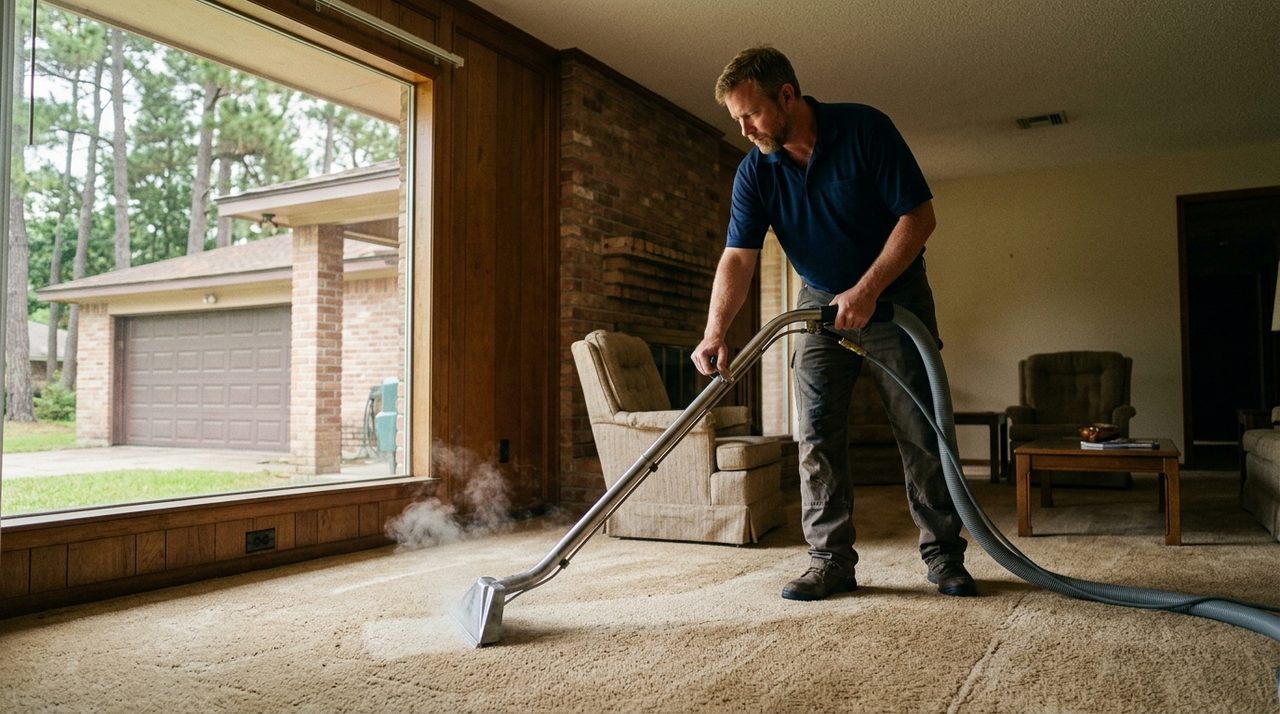
Brookhollow's 1960s–1980s slab-on-grade ranch homes along the US-290 corridor sit on Houston's expansive Beaumont clay, and that combination creates carpet-care challenges that go well below the fiber surface — moisture vapor rising through aging concrete, hard city water reactivating old stains, and decades of clay tracked in from undeveloped lots nearby. Because roughly 58 percent of Brookhollow residents are renters (ACS 2023), lease-turnover cleaning deadlines add a scheduling urgency layer on top of the standard maintenance cycle. This page focuses on what actually drives carpet problems in mid-century NW Houston homes, not generic advice.
Ranked by verified Google rating × review volume × verification tier. How we rank →
Some highly-rated pros serve Brookhollow from nearby and may not keep a Brookhollow street address. Those are listed under "Also serving Brookhollow" with their real city and distance, so you always know where each business is based.
4232 Mangum Rd, Houston, TX 77092
10200 Hempstead Rd Suite 2E, Houston, TX 77092
5702 W 34th St d, Houston, TX 77092
11500 Northwest Fwy Suite 345, Houston, TX 77092
Highly-rated pros based nearby who cover Brookhollow. Distance shown from the Brookhollow area.
Serving Brookhollow Based in Lazybrook / Timbergrove · 1.3 mi away
Serving Brookhollow Based in Lazybrook / Timbergrove · 1.5 mi away
Serving Brookhollow Based in Lazybrook / Timbergrove · 1.5 mi away
Serving Brookhollow Based in Lazybrook / Timbergrove · 1.8 mi away
Serving Brookhollow Based in Lazybrook / Timbergrove · 1.9 mi away
Serving Brookhollow Based in Lazybrook / Timbergrove · 2.1 mi away
Why it matters to you
Brookhollow homes built in the 1960s–1980s were poured on Beaumont clay slabs, and the vapor barriers under those slabs are now 40–60 years old — often degraded or absent in sections where repairs were made. Concrete moisture vapor transmission can exceed 3 lbs per 1,000 sq ft per 24 hours in Harris County clay conditions, meaning the pad can be wicking ground moisture from below at the same time a technician is trying to dry it from above. Homeowners often notice that freshly cleaned carpet smells musty within a day or two, and assume the cleaning was poor — when the real culprit is the slab itself.
What a good pro does
A qualified technician should probe carpet pad moisture levels with a calibrated moisture meter before and after extraction, not just rely on surface touch. If sub-pad readings remain elevated after drying passes, the honest recommendation is pad replacement rather than a second cleaning pass. Texas does not license carpet cleaners through TDLR, but technicians holding IICRC Water Damage Restoration Technician (WRT) certification are trained to assess exactly this scenario and can document findings in writing — useful if you are making an insurance or warranty claim.
Why it matters to you
With a median year-built of 1975 (ACS 2023), many Brookhollow carpets are original or have been in place through multiple tenancies — the neighborhood's 42 percent owner-occupancy rate means a large portion of units have seen repeated rental cycles with pets. Houston municipal water averages 130–180 mg/L hardness as CaCO₃, and when hot-water extraction machines use this mineral-rich water without a softening step, alkaline residue is left behind that reactivates dried urine salt crystals. The result is a home that smells worse two days after cleaning than it did before.
What a good pro does
Proper pet-urine treatment in a Brookhollow rental-era home requires enzyme pretreatment applied to the subfloor area (not just the fiber surface), a dwell time of at least 10–15 minutes, followed by hot-water extraction with an acidic rinse step to counteract Houston's alkaline water chemistry. Expect to pay $50–$120 per affected room above the base cleaning rate for this level of treatment — estimates only. No City of Houston trade permit is required for this work, but ask for IICRC Carpet Cleaning Technician (CCT) certification as a baseline credential.
Why it matters to you
The active commercial and residential development along the US-290 corridor constantly exposes raw Beaumont and Katy Prairie clay — iron-rich soils with a reddish-brown to dark-gray color that bonds aggressively with synthetic carpet fibers. Brookhollow homeowners near construction lots or unpaved easements see this clay ground below the fiber tips into the backing during Houston's wet-dry storm cycles, where it cannot be lifted by a single standard extraction pass. Vacuuming too aggressively before the clay dries can also abrade already-worn fibers in older carpet.
What a good pro does
The correct sequence for clay-contaminated carpet is: allow any wet clay to dry fully, then dry-vacuum thoroughly before any moisture is introduced, followed by a high-alkalinity pre-spray with mechanical agitation (a counter-rotating brush machine, not just a wand), and finally hot-water extraction. For heavily trafficked entryways in homes of this era, a second extraction pass at a lower temperature is often needed. This is a process distinction worth confirming with your provider before booking, as budget-tier services typically skip the agitation step.
Why it matters to you
With 58 percent of Brookhollow housing units occupied by renters (ACS 2023), move-out carpet cleaning is a recurring event throughout the neighborhood. While Brookhollow's HOA landscape cannot be confirmed through Harris County deed records without a plat-specific search, many individual lease agreements in NW Houston require professional cleaning certification within 24–72 hours of move-out — and landlords frequently request written documentation for deposit disputes. Demand for same-day or next-day availability spikes at month-end, and providers who can turn around a written IICRC-compliant service receipt command premium pricing.
What a good pro does
Book at least a week ahead of your move-out date if possible, and confirm in advance that the provider will issue a dated, itemized receipt that names the cleaning method (hot-water extraction is the industry standard), square footage treated, and any pretreatments applied. This documentation is what property managers and small-claims courts actually look for. No City of Houston trade permit is required for the cleaning itself, and Texas has no TDLR license for carpet cleaners — so credential verification (IICRC CCT at minimum) and written receipts are your main consumer protections.
Sources: IICRC (water/mold restoration standards), Local HOA / deed restrictions (see area profile)
Hiring carpet cleaning in Brookhollow? Brookhollow is a northwest Houston neighborhood along the US-290 corridor with housing stock generally dating to the 1960s–1980s. Homeowners here should expect maintenance patterns typical of aging slab-on-grade ranch homes, including HVAC system replacements, cast-iron drain line issues, and periodic foundation monitoring. The neighborhood falls within City of Houston permitting jurisdiction with no historic district restrictions limiting exterior modifications.
Building era
1960s–1980s (area-wide pattern; not confirmed for this specific subdivision).
Typical style
One- and two-story ranch, traditional brick, and contemporary traditional homes — based on area-wide NW Houston/US-290 corridor patterns.
Foundations
Concrete slab-on-grade (predominant for post-1960 NW Houston subdivisions; not independently confirmed for this specific neighborhood).
Common systems
Original homes likely have central A/C units nearing or past useful life, galvanized or cast-iron plumbing transitioning to PVC/PEX in renovated units, and older electrical panels (100–150 amp) that may need upgrading for modern loads.
What that means for repairs
Kitchen and bathroom remodels are common in homes of this era, along with re-piping from original galvanized or cast-iron lines, HVAC replacements, and foundation repair due to Houston's expansive clay soils.
Permit jurisdiction
City of Houston Permitting Center (neighborhood is within Houston city limits).
HOA & deed restrictions
Not confirmed — multiple 'Brookhollow' associations exist in Harris County (including Brookhollow Crossing Association, Inc. and Brookhollow Court HOA), but none could be reliably matched to the NW Houston Brookhollow area near US-290. Check Harris County Clerk records for recorded deed restrictions or management certificates tied to specific plat names.
Historic districts
No City of Houston historic district designation confirmed. Brookhollow does not appear on the HAHC list of designated historic districts, and no Certificate of Appropriateness is required for exterior work.
Contractor note
Contractors should verify lot-specific deed restrictions through Harris County Clerk records before planning exterior modifications, as HOA/POA governance for this specific Brookhollow area could not be confirmed. Standard City of Houston building permits apply.
FEMA flood zone
FEMA Zone X (low flood risk) — source: fema_nfhl. Specific bayou or creek proximity for this neighborhood could not be confirmed from available research; homeowners should verify drainage patterns at the parcel level using Harris County Flood Control District tools.
Hurricane Harvey impact
Harvey impact for the specific Brookhollow neighborhood near US-290 could not be confirmed from available sources. Harvey flood mapping in Harris County is organized by watershed rather than neighborhood name, and no news articles or HCFCD documents explicitly identified Brookhollow (NW Houston) for neighborhood-level Harvey inundation. The FEMA Zone X designation suggests lower overall flood risk, but parcel-level verification is recommended.
Heat & humidity load
Houston's extreme summer heat and humidity place heavy demand on aging HVAC systems common in 1960s–1980s homes. Slab-on-grade foundations in expansive clay soils may experience seasonal movement during drought-to-rain cycles, making foundation monitoring important. Attic insulation upgrades and proper roof ventilation are common service needs to manage cooling costs.
Working with contractors here
Contractors working in Brookhollow most commonly handle HVAC replacements, re-piping from original galvanized or cast-iron drain lines, and foundation repair — all driven by the aging mid-century housing stock typical of the US-290 corridor. Roof replacements on homes 30–50+ years old are frequent, and electrical panel upgrades are common as homeowners add modern loads. Because the HOA landscape is unclear, contractors should verify any exterior modification restrictions with the homeowner and Harris County deed records before scoping jobs. The City of Houston permitting process applies to all structural, electrical, plumbing, and mechanical work requiring permits.
Local Tip
Always ask for a written estimate before work begins. Texas contractors are required to provide one on jobs over $1,000.
Brookhollow is a northwest Houston neighborhood along the US-290 corridor with housing stock generally dating to the 1960s–1980s. Homeowners here should expect maintenance patterns typical of aging slab-on-grade ranch homes, including HVAC system replacements, cast-iron drain line issues, and periodic foundation monitoring. The neighborhood falls within City of Houston permitting jurisdiction with no historic district restrictions limiting exterior modifications.
Source: U.S. Census Bureau, ACS 5-Year 2023
Most of Brookhollow maps to FEMA Zone X (low mapped flood risk), but Houston's flash-flood reality means even low-risk blocks benefit from smart drainage and storm-hardened installs.
Source: FEMA National Flood Hazard Layer (NFHL). Flood zones vary by parcel — verify your individual FIRM panel.
Sources: IICRC (water/mold restoration standards)FEMA National Flood Hazard Layer (NFHL)Harris County Flood Control District