12903 Sugar Ridge Blvd apt 4303, Stafford, TX 77477
Best Appliance Repair in Stafford, TX
Stafford's housing stock — dominated by 1970s–1990s slab-on-grade brick ranch homes and early production builds sitting on Fort Bend County's expansive clay soils — creates a specific set of appliance stresses that newer suburbs or inner-Loop neighborhoods don't share in the same combination. Add Fort Bend groundwater that frequently pulls from harder aquifer sources, storm-related power events from Beryl (2024) and the May 2024 derecho, and a permitting process that runs through the City of Stafford's own department rather than Houston or the county, and homeowners here face a repair-vs.-replace calculus that's worth understanding before calling anyone out. This page covers the four appliance challenges that most consistently affect Stafford properties.
Verified against Google Business data
Updated 2026
See the 10 Appliance Repair Serving Stafford 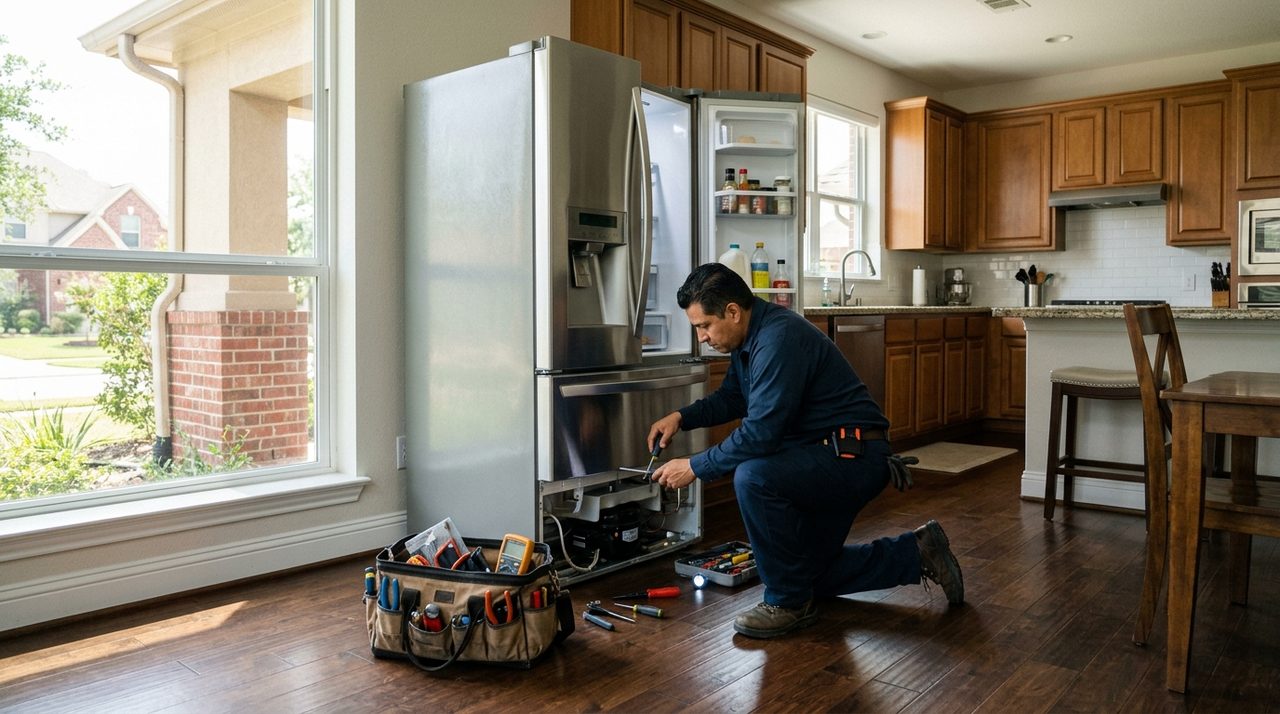
- Median home built
- 1992
- Median home value
- $247,900
- FEMA flood zone
- X (low)
- Typical repair cost (est.)
- $150–$650
- Most common local issue
- Hard-water scaling in dishwashers and ice makers from Fort Bend aquifer supply
Ranked by verified Google rating × review volume × verification tier. How we rank →
Some highly-rated pros serve Stafford from nearby and may not keep a Stafford street address. Those are listed under "Also serving Stafford" with their real city and distance, so you always know where each business is based.
Min rating:
10 resultsBased in Stafford
Open Now
2531 Cartwright Rd, Missouri City, TX 77459
Closed
13955 Murphy Rd #226, Stafford, TX 77477
Also serving Stafford
Highly-rated pros based nearby who cover Stafford. Distance shown from the Stafford area.
Closed
Serving Stafford Based in Missouri City · 2.5 mi away
Closed
Serving Stafford Based in Missouri City · 2.8 mi away
Serving Stafford Based in Sugar Land · 2.9 mi away
Open Now
Serving Stafford Based in Missouri City · 3 mi away
Closed
Serving Stafford Based in Alief · 3.2 mi away
Closed
Serving Stafford Based in Sugar Land · 3.7 mi away
Closed
Serving Stafford Based in Sugar Land · 3.8 mi away
Appliance Repair in Stafford: What You Should Know
Fort Bend Hard Water Scales Dishwashers and Ice Makers Faster Than You'd Expect
Why it matters to you
Many Stafford homes draw municipal water that originates from or blends with the Carrizo-Wilcox aquifer, which runs harder than City of Houston municipal supply — often beyond the 17–20 grains per gallon already measured in Houston's own water quality reports. In 1970s–1990s kitchens that have never had a water softener installed, spray arm orifices in dishwashers clog within a few years, ice-maker fill valves calcify and restrict flow, and washing machine inlet screens need cleaning annually rather than every few years. Homeowners who have lived with these appliances for decades often misread scaling-related failures as mechanical breakdowns.
What a good pro does
A qualified technician should inspect spray arms, inlet screens, and ice-maker orifices for lime scale buildup before ordering any replacement parts — descaling a dishwasher pump assembly ($150–$250 estimated, parts and labor) is a fraction of replacing the unit. If a softener isn't already installed, a tech can advise on inline scale filters as a stopgap. For ice makers showing restricted output, confirm valve flow rate before assuming the ice-maker module itself has failed.
Sources: ENERGY STAR / U.S. Dept. of Energy, Municipal permit office (see area profile)
Beryl and the 2024 Derecho Burned Out Control Boards in Stafford's Newer Smart Appliances
Why it matters to you
Stafford's 2000s–2010s production-build subdivisions are filled with inverter-drive washers, smart dishwashers, and variable-speed refrigerators — exactly the appliance classes most vulnerable to the voltage spikes and dirty-power restoration events that followed Hurricane Beryl (July 2024) and the May 2024 derecho. CenterPoint grid restoration in Fort Bend County ZIP codes produced the same documented surge patterns seen across the metro. Homes in Stafford without whole-home surge protection absorbed those spikes directly into appliance control boards and Wi-Fi modules, many of which showed delayed failure weeks after power returned.
What a good pro does
Control board replacement on mid-range washers and dishwashers runs an estimated $300–$650 parts and labor in the Houston market; on units under seven years old, repair usually pencils out over replacement. A technician should check for secondary damage — burned wiring harnesses, failed door latch switches that went unnoticed alongside the board failure — before quoting a single-board swap. Going forward, a UL-listed whole-home surge protector installed at the main panel is the only protection that covers all appliances simultaneously.
Sources: Municipal permit office (see area profile), Texas Department of Licensing & Regulation
Clay Soil Slab Movement Puts Stafford's Aging Washers and Dryers Out of Level — and Into Early Failure
Why it matters to you
Fort Bend County's expansive Beaumont and Houston Black clay soils cause Stafford's slab-on-grade foundations to shift seasonally, and in 1970s–1990s homes that have gone decades without foundation monitoring, out-of-level laundry room floors are common. Even a quarter-inch of slope over six feet is enough to send a front-load washer into violent off-balance spin cycles that wear drum bearings and door gaskets far ahead of schedule. Dryers on uneven slabs can also disturb exhaust vent connections, particularly in older homes where the vent run was already marginal in length.
What a good pro does
A technician diagnosing a vibrating or loud front-load washer in Stafford should check floor level with a bubble level before assuming a bearing failure — re-leveling the machine's feet takes minutes and can stop accelerated wear immediately. Bearing and drum seal replacement, when genuinely needed, runs an estimated $250–$500; on front-loaders over eight years old with hard-water history, a technician should lay out the honest replacement case. Vent connections should be re-inspected whenever any laundry appliance is serviced in a home with known foundation movement.
Sources: FEMA National Flood Hazard Layer (NFHL), Municipal permit office (see area profile)
Gas Appliance Swaps in Stafford Require a City of Stafford Permit — Not a Houston Permit
Why it matters to you
Stafford is an incorporated city with its own permitting department, and gas appliance work here falls under City of Stafford authority — not Harris County, not the City of Houston, and not Fort Bend County. Homeowners replacing a gas range or gas dryer in one of Stafford's 1970s–1980s ranch homes with original gas stub-outs sometimes discover that a technician has reconnected the gas line without pulling the required permit, leaving them with an unpermitted modification that can complicate homeowner's insurance claims and future home sales. Individual subdivision HOAs — such as Grove West Community Association — may also impose separate review requirements for exterior venting modifications tied to appliance changes.
What a good pro does
Texas law requires a TSBPE-licensed master plumber or gas fitter to perform any gas piping work beyond the appliance connection itself; the City of Stafford permit office must issue the permit before work begins on any gas line reconnection or modification. A reputable appliance-repair company will either hold the required plumbing license in-house or coordinate with a licensed sub for the gas portion and pull the permit at the City of Stafford's department directly. Before scheduling a gas appliance swap, ask the company to confirm their license number and confirm which entity will pull the permit.
Sources: Texas State Board of Plumbing Examiners, Municipal permit office (see area profile), Local HOA / deed restrictions (see area profile)
Appliance Repair in Stafford: What You Should Know
Hiring appliance repair in Stafford? Stafford is an incorporated city in Fort Bend County composed of many individual subdivisions, each with its own HOA rules, deed restrictions, and housing characteristics. The housing stock spans from 1970s ranch homes to 2010s production builds, predominantly slab-on-grade construction on expansive clay soils. Homeowners should verify their specific subdivision's HOA requirements and flood status before scoping any exterior or structural project.
- Housing era
- 1970s–1990s (bulk of existing stock), with newer infill and subdivisions from the 2000s–2010s
- Foundation
- Slab-on-grade (overwhelmingly standard for the era and region
- Flood zone
- FEMA Zone X (low flood risk) per official NFHL data
- Permits
- City of Stafford Permits Department (Stafford is an incorporated city with its own permitting…
Housing stock & systems
Building era
1970s–1990s (bulk of existing stock), with newer infill and subdivisions from the 2000s–2010s.
Typical style
One- and two-story brick veneer ranch homes, traditional and neo-eclectic production builder homes, with some townhomes and garden homes in newer phases.
Foundations
Slab-on-grade (overwhelmingly standard for the era and region; pier-and-beam limited to rare older or custom structures).
Common systems
Central AC with gas furnace; copper or CPVC supply plumbing in older homes transitioning to PEX in newer builds; 1970s–1980s homes may have original galvanized drain lines; electrical panels range from 100-amp in older homes to 200-amp in newer construction.
What that means for repairs
Kitchen and bathroom remodels are common in the 1970s–1990s stock as homeowners update finishes and fixtures. Foundation repair due to expansive clay soil movement is a recurring need. HVAC system replacements are frequent in pre-2000 homes reaching end of equipment life.
Permits & restrictions
Permit jurisdiction
City of Stafford Permits Department (Stafford is an incorporated city with its own permitting authority).
HOA & deed restrictions
No city-wide HOA exists. Many individual subdivisions have mandatory HOAs/POAs (e.g., Grove West Community Association, Inc.) that enforce deed restrictions and architectural standards. Some properties may have no HOA or minimal deed restrictions. Must be confirmed per property via deed records and Fort Bend County Clerk.
Historic districts
No historic district designation confirmed for any area within Stafford.
Contractor note
Contractors must pull permits through the City of Stafford, not Harris County or the City of Houston. Subdivision-level HOA architectural review committees may require pre-approval for exterior modifications, so contractors should confirm HOA requirements before beginning work.
Flood & weather
FEMA flood zone
FEMA Zone X (low flood risk) per official NFHL data. While the broader Fort Bend County area includes Brazos River floodplain zones, the Stafford city center area generally falls outside high-risk flood designations. Property-level verification via FEMA FIRM panels and Fort Bend County floodplain GIS is recommended.
Hurricane Harvey impact
Stafford was not identified as one of the hardest-hit cities during Hurricane Harvey (2017). While Fort Bend County experienced substantial flooding along the Brazos River, the worst-documented impacts were south and southwest of Stafford in Missouri City, Sugar Land, and Richmond/Rosenberg. Specific Stafford streets or subdivisions with repetitive flood losses could not be confirmed from available public records. Buyers and contractors should still check NFIP claims history and seller flood disclosures for individual properties.
Heat & humidity load
Extended Houston-area heat and humidity stress HVAC systems in the aging 1970s–1990s housing stock, making seasonal tune-ups and refrigerant checks essential. Slab foundations on expansive clay soils are vulnerable to differential movement during summer drought cycles, requiring homeowners to maintain consistent watering around foundations. Attic temperatures in single-story ranch homes can exceed 150°F, accelerating roof underlayment and radiant barrier degradation.
Working with contractors here
Foundation monitoring and repair is among the most common contractor engagements in Stafford due to the expansive clay soils and the age of the 1970s–1990s slab-on-grade housing stock. HVAC replacement is a high-demand service as original equipment in older homes reaches 20–30 years of age. Whole-home repiping is increasingly needed in pre-1990s homes with galvanized drain lines or deteriorating copper supply lines. Contractors should note that Stafford is an independent city with its own permitting process, inspection schedules, and code enforcement — not governed by the City of Houston or Fort Bend County for permitting purposes. Job scoping for exterior work must account for subdivision-level HOA architectural standards, which vary significantly across the city.
Local Tip
Always ask for a written estimate before work begins. Texas contractors are required to provide one on jobs over $1,000.
About Stafford
Stafford is an incorporated city in Fort Bend County composed of many individual subdivisions, each with its own HOA rules, deed restrictions, and housing characteristics. The housing stock spans from 1970s ranch homes to 2010s production builds, predominantly slab-on-grade construction on expansive clay soils. Homeowners should verify their specific subdivision's HOA requirements and flood status before scoping any exterior or structural project.
- Median year built
- 1992
- Median home value
- $247,900
- Owner-occupied
- 43%
- Population
- 17,279
- Housing units
- 6,988
- Median income
- $85,910
Source: U.S. Census Bureau, ACS 5-Year 2023
Flood & storm risk
FEMA Zone XLow flood riskMost of Stafford maps to FEMA Zone X (low mapped flood risk), but Houston's flash-flood reality means even low-risk blocks benefit from smart drainage and storm-hardened installs.
Source: FEMA National Flood Hazard Layer (NFHL). Flood zones vary by parcel — verify your individual FIRM panel.
Frequently Asked Questions
Does the City of Stafford require a permit just to reconnect a gas dryer after moving it for a laundry room remodel?
Yes — the City of Stafford's own Permits Department (not the City of Houston or Fort Bend County) governs this, and any disconnection or reconnection of a gas appliance line is considered gas piping work requiring a permit and a licensed master plumber or gas fitter. Even a simple move-and-reconnect of a gas dryer qualifies because you're disturbing the gas supply line. Confirm the exact scope with the City of Stafford before your technician shows up, since requirements can differ from what contractors used to Houston permits expect.
Sources: Municipal permit office (see area profile)Texas State Board of Plumbing Examiners
My 1980s Stafford ranch home still has the original gas range. Should I expect any extra steps when an appliance company replaces it?
Homes in Stafford's 1970s–1980s housing stock often have older flexible gas connectors and shutoff valves that may not meet current codes, so a replacement job can expand beyond just swapping the appliance. The City of Stafford may require a permit for the gas reconnection, and a licensed master plumber or gas fitter must handle any gas line work — your appliance technician alone cannot legally reconnect the gas supply in Texas. Budget time for a possible valve or connector upgrade, and confirm permit requirements with the City of Stafford Permits Department before scheduling.
Sources: Municipal permit office (see area profile)Texas State Board of Plumbing Examiners
Stafford is in FEMA Zone X, so should I still worry about flood damage to appliances in my ground-floor laundry room?
FEMA Zone X means mapped flood risk is low, but Stafford and the broader Fort Bend County area still experience intense Houston-area flash flooding that can briefly push water into garages and laundry rooms even on blocks that haven't flooded before. A few inches of standing water can saturate motor windings and control boards in washers and dryers, and most manufacturers explicitly void warranties after any flood exposure — leaving you in a repair-vs.-replace decision without warranty backing. If your laundry appliances sat in water after any storm event, have a technician assess the motor and board before continuing use, regardless of flood zone designation.
How long does appliance repair typically take to schedule in Stafford after a major storm like Beryl, and is there a price difference?
After a widespread outage event like Hurricane Beryl (2024) or the May 2024 derecho, metro-wide demand for appliance repair spikes sharply and scheduling windows in SW Houston suburbs including Stafford can stretch to one to two weeks for non-emergency work. Emergency or same-day calls during high-demand periods typically carry a trip and diagnostic surcharge estimated at $75–$125 on top of repair costs, based on Houston-market norms. If your appliance failure isn't urgent, waiting two to three weeks post-storm often means shorter queues and standard pricing; for refrigerators, prioritize scheduling quickly to avoid food-loss compounding the repair cost.
My Stafford home is owner-occupied and in a subdivision with a Grove West-style HOA — do I need HOA approval before an appliance technician installs a new dryer vent penetration through an exterior wall?
Stafford has no city-wide HOA, but many of its subdivisions — including those governed by associations like Grove West Community Association, Inc. — maintain architectural standards that can cover exterior modifications including new dryer vent penetrations visible from the street or common areas. You should pull your deed restrictions from Fort Bend County Clerk records and contact your specific subdivision's HOA or architectural review committee before any work that breaches an exterior wall. A City of Stafford permit may also be required for the penetration depending on scope, so check both the HOA and the Permits Department before scheduling.
Sources: Local HOA / deed restrictions (see area profile)Municipal permit office (see area profile)
What should I specifically ask an appliance repair technician before hiring them to work on my Stafford home's appliances, given the Fort Bend water supply and the area's storm history?
Ask whether they have experience diagnosing hard-water scale damage in dishwashers and ice makers, since Fort Bend County's groundwater — often drawn from harder aquifer sources — accelerates scaling in ways technicians used to softer municipal water may underestimate. Also ask whether they carry EPA Section 608 certification if any refrigerant-side refrigerator work is involved, since that is a federal requirement, not just a Texas one. Finally, confirm they are familiar with City of Stafford permitting for any gas or new-circuit work, not just Houston or Harris County processes — Stafford runs its own independent permit office and inspection schedule.
Sources: Municipal permit office (see area profile)Texas Department of Licensing & Regulation