Closed
1306 Marina Bay Dr APT 310C, Clear Lake Shores, TX 77565
Kemah's bayfront location on Galveston Bay puts appliances in one of the harshest operating environments in the Houston metro: salt-laden Gulf air accelerates condenser coil corrosion, FEMA Zone AE flood exposure means a single surge event can saturate motor windings and void manufacturer warranties overnight, and Beryl (2024) delivered the kind of extended outage followed by dirty-power restoration that destroys smart-appliance control boards. This page covers the four appliance-repair challenges that specifically matter in Kemah's mix of 1990s–2000s waterfront redevelopments, older bay cottages, and pier-supported elevated homes — and how permits through the City of Kemah's own building department, not Houston's or Galveston County's, govern any gas or electrical work tied to repairs.
Ranked by verified Google rating × review volume × verification tier. How we rank →
Some highly-rated pros serve Kemah from nearby and may not keep a Kemah street address. Those are listed under "Also serving Kemah" with their real city and distance, so you always know where each business is based.
1306 Marina Bay Dr APT 310C, Clear Lake Shores, TX 77565
Highly-rated pros based nearby who cover Kemah. Distance shown from the Kemah area.
Serving Kemah Based in Seabrook · 2.3 mi away
Serving Kemah Based in League City · 2.7 mi away
Serving Kemah Based in League City · 2.7 mi away
Serving Kemah Based in League City · 2.7 mi away
Serving Kemah Based in League City · 2.9 mi away
Serving Kemah Based in League City · 3.8 mi away
Serving Kemah Based in League City · 5.1 mi away
Serving Kemah Based in Dickinson · 5.4 mi away
Serving Kemah Based in Webster · 5.9 mi away
Why it matters to you
Kemah's position directly on Galveston Bay means salt-laden air flows through kitchen and utility-room vents year-round — not just during storm season. The chloride-rich atmosphere attacks the aluminum fins and copper tubing of refrigerator condenser coils within two to four years in bayfront and canal-adjacent homes, shortening compressor life well below national averages. Homeowners in the 1990s–2000s waterfront redevelopment blocks near the marina district are especially exposed because those homes were built with standard inland-grade appliances that were never spec'd for a coastal Galveston County environment.
What a good pro does
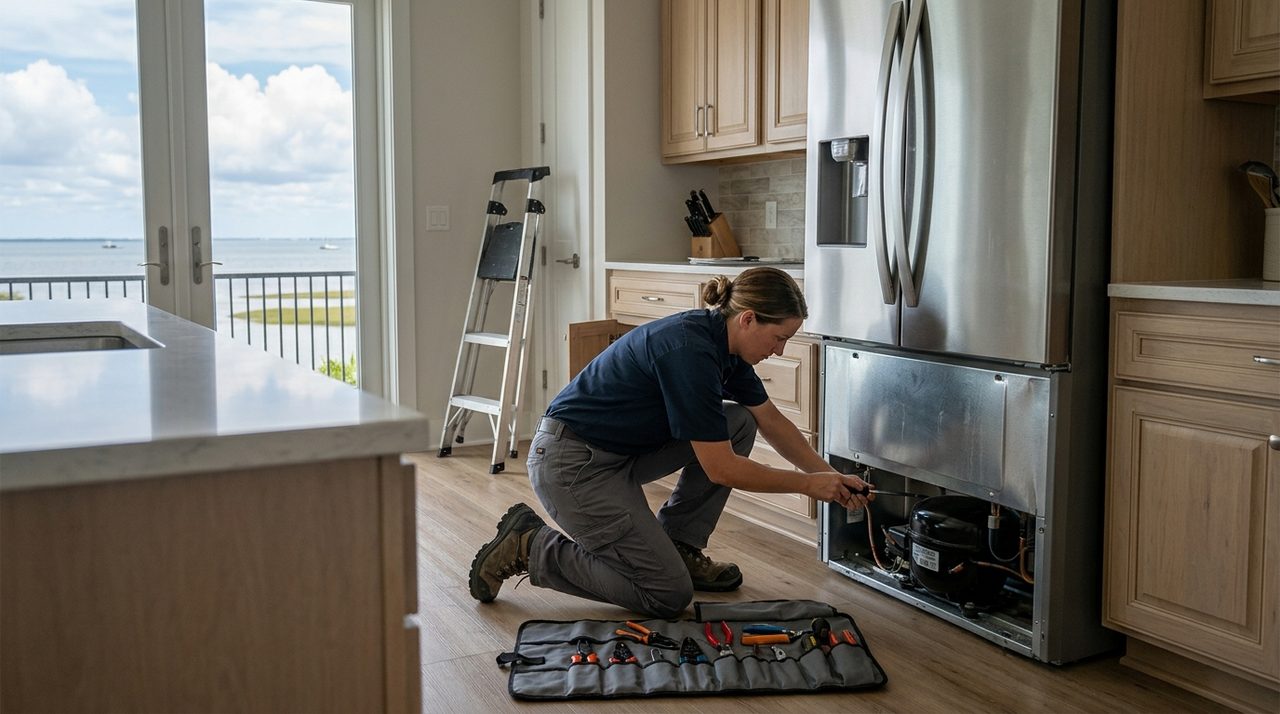
A qualified repair technician should inspect condenser coils annually in any Kemah home within a few blocks of the bay, cleaning salt deposits before they pit the fins and restrict airflow. On refrigerators showing compressor strain — audible running cycles, interior temps drifting above 38°F — a technician can also apply a conformal corrosion-inhibiting coating to exposed coil surfaces as a preventive measure. Refrigerant work requires EPA Section 608 certification from the technician; that federal credential is the standard to verify, since Texas does not issue a separate state appliance-repair license.
Sources: FEMA National Flood Hazard Layer (NFHL), Municipal permit office (see area profile)
Why it matters to you
The 1990s–2000s redevelopment wave brought a large inventory of elevated pier-supported townhome and marina-community units to Kemah, many of which were renovated or re-equipped with 2015-and-newer smart washers, inverter-drive dryers, and Wi-Fi-enabled dishwashers in the years before Beryl hit in July 2024. CenterPoint's multi-day restoration events in SE Houston following both Beryl and the May 2024 derecho sent voltage spikes through those circuits when power returned, burning out inverter boards and variable-speed motor modules in exactly the appliances designed to be most energy-efficient. Homeowners who assumed their appliances survived the storm intact sometimes found failures appearing weeks later as partially damaged boards degraded.
What a good pro does
After any extended CenterPoint outage, a technician should perform a full diagnostic cycle — not just a function check — on inverter-drive washers and dryers, testing the control board under load before declaring the unit sound. Control board replacements in this appliance class run an estimated $300–$650 parts and labor; on a unit over eight years old, the repair-versus-replace math often tips toward replacement. Going forward, a whole-home surge protector installed by a licensed electrician at the main panel is the single most cost-effective protection for Kemah homes with a full suite of smart appliances.
Sources: Municipal permit office (see area profile), Texas Department of Licensing & Regulation
Why it matters to you
Much of Kemah maps to FEMA Zone AE, and the older bay cottages and ground-floor laundry spaces beneath some elevated homes sit at or near base flood elevation. Harvey (2017) and Imelda (2019) put water into ground-level areas across the city; even a few inches of intrusion is enough to saturate washing machine motor windings, corrode dishwasher pump housing terminals, and wick moisture into dryer heating-element assemblies in ways that don't always fail immediately. Critically, virtually every major appliance manufacturer voids the warranty the moment flood water contacts the unit — meaning the standard warranty-repair pathway is closed, and the homeowner is making a pure cost-benefit decision.
What a good pro does
Before authorizing any repair on an appliance in a flood-exposed Kemah home, ask the technician to document whether the unit shows evidence of prior water intrusion — rust at base welds, discoloration on motor windings, or corrosion on wire harness connectors — because repairing a flood-compromised unit without addressing hidden damage produces premature re-failure. If the appliance has flood history and is more than six years old, replacement is usually the sounder investment. Any new appliance installation in a ground-level space beneath an elevated home should include the unit elevated off the slab surface on a platform or mounted bracket to keep it above nuisance-flood thresholds.
Sources: FEMA National Flood Hazard Layer (NFHL), Municipal permit office (see area profile)
Why it matters to you
Kemah is an independent incorporated city with its own municipal government and building department; permits for gas range, gas dryer, or gas water-heater work must be pulled through the City of Kemah, not through the City of Houston's permit office or Galveston County. This catches homeowners off guard when they hire a technician or handyman who is accustomed to Houston's permitting process, because the rules and inspection workflows are different. Any gas line reconnection or modification — including disconnecting and reconnecting a gas range during a kitchen appliance swap — requires a licensed master plumber or licensed gas fitter under Texas State Board of Plumbing Examiners (TSBPE) rules, and that work must be permitted at the City of Kemah level.
What a good pro does
Before scheduling a gas appliance replacement or reconnection in Kemah, confirm with the City of Kemah building department whether the specific scope — gas line disconnect/reconnect, flexible connector replacement, or new 240V circuit — requires a permit; do not assume the technician has already handled this. Verify that whoever touches the gas piping holds a current TSBPE license, which is searchable through the TSBPE public license lookup. For appliances in pier-supported elevated homes, also confirm the technician has access to the utility connections beneath the raised floor, as scope and labor cost can increase significantly compared to a slab-on-grade installation.
Sources: Texas State Board of Plumbing Examiners, Municipal permit office (see area profile), City of Houston Permitting Center
Hiring appliance repair in Kemah? Kemah is a small incorporated city on Galveston Bay with a mix of original bay cottages, 1990s–2000s waterfront redevelopment, and newer elevated townhome/marina communities. Homeowners here face persistent challenges from storm surge exposure, salt-air corrosion, and FEMA floodplain compliance requirements. Contractors working in Kemah must be familiar with elevated foundation systems, coastal building codes, and the City of Kemah's own permitting process.
Building era
Mixed: pre-1960s original cottages, 1970s–1980s infill, significant 1990s–2000s waterfront redevelopment, and post-2008 elevated infill.
Typical style
Coastal raised beach-house style (pier-supported with elevated living areas), traditional suburban SFRs (brick veneer or siding), and townhome/condo marina-oriented developments with stucco or fiber-cement siding.
Foundations
Mixed — pier-and-beam/elevated pile foundations dominate along the bayfront and canal-adjacent properties; slab-on-grade more common in interior and newer suburban pockets.
Common systems
Older cottages may have original copper or galvanized plumbing and outdated electrical panels; 1990s–2000s homes typically feature central HVAC, PVC/CPVC plumbing, and 200-amp electrical service. Salt-air exposure accelerates corrosion on HVAC condensers, metal roofing components, and exterior electrical fixtures across all eras.
What that means for repairs
Most common renovation activity includes elevating older homes to meet current FEMA BFE requirements, replacing storm-damaged structures with new elevated construction, upgrading HVAC and exterior materials to salt-air-resistant alternatives, and converting or remodeling ground-level areas beneath raised homes for parking or storage.
Permit jurisdiction
City of Kemah (independent incorporated city with its own municipal government and building department).
HOA & deed restrictions
No city-wide mandatory HOA or master association. HOAs are present in specific newer townhome, condo, and marina developments on a project-by-project basis. Older platted areas (e.g., original Kemah Townsite) generally have no organized HOA. Voluntary civic clubs may exist in some pockets but are not confirmed. Deed restrictions vary by subdivision — check Galveston County Clerk records for specific parcels.
Historic districts
No City of Houston historic district designation confirmed. Kemah is an independent incorporated city; no HAHC jurisdiction applies. No locally designated historic districts confirmed in current city records.
Contractor note
Contractors must pull permits through the City of Kemah, not Houston or Galveston County. Coastal AE zone requirements often mandate elevation certificates, flood-resistant materials below BFE, and compliance with FEMA substantial improvement/damage rules for renovations exceeding 50% of the structure's market value.
FEMA flood zone
FEMA Zone AE (high flood risk) — source: fema_nfhl. Kemah sits directly on Galveston Bay and is exposed to both storm surge and tidal flooding. Much of the city falls within AE and potentially VE (velocity) zones along the immediate shoreline. Proximity to Clear Creek and Galveston Bay amplifies flood risk during tropical weather events.
Hurricane Harvey impact
Kemah experienced flooding during Hurricane Harvey (2017) from a combination of extreme rainfall and storm surge/tidal influence from Galveston Bay. Specific damage data for Kemah was not itemized separately from broader Galveston County FEMA reports, but the bayfront location and low elevation made the area vulnerable to both surge-driven and rain-driven flooding. Many older, non-elevated homes in the area sustained water damage. Post-Harvey, elevated construction and stricter floodplain compliance have become more prevalent.
Heat & humidity load
Extreme humidity and sustained heat along Galveston Bay push HVAC systems hard from May through October. Salt-laden coastal air accelerates corrosion on condenser coils, ductwork fasteners, and exterior metal components. Pier-and-beam homes benefit from under-house ventilation but require regular inspection for moisture damage, mold, and pest intrusion during the humid season.
Working with contractors here
Contractors in Kemah most frequently handle foundation elevation projects, HVAC replacement with salt-air-resistant units, and exterior envelope repairs caused by coastal weather exposure. Roof replacements are common after storm events, with wind-rated materials and proper tie-downs critical given the bayfront exposure. Plumbing work in older cottages often involves full re-pipes from galvanized to modern materials. Job scoping must account for FEMA elevation requirements — any substantial improvement to a structure in the AE zone requires bringing the entire building into current floodplain compliance, which can dramatically expand project scope and cost. Access can be tight on narrow waterfront lots, and contractors should verify whether the specific property falls under a project-level HOA with architectural review requirements before beginning exterior work.
Local Tip
Always ask for a written estimate before work begins. Texas contractors are required to provide one on jobs over $1,000.
Kemah is a small incorporated city on Galveston Bay with a mix of original bay cottages, 1990s–2000s waterfront redevelopment, and newer elevated townhome/marina communities. Homeowners here face persistent challenges from storm surge exposure, salt-air corrosion, and FEMA floodplain compliance requirements. Contractors working in Kemah must be familiar with elevated foundation systems, coastal building codes, and the City of Kemah's own permitting process.
Source: U.S. Census Bureau, ACS 5-Year 2023
Much of Kemah maps to FEMA Zone AE (high flood risk), so flood-resilient detailing -- elevated equipment, water-tolerant materials, and drainage-first thinking -- is essential here, not optional; risk climbs sharply on blocks nearest Galveston Bay, where it varies parcel to parcel.
Source: FEMA National Flood Hazard Layer (NFHL). Flood zones vary by parcel — verify your individual FIRM panel.
Sources: Municipal permit office (see area profile)Texas State Board of Plumbing Examiners
Sources: Local HOA / deed restrictions (see area profile)
Sources: EPA Lead Renovation, Repair and Painting (RRP) Rule