Serving Santa Fe Based in Dickinson · 2.9 mi away
Best Water & Flood Restoration in Santa Fe, TX
Santa Fe, TX sits entirely within FEMA Zone AE in Galveston County, meaning virtually every home in this community faces a statistically significant flood risk in any given year — and with a median year built of 1991, most of its roughly 81-percent owner-occupied housing stock was constructed before modern flood-resilient building practices became standard. This page focuses on the restoration realities that are specific to Santa Fe: Category 3 bayou and surge losses, slab-edge moisture retention in Galveston County clay soils, HVAC systems that become mold incubators within days of inundation, and the permit jurisdiction split between the City of Santa Fe and unincorporated Galveston County that can stall insurance claim closures.
Verified against Google Business data
Updated 2026
See the 10 Water & Flood Restoration Serving Santa Fe 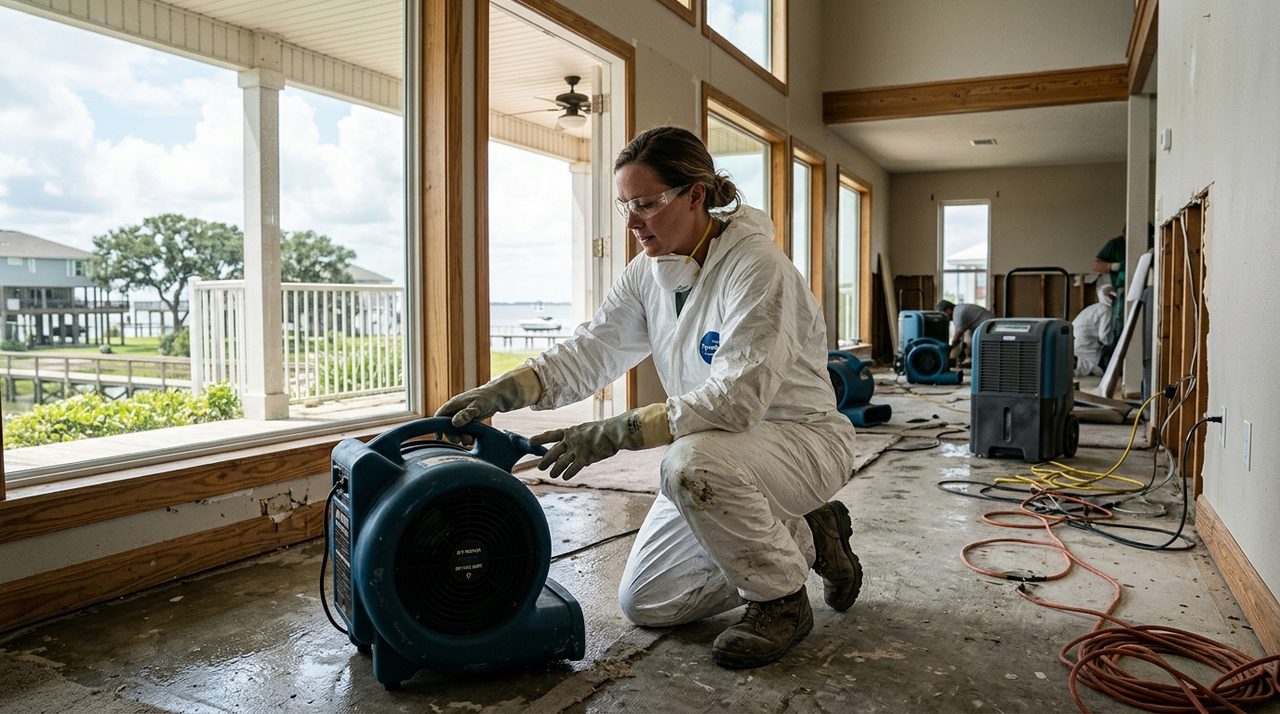
- Median home built
- 1991
- Median home value
- $290,200
- FEMA flood zone
- AE (high)
- Typical mitigation cost (est.)
- $15,000–$40,000
- Most common local issue
- Category 3 flood losses from Zone AE storm surge and coastal tropical events
Ranked by verified Google rating × review volume × verification tier. How we rank →
Some highly-rated pros serve Santa Fe from nearby and may not keep a Santa Fe street address. Those are listed under "Also serving Santa Fe" with their real city and distance, so you always know where each business is based.
Min rating:
10 resultsAlso serving Santa Fe
Highly-rated pros based nearby who cover Santa Fe. Distance shown from the Santa Fe area.
Serving Santa Fe Based in La Marque · 4.7 mi away
Serving Santa Fe Based in League City · 6.4 mi away
Closed
Serving Santa Fe Based in Dickinson · 6.7 mi away
Closed
Serving Santa Fe Based in La Marque · 7.1 mi away
Open Now
Serving Santa Fe Based in League City · 7.2 mi away
Open Now
Serving Santa Fe Based in Dickinson · 7.4 mi away
Serving Santa Fe Based in League City · 7.4 mi away
Serving Santa Fe Based in League City · 7.5 mi away
Closed
Serving Santa Fe Based in La Marque · 7.5 mi away
Water & Flood Restoration in Santa Fe: What You Should Know
Zone AE Storm Surge Means Category 3 Black Water — Not a Simple Cleanup
Why it matters to you
Santa Fe's FEMA AE designation reflects genuine inundation risk from both bayou overflow and Galveston Bay-influenced storm surge during Gulf tropical events. When that water enters a 1991-era home, it almost certainly carries sewage contamination from overloaded county drainage systems, classifying it as Category 3 (black water) under IICRC S500 standards. That classification legally requires demo of all porous materials — drywall, insulation, flooring, and bottom plates — to at least 12 inches above the flood line, a scope some insurers will try to dispute by reclassifying the loss as Category 2 gray water to limit payout.
What a good pro does
A qualified restoration contractor must document the water source and, where possible, obtain field water-quality test results to defend the Category 3 classification in writing to your insurer. Because any substantial improvement exceeding 50 percent of the structure's market value triggers Galveston County floodplain elevation requirements, the contractor should coordinate with the permit office — either the City of Santa Fe or Galveston County Engineering depending on your address — before finalizing the demo scope, since the elevation trigger can affect reconstruction costs and timelines significantly.
Sources: IICRC (water/mold restoration standards), FEMA National Flood Hazard Layer (NFHL), Municipal permit office (see area profile)
Slab-Edge Moisture Trapped by Galveston County Coastal Clay Soils
Why it matters to you
Most Santa Fe homes built around 1991 are slab-on-grade construction, and the coastal clay soils common in Galveston County hold floodwater against the slab perimeter for weeks after surface water recedes — far longer than homeowners expect. That sustained moisture wicks into bottom plates, drywall backing, and any remaining subfloor material, creating hidden saturation that standard visual inspections miss entirely. A homeowner who gut-checks a room by pressing a hand to the wall a week after flooding can still be sitting on a serious mold problem that has not yet become visible.
What a good pro does
A properly scoped restoration job in Santa Fe requires calibrated moisture meters and thermal imaging cameras at every wall base and slab edge, not just in rooms where water was visibly standing. Drying timelines in Galveston County clay conditions routinely run 5 to 10 days longer than inland jobs; industrial dehumidifiers and desiccant drying equipment sized for the actual moisture load — not a generic room count — are the correct response. Mold remediation work on any affected porous material requires a TDLR-licensed Mold Remediation Contractor (MRC) under Texas Occupations Code Chapter 1958.
Sources: IICRC (water/mold restoration standards), Texas Department of Licensing & Regulation, FEMA National Flood Hazard Layer (NFHL)
1991-Era Flex Duct Systems Becoming Mold Incubators After Inundation
Why it matters to you
Homes built around Santa Fe's median construction year of 1991 commonly used fiberglass-lined flex duct running through unconditioned attic space, a configuration that absorbs floodwater moisture and holds it against Houston-area humidity levels averaging around 74 percent. Once a home is re-energized after flooding and the central AC restarts — often done too quickly by homeowners trying to cool down — the system circulates warm humid air through already-saturated ductwork, creating textbook Aspergillus and Cladosporium growth conditions within 48 to 72 hours. This is not a surface problem; spore counts in the living space can spike before any visible mold appears on walls.
What a good pro does
A restoration professional working on a post-flood Santa Fe home should inspect all accessible flex duct runs with a moisture meter and borescope before the HVAC system is restarted, and should include a written duct assessment in the insurance scope. In most 1991-era homes that experienced more than 24 hours of inundation, full duct replacement is the correct call, not cleaning. Any electrical work exposed during duct access or air handler removal must be permitted and performed by a TDLR-licensed electrician; trade permits for this work are pulled through either the City of Santa Fe or Galveston County Engineering based on the property's jurisdiction.
Sources: IICRC (water/mold restoration standards), Texas Department of Licensing & Regulation, Municipal permit office (see area profile)
Permit Jurisdiction Split Between City of Santa Fe and Galveston County Delays Insurance Closures
Why it matters to you
Santa Fe is unusual in the SE Houston corridor because the permit jurisdiction is not a single clear answer: properties within the City of Santa Fe's municipal limits route permits through the City of Santa Fe, while parcels in unincorporated Galveston County fall under Galveston County Engineering — and the two offices have different forms, fee schedules, and inspection cadences. Mis-routing even a demolition permit to the wrong office is a real risk in this community, and a rejected or delayed permit application can stall the Certificate of Completion that your insurance carrier needs to close the claim and release reconstruction funds.
What a good pro does
Before signing any restoration contract, confirm your property's exact jurisdiction by address — your Galveston County Appraisal District record or a call to both offices can resolve it quickly. The restoration contractor should pull the demolition permit under the correct jurisdiction, while any licensed plumber (TSBPE-licensed) or electrician (TDLR-licensed) exposed during demo pulls their own trade permits through that same office. In Zone AE, any scope that constitutes a substantial improvement also requires a floodplain development permit and may require an elevation certificate, adding a step that contractors unfamiliar with Galveston County flood ordinances sometimes miss.
Sources: Municipal permit office (see area profile), FEMA National Flood Hazard Layer (NFHL), Texas State Board of Plumbing Examiners, Texas Department of Licensing & Regulation
Water & Flood Restoration in Santa Fe: What You Should Know
Hiring water & flood restoration in Santa Fe? Santa Fe sits in Galveston County's FEMA AE high-risk flood zone, making water management the dominant concern for homeowners. Specific details about the neighborhood's housing stock, HOA governance, and permit jurisdiction remain difficult to confirm without a precise subdivision name or ZIP code. Homeowners should prioritize flood-resistant materials, elevated mechanical systems, and proper drainage when planning any renovation or repair.
- Housing era
- Not confirmed - check Galveston County Appraisal District records for primary build decades
- Foundation
- Not confirmed - slab-on-grade is typical for SE Houston and Galveston County areas, but…
- Flood zone
- FEMA Zone AE (high flood risk) - source
- Permits
- Not confirmed - if within the City of Santa Fe municipal limits, permits would…
Housing stock & systems
Building era
Not confirmed - check Galveston County Appraisal District records for primary build decades.
Typical style
Not confirmed - check Galveston County Appraisal District records for architectural styles.
Foundations
Not confirmed - slab-on-grade is typical for SE Houston and Galveston County areas, but verify with local inspection records.
Common systems
Not confirmed - typical SE Houston/Galveston County homes feature central AC systems, copper or PEX plumbing, and standard residential electrical panels, but specifics depend on build era.
What that means for repairs
Given the FEMA AE flood zone designation, flood mitigation upgrades such as elevated HVAC equipment, flood vents, and water-resistant building materials are likely common renovation priorities.
Permits & restrictions
Permit jurisdiction
Not confirmed - if within the City of Santa Fe municipal limits, permits would be handled by the City of Santa Fe; if in unincorporated Galveston County, permits fall under Galveston County Engineering. Verify the exact jurisdiction by address.
HOA & deed restrictions
Not confirmed - research could not verify whether a mandatory HOA, voluntary civic club, or no organized HOA governs this specific area. Check Harris County Clerk and Galveston County Clerk records for recorded deed restrictions.
Historic districts
No City of Houston historic district designation confirmed. Santa Fe is in Galveston County and likely outside City of Houston HAHC jurisdiction.
Contractor note
Contractors should confirm whether the property falls within the City of Santa Fe or unincorporated Galveston County, as permit requirements and floodplain development regulations differ significantly between the two jurisdictions.
Flood & weather
FEMA flood zone
FEMA Zone AE (high flood risk) - source: fema_nfhl. Properties in this zone face a 1% annual chance of flooding and require flood insurance for federally backed mortgages. Proximity to local bayous, creeks, or drainage channels could not be confirmed from available research.
Hurricane Harvey impact
Not confirmed from available research - Galveston County broadly experienced significant Harvey flooding in 2017, and the AE flood zone designation suggests this area is vulnerable, but specific street-level impact and recurring flood-prone areas could not be verified. Check Galveston County flood damage records and FEMA claims data for this area.
Heat & humidity load
Houston-area summers bring extreme heat and humidity that stress HVAC systems and promote mold growth, especially in flood-prone areas where moisture intrusion compounds seasonal humidity. Proper attic ventilation, dehumidification, and regular AC maintenance are critical for homes in this zone.
Working with contractors here
The FEMA AE flood zone designation means contractors working in Santa Fe should expect flood mitigation and storm damage repair to be among the most common project types. Elevated mechanical systems, foundation inspections for water damage, and mold remediation are frequent needs. Any substantial improvement or repair exceeding 50% of the structure's market value may trigger floodplain development requirements including elevation to base flood elevation. Contractors should verify the exact permit jurisdiction—City of Santa Fe versus unincorporated Galveston County—before bidding, as compliance requirements vary. Material selections should prioritize flood-resistant options below the base flood elevation per local floodplain ordinances.
Local Tip
Always ask for a written estimate before work begins. Texas contractors are required to provide one on jobs over $1,000.
About Santa Fe
Santa Fe sits in Galveston County's FEMA AE high-risk flood zone, making water management the dominant concern for homeowners. Specific details about the neighborhood's housing stock, HOA governance, and permit jurisdiction remain difficult to confirm without a precise subdivision name or ZIP code. Homeowners should prioritize flood-resistant materials, elevated mechanical systems, and proper drainage when planning any renovation or repair.
- Median year built
- 1991
- Median home value
- $290,200
- Owner-occupied
- 81%
- Population
- 12,828
- Housing units
- 5,207
- Median income
- $95,815
Source: U.S. Census Bureau, ACS 5-Year 2023
Flood & storm risk
FEMA Zone AEHigh flood riskMuch of Santa Fe maps to FEMA Zone AE (high flood risk), so flood-resilient detailing -- elevated equipment, water-tolerant materials, and drainage-first thinking -- is essential here, not optional; as a Galveston County coastal community, tropical surge and wind add a layer generic guidance misses.
Source: FEMA National Flood Hazard Layer (NFHL). Flood zones vary by parcel — verify your individual FIRM panel.
Houston Storm Readiness in Santa Fe
Hurricane & flooding
Storm-surge events like those modeled in FEMA VE zones along Galveston Bay can deliver saltwater intrusion that demands specialized extraction protocols beyond standard freshwater flooding, so vet your Santa Fe, TX restoration contractor now to confirm they carry IICRC WRT and ASD certifications and have surge-specific drying equipment staged locally. Salt contamination accelerates corrosion and mold growth faster than Category 1 freshwater, compressing the safe drying window. As a Galveston County community, Santa Fe may follow county rather than City of Houston storm rebuild rules.
Severe storms & hail
After the May 2024 derecho, coastal homeowners discovered that wind had forced water into attic ridge vents and behind exterior cladding that appeared undamaged, leading to hidden saturation discovered only months later. Scheduling a post-storm thermal imaging inspection with a water-restoration contractor in Santa Fe, TX is the most reliable way to rule out or remediate this type of concealed water intrusion. Confirm the current FEMA panel for your Santa Fe parcel — the area maps to Zone AE, but adjacent lots can differ.
Ice storms & freezes
Uri 2021 left coastal Houston properties with freeze damage that was slower to dry than inland homes due to ambient humidity near Galveston Bay, and restoration teams using standard refrigerant dehumidifiers without supplemental desiccant units failed to reach acceptable moisture levels in wall cavities. Vet your Santa Fe, TX restoration contractor to confirm they carry desiccant equipment and understand coastal drying conditions before contracting for freeze-event response. Confirm the current FEMA panel for your Santa Fe parcel — the area maps to Zone AE, but adjacent lots can differ.
Sources: FEMA National Flood Hazard Layer (NFHL), Ready.gov -- Hurricanes, CenterPoint Energy -- Storm Center, City of Houston -- Emergency Preparedness, Ready.gov -- Winter Weather, Harris County Flood Control District
Free Santa Fe Tools & Calculators
Houston-specific estimators to plan your project before you call a pro. All results are planning estimates — a licensed local pro confirms the details on site.
Houston Freeze Prep & Pipe Insulation Checklist
Open full tool & FAQ →Your freeze checklist — 4 tasks
- 1
Disconnect & drain every outdoor hose bib
Remove hoses, drain the spigots, and cover each with an insulated faucet sock. Un-drained hose bibs are the #1 burst point in a Houston freeze.
- 2
Insulate exposed pipes in the attic & garage
Wrap any pipe in an unconditioned space (attic runs, garage walls) with foam sleeves. Houston homes rarely insulate these because they only matter a few nights a year — which is exactly why they burst.
- 3
Open cabinet doors & keep a pencil-width drip
On hard-freeze nights, open kitchen/bath cabinets so warm air reaches the pipes and let faucets on exterior walls drip to relieve pressure.
- 4
Protect the attic/garage water heater & its lines
An attic or garage tank sits in unconditioned space. Insulate the cold-inlet and hot-outlet lines and confirm the emergency drain pan is clear so a leak doesn't reach the ceiling.
This is a planning estimate only — actual requirements depend on an on-site assessment by a licensed Houston pro. If a pipe has already burst, shut off your main water supply and call a licensed Houston plumber immediately — freeze bursts flood fast.
Frequently Asked Questions
My Santa Fe home flooded — do I pull a demo permit through the City of Santa Fe or Galveston County?
It depends on whether your address falls inside the City of Santa Fe's municipal limits or in unincorporated Galveston County — two different permit offices with different forms, fees, and inspection timelines. Before your restoration contractor files anything, confirm your jurisdiction by looking up your address with the Galveston County Engineering Department or the City of Santa Fe's building office; mis-routing the permit application can delay the Certificate of Completion your insurer needs to close the claim. Ask any contractor you interview whether they have pulled permits in both jurisdictions, because the process is not interchangeable.
Sources: Municipal permit office (see area profile)
Does the Substantial Improvement rule apply to flood repairs on my Zone AE Santa Fe home, and how close to the 50% threshold am I?
Yes — because Santa Fe is mapped in FEMA Zone AE, local floodplain ordinances require that any repair or improvement exceeding 50% of the structure's pre-damage market value must bring the entire building into compliance with current base flood elevation (BFE) requirements, which could mean elevating the foundation or the entire structure. With a Census median home value around $290,200 in Santa Fe, a major Category 3 restoration scope can approach or exceed that threshold faster than homeowners expect, especially when reconstruction costs are added to the mitigation invoice. Your restoration contractor and Galveston County's floodplain administrator should both review the scope before demolition begins so you understand your exposure.
After the last hurricane season, when is the worst time to start flood restoration work in Santa Fe, and how long does full drying actually take here?
Gulf hurricane season runs June through November, and Santa Fe's coastal location means back-to-back tropical events can interrupt an active drying scope — a partially dried structure that takes on a second flood event resets to Day 1 of the drying timeline. Even without a second event, Galveston County's coastal humidity (routinely 75–90% relative humidity in summer) slows evaporative drying significantly compared to inland Houston, and IICRC S500 drying standards require reaching normal moisture levels in wall assemblies before any enclosure can begin, which on a saturated slab-on-grade structure in this climate realistically takes 5–10 days of continuous dehumidification at minimum — sometimes longer in clay-soil areas. If you're starting restoration in late summer, confirm your contractor is monitoring daily moisture readings and not simply pulling equipment on a fixed schedule.
The insurer wants to call my Santa Fe flood a Category 2 gray-water loss to limit the demo scope, but the water came off the street during the storm. How do I fight that?
Storm water that overtops streets and enters a Zone AE home in coastal Galveston County almost always qualifies as Category 3 black water under IICRC S500 because it comingles with sewage, agricultural runoff, and other contaminants before entry — and that classification drives a mandatory demo scope removing all porous materials at least 12 inches above the flood line. Your restoration contractor should document the water source with photographs, a written flood-origin narrative, and ideally water testing results, then cite IICRC S500 classification criteria when disputing a downgrade. Texas Department of Licensing and Regulation requires licensed Mold Remediation Contractors to follow industry standards, so a contractor who allows improper downgrading is also exposing themselves to liability.
Sources: IICRC (water/mold restoration standards)Texas Department of Licensing & Regulation
My 1991-built Santa Fe home has the original electrical panel — if flood restoration exposes wiring, do I need a separate licensed electrician or can the restoration crew handle it?
Any electrical work uncovered during flood demo — whether replacing damaged wiring, relocating outlets above the base flood elevation, or upgrading a panel — must be performed by a TDLR-licensed electrician and permitted separately through either the City of Santa Fe or Galveston County, depending on your jurisdiction. The restoration contractor typically pulls the demolition permit, but the electrician pulls their own trade permit and schedules their own inspection; these cannot be combined. This matters especially in 1991-era homes where aluminum branch wiring or undersized panels are common discoveries once flood-damaged drywall comes down.
Sources: Texas Department of Licensing & RegulationMunicipal permit office (see area profile)
Should I have my Santa Fe home tested for lead paint before restoration crews start demo on the flood-damaged drywall and trim?
With a Census median year built of 1991, most Santa Fe homes fall just below the 1978 cutoff EPA uses for mandatory lead-safe work practices — but if any portion of your home was built or substantially remodeled before 1978, or if you have older additions, federal RRP rules require contractors to use lead-safe work practices during demolition. Even for post-1978 homes, it's worth asking your restoration contractor whether they are EPA RRP-certified, because some 1980s–early-1990s materials still contained residual lead pigments, and flood-loosened paint creates dust exposure risk during demo. A certified firm will test or presume lead presence before grinding or dry-sanding any suspect surfaces.
Sources: EPA Lead Renovation, Repair and Painting (RRP) Rule