Open Now
2003 Clay St, Houston, TX 77003
EaDo's patchwork of 2010s–2020s infill townhomes stacked against legacy structures from earlier decades creates a water restoration landscape unlike any other Inner Loop neighborhood: a 2022 townhome on PEX plumbing shares a block with a 1960s commercial conversion whose aging supply lines and unverified foundation type demand completely different drying and repair protocols. Most of EaDo sits in FEMA Zone X, but blocks nearest Buffalo Bayou carry parcel-specific AE risk that homeowners rarely discover until a claim is filed. Understanding which building vintage, which HOA (if any), and which City of Houston permit pathway applies to your specific parcel is the difference between a clean restoration and a drawn-out insurance and inspection battle.
Ranked by verified Google rating × review volume × verification tier. How we rank →
Some highly-rated pros serve EaDo from nearby and may not keep a EaDo street address. Those are listed under "Also serving EaDo" with their real city and distance, so you always know where each business is based.
2003 Clay St, Houston, TX 77003
Highly-rated pros based nearby who cover EaDo. Distance shown from the EaDo area.
Serving EaDo Based in Midtown · 0.6 mi away
Serving EaDo Based in Midtown · 1.2 mi away
Serving EaDo Based in Midtown · 1.2 mi away
Serving EaDo Based in Midtown · 1.2 mi away
Serving EaDo Based in Midtown · 1.2 mi away
Serving EaDo Based in Midtown · 1.3 mi away
Serving EaDo Based in Midtown · 1.4 mi away
Serving EaDo Based in Midtown · 1.5 mi away
Serving EaDo Based in Midtown · 1.6 mi away
Why it matters to you
EaDo's dominant infill townhome stock — typically three-story, slab-on-grade, with shared or near-shared party walls — concentrates moisture risk in wall assemblies that are difficult to access without damaging builder-grade finishes. When a PEX supply line fails inside an interior chase or when wind-driven rain breaches a window flange (a documented failure mode in the May 2024 derecho), water migrates vertically down stud bays and pools at the slab edge, where Houston Black clay soil holds it against the perimeter long after surface drying appears complete. In a multi-story townhome with multiple floor levels of drywall above the intrusion point, the hidden saturation zone can be three times the visible damage area.
What a good pro does
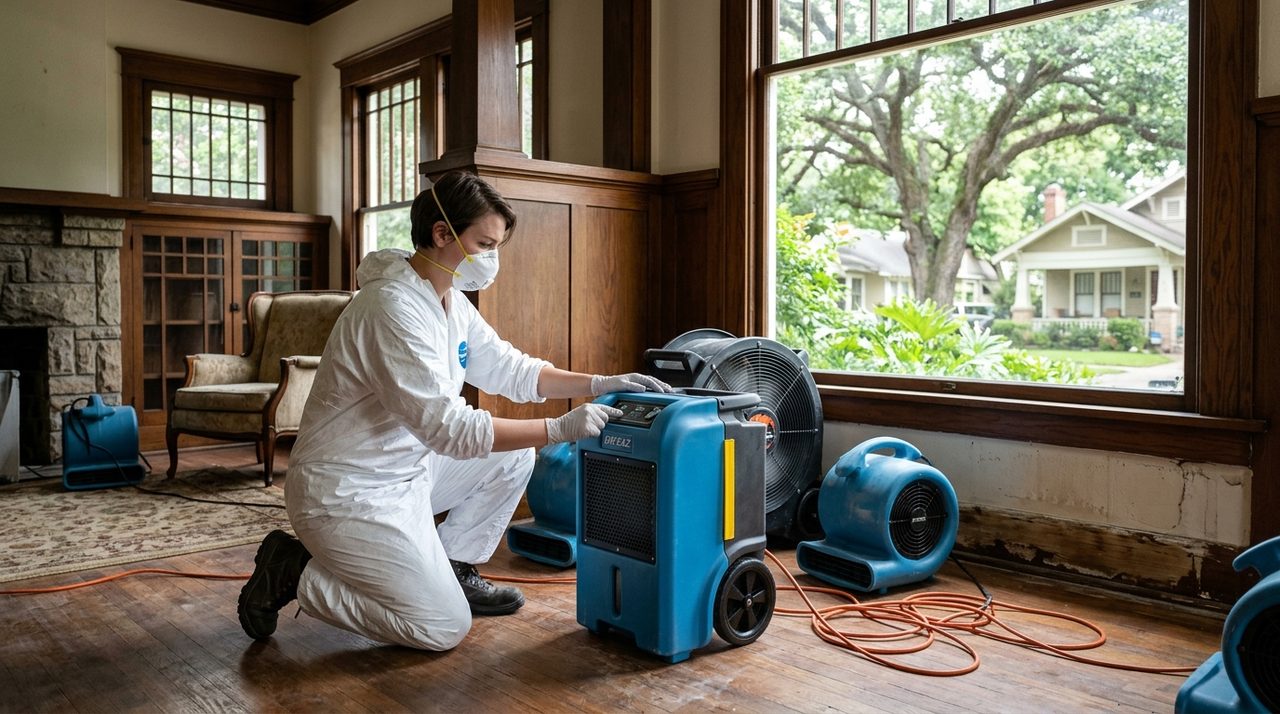
A qualified restoration contractor should use thermal imaging cameras and calibrated moisture meters to map the full saturation path from entry point to slab before any drywall removal begins — not after. Structural drying of a multi-story townhome cavity typically requires strategic drying holes or limited drywall removal at each floor level to allow airflow, with commercial dehumidifiers and air movers staged per IICRC S500 drying protocols. Any demolition touching structural elements requires a permit pulled through the City of Houston Permitting Center; the restoration firm typically pulls the demo permit while licensed sub-trades handle any exposed plumbing or electrical.
Sources: IICRC (water/mold restoration standards), City of Houston Permitting Center, Texas State Board of Plumbing Examiners
Why it matters to you
EaDo has no single neighborhood-wide HOA, but development-specific mandatory HOAs — including EaDo Square Townhome Association and EADO Edge Homeowners Association — impose architectural review requirements that technically apply to exterior restoration work, including dumpster placement, visible material removal, and re-cladding of shared-wall assemblies. IICRC S500 standards call for drying initiation within 24–48 hours of water intrusion to prevent a Category 2 loss from escalating to Category 3; an HOA review cycle that runs longer than that window can directly worsen the damage scope and insurance payout. Homeowners on older single-family lots with no HOA face none of these constraints, but may not know which category their parcel falls into until work is already underway.
What a good pro does
Before any exterior demo begins, the restoration contractor should pull the parcel-specific deed restrictions and HOA bylaws from Harris County Clerk records to confirm governing authority. If an HOA architectural review is required, the contractor should submit an emergency variance request in writing simultaneously with mobilization — not sequentially. Document the timeline meticulously, as HOA-caused delays that push drying past the 48-hour window are relevant to insurance scope disputes and can support a broader remediation claim.
Sources: Local HOA / deed restrictions (see area profile), IICRC (water/mold restoration standards), City of Houston Permitting Center
Why it matters to you
EaDo's census median year built of 1970 reflects the older legacy parcels still scattered throughout the neighborhood, and these structures carry compound water restoration risks that newer townhomes do not. Pre-2000 flexible ductwork in attic-mounted air handlers absorbs floodwater and becomes a mold incubator within 48–72 hours in Houston's average 74% relative humidity; older galvanized or cast-iron drain lines are more prone to sewage backflow during heavy rain events. Blocks nearest Buffalo Bayou shift from FEMA Zone X to AE on a parcel-by-parcel basis, meaning a legacy structure within a few hundred feet of the bayou may carry repetitive-loss history that an owner of a newer infill home on the same street does not.
What a good pro does
Restoration contractors scoping legacy structures in EaDo should inspect HVAC ductwork as a standard line item — not an add-on — because replacement of failed flex duct is almost always required after extended inundation and adds $2,500–$10,000 (est.) to the remediation scope. Any firm performing mold assessment or remediation must hold a TDLR-issued Mold Remediation Contractor (MRC) license under Texas Occupations Code Chapter 1958. Check HCFCD flood infrastructure maps to determine whether a specific legacy parcel sits within a bayou overflow corridor before finalizing the restoration scope and insurance documentation.
Sources: Texas Department of Licensing & Regulation, Harris County Flood Control District, IICRC (water/mold restoration standards)
Why it matters to you
EaDo sits mostly in FEMA Zone X, which means most water losses here originate from internal plumbing failures, wind-driven rain intrusion, or flash flooding rather than bayou overflow — and that source distinction matters enormously for insurance classification. Insurers sometimes attempt to reclassify a loss as Category 2 (gray water, limited demo required) when source documentation is ambiguous, but combined sewer overflows during Houston storm events can contaminate street flooding to Category 3 levels even in Zone X neighborhoods. A misclassification costs homeowners thousands in unreimbursed demo and remediation work because IICRC S500 Category 3 standards require removal of all porous materials to at least 12 inches above the flood line.
What a good pro does
Document the water source at first contact: photograph street drainage conditions, note any sewage odor or visible contamination, and request water sampling if source classification is contested. The restoration contractor should provide a written scope letter citing IICRC S500 water category criteria and, if Category 3 is appropriate, reference TCEQ combined sewer overflow records for the storm event as supporting evidence. All demolition work must be permitted through the City of Houston Permitting Center, and the Certificate of Completion from those permits is required documentation to close most insurance claims.
Sources: IICRC (water/mold restoration standards), Texas Commission on Environmental Quality, City of Houston Permitting Center
Hiring water & flood restoration in EaDo? EaDo is a fast-evolving Inner Loop neighborhood dominated by newer townhome and condo developments interspersed with older commercial and residential parcels. Homeowners must verify HOA obligations, deed restrictions, and flood risk on a parcel-by-parcel basis, as there is no single neighborhood-wide governing structure. Contractors working here encounter a wide range of building vintages and systems, from brand-new construction to legacy structures requiring full-system upgrades.
Building era
Not confirmed from available sources — significant newer infill (2010s–2020s townhomes) alongside older legacy structures of varied vintage.
Typical style
Not confirmed neighborhood-wide — newer stock is predominantly modern townhome and condo construction; older parcels vary.
Foundations
Not confirmed — newer townhomes typically slab-on-grade, but older structures may include pier-and-beam; verify per parcel.
Common systems
Newer townhomes typically feature modern HVAC (high-efficiency split systems), PEX or copper plumbing, and updated electrical panels; older structures may have outdated systems requiring upgrades.
What that means for repairs
Renovation activity is driven by older parcels being redeveloped or updated to match the neighborhood's rapid gentrification. Interior remodels, full gut-rehabs of legacy structures, and new-build townhome fit-outs are all common.
Permit jurisdiction
City of Houston — Houston Permitting Center.
HOA & deed restrictions
No single neighborhood-wide mandatory HOA. Multiple development-specific mandatory HOAs exist, including EaDo Square Townhome Association and EADO Edge Homeowners Association. Many older single-family lots have no HOA. Deed restrictions vary by subdivision — check Harris County Clerk records for specific parcels.
Historic districts
No City of Houston historic district designation confirmed. Check the City of Houston historic-district map and parcel records for site-specific status.
Contractor note
Contractors must determine whether a specific property falls under a development HOA with architectural review requirements before beginning exterior work. Always verify deed restrictions and HOA bylaws at the parcel level, as adjacent properties may have entirely different governing structures.
FEMA flood zone
FEMA Zone X (low flood risk). EaDo is located east of Downtown Houston in proximity to Buffalo Bayou and its tributaries; while the FEMA designation indicates low risk, site-specific elevation and drainage conditions should be verified, especially for parcels closer to bayou corridors.
Hurricane Harvey impact
Not confirmed from available research whether EaDo experienced significant flooding during Hurricane Harvey 2017. Flood impact should be evaluated parcel-by-parcel using FEMA flood maps, elevation certificates, and Harris County Flood Control District records. No specific recurring-flood streets were identified in research.
Heat & humidity load
Houston's extreme summer heat and humidity place heavy demand on HVAC systems in newer townhomes with large window expanses and flat roofs. Newer construction generally handles moisture well, but older structures may face condensation, mold, and drainage issues. Flat-roof townhome designs require vigilant roof maintenance and drainage inspections during heavy summer rain events.
Working with contractors here
Contractors in EaDo most commonly work on newer townhome warranty-period punch lists, HVAC optimization for multi-story townhome layouts, and full renovations of older legacy structures being brought up to modern standards. The mix of building vintages means job scoping must account for whether a property is a 2020s new-build with builder-grade finishes or an older structure potentially requiring foundation evaluation, re-plumbing, and electrical panel upgrades. Multi-story townhome access can present challenges for exterior work, particularly with tight lot lines and shared walls. Contractors should always confirm HOA approval requirements before exterior modifications, as development-specific HOAs may require architectural review even for seemingly minor changes.
Local Tip
Always ask for a written estimate before work begins. Texas contractors are required to provide one on jobs over $1,000.
EaDo is a fast-evolving Inner Loop neighborhood dominated by newer townhome and condo developments interspersed with older commercial and residential parcels. Homeowners must verify HOA obligations, deed restrictions, and flood risk on a parcel-by-parcel basis, as there is no single neighborhood-wide governing structure. Contractors working here encounter a wide range of building vintages and systems, from brand-new construction to legacy structures requiring full-system upgrades.
Source: U.S. Census Bureau, ACS 5-Year 2023
Most of EaDo maps to FEMA Zone X (low mapped flood risk), but Houston's flash-flood reality means even low-risk blocks benefit from smart drainage and storm-hardened installs; risk climbs sharply on blocks nearest Buffalo Bayou, where it varies parcel to parcel.
Source: FEMA National Flood Hazard Layer (NFHL). Flood zones vary by parcel — verify your individual FIRM panel.
Water-restoration companies serving EaDo can install or recommend backflow prevention add-ons on floor drains and advise on contents-elevation strategies that limit category-2 water contact during a tropical event. The May 2024 derecho reminded Houston homeowners that extreme rain is not exclusive to named hurricanes, making year-round readiness essential. Much of the housing stock predates modern wind codes (median build year 1970), so retrofits matter more here. Confirm the current FEMA panel for your EaDo parcel — the area maps to Zone X, but adjacent lots can differ.
Even in low-flood-mapped areas of EaDo, intense thunderstorm rainfall can overwhelm gutter systems and force water through foundation weep holes or into slab expansion joints, creating sub-floor moisture that feeds mold undetected. An IICRC-certified water-restoration technician can use penetrating moisture meters to confirm whether a post-storm inspection is clear or whether targeted structural drying is needed. Confirm the current FEMA panel for your EaDo parcel — the area maps to Zone X, but adjacent lots can differ.
Homes in lower-flood-risk areas of EaDo are not immune to the interior water losses Uri 2021 caused — burst attic supply lines and failed icemaker connections caused extensive drywall and flooring damage regardless of floodplain designation. A water-restoration contractor can extract standing water, remove wet flooring, and place structural drying equipment within the window that prevents a straightforward dryout from escalating to mold remediation. With a median build year of 1970, the older building stock here is more exposed to hard-freeze damage than newer construction. In-city EaDo work falls under City of Houston floodplain and permitting rules.
Sources: FEMA National Flood Hazard Layer (NFHL), Ready.gov -- Hurricanes, CenterPoint Energy -- Storm Center, City of Houston -- Emergency Preparedness, Ready.gov -- Winter Weather, Harris County Flood Control District
Houston-specific estimators to plan your project before you call a pro. All results are planning estimates — a licensed local pro confirms the details on site.
Disconnect & drain every outdoor hose bib
Remove hoses, drain the spigots, and cover each with an insulated faucet sock. Un-drained hose bibs are the #1 burst point in a Houston freeze.
Insulate exposed pipes in the attic & garage
Wrap any pipe in an unconditioned space (attic runs, garage walls) with foam sleeves. Houston homes rarely insulate these because they only matter a few nights a year — which is exactly why they burst.
Open cabinet doors & keep a pencil-width drip
On hard-freeze nights, open kitchen/bath cabinets so warm air reaches the pipes and let faucets on exterior walls drip to relieve pressure.
Protect the attic/garage water heater & its lines
An attic or garage tank sits in unconditioned space. Insulate the cold-inlet and hot-outlet lines and confirm the emergency drain pan is clear so a leak doesn't reach the ceiling.
This is a planning estimate only — actual requirements depend on an on-site assessment by a licensed Houston pro. If a pipe has already burst, shut off your main water supply and call a licensed Houston plumber immediately — freeze bursts flood fast.
Sources: City of Houston Permitting Center
Sources: IICRC (water/mold restoration standards)Texas Department of Licensing & RegulationFEMA National Flood Hazard Layer (NFHL)
Sources: FEMA National Flood Hazard Layer (NFHL)Harris County Flood Control District
Sources: IICRC (water/mold restoration standards)Local HOA / deed restrictions (see area profile)