Open Now
13130 Perry Rd, Houston, TX 77070
Champions Forest sits squarely in FEMA Zone AE along the Cypress Creek corridor in unincorporated Harris County, and its 1970s–80s slab-on-grade brick homes have now absorbed multiple major flood cycles — Harvey 2017 and Beryl 2024 chief among them — leaving layers of accumulated structural saturation that a single insurance claim rarely captures. Because these homes predate modern flex-duct and plumbing standards, water intrusion routinely triggers cascading damage to aging HVAC systems and galvanized supply lines that were already near the end of their service life. Harris County Engineering issues permits here rather than the City of Houston, and every exterior remediation step must also clear an Architectural Control Committee review from whichever section HOA governs your lot — details that shape every restoration timeline and budget.
Ranked by verified Google rating × review volume × verification tier. How we rank →
13130 Perry Rd, Houston, TX 77070
6723 Theall Rd suite c, Houston, TX 77066
16727 Mackenzie Mesa Dr, Spring, TX 77379
18912 Tomato St Unit 108, Spring, TX 77379
18901 Kuykendahl Rd suite f, Spring, TX 77379
16011 Hollister St, Houston, TX 77066
6823 Theall Rd, Houston, TX 77066
16011 Hollister St ste c, Houston, TX 77066
10952 FM 1960 W, Houston, TX 77070
7315 Spring Cypress Rd #511, Spring, TX 77379
Why it matters to you
Large sections of Champions Forest carry FEMA Zone AE designations tied to Cypress Creek overflow, and homes here have been inundated more than once — Harvey 2017 drove widespread flood claims across northwest Harris County, and Beryl 2024 reopened those wounds in many of the same blocks. The problem isn't just each individual event: the Houston Black clay soil along this corridor holds water against slab perimeters for weeks after visible flooding recedes, wicking moisture into bottom plates and drywall long after the street clears. On a 1970s or early-1980s slab-on-grade home, that repeated saturation accumulates in ways that a single-event restoration scope will underestimate.
What a good pro does
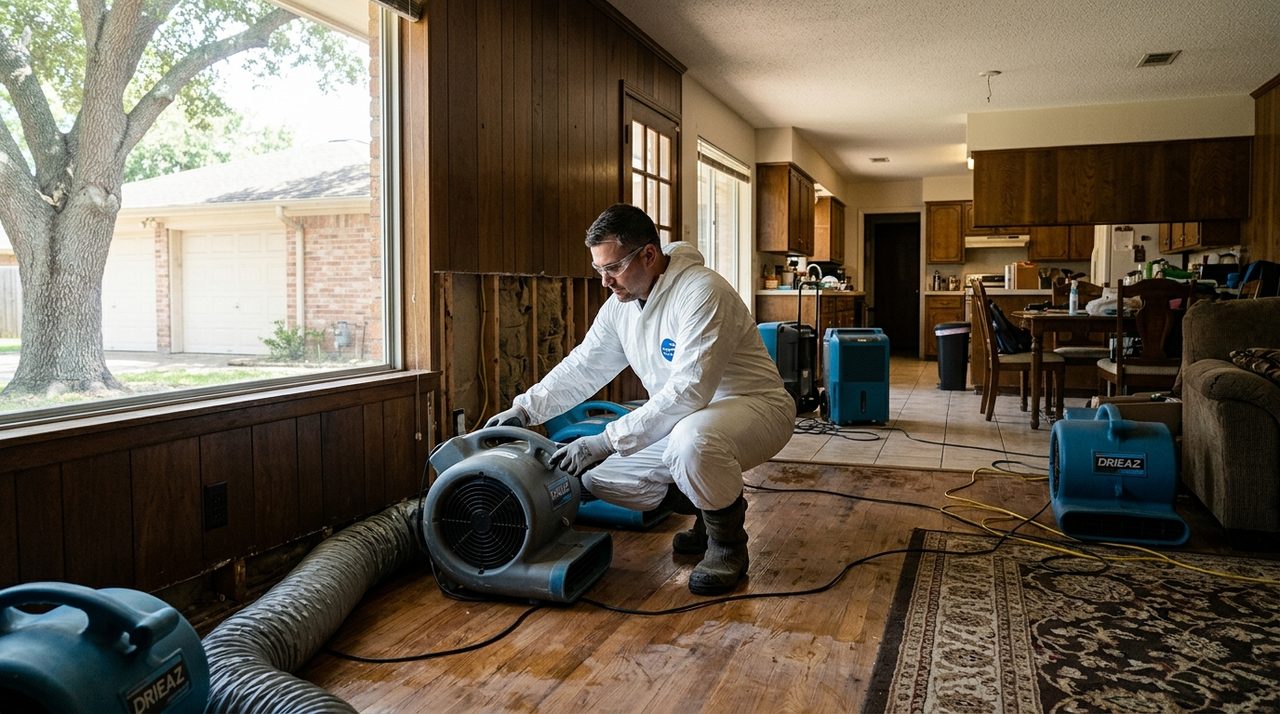
A qualified restoration contractor should pull FEMA Flood Insurance Rate Map data for your specific parcel and review prior claim history before finalizing a demo scope, because a Repetitive Loss or Severe Repetitive Loss designation changes the required approach. IICRC S500 standards govern the drying protocol, and on AE-zone lots with clay-heavy soil, extended dehumidification equipment runs — often 5 to 10 days longer than the national average — are necessary before moisture readings stabilize in slab-adjacent assemblies. Harris County Engineering issues the demolition permit for this work; your contractor must submit to the county rather than a City of Houston permit office.
Sources: FEMA National Flood Hazard Layer (NFHL), Harris County Flood Control District, IICRC (water/mold restoration standards)
Why it matters to you
Champions Forest homes built between the mid-1970s and late 1980s overwhelmingly use attic-mounted air handlers with flex duct runs that are now 40 to 50 years old — well past the 15-to-25-year service life typical of that generation of insulated flex. When floodwater enters and the HVAC system continues to run (or restarts too quickly after a storm), the fiberglass lining inside saturated duct sections reaches ideal conditions for Cladosporium and Aspergillus growth within 48 to 72 hours, given Houston's average 74 percent relative humidity and summer temperatures that routinely exceed 90°F. Many homeowners in affected sections replaced drywall and flooring after Harvey but left original ductwork in place, meaning a Beryl 2024 claim may be arriving on top of an already-compromised air distribution system.
What a good pro does
A restoration contractor should perform a full duct inspection using moisture meters and, where warranted, thermal imaging before reinstating HVAC operation — not after. If flex duct insulation has absorbed floodwater, replacement is almost always more cost-effective than attempting in-place drying given the age of the system. Any firm performing mold assessment or remediation in Texas must hold a TDLR-issued Mold Remediation Contractor license; confirm that credential before signing a contract. Duct replacement itself is a mechanical trade requiring a separate Harris County permit pulled by a licensed HVAC contractor.
Sources: IICRC (water/mold restoration standards), Texas Department of Licensing & Regulation, Harris County Flood Control District
Why it matters to you
When Cypress Creek overflows into Champions Forest streets and homes, that water is commingled with stormwater runoff, soil contaminants, and in many cases sanitary sewer overflow — classifying it as Category 3 (black water) under IICRC S500 standards, which requires demolition of all porous materials to at least 12 inches above the flood line. Insurers handling claims in this neighborhood have, in some cases, attempted to reclassify creek-sourced flood losses as Category 2 (gray water) to reduce the required demo scope and limit the payout. In a FEMA AE zone with documented Cypress Creek overflow history, that reclassification is almost never appropriate, but without written documentation of water source and on-site testing results, homeowners can find themselves locked into a reduced scope that leaves contaminated materials in the wall cavity.
What a good pro does
From the first hour on site, your restoration contractor should document the flood source — Cypress Creek overflow, street flooding, or interior pipe failure — with photographs, water testing results, and written notation tied to HCFCD gauge data for the storm event, which is publicly available. That documentation is the foundation for defending a Category 3 scope with the insurer and, if needed, a public adjuster. The IICRC S500 standard is the industry reference for water loss classification; make sure any scope-of-loss dispute cites it explicitly rather than relying on verbal claims.
Sources: IICRC (water/mold restoration standards), Harris County Flood Control District, FEMA National Flood Hazard Layer (NFHL)
Why it matters to you
Champions Forest is governed by multiple mandatory property owners associations — Champion Forest Fund Inc. covers Sections 1 through 10, with separate HOAs for Sections 11, 12, and Villas — each with its own Architectural Control Committee that technically has authority over exterior modifications, including dumpster placement, removal of exterior cladding, and re-cladding material choices. IICRC S500 is explicit that drying must begin within 24 to 48 hours of water intrusion to prevent a Category 2 loss from escalating to Category 3; an ACC review cycle that runs 5 to 10 business days can eliminate that window entirely. The stakes are real: a loss that requires $5,000 to $8,000 in mitigation while still Category 2 can cost $20,000 to $40,000 once it crosses into full Category 3 demo territory.
What a good pro does
Before any exterior demolition or equipment staging, your contractor should contact the governing section's HOA directly — not just the master association — to clarify whether an emergency provision exists that allows immediate protective work pending formal ACC review. Many HOA governing documents include emergency carve-outs; a contractor familiar with Champions Forest's section structure will know to look for them. Harris County Engineering permits for the demolition work must also be in hand before structural materials are removed; the permit process runs through the county, not a City of Houston office, which affects both form requirements and inspection scheduling.
Sources: Local HOA / deed restrictions (see area profile), IICRC (water/mold restoration standards), Municipal permit office (see area profile)
Hiring water & flood restoration in Champions Forest? Champions Forest is a large, multi-section subdivision in the Klein ISD area of northwest Harris County, built primarily from the mid-1970s through the late 1980s. Homeowners here deal with aging slab-on-grade foundations, original-era HVAC and plumbing systems that are reaching or past their expected lifespan, and FEMA AE flood zone designations that affect insurance requirements and exterior renovation planning. Multiple mandatory HOAs with architectural control committees govern exterior modifications, so contractors must factor in ACC approval timelines.
Building era
Primarily mid-1970s through late 1980s, with some later sections extending into the early 1990s.
Typical style
Traditional brick two-story homes with Colonial and Georgian influences; some single-story ranch-style homes and occasional Tudor and French traditional elevations.
Foundations
Slab-on-grade (regional inference for 1970s–1980s production homes in NW Harris County; confirm via HCAD or individual inspection).
Common systems
Original homes likely have R-22 refrigerant HVAC systems nearing or past replacement age, copper or galvanized steel supply plumbing transitioning to PEX in renovated homes, and 100–200 amp electrical panels that may need upgrading for modern loads.
What that means for repairs
Kitchen and bathroom remodels are common as homes from this era are updated to modern standards. HVAC full-system replacements are frequent due to age. Foundation repair and re-leveling are periodic needs given expansive clay soils and slab-on-grade construction. Post-Harvey flood damage repairs drove significant interior renovation activity in affected sections.
Permit jurisdiction
Harris County Engineering (unincorporated Harris County, Klein area — not within City of Houston limits).
HOA & deed restrictions
Mandatory property owners associations govern all sections. Sections 1–10 are governed by Champion Forest Fund, Inc. (Champion Forest HOA). Additional mandatory HOAs include Champion Forest Eleven HOA (161 lots), Champion Forest Twelve Homeowners Association Inc., and Champion Forest Villas HOA. All require Architectural Control Committee (ACC) approval for exterior modifications.
Historic districts
No City of Houston historic district designation confirmed.
Contractor note
Contractors must obtain Harris County permits for structural, mechanical, and electrical work and should coordinate ACC approval from the applicable section's HOA before beginning any exterior modifications. Work in the FEMA AE flood zone may require elevation certificates and floodplain development permits.
FEMA flood zone
FEMA Zone AE (high flood risk) — source: fema_nfhl. Champions Forest is situated in northwest Harris County near Cypress Creek, a major drainage corridor that has historically been associated with significant flooding events.
Hurricane Harvey impact
No official neighborhood-wide flood impact summary was found in available HOA or public records. Areas near Cypress Creek in northwest Harris County experienced significant Harvey flooding and subsequent buyout activity, but specific street-level impact within Champions Forest is not clearly documented in available sources. Homeowners should check Harris County Flood Control District records and individual property flood history for confirmation.
Heat & humidity load
Homes from the 1970s–80s with original insulation and single-pane windows face high cooling costs during Houston summers. Aging HVAC systems are under maximum stress from May through September, making this the peak period for emergency AC repair calls. Humidity management is critical to prevent mold in homes that experienced prior flooding or have insufficient attic ventilation.
Working with contractors here
Contractors working in Champions Forest most commonly handle HVAC replacements, foundation leveling, and plumbing re-pipes — all driven by the 40–50-year age of the housing stock. Kitchen and bath remodels are a strong secondary market as homeowners modernize dated interiors. Flood mitigation work, including elevated electrical panels, moisture barriers, and drainage improvements, is relevant given the AE flood zone designation. All exterior work requires ACC approval from the applicable section's HOA (Champion Forest Fund for Sections 1–10, or the respective section HOA), so contractors should build approval lead time into project schedules. Harris County permitting applies rather than City of Houston permits, which affects inspection scheduling and code requirements.
Local Tip
Always ask for a written estimate before work begins. Texas contractors are required to provide one on jobs over $1,000.
Champions Forest is a large, multi-section subdivision in the Klein ISD area of northwest Harris County, built primarily from the mid-1970s through the late 1980s. Homeowners here deal with aging slab-on-grade foundations, original-era HVAC and plumbing systems that are reaching or past their expected lifespan, and FEMA AE flood zone designations that affect insurance requirements and exterior renovation planning. Multiple mandatory HOAs with architectural control committees govern exterior modifications, so contractors must factor in ACC approval timelines.
Source: U.S. Census Bureau, ACS 5-Year 2023
Much of Champions Forest maps to FEMA Zone AE (high flood risk), so flood-resilient detailing -- elevated equipment, water-tolerant materials, and drainage-first thinking -- is essential here, not optional.
Source: FEMA National Flood Hazard Layer (NFHL). Flood zones vary by parcel — verify your individual FIRM panel.
Flood-control upgrades like interior drainage channels and vapor-barrier reinforcement in crawl spaces are worth completing before June 1 if your Champions Forest property sits in FEMA Zone AE inside the 100-year floodplain territory. A credentialed restoration firm can assess residual moisture from prior events that could accelerate mold within the 48-hour window a new storm opens. Confirm the current FEMA panel for your Champions Forest parcel — the area maps to Zone AE, but adjacent lots can differ.
After any severe thunderstorm drops concentrated rainfall on Champions Forest, have a water-restoration professional perform a moisture scan of attic decking and top-floor ceilings, because wind-lifted shingles allow water tracking that is invisible from below until mold colonies are established. Early extraction and targeted structural drying prevent a minor roof breach from escalating into a category-3 contamination claim. In-city Champions Forest work falls under City of Houston floodplain and permitting rules.
Winter Storm Uri 2021 caused burst supply lines and failed condensate pans that deposited water into wall cavities and under flooring in thousands of Houston homes, and in flood-prone Champions Forest that moisture compounded pre-existing humidity trapped from prior storm seasons. An IICRC-certified water-restoration contractor should inspect any structure that experienced pipe failure during Uri or subsequent freezes for residual moisture that accelerates mold during warm-up. In-city Champions Forest work falls under City of Houston floodplain and permitting rules.
Sources: FEMA National Flood Hazard Layer (NFHL), Ready.gov -- Hurricanes, CenterPoint Energy -- Storm Center, City of Houston -- Emergency Preparedness, Ready.gov -- Winter Weather, Harris County Flood Control District
Houston-specific estimators to plan your project before you call a pro. All results are planning estimates — a licensed local pro confirms the details on site.
Disconnect & drain every outdoor hose bib
Remove hoses, drain the spigots, and cover each with an insulated faucet sock. Un-drained hose bibs are the #1 burst point in a Houston freeze.
Insulate exposed pipes in the attic & garage
Wrap any pipe in an unconditioned space (attic runs, garage walls) with foam sleeves. Houston homes rarely insulate these because they only matter a few nights a year — which is exactly why they burst.
Open cabinet doors & keep a pencil-width drip
On hard-freeze nights, open kitchen/bath cabinets so warm air reaches the pipes and let faucets on exterior walls drip to relieve pressure.
Protect the attic/garage water heater & its lines
An attic or garage tank sits in unconditioned space. Insulate the cold-inlet and hot-outlet lines and confirm the emergency drain pan is clear so a leak doesn't reach the ceiling.
This is a planning estimate only — actual requirements depend on an on-site assessment by a licensed Houston pro. If a pipe has already burst, shut off your main water supply and call a licensed Houston plumber immediately — freeze bursts flood fast.
Sources: Municipal permit office (see area profile)
Sources: Texas State Board of Plumbing ExaminersEPA Lead Renovation, Repair and Painting (RRP) Rule
Sources: FEMA National Flood Hazard Layer (NFHL)Harris County Flood Control District
Sources: Local HOA / deed restrictions (see area profile)
Sources: Texas Department of Licensing & RegulationIICRC (water/mold restoration standards)