6727 Theall Rd suite a, Houston, TX 77066
Best Roofers in Champions Forest
Champions Forest's brick two-stories, built between the mid-1970s and late 1980s in unincorporated northwest Harris County, are now carrying 40-plus-year-old roofing systems that were never engineered for Class 4 impact resistance or the straight-line wind forces the May 2024 derecho delivered across Harris County. Layered on top: every re-roof here touches two separate approval chains — Harris County Engineering for the permit and the applicable section's Architectural Control Committee for the material choice — a combination that catches many homeowners off guard after storm damage. This page explains the four roofing challenges that specifically matter in this neighborhood and what to ask any contractor before signing.
Verified against Google Business data
Updated 2026
See the 10 Roofers Serving Champions Forest 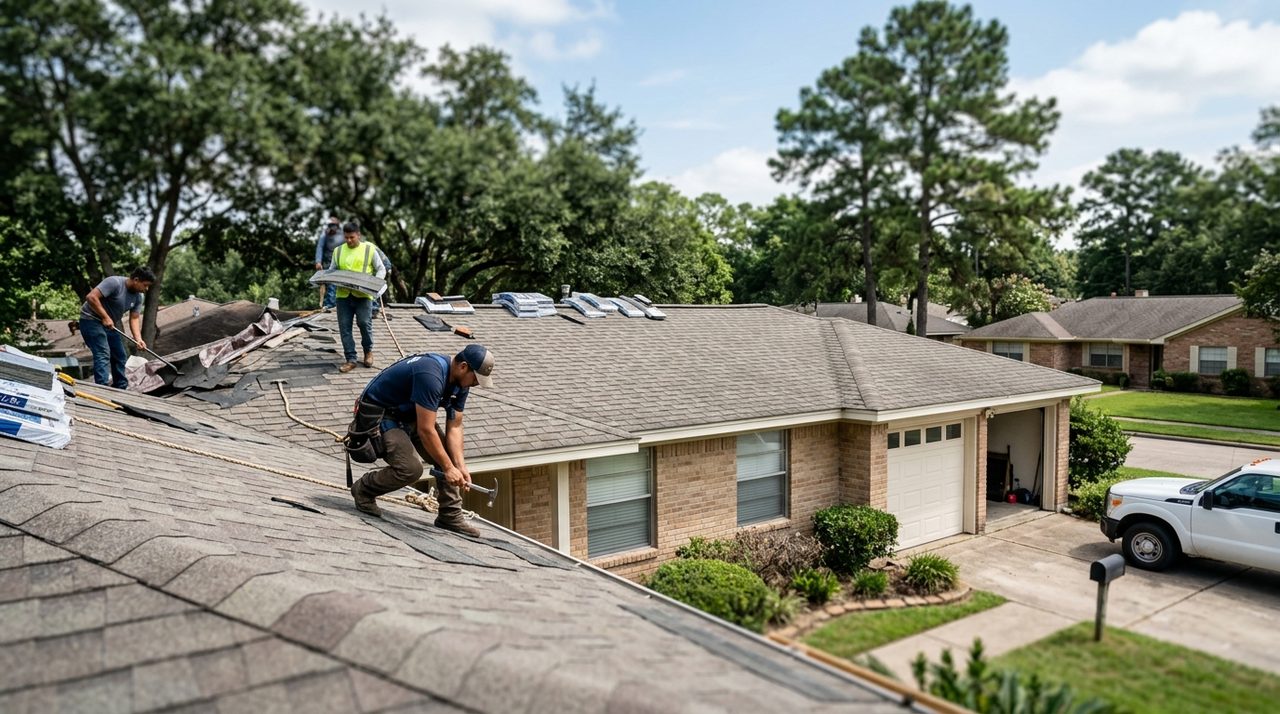
- Median home built
- 1993
- Median home value
- $293,572
- FEMA flood zone
- AE (high)
- Typical re-roof cost (est.)
- $9,000–$16,000 for architectural shingles; Class 4 IR upgrade adds $1,500–$3,500
- Most common local issue
- Aged 3-tab and early architectural shingles (40+ years) with granule loss and hidden hail bruising
Ranked by verified Google rating × review volume × verification tier. How we rank →
Min rating:
10 results Closed
11745 Jones Rd, Houston, TX 77070
Open Now
18316 Tomball Pkwy, Houston, TX 77070
Closed
17015 Seven Pines Dr building 2, Spring, TX 77379
Open Now
16682 Champion Forest Dr, Spring, TX 77379
Open Now
18825 Texas 249 Access Rd, Houston, TX 77070
Open Now
19923 Stuebner Airline Rd #B, Spring, TX 77379
Open Now
118 Vintage Park Blvd suite 5, Houston, TX 77070
Closed
6811 Theall Rd, Houston, TX 77066
Open Now
12513 Jones Rd, Houston, TX 77070
Roofers in Champions Forest: What You Should Know
Forty-Year-Old Shingles and Hail Bruising You Can't See from the Ground
Why it matters to you
Most Champions Forest homes were roofed during original construction in the mid-1970s through late 1980s with standard 3-tab or early-generation architectural shingles that carried 20-to-25-year design lives. Even homes that received a first replacement in the 1990s or early 2000s are now past the 20-year mark. Harris County sits in a zone where NOAA SPC data shows 3–5 significant hail events per year, and repeated impacts cause granule loss and fiberglass mat bruising that is invisible from the street but voids manufacturer warranties and accelerates UV-driven binder oxidation in Houston's 2,700-plus cooling-degree-day summers.
What a good pro does
A qualified roofer should conduct an in-person, on-roof inspection — not just a drive-by — and document granule loss in gutters, tab creasing, and soft-spot bruising with photographs. If replacement is indicated, ask specifically about Class 4 impact-resistant shingles; the upgrade cost of roughly $1,500–$3,500 (est.) over standard architectural shingles is frequently offset by TWIA or private insurer premium discounts available to Harris County homeowners. Because Texas issues no state roofing contractor license, verify the contractor carries general liability and workers' compensation insurance before any work begins.
Sources: Texas Windstorm Insurance Association (TWIA), International Residential Code (as adopted by City of Houston)
Harris County Permits and HOA Approval — Two Separate Clocks Running at Once
Why it matters to you
Champions Forest sits in unincorporated Harris County, meaning roofing permits are issued by Harris County Engineering, not the City of Houston — a distinction that affects inspection scheduling, fee structures, and which code cycle applies. Simultaneously, every exterior material change — including switching shingle color or upgrading to metal — requires Architectural Control Committee approval from the homeowner's specific section HOA (Champion Forest Fund, Inc. for Sections 1–10, or the section-specific association for later sections). ACC review can take 10–30 days, and starting work before approval can trigger fines and a forced redo at the homeowner's expense.
What a good pro does
Plan any re-roof in two parallel tracks: submit the ACC application with the proposed shingle manufacturer, product line, and color chip the day you accept a contractor's estimate, and have your contractor pull the Harris County building permit simultaneously. A contractor who tells you permits are not needed for a full tear-off and replacement in this jurisdiction should be questioned — Harris County requires permits for full roof replacement with structural components. Build the ACC approval window into your project timeline, especially if you are considering metal roofing, which many Champions Forest ACC guidelines subject to additional scrutiny.
Sources: Local HOA / deed restrictions (see area profile), Municipal permit office (see area profile), International Residential Code (as adopted by City of Houston)
Attic Ventilation Deficits and Silent Deck Rot in a High-Humidity Climate
Why it matters to you
Homes built in Champions Forest during the 1970s and 1980s typically rely on original gable vents or box vents — systems that predate the balanced ridge-and-soffit ventilation ratios now codified in IRC R806. Houston's annual average relative humidity exceeds 75%, and without proper airflow, moisture condenses year-round on OSB or plywood roof decking. Because these are slab-on-grade homes with no crawl space to buffer the moisture load, the attic cavity is the only buffer — and when ventilation fails, decking delaminates silently over years. A re-roof that lays new shingles over compromised decking will fail prematurely regardless of shingle quality.
What a good pro does
Before accepting any re-roof proposal, ask the contractor to probe the existing decking during the initial inspection and to specify in writing how many squares of decking replacement are included or excluded from the bid. Any proposal for a Champions Forest home from this era should include an assessment of the existing vent-to-floor-area ratio and a recommendation for ridge vent addition or soffit vent unblocking if the current system is undersized. Proper decking and ventilation work is covered under the Harris County permit scope, so confirm it is included on the permit application.
Sources: International Residential Code (as adopted by City of Houston), Municipal permit office (see area profile)
FEMA Zone AE Flood Risk and What It Means for Roofing Decisions
Why it matters to you
Significant portions of Champions Forest are mapped to FEMA Flood Zone AE — the high-risk designation tied to Cypress Creek flooding — which directly affects how a roofing project is scoped after a storm event. If a home in an AE zone sustains substantial damage (roof plus structural combined), Harris County floodplain rules can trigger Substantial Improvement review, potentially requiring elevation upgrades that change the entire project scope. Post-Harvey flood damage drove extensive interior renovation activity in affected Champions Forest sections, and homes that sustained combined roof and interior water damage in 2017 may have had repairs completed under time pressure that left ventilation or flashing details underspecified.
What a good pro does
If your Champions Forest home sustained Harvey (2017), Tropical Storm Beta (2020), or the June 2024 rainfall event damage — and you have not had a full roof inspection since — schedule one before the next hurricane season. A contractor working on a home in Zone AE should confirm with the Harris County Floodplain Administrator whether a floodplain development permit is required before pulling the roofing permit, particularly if the project includes any structural deck replacement. Homeowners carrying TWIA wind-and-hail coverage should also verify that any installed product meets TWIA's eligibility requirements before signing a contract.
Sources: FEMA National Flood Hazard Layer (NFHL), Texas Windstorm Insurance Association (TWIA), Local HOA / deed restrictions (see area profile)
Roofers in Champions Forest: What You Should Know
Hiring roofers in Champions Forest? Champions Forest is a large, multi-section subdivision in the Klein ISD area of northwest Harris County, built primarily from the mid-1970s through the late 1980s. Homeowners here deal with aging slab-on-grade foundations, original-era HVAC and plumbing systems that are reaching or past their expected lifespan, and FEMA AE flood zone designations that affect insurance requirements and exterior renovation planning. Multiple mandatory HOAs with architectural control committees govern exterior modifications, so contractors must factor in ACC approval timelines.
- Housing era
- Primarily mid-1970s through late 1980s, with some later sections extending into the early 1990s
- Foundation
- Slab-on-grade (regional inference for 1970s–1980s production homes in NW Harris County
- Flood zone
- FEMA Zone AE (high flood risk) — source
- Permits
- Harris County Engineering (unincorporated Harris County, Klein area — not within City of Houston…
Housing stock & systems
Building era
Primarily mid-1970s through late 1980s, with some later sections extending into the early 1990s.
Typical style
Traditional brick two-story homes with Colonial and Georgian influences; some single-story ranch-style homes and occasional Tudor and French traditional elevations.
Foundations
Slab-on-grade (regional inference for 1970s–1980s production homes in NW Harris County; confirm via HCAD or individual inspection).
Common systems
Original homes likely have R-22 refrigerant HVAC systems nearing or past replacement age, copper or galvanized steel supply plumbing transitioning to PEX in renovated homes, and 100–200 amp electrical panels that may need upgrading for modern loads.
What that means for repairs
Kitchen and bathroom remodels are common as homes from this era are updated to modern standards. HVAC full-system replacements are frequent due to age. Foundation repair and re-leveling are periodic needs given expansive clay soils and slab-on-grade construction. Post-Harvey flood damage repairs drove significant interior renovation activity in affected sections.
Permits & restrictions
Permit jurisdiction
Harris County Engineering (unincorporated Harris County, Klein area — not within City of Houston limits).
HOA & deed restrictions
Mandatory property owners associations govern all sections. Sections 1–10 are governed by Champion Forest Fund, Inc. (Champion Forest HOA). Additional mandatory HOAs include Champion Forest Eleven HOA (161 lots), Champion Forest Twelve Homeowners Association Inc., and Champion Forest Villas HOA. All require Architectural Control Committee (ACC) approval for exterior modifications.
Historic districts
No City of Houston historic district designation confirmed.
Contractor note
Contractors must obtain Harris County permits for structural, mechanical, and electrical work and should coordinate ACC approval from the applicable section's HOA before beginning any exterior modifications. Work in the FEMA AE flood zone may require elevation certificates and floodplain development permits.
Flood & weather
FEMA flood zone
FEMA Zone AE (high flood risk) — source: fema_nfhl. Champions Forest is situated in northwest Harris County near Cypress Creek, a major drainage corridor that has historically been associated with significant flooding events.
Hurricane Harvey impact
No official neighborhood-wide flood impact summary was found in available HOA or public records. Areas near Cypress Creek in northwest Harris County experienced significant Harvey flooding and subsequent buyout activity, but specific street-level impact within Champions Forest is not clearly documented in available sources. Homeowners should check Harris County Flood Control District records and individual property flood history for confirmation.
Heat & humidity load
Homes from the 1970s–80s with original insulation and single-pane windows face high cooling costs during Houston summers. Aging HVAC systems are under maximum stress from May through September, making this the peak period for emergency AC repair calls. Humidity management is critical to prevent mold in homes that experienced prior flooding or have insufficient attic ventilation.
Working with contractors here
Contractors working in Champions Forest most commonly handle HVAC replacements, foundation leveling, and plumbing re-pipes — all driven by the 40–50-year age of the housing stock. Kitchen and bath remodels are a strong secondary market as homeowners modernize dated interiors. Flood mitigation work, including elevated electrical panels, moisture barriers, and drainage improvements, is relevant given the AE flood zone designation. All exterior work requires ACC approval from the applicable section's HOA (Champion Forest Fund for Sections 1–10, or the respective section HOA), so contractors should build approval lead time into project schedules. Harris County permitting applies rather than City of Houston permits, which affects inspection scheduling and code requirements.
Local Tip
Always ask for a written estimate before work begins. Texas contractors are required to provide one on jobs over $1,000.
About Champions Forest
Champions Forest is a large, multi-section subdivision in the Klein ISD area of northwest Harris County, built primarily from the mid-1970s through the late 1980s. Homeowners here deal with aging slab-on-grade foundations, original-era HVAC and plumbing systems that are reaching or past their expected lifespan, and FEMA AE flood zone designations that affect insurance requirements and exterior renovation planning. Multiple mandatory HOAs with architectural control committees govern exterior modifications, so contractors must factor in ACC approval timelines.
- Median year built
- 1993
- Median home value
- $293,572
- Owner-occupied
- 65.5%
- Population
- 212,347
- Housing units
- 79,382
- Median income
- $89,514
Source: U.S. Census Bureau, ACS 5-Year 2023
Flood & storm risk
FEMA Zone AEHigh flood riskMuch of Champions Forest maps to FEMA Zone AE (high flood risk), so flood-resilient detailing -- elevated equipment, water-tolerant materials, and drainage-first thinking -- is essential here, not optional.
Source: FEMA National Flood Hazard Layer (NFHL). Flood zones vary by parcel — verify your individual FIRM panel.
Houston Storm Readiness in Champions Forest
Hurricane & flooding
Schedule a pre-season wind-uplift inspection in Champions Forest because FEMA Zone AE inside the 100-year floodplain means post-storm access for emergency tarping can be delayed by days when roads are inundated. A roofer should mechanically re-nail any lifted starter strips and perimeter field sheets now, while the roof is still reachable. Confirm the current FEMA panel for your Champions Forest parcel — the area maps to Zone AE, but adjacent lots can differ.
Severe storms & hail
Straight-line winds from the May 2024 derecho peeled entire roof sections off homes in low-lying Houston neighborhoods where FEMA Zone AE inside the 100-year floodplain later made contractor access difficult for days. Ask a roofer to inspect your drip-edge fastening and rake-edge shingle overhang—both are commonly under-nailed and are the first points of progressive peel under 80-mph gust loads in Champions Forest. In-city Champions Forest work falls under City of Houston floodplain and permitting rules.
Ice storms & freezes
Before a forecast freeze in Champions Forest, ask a roofer to check that all attic ventilation pathways are clear and unobstructed, because blocked soffit vents allow warm moist attic air to accumulate and melt ice from below, creating ice dams that drive water under shingles and through FEMA Zone AE inside the 100-year floodplain-compromised decking. A roofer can also temporarily insulate any known cold-bridge points at the eave with batt material to reduce ice-dam formation. In-city Champions Forest work falls under City of Houston floodplain and permitting rules.
Sources: FEMA National Flood Hazard Layer (NFHL), Ready.gov -- Hurricanes, CenterPoint Energy -- Storm Center, City of Houston -- Emergency Preparedness, Ready.gov -- Winter Weather, Harris County Flood Control District
Free Champions Forest Tools & Calculators
Houston-specific estimators to plan your project before you call a pro. All results are planning estimates — a licensed local pro confirms the details on site.
Hurricane Roof Wind-Load & TDI/WPI-8 Estimator
Open full tool & FAQ →115–120 mph
Estimated design wind speed for your zone
Outside the TDI catastrophe area, so a WPI-8 is generally not mandated — but Houston still sees hurricane-force gusts (Beryl, 2024). Insist on properly rated shingles installed to the manufacturer's high-wind nailing pattern (6 nails) and starter strips, or a wind claim can be denied for improper installation.
Find a Houston roofer →This is a planning estimate only — actual requirements depend on an on-site assessment by a licensed Houston pro. Wind-speed zones are approximate; your exact TDI/WPI-8 obligation depends on your address's designation. Verify with the Texas Department of Insurance before contracting.
Houston Freeze Prep & Pipe Insulation Checklist
Open full tool & FAQ →Your freeze checklist — 4 tasks
- 1
Disconnect & drain every outdoor hose bib
Remove hoses, drain the spigots, and cover each with an insulated faucet sock. Un-drained hose bibs are the #1 burst point in a Houston freeze.
- 2
Insulate exposed pipes in the attic & garage
Wrap any pipe in an unconditioned space (attic runs, garage walls) with foam sleeves. Houston homes rarely insulate these because they only matter a few nights a year — which is exactly why they burst.
- 3
Open cabinet doors & keep a pencil-width drip
On hard-freeze nights, open kitchen/bath cabinets so warm air reaches the pipes and let faucets on exterior walls drip to relieve pressure.
- 4
Protect the attic/garage water heater & its lines
An attic or garage tank sits in unconditioned space. Insulate the cold-inlet and hot-outlet lines and confirm the emergency drain pan is clear so a leak doesn't reach the ceiling.
This is a planning estimate only — actual requirements depend on an on-site assessment by a licensed Houston pro. If a pipe has already burst, shut off your main water supply and call a licensed Houston plumber immediately — freeze bursts flood fast.
Frequently Asked Questions
Does my Champions Forest re-roof need a Harris County permit, and is that different from what my neighbor in Spring or Cypress had to do?
Champions Forest sits in unincorporated Harris County, so your permit comes from Harris County Engineering — not the City of Houston Permitting Center and not a suburban city office like Pearland's or Sugar Land's. Harris County requires a roofing permit for full tear-offs and structural deck repairs; your contractor must pull that permit before work begins and schedule a county inspection, which runs on a different queue than municipal inspections in incorporated suburbs. Confirm your contractor is registered to pull Harris County permits specifically, since some storm-chasers who flooded the area after the May 2024 derecho are only registered with the City of Houston.
Sources: Municipal permit office (see area profile)
My Champions Forest home is in FEMA Zone AE — does that change anything about how my new roof should be detailed or what materials I should choose?
Zone AE flood risk primarily affects your foundation, mechanical equipment, and lower-envelope materials, but it has an indirect roofing implication: after a flood event, moisture that enters through a compromised roof can compound structural damage that FEMA's National Flood Insurance Program may not fully cover if it determines the entry point was a pre-existing roof failure rather than flood inundation. For Champions Forest homes, this means making sure flashing, eave details, and fascia-to-soffit junctions are watertight — Harvey-era repairs done hastily sometimes left gaps at those transitions that now allow wind-driven rain intrusion during heavy Gulf moisture events. Ask your roofer to inspect and reseal all penetrations and kick-out flashing as part of any re-roof scope.
How long should I realistically budget for the full approval process — Harris County permit plus Champion Forest HOA ACC — before my roofer can start?
Plan for two overlapping but independent clocks: Harris County permit review typically takes 5–15 business days for a straightforward re-roof application, while ACC approval through Champion Forest Fund, Inc. (Sections 1–10) or your section's specific HOA can take 10–30 days depending on submission completeness and the board's meeting schedule. Submitting both applications simultaneously the day you sign your roofing contract is the fastest legal path — your contractor cannot start without both approvals in hand, and the HOA clock does not stop for storm urgency. Budget 3–5 weeks total for a normal approval cycle; post-storm surges can stretch Harris County inspection scheduling further.
Sources: Local HOA / deed restrictions (see area profile)Municipal permit office (see area profile)
My Champions Forest home was built in the early 1980s — is there any chance the old roof deck contains lead-based materials I should know about before a tear-off?
The roof deck itself (OSB or plywood sheathing) is not a lead-paint concern, but the painted fascia boards, soffits, and any painted metal flashing on a pre-1978 home can contain lead-based paint that becomes disturbed dust during tear-off work. EPA's Renovation, Repair and Painting (RRP) rule requires contractors disturbing more than six square feet of painted surface on a pre-1978 home to be EPA Lead-Safe Certified and follow containment protocols. Champions Forest homes built in the late 1970s through early 1980s fall right in this window, so ask your roofer to confirm their RRP certification before they start grinding off old drip edge and fascia-adjacent shingles.
Sources: EPA Lead Renovation, Repair and Painting (RRP) Rule
Is there a better or worse time of year to schedule a full re-roof on a Champions Forest home, given Houston's weather patterns?
October through early December is generally the best window in northwest Harris County: the peak Atlantic hurricane season has passed, ambient temperatures drop enough that asphalt shingles seal their self-sealing strips properly (they need sustained temps above roughly 40°F but below 90°F to bond correctly), and contractor demand usually eases after the post-summer storm repair backlog clears. Avoid scheduling a full tear-off during the May–June hail season peak or during August–September when another named storm could leave your stripped deck exposed for days. If you're in a post-storm situation, get a quality temporary tarp secured and then wait for the surge demand — and its 15–25% price premium — to ease before contracting the full replacement.
My Champions Forest HOA requires ACC approval for roofing material changes — does upgrading from standard 3-tab to Class 4 impact-resistant shingles count as a 'change' that needs committee sign-off?
Yes, and the color and profile of the shingle matter as much as the performance class to Champion Forest's ACC — submitting a product data sheet and a color sample chip is typically required even if you are staying within the same general appearance category. Class 4 impact-resistant shingles (which can reduce TWIA wind/hail premium surcharges if the product is listed on TWIA's approved list) often come in slightly different textures than the original 1980s 3-tab your home may have had, which is enough for the ACC to require a formal review. Submit the manufacturer's product brochure, the color name, and a sample to your specific section HOA along with the permit application to avoid a rejection that restarts the 10–30 day clock.
Sources: Local HOA / deed restrictions (see area profile)Texas Windstorm Insurance Association (TWIA)