Closed
Serving Upper Kirby Based in West University · 0.8 mi away
Upper Kirby's rapid infill redevelopment — mid-century bungalows razed and replaced by three-story townhome clusters, plus high-rise condominiums squeezed onto narrow lots — has left a fragmented urban canopy where surviving mature trees sit dangerously close to slab foundations, shared fences, utility easements, and property lines with zero staging room. The City of Houston does not require a homeowner permit for routine private-property tree removal, but the individual COAs and HOAs governing Upper Kirby's condo and townhome buildings often impose their own exterior-work approval requirements that can delay a job before a single branch comes down. Understanding those three layers — slab-root conflict, dense urban access, and building-level HOA rules — is what separates a clean Upper Kirby tree removal from an expensive dispute.
Ranked by verified Google rating × review volume × verification tier. How we rank →
Some highly-rated pros serve Upper Kirby from nearby and may not keep a Upper Kirby street address. Those are listed under "Also serving Upper Kirby" with their real city and distance, so you always know where each business is based.
Highly-rated pros based nearby who cover Upper Kirby. Distance shown from the Upper Kirby area.
Serving Upper Kirby Based in West University · 0.8 mi away
Serving Upper Kirby Based in Galleria · 1.3 mi away
Serving Upper Kirby Based in River Oaks · 1.5 mi away
Serving Upper Kirby Based in Galleria · 2.4 mi away
Serving Upper Kirby Based in Tanglewood · 4.1 mi away
Serving Upper Kirby Based in Lazybrook / Timbergrove · 4.5 mi away
Serving Upper Kirby Based in Lazybrook / Timbergrove · 4.6 mi away
Serving Upper Kirby Based in Bellaire · 4.6 mi away
Serving Upper Kirby Based in Braeswood · 4.9 mi away
Serving Upper Kirby Based in The Heights · 5.1 mi away
Why it matters to you
Upper Kirby's surviving 1940s–1960s bungalows and ranch homes sit on Harris County's expansive Beaumont Black clay, where large surface-feeding live oak and water oak roots exploit the soil's shrink-swell cycle to lever slab edges upward and crack driveways. With census median year-built at 1994 across the mix, the oldest single-family lots can have 60-plus-year-old oak canopies whose root systems extend well beyond the dripline — often reaching the slab perimeter of the home itself or the shared concrete apron of an adjacent townhome built on a subdivided lot.
What a good pro does
A qualified ISA Certified Arborist should assess root proximity with a ground-penetrating assessment before cutting begins, then recommend whether full removal, directional root pruning with a root barrier installation, or selective limb reduction achieves the homeowner's goal without destabilizing neighboring structures. Because the City of Houston does not require a permit for private-property tree removal, scheduling is not held up by permitting, but the arborist should document the root conflict in writing before work starts in case a slab repair claim arises later.
Sources: City of Houston Permitting Center
Why it matters to you
Upper Kirby has no single neighborhood-wide HOA, but the individual condo associations (COAs) and townhome cluster HOAs that govern most of the neighborhood's dense residential stock typically require architectural committee approval before any exterior work — including tree removal that affects shared courtyards, rooftop planters, or the common-area landscaping found in buildings like 2520 Robinhood at Kirby COA. Owners of the 35.4% owner-occupied units in multifamily buildings who skip this step risk fines and mandatory replanting orders that can cost more than the original removal.
What a good pro does
Before hiring any crew, request the building's CC&Rs or deed restriction documents and identify whether a tree removal requires a written architectural committee application, a waiting period, or a specific contractor insurance minimum. A reputable Upper Kirby tree company will ask for this documentation proactively and submit the application on the homeowner's behalf — do not accept a contractor who wants to start work before HOA or COA clearance is confirmed in writing.
Sources: Local HOA / deed restrictions (see area profile), City of Houston Permitting Center
Why it matters to you
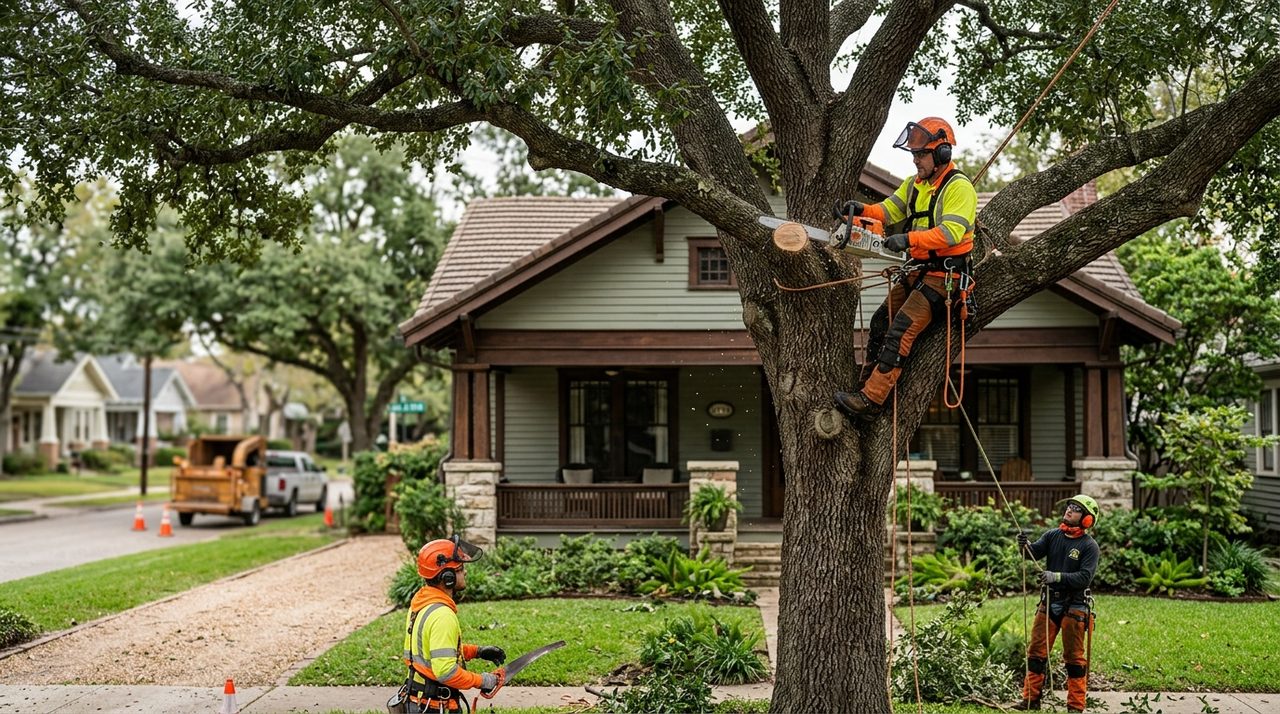
Upper Kirby's three-story stucco townhomes are routinely built on 25- to 30-foot-wide lots with zero side setback, meaning a tree between two structures may have less than four feet of clearance on each side and CenterPoint Energy distribution lines running directly overhead. There is typically no room to swing a conventional crane or drop full sections, and neighboring buildings' windows, parked vehicles in tight rear-access alleys, and rooftop HVAC units all become potential damage points during a rigging operation.
What a good pro does
Look specifically for crews with urban-removal experience who use sectional hand-rigging, aerial lift equipment sized for tight alley access, and ground protection mats to prevent slab cracking from equipment weight. Any work within ten feet of CenterPoint distribution lines requires the crew to notify CenterPoint before starting — they do not perform the work but can de-energize or insulate lines for a scheduled window. Verify that the contractor carries a minimum of $1 million general liability and ask for a site-specific rigging plan before signing a contract.
Sources: City of Houston Permitting Center, Local HOA / deed restrictions (see area profile)
Why it matters to you
Upper Kirby's Inner Loop location means it sits in the direct path of energy-corridor-area storms — the May 2024 derecho's 100-plus mph straight-line winds and Hurricane Beryl 2024 both generated sudden, area-wide demand for emergency tree removal across the neighborhood's mix of townhomes, condos, and surviving single-family homes. During those surges, out-of-state crews with no local presence and no verifiable insurance flooded the area, and base removal prices ran 40–80% above normal rates, so a mid-size water oak that would normally cost $750–$1,800 to remove was quoted at $2,500–$3,200 by operators who had no accountability if something went wrong.
What a good pro does
In the weeks following any named storm or derecho, insist on a written, itemized quote — not a verbal door-knock offer — and verify the company's Texas business registration and liability insurance certificate directly with their insurer before signing. ISA Certified Arborist credentials are searchable at the ISA's public database and confirm a minimum standard of training that fly-by-night crews will not have. If a tree is posing an immediate safety hazard to a structure, document the damage with timestamped photos before any work begins, as this record supports any homeowner's insurance claim for debris removal costs.
Sources: City of Houston Permitting Center, Local HOA / deed restrictions (see area profile)
Hiring tree removal in Upper Kirby? Upper Kirby's housing stock spans mid-century single-family homes, modern townhomes, and mid- to high-rise condominiums, creating an unusually diverse home service landscape within a compact urban footprint. Contractors must be prepared for slab-on-grade foundations on newer builds, occasional pier-and-beam on surviving 1940s–1960s homes, and the unique permitting and access challenges of working in dense multifamily structures. Individual condo and townhome buildings typically have their own HOA rules governing exterior work, so verifying architectural guidelines before scoping a project is essential.
Building era
Mixed: original single-family from 1940s–1960s; heavy infill redevelopment from 1980s–present, with ongoing high-rise construction through the 2020s.
Typical style
Modern urban townhomes (three-story stucco/brick), mid- and high-rise contemporary condominiums, and remaining mid-century bungalows and ranch-style homes.
Foundations
Predominantly slab-on-grade for post-1970 townhomes, condos, and newer single-family; some remaining pier-and-beam on older mid-century homes.
Common systems
Newer townhomes and condos typically have central HVAC with high-efficiency units, PEX or copper plumbing, and 200-amp electrical panels. Surviving mid-century homes may have original galvanized or cast-iron plumbing, older R-22 HVAC systems, and 100-amp electrical service requiring upgrades.
What that means for repairs
Tear-down-and-rebuild of mid-century single-family lots into townhome clusters is the dominant renovation pattern. Condo and townhome interior remodels—kitchens, bathrooms, and flooring—are extremely common. Older surviving homes frequently need full plumbing re-pipes, electrical panel upgrades, and HVAC replacements.
Permit jurisdiction
City of Houston — Houston Permitting Center.
HOA & deed restrictions
No single mandatory neighborhood-wide HOA exists. Individual condo and townhome buildings (e.g., 2520 Robinhood at Kirby COA) have mandatory HOAs/COAs. Detached single-family homes may be subject to lot-level deed restrictions and voluntary civic clubs, but no master HOA governs the entire Upper Kirby area.
Historic districts
No City of Houston historic district designation confirmed.
Contractor note
Contractors working in condo or townhome buildings must coordinate with the individual building's HOA or COA for exterior modifications, access scheduling, and noise restrictions. Deed restrictions on single-family lots vary by plat and should be verified before proposing exterior changes.
FEMA flood zone
FEMA Zone X (low flood risk) per official NFHL data. Upper Kirby is not immediately adjacent to a major bayou channel, though it sits between Buffalo Bayou to the north and Braes Bayou to the south. Property-level flood determinations should still be verified for parcels near drainage corridors.
Hurricane Harvey impact
No publicly available sources single out Upper Kirby as a major repetitive structural flood-loss area during Hurricane Harvey. The neighborhood experienced citywide street ponding common across Inner Loop commercial corridors, but it was not identified as a Harvey hot spot comparable to Meyerland or Memorial. Property-level Harvey impact should be confirmed through seller disclosures and Harris County Flood Control District records.
Heat & humidity load
Houston's extreme summer heat and humidity drive heavy HVAC demand across all building types. Older mid-century homes with original insulation and single-pane windows struggle with cooling efficiency. High-rise and mid-rise condos may experience rooftop HVAC unit strain and condensate drain issues. Flat-roof townhomes common in the area require regular inspection for ponding water and membrane degradation.
Working with contractors here
Upper Kirby's contractor demand is driven by its three distinct housing types. Modern townhomes and condos generate steady interior remodel work—kitchen and bath upgrades, flooring, and smart home installations—often requiring HOA-compliant specifications and contractor insurance minimums. Surviving mid-century single-family homes frequently need full mechanical system overhauls: galvanized plumbing re-pipes, electrical panel upgrades from 100 to 200 amps, and HVAC conversions from R-22 to modern refrigerant systems. The neighborhood's density creates logistical challenges including limited staging areas, tight lot access, and coordinating with building management for elevator and loading dock access in high-rise projects. Contractors should plan for City of Houston permitting timelines and verify whether individual building HOAs require pre-approved contractor lists or additional liability coverage.
Local Tip
Always ask for a written estimate before work begins. Texas contractors are required to provide one on jobs over $1,000.
Upper Kirby's housing stock spans mid-century single-family homes, modern townhomes, and mid- to high-rise condominiums, creating an unusually diverse home service landscape within a compact urban footprint. Contractors must be prepared for slab-on-grade foundations on newer builds, occasional pier-and-beam on surviving 1940s–1960s homes, and the unique permitting and access challenges of working in dense multifamily structures. Individual condo and townhome buildings typically have their own HOA rules governing exterior work, so verifying architectural guidelines before scoping a project is essential.
Source: U.S. Census Bureau, ACS 5-Year 2023
Most of Upper Kirby maps to FEMA Zone X (low mapped flood risk), but Houston's flash-flood reality means even low-risk blocks benefit from smart drainage and storm-hardened installs.
Source: FEMA National Flood Hazard Layer (NFHL). Flood zones vary by parcel — verify your individual FIRM panel.
Wind is the primary tree hazard in lower-risk Upper Kirby neighborhoods during a Gulf hurricane, so focus pre-storm efforts on removing dead or structurally weak trees that could reach your roof line or power drop. A TDLR-licensed contractor can perform a hazard assessment and complete removal well before a storm's 72-hour watch window, when crews become unavailable across the Houston metro. Confirm the current FEMA panel for your Upper Kirby parcel — the area maps to Zone X, but adjacent lots can differ.
After any severe thunderstorm drops large limbs in your yard in Upper Kirby, have a licensed contractor assess the parent tree for hidden decay before assuming the remaining structure is sound. Snap failures during the May 2024 derecho frequently involved trees that had experienced prior lightning strikes or previous partial limb loss that had gone uninspected. In-city Upper Kirby work falls under City of Houston floodplain and permitting rules.
The most actionable winter prep for tree removal in Upper Kirby is removing any tree or large limb that hangs directly over a roofline, vehicle parking area, or power service drop before the first freeze advisory. Ice adds weight faster than most homeowners expect, and Houston trees that have never experienced sustained ice loading have no adaptive resilience to that stress. In-city Upper Kirby work falls under City of Houston floodplain and permitting rules.
Sources: FEMA National Flood Hazard Layer (NFHL), Ready.gov -- Hurricanes, CenterPoint Energy -- Storm Center, City of Houston -- Emergency Preparedness, Ready.gov -- Winter Weather, Harris County Flood Control District
Houston-specific estimators to plan your project before you call a pro. All results are planning estimates — a licensed local pro confirms the details on site.
Grouped by mature root aggression & water demand.
Trunk center to the nearest exterior wall.
The root zone likely reaches your foundation's soil during Houston's dry summers, when clay shrinks most. Watch for sticking doors and diagonal cracks, keep soil moisture even with a soaker hose during drought, and have a foundation pro evaluate if you see any movement.
Find a Houston foundation pro →This is a planning estimate only — actual requirements depend on an on-site assessment by a licensed Houston pro. Guidance is based on general species root behavior in expansive clay, not a soil test.
Disconnect & drain every outdoor hose bib
Remove hoses, drain the spigots, and cover each with an insulated faucet sock. Un-drained hose bibs are the #1 burst point in a Houston freeze.
Insulate exposed pipes in the attic & garage
Wrap any pipe in an unconditioned space (attic runs, garage walls) with foam sleeves. Houston homes rarely insulate these because they only matter a few nights a year — which is exactly why they burst.
Open cabinet doors & keep a pencil-width drip
On hard-freeze nights, open kitchen/bath cabinets so warm air reaches the pipes and let faucets on exterior walls drip to relieve pressure.
Protect the attic/garage water heater & its lines
An attic or garage tank sits in unconditioned space. Insulate the cold-inlet and hot-outlet lines and confirm the emergency drain pan is clear so a leak doesn't reach the ceiling.
This is a planning estimate only — actual requirements depend on an on-site assessment by a licensed Houston pro. If a pipe has already burst, shut off your main water supply and call a licensed Houston plumber immediately — freeze bursts flood fast.
Sources: City of Houston Permitting CenterLocal HOA / deed restrictions (see area profile)
Sources: Local HOA / deed restrictions (see area profile)
Sources: City of Houston Permitting CenterTexas Commission on Environmental Quality