Open Now
2102 Delery Dr, Houston, TX 77055
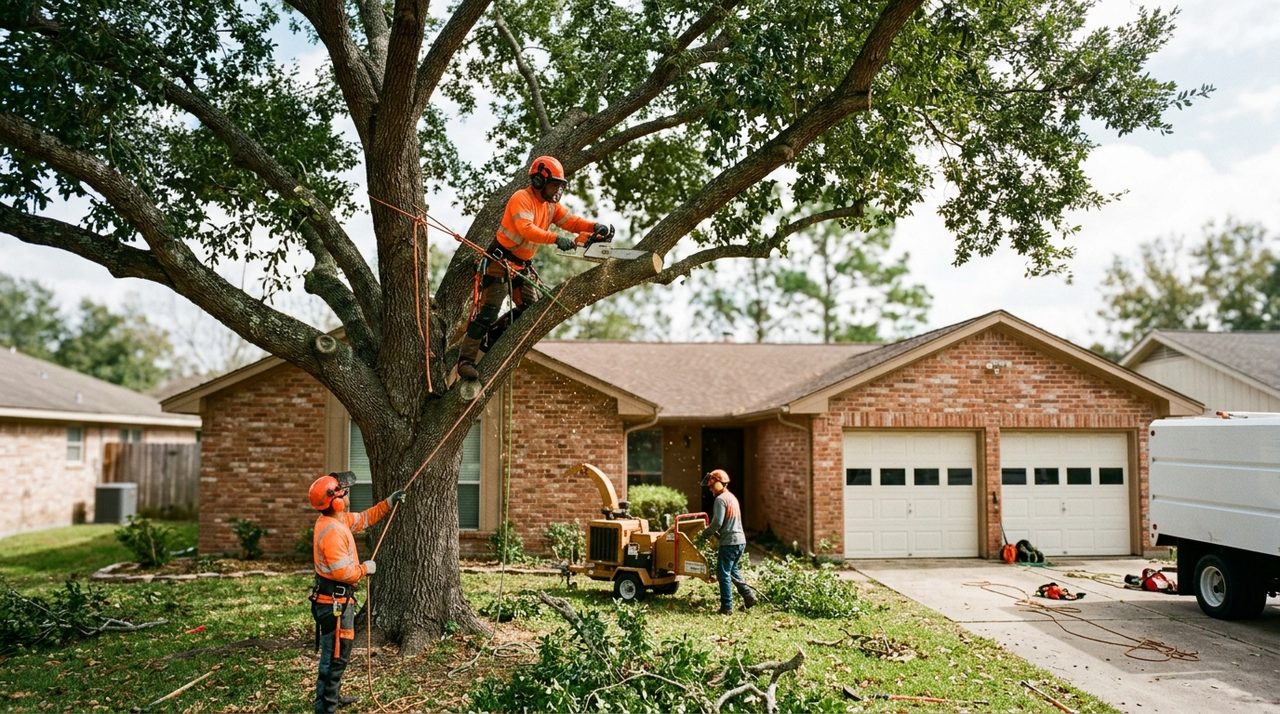
Lazybrook and Timbergrove's 1950s–1960s ranch homes sit beneath a dense canopy of mature live oaks, water oaks, and opportunistic Chinese tallow trees that have had 60-plus years to establish root systems in Houston's expansive Black clay soil — a combination that puts slab edges, aging cast-iron drain lines, and cracked driveways at real risk. Because the neighborhood falls entirely within Houston city limits, tree removal on private property does not require a City of Houston permit, but the Timbergrove Manor Civic Club's deed restriction review process adds a step that can delay work if homeowners skip it. Understanding what the roots are doing underground, which trees need to go, and which ones are quietly cutting your summer electricity bill is what separates a well-planned removal from an expensive regret.
Ranked by verified Google rating × review volume × verification tier. How we rank →
Some highly-rated pros serve Lazybrook / Timbergrove from nearby and may not keep a Lazybrook / Timbergrove street address. Those are listed under "Also serving Lazybrook / Timbergrove" with their real city and distance, so you always know where each business is based.
2102 Delery Dr, Houston, TX 77055
802 Wakefield Dr, Houston, TX 77018
1929 Coulcrest Dr, Houston, TX 77055
Dirección cercana:, 7723 Long Point Rd, Houston, TX 77055
448 W 19th St #557, Houston, TX 77008
731 W 18th St, Houston, TX 77008
Highly-rated pros based nearby who cover Lazybrook / Timbergrove. Distance shown from the Lazybrook / Timbergrove area.
Serving Lazybrook / Timbergrove Based in Brookhollow · 2.7 mi away
Serving Lazybrook / Timbergrove Based in Galleria · 3.2 mi away
Serving Lazybrook / Timbergrove Based in River Oaks · 3.4 mi away
Why it matters to you
Original Lazybrook and Timbergrove homes were built in an era when cast-iron and clay sewer laterals were standard, and those lines are now 60–70 years old. Mature live oaks and water oaks within 20 feet of a foundation or sewer cleanout can drive roots into hairline cracks in those aging pipes, causing slow drains or full blockages long before the problem surfaces at ground level. Houston's expansive Black clay soil amplifies the issue by cycling through wet-season swelling and dry-season shrinkage, which widens those cracks further over time.
What a good pro does
Before any large-tree removal in this neighborhood, a qualified ISA Certified Arborist should assess root spread and a plumber should scope the relevant sewer lateral with a camera. If roots have already infiltrated a pipe, simple removal without stump grinding to the correct depth leaves the root mass in place to continue decaying against the line. Stump grinding to at least 12 inches below grade — quoted separately, typically $150–$400 per stump in the Houston metro — is the minimum standard for trees within striking distance of a lateral.
Sources: City of Houston Permitting Center, Harris County Flood Control District
Why it matters to you
White Oak Bayou's corridor runs along the southern edge of Lazybrook/Timbergrove, and the disturbed, moisture-rich soil along its banks is exactly the habitat where Chinese tallow — a state-listed invasive in Texas — reseeds aggressively and spreads onto adjacent residential lots. The tree grows over five feet per year, develops a root system that cracks concrete driveways and brick edging, and resprouts vigorously from the cut stump if not treated immediately after removal. Some municipal composting facilities in the Houston metro refuse to accept Chinese tallow wood, complicating disposal.
What a good pro does
Removal must be paired with same-day herbicide treatment of the cut stump — typically a concentrated triclopyr product applied within minutes of the final cut — to prevent vigorous resprouting. Ask your contractor explicitly whether they carry herbicide for stump treatment and whether debris will be chipped on-site or hauled off, since chip-in-place of tallow can leave viable seed in the mulch pile. Verify with the Texas A&M AgriLife Extension guidance on invasive species disposal before choosing a disposal method.
Sources: Texas Commission on Environmental Quality, Harris County Flood Control District
Why it matters to you
Unlike unincorporated Harris County suburbs, Lazybrook and Timbergrove sit inside Houston city limits, so the City of Houston does not require a homeowner permit to remove a tree on private property. However, the Timbergrove Manor Civic Club enforces deed restrictions that vary by section and require design review approval before exterior modifications and certain landscape changes on affected lots. Homeowners who hire a crew and proceed without checking their specific section's deed restrictions risk fines and forced replanting orders from the civic club.
What a good pro does
Before scheduling any tree removal involving a tree visible from the street or covered under your recorded lot restrictions, contact the Timbergrove Manor Civic Club directly to confirm whether your section's deed restrictions address tree removal and whether a written approval is needed. This process is separate from anything at the City of Houston Permitting Center. A reputable local arborist familiar with inner-loop Houston neighborhoods will ask about deed restriction status before scheduling, not after.
Sources: Local HOA / deed restrictions (see area profile), City of Houston Permitting Center
Why it matters to you
Lazybrook and Timbergrove's mature live oaks — many planted when the ranches were built in the 1950s — have had decades to grow to canopy-shading size on lots where the home's west and southwest exposures face the afternoon sun most directly. Houston routinely logs over 3,500 cooling degree days per year, and a mature live oak shading a west-facing brick wall or an outdoor AC condenser unit can measurably reduce summer cooling loads. Homeowners removing a problem tree near the foundation sometimes discover this only after their first post-removal electricity bill arrives in July.
What a good pro does
Before committing to full removal of a large shade tree on the west or southwest side of the house, ask the arborist whether crown reduction, cabling, or strategic limb removal could address the structural concern while preserving the cooling benefit. If removal is the only safe option, budgeting for shade-replacement planting — a fast-growing native like a cedar elm or a properly sited crape myrtle cluster — in the same season helps limit the multi-year energy cost impact while the new tree establishes.
Sources: City of Houston Permitting Center
Hiring tree removal in Lazybrook / Timbergrove? Lazybrook/Timbergrove is defined by 1950s–1960s ranch-style brick homes inside the 610 Loop, many of which are now reaching the age where major systems need replacement or full renovation. Proximity to White Oak Bayou introduces flood-risk considerations for any ground-level work, and the Timbergrove Manor Civic Club requires design review approval before permitting for new construction and renovations, adding a step contractors must plan for.
Building era
1950s–1960s, with ongoing infill and teardown rebuilds.
Typical style
One-story, mid-century ranch-style brick homes; newer two-story infill construction is increasing.
Foundations
Not confirmed from available sources - both slab-on-grade and pier-and-beam are common in 1950s–1960s Houston construction. Verify on a per-property basis.
Common systems
Original homes likely have galvanized or cast-iron drain lines, copper supply lines, older electrical panels (60–100 amp), and aging central HVAC systems. Many have undergone partial updates over the decades.
What that means for repairs
Teardowns and full rebuilds are common as land values inside the Loop have risen. Whole-home remodels of original ranches are also frequent, including kitchen and bath modernizations, re-plumbing, and electrical panel upgrades. Timbergrove Manor Civic Club requires design review before City of Houston permitting for new construction and major renovations.
Permit jurisdiction
City of Houston Permitting Center (neighborhood is within Houston city limits, inside the 610 Loop).
HOA & deed restrictions
No mandatory master HOA. Governance is through civic clubs: Timbergrove Manor Civic Club (TMCC, 501(c)(4)) and Lazybrook Civic Club. Deed restrictions are enforced at the subdivision level and vary by section. Whether civic club dues are legally mandatory varies by section and is not definitively documented in public-facing materials.
Historic districts
No City of Houston historic district designation confirmed. HAHC Certificates of Appropriateness are not required for exterior work based on available research.
Contractor note
Contractors working in Timbergrove must obtain civic club design review approval before applying for City of Houston permits for new construction and major renovations. Deed restrictions vary by section, so scope of work and exterior modifications should be verified against the specific lot's recorded restrictions.
FEMA flood zone
FEMA Zone X (low flood risk) per official NFHL data. However, the neighborhood borders White Oak Bayou, and properties closer to the bayou may carry higher effective flood risk. Individual properties should be checked against HCFCD inundation maps and may require elevation certificates.
Hurricane Harvey impact
Specific Harvey 2017 impact data for Lazybrook/Timbergrove is not available from the sources reviewed. The neighborhood's adjacency to White Oak Bayou suggests some homes near the bayou likely experienced flooding, but street-level or block-level inundation data was not confirmed. Check HCFCD Harvey inundation maps and Harris County Repetitive Loss/Severe Repetitive Loss lists for property-specific history.
Heat & humidity load
Original 1950s–1960s homes with aging HVAC systems face heavy summer cooling loads. Older ductwork in attics or crawlspaces may be poorly insulated, driving up energy costs. Pier-and-beam homes (where present) may see moisture-related issues under the house during Houston's humid summers. Bayou-adjacent lots may experience increased mosquito pressure and standing water concerns.
Working with contractors here
The dominant work in Lazybrook/Timbergrove involves either full teardown-and-rebuild projects or deep renovations of 60–70-year-old ranch homes. Re-plumbing (replacing galvanized or cast-iron lines), electrical panel upgrades, and HVAC replacement are among the most common system jobs. Foundation evaluation is important given the age of the housing stock, though the predominant foundation type is not uniformly documented. Contractors should budget time for Timbergrove Manor Civic Club design review when scoping exterior-facing or new construction work, as this approval is required before the City of Houston will issue permits. Flood risk near White Oak Bayou should be assessed before any ground-level or below-grade scope, including foundation work and landscaping drainage.
Local Tip
Always ask for a written estimate before work begins. Texas contractors are required to provide one on jobs over $1,000.
Lazybrook/Timbergrove is defined by 1950s–1960s ranch-style brick homes inside the 610 Loop, many of which are now reaching the age where major systems need replacement or full renovation. Proximity to White Oak Bayou introduces flood-risk considerations for any ground-level work, and the Timbergrove Manor Civic Club requires design review approval before permitting for new construction and renovations, adding a step contractors must plan for.
Source: U.S. Census Bureau, ACS 5-Year 2023
Most of Lazybrook / Timbergrove maps to FEMA Zone X (low mapped flood risk), but Houston's flash-flood reality means even low-risk blocks benefit from smart drainage and storm-hardened installs.
Source: FEMA National Flood Hazard Layer (NFHL). Flood zones vary by parcel — verify your individual FIRM panel.
After a hurricane makes landfall, tree removal demand across the Houston metro surges overnight, so contracting a licensed crew in Lazybrook / Timbergrove for pre-storm hazard removal is far faster and less expensive than emergency post-storm work. Focus removal priority on trees with crowns that extend over the roofline or within one tree-length of the structure, which is where wind-throw damage concentrates. In-city Lazybrook / Timbergrove work falls under City of Houston floodplain and permitting rules.
Wind and lightning are the dominant tree hazards in Lazybrook / Timbergrove during severe Houston thunderstorms, and the May 2024 derecho proved that low-flood-risk areas are not insulated from widespread tree-on-structure damage when straight-line winds exceed 75 mph. A pre-season inspection by a licensed tree removal contractor focused on dead wood, weak branch attachments, and trees leaning toward structures is the most direct mitigation step available. In-city Lazybrook / Timbergrove work falls under City of Houston floodplain and permitting rules.
Wind loading on ice-coated canopies in Lazybrook / Timbergrove during a hard freeze creates the same failure risk as a severe windstorm, and lower flood-risk areas are just as exposed to ice-storm tree damage as any other part of the Houston metro. Uri 2021 left neighborhoods across the city dealing with fallen trees on homes and vehicles for weeks, primarily because no pre-storm removal of structurally weak specimens had been completed. In-city Lazybrook / Timbergrove work falls under City of Houston floodplain and permitting rules.
Sources: FEMA National Flood Hazard Layer (NFHL), Ready.gov -- Hurricanes, CenterPoint Energy -- Storm Center, City of Houston -- Emergency Preparedness, Ready.gov -- Winter Weather, Harris County Flood Control District
Houston-specific estimators to plan your project before you call a pro. All results are planning estimates — a licensed local pro confirms the details on site.
Grouped by mature root aggression & water demand.
Trunk center to the nearest exterior wall.
The root zone likely reaches your foundation's soil during Houston's dry summers, when clay shrinks most. Watch for sticking doors and diagonal cracks, keep soil moisture even with a soaker hose during drought, and have a foundation pro evaluate if you see any movement.
Find a Houston foundation pro →This is a planning estimate only — actual requirements depend on an on-site assessment by a licensed Houston pro. Guidance is based on general species root behavior in expansive clay, not a soil test.
Disconnect & drain every outdoor hose bib
Remove hoses, drain the spigots, and cover each with an insulated faucet sock. Un-drained hose bibs are the #1 burst point in a Houston freeze.
Insulate exposed pipes in the attic & garage
Wrap any pipe in an unconditioned space (attic runs, garage walls) with foam sleeves. Houston homes rarely insulate these because they only matter a few nights a year — which is exactly why they burst.
Open cabinet doors & keep a pencil-width drip
On hard-freeze nights, open kitchen/bath cabinets so warm air reaches the pipes and let faucets on exterior walls drip to relieve pressure.
Protect the attic/garage water heater & its lines
An attic or garage tank sits in unconditioned space. Insulate the cold-inlet and hot-outlet lines and confirm the emergency drain pan is clear so a leak doesn't reach the ceiling.
This is a planning estimate only — actual requirements depend on an on-site assessment by a licensed Houston pro. If a pipe has already burst, shut off your main water supply and call a licensed Houston plumber immediately — freeze bursts flood fast.
Sources: City of Houston Permitting CenterLocal HOA / deed restrictions (see area profile)
Sources: Local HOA / deed restrictions (see area profile)
Sources: Harris County Flood Control DistrictFEMA National Flood Hazard Layer (NFHL)Texas Commission on Environmental Quality