Closed
9001 Jameel Rd #150, Houston, TX 77040
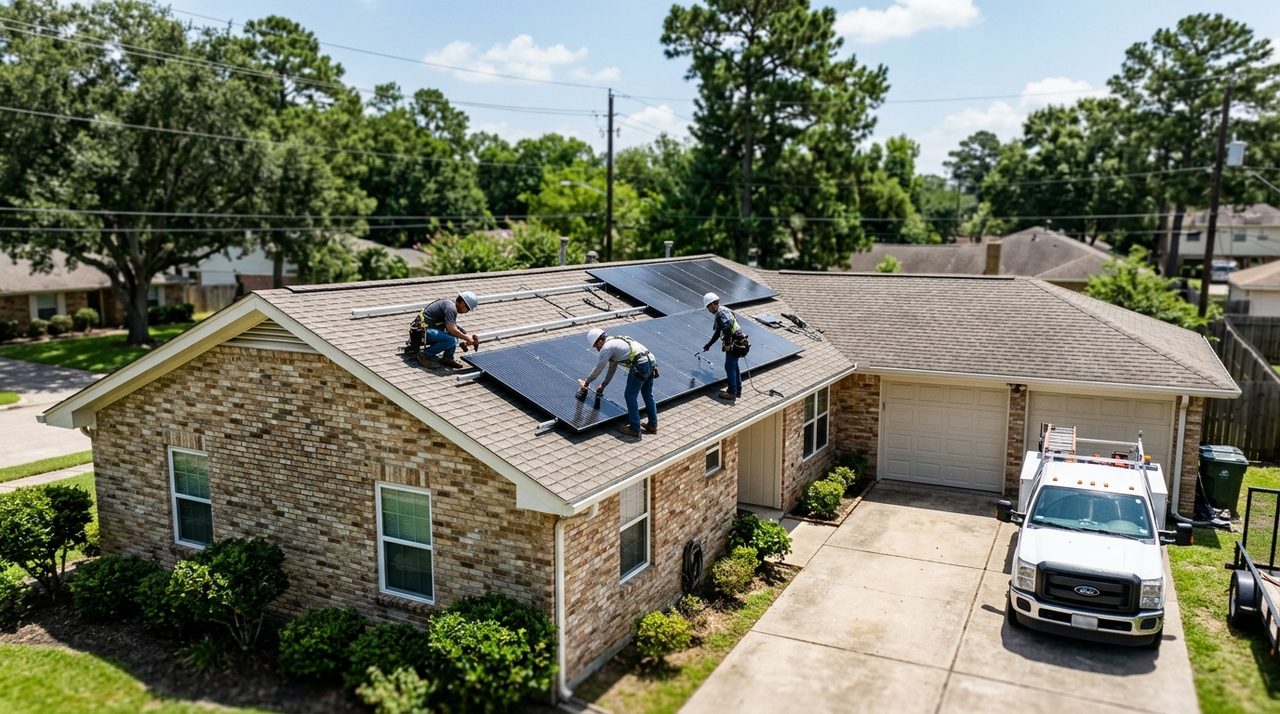
NW Houston's sprawl of 1980s–1990s brick tract homes on expansive Harris County clay sits at the intersection of three solar-specific headaches: mandatory HOA architectural review that can force non-optimal panel placement, a split permit jurisdiction that trips up installers who don't confirm whether an address falls inside Houston city limits or unincorporated Harris County, and aging composition shingle roofs nearing the end of their rated life just as homeowners are ready to install 25-year panel arrays. This page covers what actually matters for solar in these subdivisions—before you sign a contract.
Ranked by verified Google rating × review volume × verification tier. How we rank →
Some highly-rated pros serve NW Houston from nearby and may not keep a NW Houston street address. Those are listed under "Also serving NW Houston" with their real city and distance, so you always know where each business is based.
9001 Jameel Rd #150, Houston, TX 77040
6911 Breen Dr Building B, Houston, TX 77086
Highly-rated pros based nearby who cover NW Houston. Distance shown from the NW Houston area.
Serving NW Houston Based in Jersey Village · 3 mi away
Serving NW Houston Based in Jersey Village · 3.9 mi away
Serving NW Houston Based in Jersey Village · 4.3 mi away
Serving NW Houston Based in Jersey Village · 4.8 mi away
Serving NW Houston Based in Jersey Village · 5.5 mi away
Serving NW Houston Based in Spring Branch · 5.5 mi away
Serving NW Houston Based in Spring Branch · 5.7 mi away
Why it matters to you
Nearly every platted NW Houston subdivision — from Memorial Northwest to Meadows of Northwest Park — has a mandatory HOA with an architectural review committee. Under Texas Property Code §202.010, an HOA cannot block solar outright, but it can require that panels be 'not visible from the street,' which on NW Houston's gable-fronted, north-facing street elevations routinely means rear-slope or east-facing placement. Depending on your lot's tree canopy and roof orientation, that restriction can reduce annual production by 15–25% compared to an optimal south-facing layout, a shortfall that quietly guts your payback timeline without ever appearing in a sales quote.
What a good pro does
Before design begins, request your subdivision's deed restrictions from Harris County real property records and submit a written pre-application to the HOA architectural committee — approval can take two to six weeks in NW Houston subdivisions. A qualified installer will model production for both the HOA-compliant placement and the optimal placement so you can make a clear-eyed financial comparison. The installer must also pull permits through the correct jurisdiction — Houston Permitting Center if inside city limits, Harris County Engineering Department if unincorporated — because submittal packages and inspection timelines differ between the two.
Sources: Local HOA / deed restrictions (see area profile), City of Houston Permitting Center, Municipal permit office (see area profile)
Why it matters to you
NW Houston's median home was built in 1985, and the largest housing concentration falls in the 1980s–1990s. Houston's combination of UV index averaging 10–11, summer humidity above 90%, and recurring hail events degrades standard 3-tab asphalt shingles in 12–15 years rather than their rated 20–25. Many of these roofs — even ones that 'passed' a post-hail inspection — are now 15–25 years old. An installer who mounts a 25-year panel array on a roof at end of life is setting you up for an $8,000–$14,000 remove-and-reinstall bill within five years when the roof inevitably needs replacement, a cost that is almost never disclosed upfront.
What a good pro does
Insist on an independent roofing inspection — not one performed by the solar company — before any contract is signed. A reputable installer will document roof age and condition in writing and will not proceed without either a clean report or a re-roof performed first. Budget $8,000–$18,000 for re-roofing prior to installation if your shingles are older than 12 years; factor that into your ITC calculations, since a necessary roof upgrade that is part of the solar project may qualify for the 30% credit on the portion attributable to solar support.
Sources: International Residential Code (as adopted by City of Houston), ENERGY STAR / U.S. Dept. of Energy
Why it matters to you
NW Houston is one of the few parts of the metro where you genuinely cannot assume which permit office governs your address. Parcels inside Houston city limits go through the Houston Permitting Center, which averages two to four weeks for solar electrical and structural review. Unincorporated Harris County parcels — common throughout NW Houston's outer subdivisions — go through the Harris County Engineering Department, which has its own submittal checklist and inspection schedule. An installer who pulls the wrong permit, or skips the county process assuming Houston jurisdiction, can leave your system stuck in a compliance limbo that delays CenterPoint interconnection approval by months.
What a good pro does
Confirm municipal status at the Harris County Appraisal District or Houston Permitting Center address lookup before the design phase, not after. Every Houston-metro solar installation — regardless of jurisdiction — requires a building and electrical permit, and CenterPoint Energy must approve the interconnection agreement before the system can be legally energized. The installer's master electrician of record must be licensed through TDLR and must pull permits under their license number in the correct jurisdiction; ask to see both the TDLR electrical contractor license and the actual permit application before work begins.
Sources: City of Houston Permitting Center, Texas Department of Licensing & Regulation, Municipal permit office (see area profile)
Why it matters to you
A typical NW Houston home built in the 1980s carries the original production-build insulation — often R-11 walls and R-19 attics — well below modern code minimums, pushing cooling loads significantly higher than what a national solar sizing calculator will estimate. Houston accumulates roughly 3,000 cooling degree days annually, and a 2,200-square-foot 1980s brick home here can draw 1,600–1,900 kWh per month from June through September. Installers who size systems using national average consumption figures rather than your actual CenterPoint billing history routinely deliver arrays that offset only 40–50% of real load instead of the 80–100% quoted in the sales presentation.
What a good pro does
Provide 24 months of CenterPoint billing data — downloadable from your online account — and require that the installer's production model be built from that specific usage history, not a regional average. An NABCEP-certified PV Installation Professional is trained to reconcile measured load data against local irradiance values; that certification is the credential to verify before trusting any production estimate. If your 1980s home has never had an energy audit, a pre-solar air-sealing and insulation upgrade will reduce the array size you need and improve your payback period more than any equipment upgrade.
Sources: North American Board of Certified Energy Practitioners (NABCEP), ENERGY STAR / U.S. Dept. of Energy
Hiring solar installers in NW Houston? NW Houston encompasses dozens of separate subdivisions spanning construction eras from the 1960s through the 2010s, each with its own HOA and deed restrictions. Homeowners here typically manage aging slab-on-grade foundations on expansive clay soils, production-era HVAC systems, and roofing exposed to severe summer heat. Permit jurisdiction varies between the City of Houston and Harris County depending on whether the specific parcel falls inside or outside city limits.
Building era
1970s–2000s, with the largest concentration in the 1980s–1990s.
Typical style
Traditional suburban brick or brick-and-siding one- and two-story homes, Texas traditional with gables and attached garages.
Foundations
Concrete slab-on-grade (predominant for post-1960 tract housing in Harris County).
Common systems
Central A/C with forced-air gas furnaces typical of 1980s–1990s production builds; copper or CPVC supply lines with cast iron or PVC drains; 200-amp electrical panels in newer sections, 100-amp in older 1970s-era homes.
What that means for repairs
Kitchen and bath remodels are common in 1970s–1980s homes reaching 40+ years. Foundation repair due to expansive clay soils is frequent. Roof replacements cycle every 15–20 years due to hail and heat exposure. HOA architectural review is typically required before exterior modifications.
Permit jurisdiction
Mixed — parcels within Houston city limits use the Houston Permitting Center; unincorporated Harris County parcels (common in NW Houston) use Harris County Engineering Department. Verify annexation status per address.
HOA & deed restrictions
Most platted subdivisions have mandatory HOAs or POAs. Notable examples include Memorial Northwest Homeowners Association (mandatory for all property owners) and Meadows of Northwest Park HOA (mandatory). Older unplatted acreage tracts may lack formal HOAs. Confirm HOA status per property via deed records and the TREC HOA Management Certificate Database.
Historic districts
No City of Houston historic district designation confirmed.
Contractor note
Contractors must verify whether a specific address is inside Houston city limits or unincorporated Harris County, as permit requirements and inspection processes differ. Most subdivision HOAs require architectural committee approval before exterior work begins.
FEMA flood zone
FEMA Zone X500 (moderate flood risk) — source: fema_nfhl. Portions of NW Houston near Cypress Creek, White Oak Bayou tributaries, and low-lying creek corridors may carry higher localized flood risk; confirm zone by specific address.
Hurricane Harvey impact
Harvey impact varied significantly across NW Houston. Areas near Cypress Creek and low-lying bayou tributaries experienced serious structural flooding, while higher-ground subdivisions saw little to no flooding. No single characterization applies area-wide. Some NW Houston subdivisions faced post-Harvey HOA disputes including foreclosure actions over unpaid dues and legal costs.
Heat & humidity load
Prolonged 95°F+ heat and high humidity stress aging HVAC systems in 1980s–1990s homes, accelerating compressor failures and ductwork degradation in unconditioned attic spaces. Slab movement peaks during summer drought cycles on expansive clay soils, causing doors to stick and drywall cracks to appear.
Working with contractors here
The most common service calls in NW Houston involve foundation leveling and pier installation on expansive clay soils, HVAC system replacement in 1980s–1990s production homes, and composition shingle roof replacements after hail events. Plumbing repiping is increasingly common as original polybutylene and CPVC lines in 1980s–1990s homes reach end of life. Contractors should plan for HOA architectural review timelines before scheduling exterior work—approval can take two to six weeks depending on the subdivision. Because permit jurisdiction is split between Houston and Harris County, job scoping must begin with confirming the property's municipal status to ensure correct permits and inspections.
Local Tip
Always ask for a written estimate before work begins. Texas contractors are required to provide one on jobs over $1,000.
NW Houston encompasses dozens of separate subdivisions spanning construction eras from the 1960s through the 2010s, each with its own HOA and deed restrictions. Homeowners here typically manage aging slab-on-grade foundations on expansive clay soils, production-era HVAC systems, and roofing exposed to severe summer heat. Permit jurisdiction varies between the City of Houston and Harris County depending on whether the specific parcel falls inside or outside city limits.
Source: U.S. Census Bureau, ACS 5-Year 2023
NW Houston carries FEMA Zone X500 (moderate flood risk): outside the 100-year floodplain but inside the 500-year, so heavy-rain events still reach homes and flood-aware work pays off.
Source: FEMA National Flood Hazard Layer (NFHL). Flood zones vary by parcel — verify your individual FIRM panel.
Hurricane-rated racking hardware — not standard residential mounting — is what keeps panels on Houston roofs when sustained winds exceed 90 mph; confirm your NW Houston system carries a wind-uplift rating appropriate for Harris or Galveston County's design wind speed. An annual pre-season torque check on all lag bolts and rail clamps by a licensed solar technician takes less than two hours and protects your investment. In-city NW Houston work falls under City of Houston floodplain and permitting rules.
Hail is a near-annual severe-weather hazard across the Houston metro, and NW Houston homeowners should check their solar panel warranty for hail-impact rating — most tier-one panels are tested to IEC 61215 one-inch hail but not larger golf-ball-size stones common in Texas supercells. After any hail event, a TDLR-licensed solar technician can run an IV-curve trace test to detect hidden cell damage that a visual inspection would miss. In-city NW Houston work falls under City of Houston floodplain and permitting rules.
A hard freeze in NW Houston can cause conduit carrying solar wiring along an exterior wall to contract and stress fittings; before winter, ask your TDLR-licensed installer to inspect any exposed conduit runs and confirm all fittings are properly supported to prevent a disconnect that would take the array offline. Keeping the solar system fully operational through a Uri-style freeze event is critical if your battery backup is your primary source of heat-sustaining power. With a median build year of 1985, the older building stock here is more exposed to hard-freeze damage than newer construction. Confirm the current FEMA panel for your NW Houston parcel — the area maps to Zone X500, but adjacent lots can differ.
Sources: FEMA National Flood Hazard Layer (NFHL), Ready.gov -- Hurricanes, CenterPoint Energy -- Storm Center, City of Houston -- Emergency Preparedness, Ready.gov -- Winter Weather, Harris County Flood Control District
Houston-specific estimators to plan your project before you call a pro. All results are planning estimates — a licensed local pro confirms the details on site.
Disconnect & drain every outdoor hose bib
Remove hoses, drain the spigots, and cover each with an insulated faucet sock. Un-drained hose bibs are the #1 burst point in a Houston freeze.
Insulate exposed pipes in the attic & garage
Wrap any pipe in an unconditioned space (attic runs, garage walls) with foam sleeves. Houston homes rarely insulate these because they only matter a few nights a year — which is exactly why they burst.
Open cabinet doors & keep a pencil-width drip
On hard-freeze nights, open kitchen/bath cabinets so warm air reaches the pipes and let faucets on exterior walls drip to relieve pressure.
Protect the attic/garage water heater & its lines
An attic or garage tank sits in unconditioned space. Insulate the cold-inlet and hot-outlet lines and confirm the emergency drain pan is clear so a leak doesn't reach the ceiling.
This is a planning estimate only — actual requirements depend on an on-site assessment by a licensed Houston pro. If a pipe has already burst, shut off your main water supply and call a licensed Houston plumber immediately — freeze bursts flood fast.
Sources: City of Houston Permitting CenterMunicipal permit office (see area profile)
Sources: Texas Department of Licensing & RegulationCity of Houston Permitting Center
Sources: FEMA National Flood Hazard Layer (NFHL)International Residential Code (as adopted by City of Houston)
Sources: Local HOA / deed restrictions (see area profile)
Sources: Texas Department of Licensing & RegulationNorth American Board of Certified Energy Practitioners (NABCEP)