Closed
203 TX-332, Lake Jackson, TX 77566
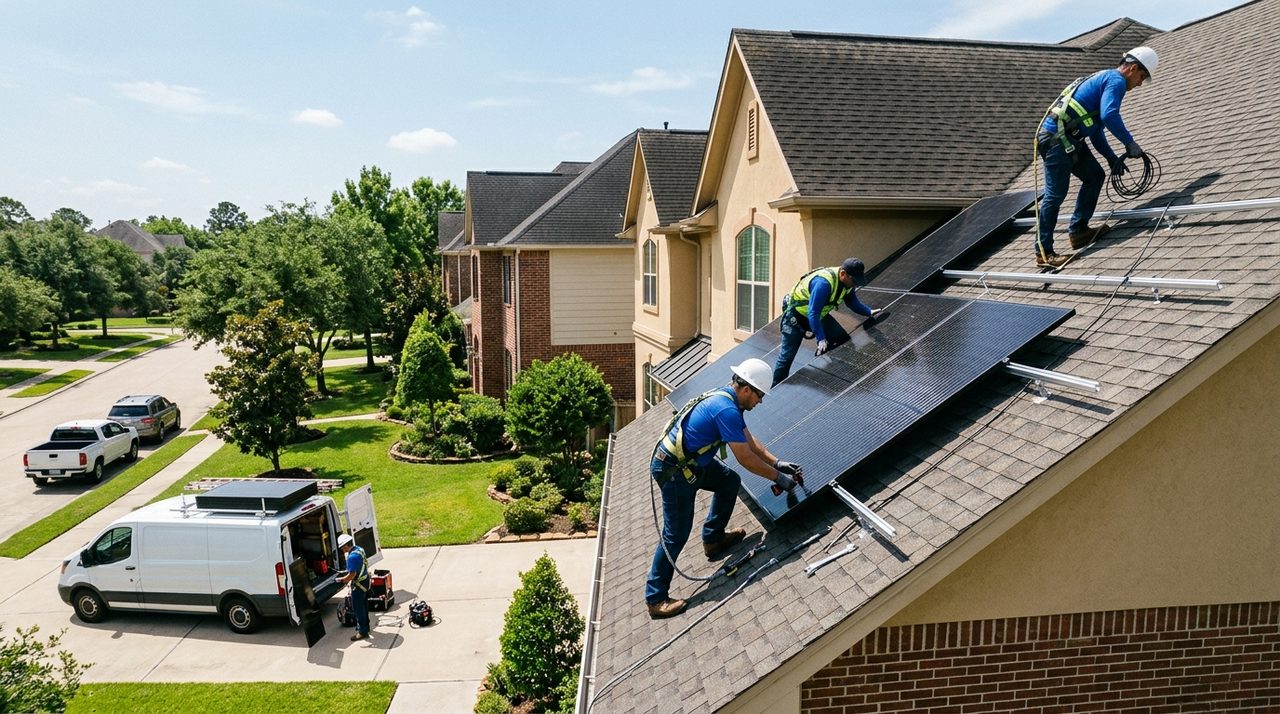
Lake Jackson sits roughly 60 miles southwest of Houston in Brazoria County, close enough to the Gulf that its solar arrays face real hurricane-wind exposure yet far enough inland to land in FEMA Zone X—a combination that shapes every decision from racking hardware selection to insurance documentation. The city's median home was built around 1983, putting the bulk of the housing stock in an age bracket where original roofing is at or past end-of-life and electrical panels may need upgrading before a battery-backed system can be safely added. Because Lake Jackson is an independent incorporated city, every solar permit routes through City of Lake Jackson Permitting—not Brazoria County, not the City of Houston—and interconnection runs through CenterPoint Energy's separate queue, adding layers that generic online cost calculators never account for.
Ranked by verified Google rating × review volume × verification tier. How we rank →
203 TX-332, Lake Jackson, TX 77566
Why it matters to you
With a Census median year built of 1983, a large share of Lake Jackson homes are carrying original or first-replacement asphalt shingle roofs that are 12–20 years old. Houston's Gulf Coast UV index of 10–11 and summer heat cycles above 95°F degrade standard 3-tab shingles in 12–15 years rather than the rated 20–25, meaning many roofs in the Dow-era neighborhoods off This Way and Circle Way are already at or past serviceable life. Mounting a 25-year panel array on a roof with five or fewer years of life remaining creates a near-certain future cost of $8,000–$14,000 (estimated) to remove, re-roof, and reinstall—an expense almost never surfaced in a sales quote.
What a good pro does
A qualified installer should pull roof-age documentation from Brazoria County appraisal records and visually inspect decking, flashing, and granule loss before any contract is signed. If the roof needs replacement, the permit package submitted to City of Lake Jackson Permitting should bundle both the roofing and solar structural submittals so inspections can be coordinated in a single queue rather than two sequential ones, saving weeks. The master electrician pulling the solar permit under their TDLR-issued Electrical Contractor license can also flag whether the existing electrical service is sized to handle the new inverter feed without a simultaneous panel upgrade.
Sources: Municipal permit office (see area profile), Texas Department of Licensing & Regulation, International Residential Code (as adopted by City of Houston)
Why it matters to you
Lake Jackson is in Brazoria County, a TWIA-eligible coastal county where homes may carry Texas Windstorm Insurance Association coverage or private equivalents that require wind-rated hardware documentation for policy continuity. ASCE 7 design wind speeds for this zone run 130–140 mph at grade, and post-Harvey and post-Beryl inspections across the Brazoria coast repeatedly found under-torqued rail attachments and improperly flashed penetrations that allowed panels to lift and breach roof decks. A homeowner who installs an array without manufacturer wind-rating certifications on file risks both a voided roof warranty and a claim denial if a named storm causes damage.
What a good pro does
Installers working in Lake Jackson should specify racking systems with documented testing to 130+ mph uplift and provide the homeowner with a stamped engineering letter that matches the product data sheet—documentation TWIA and private wind insurers can reference at claim time. Every roof penetration must be flashed with compatible materials and sealed to IRC standards for coastal exposure, and the completed installation must pass the City of Lake Jackson's structural inspection before interconnection is approved. Ask the installer to hand over a physical copy of the racking manufacturer's ICC-ES or equivalent wind-load report, not just a verbal assurance.
Sources: Texas Windstorm Insurance Association (TWIA), International Residential Code (as adopted by City of Houston), Municipal permit office (see area profile)
Why it matters to you
Winter Storm Uri in February 2021 and subsequent grid stress events have made battery backup a priority for Lake Jackson homeowners, many of whom lost power for days in homes built before whole-house generators were standard. The appeal is real, but the path is longer than most sales pitches admit: adding a Tesla Powerwall or Enphase IQ Battery to a Lake Jackson installation requires a separate storage interconnection application to CenterPoint Energy that can add 6–10 weeks to the project schedule, on top of the City of Lake Jackson building and electrical permit review. Homes built around 1983 also frequently have 100-amp or undersized 150-amp panels that must be upgraded to 200 amps before a battery system can be safely integrated, adding an estimated $2,000–$4,500 to project cost.
What a good pro does
The licensed master electrician pulling the permit through City of Lake Jackson Permitting should conduct a load calculation on the existing panel before any battery equipment is ordered, confirming whether a service upgrade is needed and sizing it correctly the first time. The CenterPoint interconnection application for the storage-paired system should be submitted in parallel with the city permit application—not after—to prevent the two review clocks from running sequentially. NABCEP-certified installers with documented storage experience in the CenterPoint service territory are the clearest indicator that a firm has navigated this specific queue before.
Sources: Municipal permit office (see area profile), Texas Department of Licensing & Regulation, North American Board of Certified Energy Practitioners (NABCEP)
Why it matters to you
Lake Jackson's Gulf Coast location delivers roughly 3,000 cooling degree days annually, and a typical 2,200 sq ft home here can draw 1,400–1,800 kWh per month from June through September—numbers that national solar sizing tools based on continental U.S. averages routinely undercount by 20–30%. Older 1980s homes in Lake Jackson with minimal attic insulation and single-pane windows push that load even higher, and any household adding an EV charger or pool pump compounds the gap further. An installer who quotes an 8 kW system using national average consumption data instead of the homeowner's actual CenterPoint billing history may deliver a system that offsets only 40–50% of real load rather than the 80–100% promised.
What a good pro does
Require the installer to pull at least 12 months of CenterPoint usage data—available on your online account or via a usage release form—and build the system design around your actual peak summer months, not a blended annual average. The final system size and expected offset percentage should appear as a line item in the written contract, not just in a sales deck. A reputable installer will also note whether your home's building envelope improvements (added attic insulation, window film) could reduce the required array size and improve overall return, particularly in a 1983-vintage home where envelope performance is often well below current IECC standards.
Sources: ENERGY STAR / U.S. Dept. of Energy, North American Board of Certified Energy Practitioners (NABCEP), Municipal permit office (see area profile)
Hiring solar installers in Lake Jackson? Lake Jackson is an incorporated city in Brazoria County, originally developed as a residential community for the Dow Chemical complex. Homeowners here deal with city-level permitting rather than Houston or county jurisdiction, and HOA requirements vary widely by subdivision. The housing stock spans several decades, and Gulf Coast climate conditions drive ongoing maintenance needs for roofing, HVAC, and moisture management.
Building era
Mid-20th century onward; specific dominant decade not confirmed in available records.
Typical style
Not confirmed - no authoritative city-wide architectural style survey available; likely a mix of ranch, traditional, and newer construction.
Foundations
Likely predominantly slab-on-grade consistent with Gulf Coast construction practices, but not confirmed by Lake Jackson-specific documentation.
Common systems
Expect a range of HVAC systems from older central units to modern high-efficiency systems; older homes may have galvanized or copper plumbing; electrical panels in mid-century homes may need updating.
What that means for repairs
Older mid-century homes near the original Dow-era neighborhoods are candidates for electrical panel upgrades, plumbing replacement, and HVAC modernization. Kitchen and bathroom remodels are common as homeowners update aging interiors.
Permit jurisdiction
City of Lake Jackson Permitting (independent incorporated city with its own Planning Commission and development review process).
HOA & deed restrictions
No single city-wide mandatory HOA. Some subdivisions have mandatory HOAs/POAs managed by firms such as Graham Management and Spectrum Association Management, while other properties have only deed restrictions or no formal association. Confirm HOA status through Brazoria County deed records and TREC HOA Management Certificate database for any specific property.
Historic districts
No City of Houston historic district designation applies; Lake Jackson is a separate incorporated city. No local historic district designation confirmed in available research.
Contractor note
Contractors must obtain permits through the City of Lake Jackson, not the City of Houston or Brazoria County. Verify subdivision-specific deed restrictions before beginning exterior modifications, as enforcement varies by neighborhood.
FEMA flood zone
FEMA Zone X (low flood risk) per official NFHL data. Brazoria County experienced significant Harvey-era flooding along the Brazos River and low-lying areas; site-specific flood risk should still be evaluated using Brazoria County FIRMs and city floodplain maps.
Hurricane Harvey impact
Brazoria County experienced significant flooding during Hurricane Harvey, particularly along the Brazos River corridor. However, no publicly available source was found that itemizes specific Lake Jackson neighborhoods or streets that flooded. Property-level Harvey impact should be verified through seller's disclosure, insurance claim history, and Brazoria County flood records.
Heat & humidity load
Extreme Gulf Coast heat and humidity place heavy demands on HVAC systems and increase risk of moisture intrusion, mold, and wood rot. Older homes without modern vapor barriers or adequate attic ventilation are especially vulnerable. Roof inspections and HVAC maintenance are critical before each summer season.
Working with contractors here
Contractors in Lake Jackson most commonly work on HVAC replacement and maintenance due to the demanding Gulf Coast climate and aging systems in mid-century homes. Plumbing repairs and re-pipes are frequent in older subdivisions where original galvanized lines have deteriorated. Roofing work is steady, driven by hurricane season exposure and general weathering. Because Lake Jackson is an independent city, contractors must navigate its own permitting process, which differs from both Houston and unincorporated Brazoria County procedures. Job scoping should always include verification of HOA or deed restriction requirements, as these vary significantly between subdivisions.
Local Tip
Always ask for a written estimate before work begins. Texas contractors are required to provide one on jobs over $1,000.
Lake Jackson is an incorporated city in Brazoria County, originally developed as a residential community for the Dow Chemical complex. Homeowners here deal with city-level permitting rather than Houston or county jurisdiction, and HOA requirements vary widely by subdivision. The housing stock spans several decades, and Gulf Coast climate conditions drive ongoing maintenance needs for roofing, HVAC, and moisture management.
Source: U.S. Census Bureau, ACS 5-Year 2023
Most of Lake Jackson maps to FEMA Zone X (low mapped flood risk), but Houston's flash-flood reality means even low-risk blocks benefit from smart drainage and storm-hardened installs; as a Brazoria County coastal community, tropical surge and wind add a layer generic guidance misses.
Source: FEMA National Flood Hazard Layer (NFHL). Flood zones vary by parcel — verify your individual FIRM panel.
After extended outages during past Gulf storms, homeowners in Lake Jackson, TX discovered that grid-tied solar without battery storage goes dark the moment CenterPoint cuts power for line-worker safety. Ask your licensed solar installer about adding a code-compliant rapid-shutdown device and a battery backup that can island critical loads during a multi-day outage. As a Brazoria County community, Lake Jackson may follow county rather than City of Houston storm rebuild rules.
Power outages in Lake Jackson, TX caused by severe thunderstorm damage to CenterPoint infrastructure can last 24 to 72 hours even without a named storm; a solar battery backup system paired with a properly permitted transfer switch lets you run essential loads independently of the grid. Ensure your installer pulled a City of Houston permit and scheduled a final inspection so the system is code-confirmed before storm season. Confirm the current FEMA panel for your Lake Jackson parcel — the area maps to Zone X, but adjacent lots can differ.
Winter Storm Uri demonstrated that even low-flood-risk areas of the Houston metro face multi-day power outages when the ERCOT grid is stressed; solar homeowners in Lake Jackson, TX should test their battery backup system's automatic transfer function annually, ideally before December, to confirm it will island critical loads smoothly if the grid fails during a freeze. A TDLR-licensed solar technician can perform this test and verify that the rapid-shutdown system resets correctly when grid power is restored. With a median build year of 1983, the older building stock here is more exposed to hard-freeze damage than newer construction. As a Brazoria County community, Lake Jackson may follow county rather than City of Houston storm rebuild rules.
Sources: FEMA National Flood Hazard Layer (NFHL), Ready.gov -- Hurricanes, CenterPoint Energy -- Storm Center, City of Houston -- Emergency Preparedness, Ready.gov -- Winter Weather, Harris County Flood Control District
Houston-specific estimators to plan your project before you call a pro. All results are planning estimates — a licensed local pro confirms the details on site.
Disconnect & drain every outdoor hose bib
Remove hoses, drain the spigots, and cover each with an insulated faucet sock. Un-drained hose bibs are the #1 burst point in a Houston freeze.
Insulate exposed pipes in the attic & garage
Wrap any pipe in an unconditioned space (attic runs, garage walls) with foam sleeves. Houston homes rarely insulate these because they only matter a few nights a year — which is exactly why they burst.
Open cabinet doors & keep a pencil-width drip
On hard-freeze nights, open kitchen/bath cabinets so warm air reaches the pipes and let faucets on exterior walls drip to relieve pressure.
Protect the attic/garage water heater & its lines
An attic or garage tank sits in unconditioned space. Insulate the cold-inlet and hot-outlet lines and confirm the emergency drain pan is clear so a leak doesn't reach the ceiling.
This is a planning estimate only — actual requirements depend on an on-site assessment by a licensed Houston pro. If a pipe has already burst, shut off your main water supply and call a licensed Houston plumber immediately — freeze bursts flood fast.
Sources: Municipal permit office (see area profile)Texas Department of Licensing & Regulation
Sources: Local HOA / deed restrictions (see area profile)
Sources: FEMA National Flood Hazard Layer (NFHL)Texas Windstorm Insurance Association (TWIA)
Sources: Municipal permit office (see area profile)
Sources: Texas Department of Licensing & RegulationNorth American Board of Certified Energy Practitioners (NABCEP)