Closed
Serving Angleton Based in Lake Jackson · 8.7 mi away
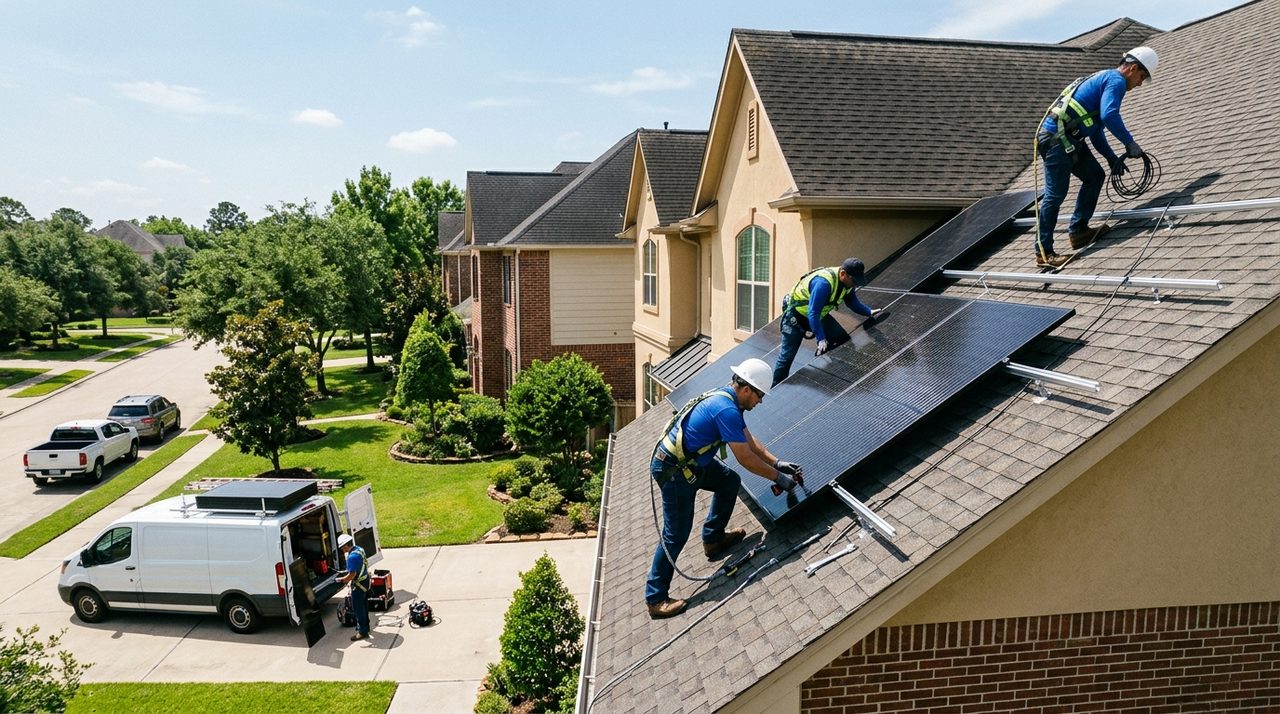
Angleton's median home was built in 1978, meaning a large share of the city's ranch-style brick houses carry aging 60–100-amp electrical panels and original asphalt shingles that are already past their expected service life under Brazoria County's punishing UV and humidity—two facts that reshape what a solar installation actually costs and requires here. Add Brazoria County's coastal wind exposure, the expansive Vertisol clay soil underneath nearly every slab in town, and a split permitting reality between the City of Angleton Building Department and Brazoria County Engineering, and you have a project environment that generic solar sales pitches simply don't address. This page walks through the four challenges that matter most for Angleton homeowners specifically.
Ranked by verified Google rating × review volume × verification tier. How we rank →
Some highly-rated pros serve Angleton from nearby and may not keep a Angleton street address. Those are listed under "Also serving Angleton" with their real city and distance, so you always know where each business is based.
Highly-rated pros based nearby who cover Angleton. Distance shown from the Angleton area.
Serving Angleton Based in Lake Jackson · 8.7 mi away
Why it matters to you
Angleton's Census-median home was built in 1978, and a substantial portion of the in-town ranch stock still has its original or once-replaced 3-tab shingles. Brazoria County's combination of 95°F+ summer heat, 90%+ humidity, and UV index averaging 10–11 shortens standard shingle life to 12–15 years rather than the marketed 20–25. An installer who mounts a 25-year panel array on a 12-year-old shingle roof is setting you up for an $8,000–$14,000 remove-and-reinstall bill when the roof fails underneath—a cost almost never disclosed during the sales pitch.
What a good pro does
A qualified installer should pull the permit history from the City of Angleton Building Department or Brazoria County Engineering (depending on your parcel) to establish actual roof age, then provide a written roof-condition assessment before any contract is signed. If shingles are within five to eight years of end-of-life, bundling a re-roof into the project scope before racking goes up is the only financially rational path. Installers must hold a valid TDLR Electrical Contractor license and have the master electrician coordinate the sequencing with the roofing subcontractor so inspections don't conflict.
Sources: Municipal permit office (see area profile), Texas Department of Licensing & Regulation, International Residential Code (as adopted by City of Houston)
Why it matters to you
Angleton sits in Brazoria County, which falls within ASCE 7 Wind Zone D with design wind speeds of 130–140 mph at grade—the same zone that produced documented panel-lift failures after Harvey in 2017 and Beryl in 2024 in communities just to the east and south. Coastal Brazoria County properties also fall under TWIA (Texas Windstorm Insurance Association) territory, and TWIA requires wind-rated hardware documentation at time of claim; an array installed without proper WPI-8 certification can void your wind coverage on both the panels and the roof beneath them.
What a good pro does
Before signing a contract, ask the installer to produce the specific racking manufacturer's wind-rating test report for the attachment method they plan to use on your roof type—brick-veneer ranch homes require different flashing and lag-torque specs than newer fiber-cement siding houses. A reputable installer will submit the required documentation to the City of Angleton Building Department or Brazoria County Engineering as part of the structural permit set, and will carry NABCEP PV Installation Professional certification as evidence of wind-load design competency. Verify TWIA compliance separately with your insurance agent before energization.
Sources: Texas Windstorm Insurance Association (TWIA), North American Board of Certified Energy Practitioners (NABCEP), Municipal permit office (see area profile)
Why it matters to you
The Beaumont/Houston Black clay (Vertisol series) that causes foundation repair calls throughout Brazoria County also undermines ground-mount solar footings. This same soil swells up to four inches seasonally, and installers who spec helical piers or concrete ballast using standard Great Plains or Midwest tables—without a geotechnical adjustment for local Vertisol behavior—routinely see racking misalignment within two to three years. Misalignment voids most manufacturer tilt warranties and reduces annual energy production measurably as panels drift off optimal angle.
What a good pro does
For any ground-mount system in Angleton, require the installer to provide an engineered footing design specifically accounting for Brazoria County clay swell potential—not a generic national spec sheet. Ground-mount systems on this soil profile run 20–35% more per watt than roof-mount due to the additional geotechnical and trenching work, so budget accordingly (estimate: $3.40–$4.70/watt before ITC for a ground-mount here). The Brazoria County Engineering office reviews structural submittals for unincorporated parcels; city-limit properties go through the City of Angleton Building Department, and inspection timelines differ between the two.
Sources: Municipal permit office (see area profile), International Residential Code (as adopted by City of Houston), FEMA National Flood Hazard Layer (NFHL)
Why it matters to you
Post-Uri battery demand is real in Angleton—the 2021 freeze hit Brazoria County hard, and many homeowners with the city's substantial stock of 1950s–1980s ranch homes still have 60–100-amp service panels that cannot physically support a modern solar inverter, a Tesla Powerwall or Enphase IQ Battery, and existing home loads simultaneously. Attempting to integrate battery storage on an undersized or Federal Pacific / Zinsco-era panel is a code violation and an insurance liability, not just an inconvenience.
What a good pro does
A qualified installer will pull your CenterPoint Energy historical usage data (Angleton is CenterPoint territory) to size the array correctly for Angleton's roughly 3,000 annual cooling degree days, then flag any panel upgrade requirement before quoting storage integration. Panel upgrades to 200-amp service typically add $2,500–$5,000 to the project and require a separate electrical permit from the City of Angleton Building Department or Brazoria County Engineering. CenterPoint's interconnection application for a storage-paired system adds six to ten weeks to the timeline beyond a basic grid-tie install, so start the process early. Confirm your installer holds a valid TDLR Electrical Contractor license, as all permitted electrical work including the panel upgrade must be pulled by a licensed master electrician.
Sources: Texas Department of Licensing & Regulation, Municipal permit office (see area profile), ENERGY STAR / U.S. Dept. of Energy
Hiring solar installers in Angleton? Angleton is the Brazoria County seat with housing ranging from 1950s ranch homes near downtown to newer production-built subdivisions on the outskirts. There is no single mandatory HOA—restrictions and associations vary by subdivision, requiring lot-level verification. Contractors should confirm whether a property falls inside city limits (City of Angleton permitting) or in unincorporated Brazoria County, as the permitting jurisdiction and requirements differ.
Building era
1950s–1980s in older in-town areas; 1990s–present in newer subdivisions at the city fringe.
Typical style
Ranch-style one-story brick or brick/wood homes in older areas; traditional suburban brick-and-siding 1–2 story homes in newer subdivisions; scattered farmhouses and manufactured homes in unincorporated areas.
Foundations
Predominantly slab-on-grade for post-1950s construction; some older homes may have pier-and-beam, but slab dominates across the area.
Common systems
Older in-town homes (1950s–1970s) may have original galvanized or cast-iron plumbing, aging electrical panels (60–100 amp), and older central HVAC or window units. Newer subdivision homes (1990s+) typically have copper or PEX plumbing, 200-amp panels, and central HVAC with ductwork in attics.
What that means for repairs
Older in-town homes frequently need plumbing re-pipes, electrical panel upgrades, and HVAC modernization. Kitchen and bath remodels are common in 1960s–1980s ranch homes. Newer subdivisions see cosmetic updates and occasional foundation repair due to Brazoria County's expansive clay soils.
Permit jurisdiction
City of Angleton Building Department for properties within city limits; Brazoria County Engineering for properties in unincorporated areas. Not under City of Houston permitting jurisdiction.
HOA & deed restrictions
No citywide mandatory HOA. Multiple individual subdivision POAs/HOAs exist (e.g., Angleton Heritage Court Property Owners Association, Inc.), each governing only its own subdivision. Many older platted areas have only deed restrictions with no active association. HOA status must be verified by subdivision name via the Texas HOA/POA Management Certificate Search for Brazoria County and the property's deed and title commitment.
Historic districts
No City of Houston historic district designation confirmed. Angleton is not within Houston's HAHC jurisdiction.
Contractor note
Contractors must first determine whether a property is inside Angleton city limits or in unincorporated Brazoria County, as permit requirements, inspections, and fee structures differ. Some subdivisions have architectural review requirements through their POA that must be satisfied in addition to municipal or county permits.
FEMA flood zone
FEMA Zone X (low flood risk) per official NFHL data. However, portions of greater Angleton and Brazoria County near Bastrop Bayou and other local waterways may carry higher flood designations; buyers and contractors should verify flood zone status for specific parcels via FEMA's Flood Map Service Center.
Hurricane Harvey impact
Not confirmed from research for specific Angleton neighborhoods. Brazoria County experienced widespread flooding during Hurricane Harvey (2017), and mandatory evacuations were issued for parts of the county due to Brazos River and bayou flooding. Specific Harvey impact for individual Angleton subdivisions should be verified through Brazoria County Clerk records and FEMA damage reports.
Heat & humidity load
Angleton's humid subtropical climate and Brazoria County's coastal proximity drive heavy HVAC demand from May through October. Older homes with undersized or aging systems are prone to compressor failure and ductwork condensation issues. Slab foundations on expansive clay soils may shift during summer drought cycles, potentially causing foundation stress and related plumbing issues.
Working with contractors here
Contractors in Angleton most commonly handle HVAC replacements, plumbing re-pipes, and electrical upgrades in the town's substantial stock of 1950s–1980s ranch homes. Foundation repair is a recurring need due to Brazoria County's expansive clay soils, which shift with seasonal moisture changes. Newer subdivisions generate demand for cosmetic remodeling, fence installation, and roof replacements after storm events. Job scoping should account for the lack of a unified HOA—restrictions vary by subdivision, and some older lots have minimal or expired deed restrictions, while newer developments may require architectural committee approval. Contractors unfamiliar with the area should verify the permitting jurisdiction (city vs. county) before beginning work, as inspection schedules and code enforcement practices differ between the two.
Local Tip
Always ask for a written estimate before work begins. Texas contractors are required to provide one on jobs over $1,000.
Angleton is the Brazoria County seat with housing ranging from 1950s ranch homes near downtown to newer production-built subdivisions on the outskirts. There is no single mandatory HOA—restrictions and associations vary by subdivision, requiring lot-level verification. Contractors should confirm whether a property falls inside city limits (City of Angleton permitting) or in unincorporated Brazoria County, as the permitting jurisdiction and requirements differ.
Source: U.S. Census Bureau, ACS 5-Year 2023
Most of Angleton maps to FEMA Zone X (low mapped flood risk), but Houston's flash-flood reality means even low-risk blocks benefit from smart drainage and storm-hardened installs; as a Brazoria County coastal community, tropical surge and wind add a layer generic guidance misses.
Source: FEMA National Flood Hazard Layer (NFHL). Flood zones vary by parcel — verify your individual FIRM panel.
Wind damage, not flooding, is the primary hurricane threat for solar systems in lower-risk Angleton, TX, so prioritize a pre-season inspection confirming your racking's hurricane-rated uplift capacity meets the local design wind speed in the City of Houston building code. Loose or improperly torqued rail clamps were a leading cause of panel loss across the metro after Beryl 2024's sustained tropical-force winds. Confirm the current FEMA panel for your Angleton parcel — the area maps to Zone X, but adjacent lots can differ.
Power outages in Angleton, TX caused by severe thunderstorm damage to CenterPoint infrastructure can last 24 to 72 hours even without a named storm; a solar battery backup system paired with a properly permitted transfer switch lets you run essential loads independently of the grid. Ensure your installer pulled a City of Houston permit and scheduled a final inspection so the system is code-confirmed before storm season. Confirm the current FEMA panel for your Angleton parcel — the area maps to Zone X, but adjacent lots can differ.
Winter Storm Uri demonstrated that even low-flood-risk areas of the Houston metro face multi-day power outages when the ERCOT grid is stressed; solar homeowners in Angleton, TX should test their battery backup system's automatic transfer function annually, ideally before December, to confirm it will island critical loads smoothly if the grid fails during a freeze. A TDLR-licensed solar technician can perform this test and verify that the rapid-shutdown system resets correctly when grid power is restored. With a median build year of 1978, the older building stock here is more exposed to hard-freeze damage than newer construction. Confirm the current FEMA panel for your Angleton parcel — the area maps to Zone X, but adjacent lots can differ.
Sources: FEMA National Flood Hazard Layer (NFHL), Ready.gov -- Hurricanes, CenterPoint Energy -- Storm Center, City of Houston -- Emergency Preparedness, Ready.gov -- Winter Weather, Harris County Flood Control District
Houston-specific estimators to plan your project before you call a pro. All results are planning estimates — a licensed local pro confirms the details on site.
Disconnect & drain every outdoor hose bib
Remove hoses, drain the spigots, and cover each with an insulated faucet sock. Un-drained hose bibs are the #1 burst point in a Houston freeze.
Insulate exposed pipes in the attic & garage
Wrap any pipe in an unconditioned space (attic runs, garage walls) with foam sleeves. Houston homes rarely insulate these because they only matter a few nights a year — which is exactly why they burst.
Open cabinet doors & keep a pencil-width drip
On hard-freeze nights, open kitchen/bath cabinets so warm air reaches the pipes and let faucets on exterior walls drip to relieve pressure.
Protect the attic/garage water heater & its lines
An attic or garage tank sits in unconditioned space. Insulate the cold-inlet and hot-outlet lines and confirm the emergency drain pan is clear so a leak doesn't reach the ceiling.
This is a planning estimate only — actual requirements depend on an on-site assessment by a licensed Houston pro. If a pipe has already burst, shut off your main water supply and call a licensed Houston plumber immediately — freeze bursts flood fast.
Sources: Municipal permit office (see area profile)Texas Department of Licensing & Regulation
Sources: Local HOA / deed restrictions (see area profile)
Sources: Municipal permit office (see area profile)
Sources: Texas Windstorm Insurance Association (TWIA)FEMA National Flood Hazard Layer (NFHL)
Sources: North American Board of Certified Energy Practitioners (NABCEP)ENERGY STAR / U.S. Dept. of Energy
Sources: Texas Department of Licensing & RegulationNorth American Board of Certified Energy Practitioners (NABCEP)