Closed
Serving Kingwood Based in Humble · 2.5 mi away
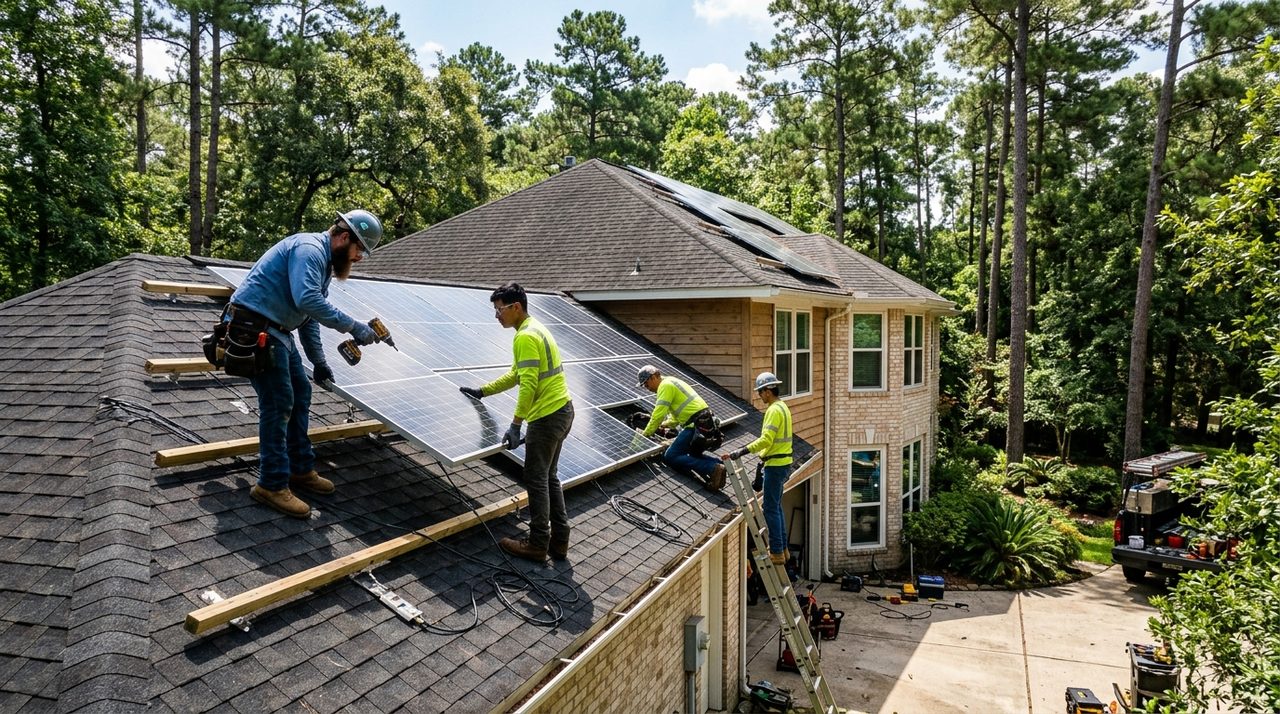
Kingwood's multi-decade build-out — from 1970s Greentree and Woodland Hills villages through 2000s and 2010s subdivisions — means a solar installer here is making decisions shaped by wildly different roof ages, electrical panel generations, and HOA architectural review processes depending on which village your home sits in. Every installation is permitted through the Houston Permitting Center (not a separate Kingwood office), interconnected through CenterPoint Energy, and must clear both the Lake Houston Community Association and any village-level HOA architectural review before a single bracket is drilled. Read on to understand the four issues that most directly affect solar value and timeline for Kingwood homeowners.
Ranked by verified Google rating × review volume × verification tier. How we rank →
Some highly-rated pros serve Kingwood from nearby and may not keep a Kingwood street address. Those are listed under "Also serving Kingwood" with their real city and distance, so you always know where each business is based.
Highly-rated pros based nearby who cover Kingwood. Distance shown from the Kingwood area.
Serving Kingwood Based in Humble · 2.5 mi away
Serving Kingwood Based in Greenspoint · 7 mi away
Why it matters to you
Texas Property Code §202.010 lets HOAs restrict panels to locations 'not visible from the street,' and in Kingwood that rule is enforced at two levels: the master Lake Houston Community Association and, separately, your village HOA's architectural review committee. Depending on which village you live in, south-facing arrays on front-facing roof slopes can be rejected outright, forcing installers to orient panels toward the rear or east — a placement shift that can reduce annual production by 15–25% compared to optimal south-facing orientation.
What a good pro does
A qualified installer will request your village's specific architectural guidelines — not just the master association rules — before finalizing the system design, and will model both an HOA-compliant rear/east layout and an optimal south layout so you understand the production trade-off in kilowatt-hours per year before signing a contract. This dual-submittal design step also avoids the costly re-engineering that happens when a permit-ready plan is rejected at the HOA level weeks into the process.
Sources: Local HOA / deed restrictions (see area profile), Municipal permit office (see area profile)
Why it matters to you
With a Census median year built of 1997, a large share of Kingwood homes are carrying 25-to-28-year-old original asphalt shingle roofs — and Houston's combination of UV index 10–11 summers, 90%+ humidity, and the freeze-thaw stress of Winter Storm Uri degrades standard 3-tab shingles well before their rated lifespan. Mounting a 25-year panel array on a roof that is already near or past its service life creates a near-certain scenario where you pay $8,000–$14,000 to remove, re-roof, and reinstall panels within five to seven years, a cost almost never disclosed upfront by installers who don't inspect the substrate first.
What a good pro does
Before any racking is specified, a responsible installer will pull the permit through the Houston Permitting Center (which requires a structural attachment plan) and should provide a written roof-age assessment — or require a licensed roofing contractor's inspection report — as part of the project file. If shingles show granule loss, soft decking, or are original to a pre-2002 Kingwood home, replacing the roof before installation is the economically correct sequence, not an upsell.
Sources: City of Houston Permitting Center, International Residential Code (as adopted by City of Houston), ENERGY STAR / U.S. Dept. of Energy
Why it matters to you
Post-Uri demand for battery storage (Tesla Powerwall, Enphase IQ Battery) is high in Kingwood given that most of the community experienced prolonged outages in February 2021. However, homes in older Kingwood villages — Greentree, Woodland Hills, and others developed in the 1970s and 1980s — frequently have 100A or early 150A panels with breaker configurations that cannot safely support a battery inverter without a full panel upgrade. CenterPoint's interconnection process for storage-paired systems also requires a separate metering application that adds 6–10 weeks to the energization timeline beyond a standard grid-tie permit.
What a good pro does
The electrician of record (who must be a TDLR-licensed master electrician to pull the permit at the Houston Permitting Center) should perform a load calculation and panel assessment before battery pricing is quoted. If an upgrade to a 200A panel is needed, that work must be permitted separately and scheduled to complete before the solar interconnection application is submitted to CenterPoint, keeping the overall project on a predictable timeline rather than discovering the bottleneck mid-installation.
Sources: Texas Department of Licensing & Regulation, City of Houston Permitting Center, North American Board of Certified Energy Practitioners (NABCEP)
Why it matters to you
Kingwood homes — particularly the larger two-story traditional-style houses common across its villages — carry some of the metro's highest cooling loads, with typical usage of 1,400–1,800 kWh per month from June through September. Installers who size systems using national or even Texas-average consumption data rather than your actual CenterPoint account history routinely propose 6–7 kW systems that offset only 40–50% of real summer demand, well below the 80–100% offset range that makes the economics pencil out in a high-cost-per-kWh CenterPoint rate structure.
What a good pro does
Ask any installer to show their sizing calculation based on your last 12 months of CenterPoint bills, not a generic square-footage estimate. A NABCEP-certified system designer will also account for pool pumps (common in Kingwood), EV chargers, and any planned additions before specifying array size. The 30% federal Investment Tax Credit applies to the full installed cost, so right-sizing to cover your actual load — rather than undersizing to hit a lower sticker price — typically produces significantly better 10-year returns.
Sources: North American Board of Certified Energy Practitioners (NABCEP), ENERGY STAR / U.S. Dept. of Energy, Texas Department of Licensing & Regulation
Hiring solar installers in Kingwood? Kingwood is a large master-planned community in northeast Houston with a mandatory community association structure and deed restrictions governing exterior modifications. The neighborhood encompasses multiple villages with varying build periods, meaning housing stock age and systems vary significantly by subdivision. Homeowners should verify both community-wide and village-level deed restrictions before undertaking exterior or structural work.
Building era
Mixed — development spans from the 1970s through the 2010s across various villages. Specific decade varies by subdivision.
Typical style
Not confirmed from available sources — likely a mix of traditional suburban styles typical of Houston master-planned communities across multiple decades.
Foundations
Not confirmed — slab-on-grade is typical for Houston-area suburban construction of this era, but specific confirmation not available for all Kingwood villages.
Common systems
Given the multi-decade build-out, systems range widely: older sections may have original HVAC, galvanized or copper plumbing, and older electrical panels, while newer sections feature modern systems. Homes from the 1970s–1980s may have aging ductwork and R-22 refrigerant HVAC units requiring replacement.
What that means for repairs
Renovation activity likely varies by village age — older Kingwood sections (Greentree, Woodland Hills) may see full HVAC replacements, kitchen/bath remodels, and roof replacements, while newer sections focus on cosmetic updates. All exterior modifications must comply with deed restrictions enforced by the community association.
Permit jurisdiction
Houston Permitting Center — Kingwood is within City of Houston limits. No separate Kingwood municipal permit office exists.
HOA & deed restrictions
Mandatory master association structure — the Lake Houston Community Association manages community-wide facilities and business. Mandatory Kingwood Association fees are approximately $200–$400 annually. Many villages/subdivisions have additional HOAs with fees of $100–$600 annually. Some areas include gated-community surcharges. Deed restrictions are enforced by community associations in lieu of municipal zoning.
Historic districts
No City of Houston historic district designation confirmed.
Contractor note
Contractors must obtain City of Houston permits for regulated work and ensure all exterior modifications comply with both the master community association deed restrictions and any applicable village-level HOA architectural review requirements before beginning work.
FEMA flood zone
FEMA Zone X (low flood risk) — source: fema_nfhl. Note: Kingwood is situated near the San Jacinto River and Lake Houston; flood risk can vary significantly by specific tract and proximity to waterways. Homeowners in areas closer to the river or drainage channels should verify their individual FIRM panel.
Hurricane Harvey impact
Parts of Kingwood were impacted by Hurricane Harvey in 2017, but specific streets and recurring flood areas could not be confirmed from available sources. Homeowners should check Harris County Flood Control District records and FEMA flood insurance claims data for tract-specific Harvey impact information.
Heat & humidity load
Houston's extreme summer heat and humidity stress HVAC systems heavily across Kingwood's varied housing stock. Older homes may have undersized or aging units struggling to maintain efficiency. High humidity also creates conditions for mold growth in attics and crawl spaces, and heavy summer storms can expose roofing and drainage vulnerabilities.
Working with contractors here
Kingwood's multi-decade build-out means contractors encounter a wide range of systems and conditions depending on the specific village. Older sections built in the 1970s–1980s commonly need HVAC replacements, re-roofing, plumbing upgrades, and electrical panel modernization. Newer sections may focus on cosmetic remodeling and energy efficiency improvements. All exterior work must be pre-approved through the relevant community association or village HOA architectural review process, which can add lead time to project scheduling. Contractors should also be aware that flood remediation and moisture mitigation remain relevant trades in sections closer to waterways, even in areas mapped as Zone X.
Local Tip
Always ask for a written estimate before work begins. Texas contractors are required to provide one on jobs over $1,000.
Kingwood is a large master-planned community in northeast Houston with a mandatory community association structure and deed restrictions governing exterior modifications. The neighborhood encompasses multiple villages with varying build periods, meaning housing stock age and systems vary significantly by subdivision. Homeowners should verify both community-wide and village-level deed restrictions before undertaking exterior or structural work.
Source: U.S. Census Bureau, ACS 5-Year 2023
Most of Kingwood maps to FEMA Zone X (low mapped flood risk), but Houston's flash-flood reality means even low-risk blocks benefit from smart drainage and storm-hardened installs; risk climbs sharply on blocks nearest the San Jacinto River and Lake Houston, where it varies parcel to parcel.
Source: FEMA National Flood Hazard Layer (NFHL). Flood zones vary by parcel — verify your individual FIRM panel.
Wind damage, not flooding, is the primary hurricane threat for solar systems in lower-risk Kingwood, TX, so prioritize a pre-season inspection confirming your racking's hurricane-rated uplift capacity meets the local design wind speed in the City of Houston building code. Loose or improperly torqued rail clamps were a leading cause of panel loss across the metro after Beryl 2024's sustained tropical-force winds. Confirm the current FEMA panel for your Kingwood parcel — the area maps to Zone X, but adjacent lots can differ.
Wind uplift from severe thunderstorm straight-line winds — not just hurricanes — is the most common cause of panel dislodgement in Kingwood, TX; confirm with your TDLR-licensed installer that your racking was installed with hurricane-rated lag screws into verified rafter locations, not just into decking. The May 2024 derecho demonstrated that 80-plus-mph gusts arrive with little warning and no opportunity for last-minute hardware checks. As a Harris County community, Kingwood may follow county rather than City of Houston storm rebuild rules.
Ice accumulation temporarily cuts solar panel output in Kingwood, TX, but the larger freeze-related risk for solar homeowners is an inverter or battery enclosure mounted in an uninsulated garage or attic space exposed to sub-freezing temperatures — equipment manufacturers specify minimum operating temperatures, and falling below them can cause shutdowns or permanent damage. Ask your installer to confirm all system components are within their rated temperature range before the next hard freeze. Confirm the current FEMA panel for your Kingwood parcel — the area maps to Zone X, but adjacent lots can differ.
Sources: FEMA National Flood Hazard Layer (NFHL), Ready.gov -- Hurricanes, CenterPoint Energy -- Storm Center, City of Houston -- Emergency Preparedness, Ready.gov -- Winter Weather, Harris County Flood Control District
Houston-specific estimators to plan your project before you call a pro. All results are planning estimates — a licensed local pro confirms the details on site.
Disconnect & drain every outdoor hose bib
Remove hoses, drain the spigots, and cover each with an insulated faucet sock. Un-drained hose bibs are the #1 burst point in a Houston freeze.
Insulate exposed pipes in the attic & garage
Wrap any pipe in an unconditioned space (attic runs, garage walls) with foam sleeves. Houston homes rarely insulate these because they only matter a few nights a year — which is exactly why they burst.
Open cabinet doors & keep a pencil-width drip
On hard-freeze nights, open kitchen/bath cabinets so warm air reaches the pipes and let faucets on exterior walls drip to relieve pressure.
Protect the attic/garage water heater & its lines
An attic or garage tank sits in unconditioned space. Insulate the cold-inlet and hot-outlet lines and confirm the emergency drain pan is clear so a leak doesn't reach the ceiling.
This is a planning estimate only — actual requirements depend on an on-site assessment by a licensed Houston pro. If a pipe has already burst, shut off your main water supply and call a licensed Houston plumber immediately — freeze bursts flood fast.
Sources: City of Houston Permitting CenterTexas Department of Licensing & Regulation
Sources: City of Houston Permitting Center
Sources: Local HOA / deed restrictions (see area profile)
Sources: City of Houston Permitting Center
Sources: FEMA National Flood Hazard Layer (NFHL)North American Board of Certified Energy Practitioners (NABCEP)