Closed
1930 Humble Pl Dr, Humble, TX 77338
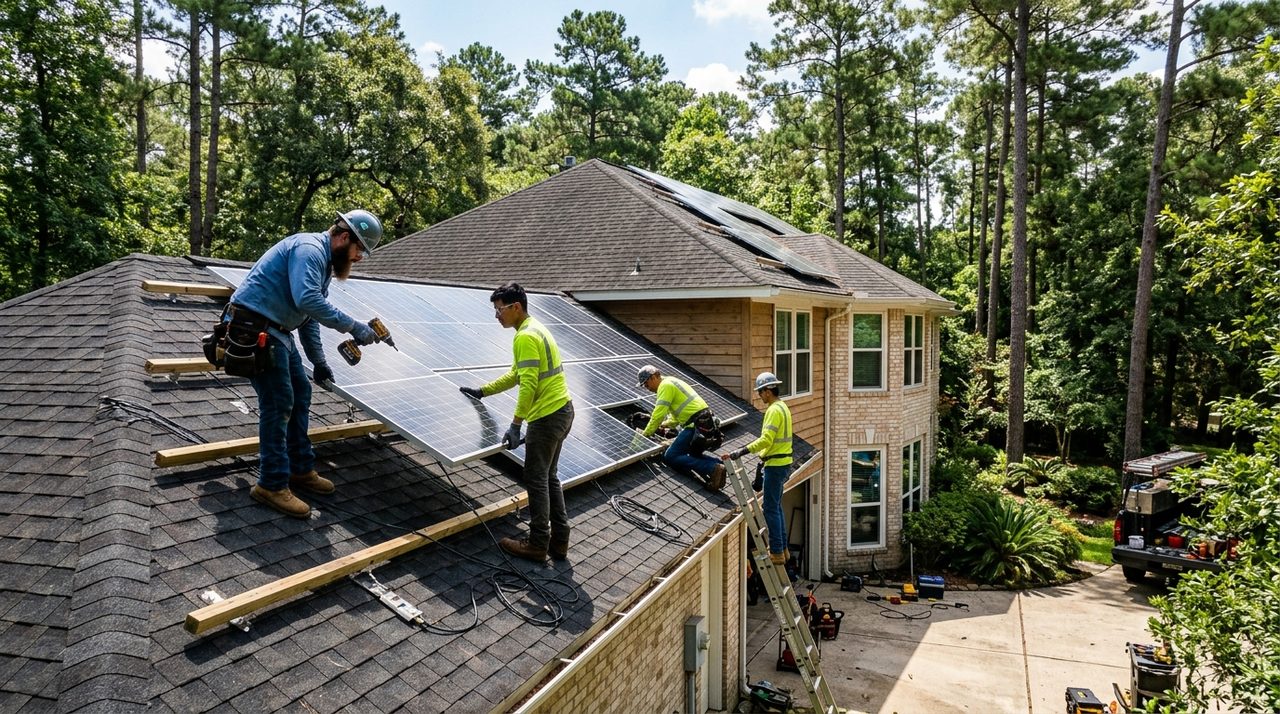
Humble's roughly 1,400 owner-occupied homes—many built between 1978 and 2000 on Harris County clay and now carrying aging shingles and a mix of 100-amp and 200-amp panels—face a three-way permit jurisdiction split (City of Humble, Houston Permitting Center, or Harris County Engineering) that can derail a solar project before the first module is racked. Add subdivision-by-subdivision HOA architectural review requirements and CenterPoint Energy interconnection queues, and the permit-to-energization timeline here routinely runs longer than in cleaner single-jurisdiction suburbs. This page explains exactly which Humble-specific conditions to resolve before signing a solar contract.
Ranked by verified Google rating × review volume × verification tier. How we rank →
Some highly-rated pros serve Humble from nearby and may not keep a Humble street address. Those are listed under "Also serving Humble" with their real city and distance, so you always know where each business is based.
1930 Humble Pl Dr, Humble, TX 77338
Highly-rated pros based nearby who cover Humble. Distance shown from the Humble area.
Serving Humble Based in Greenspoint · 4.8 mi away
Serving Humble Based in Greenspoint · 8.9 mi away
Serving Humble Based in Spring · 9.1 mi away
Serving Humble Based in Spring · 9.1 mi away
Why it matters to you
A home two blocks from your neighbor could fall under the City of Humble's permit office, the Houston Permitting Center, or Harris County Engineering—each with different electrical submittal packets, inspection timelines, and CenterPoint interconnection queues. Choosing the wrong jurisdiction means a rejected application, a restart fee, and weeks of lost time, all before a single panel goes on your roof.
What a good pro does
A qualified installer must verify your exact parcel's governing authority against Harris County Appraisal District records before pulling any permit. They then confirm whether CenterPoint's standard residential interconnection form applies or whether Harris County ETJ processing is required, and build the correct inspection schedule accordingly. All electrical work must be pulled by a TDLR-licensed master electrician regardless of which jurisdiction governs your address.
Sources: Municipal permit office (see area profile), Texas Department of Licensing & Regulation, City of Houston Permitting Center
Why it matters to you
Many Humble subdivisions—including those governed by HOAs like Foxwood—require architectural committee approval for any exterior modification, including rooftop solar. Under Texas Property Code §202.010, your HOA can legally require placement that keeps panels 'not visible from the street,' which in NE Houston's east-west street grids often means east- or north-slope mounting that reduces annual production by 15–25% versus an optimal south-facing orientation.
What a good pro does
Before signing a contract, have your installer run a shading and orientation analysis on every viable roof slope and present it to your HOA architectural committee with the production loss documented in writing. A good installer will also help you draft the submission package—site plan, mounting specs, panel dimensions—in the format each specific Humble subdivision HOA requires, reducing the back-and-forth that commonly adds 4–6 weeks to local timelines.
Sources: Local HOA / deed restrictions (see area profile), North American Board of Certified Energy Practitioners (NABCEP)
Why it matters to you
Humble's Census median year-built of 1983 means a large share of the housing stock carries original or early-replacement asphalt shingles now well past their effective lifespan in Houston's UV index 10–11 summers and 52-inch annual rainfall. Mounting a 25-year panel array on a 12-year-old budget shingle job—common after Harvey's 2017 emergency re-roofs in NE Harris County—virtually guarantees a $8,000–$14,000 panel removal and reinstall bill within five years, a cost almost never disclosed upfront by installers eager to close a deal.
What a good pro does
Demand that your installer perform a dated roof inspection and provide a written opinion on remaining shingle life before contract signing. If the roof has fewer than 10 years of serviceable life, the financially sound sequence is re-roof first, then solar—many Humble installers can coordinate with a roofing contractor and pull both permits simultaneously through the correct jurisdiction to minimize total project duration.
Sources: International Residential Code (as adopted by City of Houston), Municipal permit office (see area profile)
Why it matters to you
A typical 2,200 sq ft Humble home built in the 1980s—likely with minimal attic insulation by today's standards and an aging forced-air system—can draw 1,500–1,800 kWh per month during June through September. Installers who size systems using national consumption averages rather than your actual CenterPoint billing history consistently deliver systems that offset only 40–50% of real load instead of the 80–100% they quote, leaving homeowners with a solar bill and a large CenterPoint bill simultaneously.
What a good pro does
Require your installer to pull 12 months of CenterPoint interval data from your account—not a national average—and size the array to that actual load, accounting for any planned additions like an EV charger or pool pump. NABCEP-certified designers are trained to run Houston-specific irradiance and load modeling; ask to see the PVWatts or equivalent output report with your address's specific tilt, orientation, and shading inputs before signing.
Sources: North American Board of Certified Energy Practitioners (NABCEP), ENERGY STAR / U.S. Dept. of Energy, Texas Department of Licensing & Regulation
Hiring solar installers in Humble? Humble spans incorporated city limits, City of Houston boundaries, and unincorporated Harris County, creating a patchwork of permitting jurisdictions that contractors must navigate carefully. Many platted subdivisions have mandatory HOAs with architectural control requirements, while older pockets may rely only on deed restrictions or civic clubs. The predominantly post-1970s housing stock means slab foundations and aging HVAC systems are common service concerns.
Building era
Primarily late 1970s through 2000s across most subdivisions; some newer infill development ongoing.
Typical style
Not confirmed from available sources - typical NE Houston suburban mix expected (traditional brick, ranch, and contemporary styles). Check Harris County Appraisal District for specific subdivisions.
Foundations
Predominantly concrete slab-on-grade, consistent with post-1970s mass-production construction practices in the Houston metro area.
Common systems
Forced-air HVAC (many original systems in 1980s-1990s homes approaching or past useful life), copper and CPVC plumbing, 200-amp electrical panels in newer homes with some older 100-amp panels in 1970s-era construction.
What that means for repairs
HVAC replacement and roof replacement are common due to age of housing stock. Kitchen and bathroom remodels are frequent in 1980s-1990s era homes. Homeowners in HOA-governed subdivisions must obtain architectural approval before exterior modifications.
Permit jurisdiction
Mixed jurisdiction: City of Humble Permits (within Humble city limits), Houston Permitting Center (within Houston city limits), or Harris County Engineering (unincorporated areas). Verify exact jurisdiction by property address before pulling permits.
HOA & deed restrictions
No single area-wide mandatory HOA. Many platted subdivisions have their own mandatory HOAs with architectural control (e.g., Foxwood HOA requires approval for all property improvements and modifications). Some older or smaller areas may have only deed restrictions or civic clubs. Confirm HOA status for any specific address via hoa.texas.gov or Harris County Clerk records.
Historic districts
No City of Houston historic district designation confirmed.
Contractor note
Contractors must verify which jurisdiction governs each property before starting work, as the Humble area straddles three permitting authorities. HOA architectural approval is commonly required in addition to municipal permits.
FEMA flood zone
FEMA Zone X (low flood risk) per official NFHL data. However, the broader Humble area includes properties along San Jacinto River tributaries and local drainage channels; individual parcels may carry different flood zone designations. Always verify flood zone by specific property address.
Hurricane Harvey impact
No documented, citable Harvey flood-impact information was confirmed for Humble/NE Houston from available research. The broader NE Houston area near the San Jacinto River and Lake Houston experienced significant Harvey-related flooding, but specific street-level impact for Humble subdivisions should be verified through Harris County Flood Control District inundation maps and seller disclosure records.
Heat & humidity load
Extended Houston summers with sustained temperatures above 95°F and high humidity stress aging HVAC systems in 1980s-1990s homes. Slab foundations in clay soils are susceptible to seasonal movement during summer drought cycles, potentially causing door/window alignment issues and minor cracking. Attic temperatures can exceed 150°F, accelerating roof aging and increasing demand for attic insulation and ventilation upgrades.
Working with contractors here
HVAC replacement and repair is the most consistent service need in Humble, driven by aging systems in the large stock of 1980s-1990s homes facing Houston's extreme summer heat. Roof replacement is common, as many original roofs have exceeded their 20-25 year lifespan. Foundation monitoring and minor repair work is frequent due to the expansive clay soils typical of NE Harris County. Contractors should be prepared to navigate HOA architectural review processes in most subdivisions, which can add lead time to exterior projects. The mixed permitting jurisdiction (City of Humble, City of Houston, or Harris County) means contractors must verify the governing authority for each job site before beginning work.
Local Tip
Always ask for a written estimate before work begins. Texas contractors are required to provide one on jobs over $1,000.
Humble spans incorporated city limits, City of Houston boundaries, and unincorporated Harris County, creating a patchwork of permitting jurisdictions that contractors must navigate carefully. Many platted subdivisions have mandatory HOAs with architectural control requirements, while older pockets may rely only on deed restrictions or civic clubs. The predominantly post-1970s housing stock means slab foundations and aging HVAC systems are common service concerns.
Source: U.S. Census Bureau, ACS 5-Year 2023
Most of Humble maps to FEMA Zone X (low mapped flood risk), but Houston's flash-flood reality means even low-risk blocks benefit from smart drainage and storm-hardened installs; risk climbs sharply on blocks nearest the San Jacinto River, where it varies parcel to parcel.
Source: FEMA National Flood Hazard Layer (NFHL). Flood zones vary by parcel — verify your individual FIRM panel.
After extended outages during past Gulf storms, homeowners in Humble, TX discovered that grid-tied solar without battery storage goes dark the moment CenterPoint cuts power for line-worker safety. Ask your licensed solar installer about adding a code-compliant rapid-shutdown device and a battery backup that can island critical loads during a multi-day outage. Because Humble drains toward the San Jacinto River, block-level runoff can differ sharply from the mapped zone.
Power outages in Humble, TX caused by severe thunderstorm damage to CenterPoint infrastructure can last 24 to 72 hours even without a named storm; a solar battery backup system paired with a properly permitted transfer switch lets you run essential loads independently of the grid. Ensure your installer pulled a City of Houston permit and scheduled a final inspection so the system is code-confirmed before storm season. Because Humble drains toward the San Jacinto River, block-level runoff can differ sharply from the mapped zone.
Ice accumulation temporarily cuts solar panel output in Humble, TX, but the larger freeze-related risk for solar homeowners is an inverter or battery enclosure mounted in an uninsulated garage or attic space exposed to sub-freezing temperatures — equipment manufacturers specify minimum operating temperatures, and falling below them can cause shutdowns or permanent damage. Ask your installer to confirm all system components are within their rated temperature range before the next hard freeze. With a median build year of 1983, the older building stock here is more exposed to hard-freeze damage than newer construction. Because Humble drains toward the San Jacinto River, block-level runoff can differ sharply from the mapped zone.
Sources: FEMA National Flood Hazard Layer (NFHL), Ready.gov -- Hurricanes, CenterPoint Energy -- Storm Center, City of Houston -- Emergency Preparedness, Ready.gov -- Winter Weather, Harris County Flood Control District
Houston-specific estimators to plan your project before you call a pro. All results are planning estimates — a licensed local pro confirms the details on site.
Disconnect & drain every outdoor hose bib
Remove hoses, drain the spigots, and cover each with an insulated faucet sock. Un-drained hose bibs are the #1 burst point in a Houston freeze.
Insulate exposed pipes in the attic & garage
Wrap any pipe in an unconditioned space (attic runs, garage walls) with foam sleeves. Houston homes rarely insulate these because they only matter a few nights a year — which is exactly why they burst.
Open cabinet doors & keep a pencil-width drip
On hard-freeze nights, open kitchen/bath cabinets so warm air reaches the pipes and let faucets on exterior walls drip to relieve pressure.
Protect the attic/garage water heater & its lines
An attic or garage tank sits in unconditioned space. Insulate the cold-inlet and hot-outlet lines and confirm the emergency drain pan is clear so a leak doesn't reach the ceiling.
This is a planning estimate only — actual requirements depend on an on-site assessment by a licensed Houston pro. If a pipe has already burst, shut off your main water supply and call a licensed Houston plumber immediately — freeze bursts flood fast.
Sources: Municipal permit office (see area profile)City of Houston Permitting Center
Sources: Texas Department of Licensing & RegulationMunicipal permit office (see area profile)
Sources: Local HOA / deed restrictions (see area profile)
Sources: FEMA National Flood Hazard Layer (NFHL)International Residential Code (as adopted by City of Houston)
Sources: City of Houston Permitting Center
Sources: North American Board of Certified Energy Practitioners (NABCEP)ENERGY STAR / U.S. Dept. of Energy