15821 E Freeway Service Rd, Channelview, TX 77530
Best Solar Installers in Highlands, TX
Highlands is an unincorporated east Harris County community where 1960s–1980s ranch homes, low-pitch roofs, aging 100–150-amp electrical panels, and Harris County permitting—not City of Houston rules—define every solar project from day one. The proximity to the San Jacinto River floodplain and the area's semi-rural character mean installers must navigate parcel-level flood compliance, undersized panels that rarely survive a battery integration without an upgrade, and a county permit office whose inspection cadence and submittal checklist differ meaningfully from what most Houston-facing installers run by default. Getting these details right before signing a contract is the difference between a working system and a costly mid-project stall.
Verified against Google Business data
Updated 2026
See the 6 Solar Installers Serving Highlands 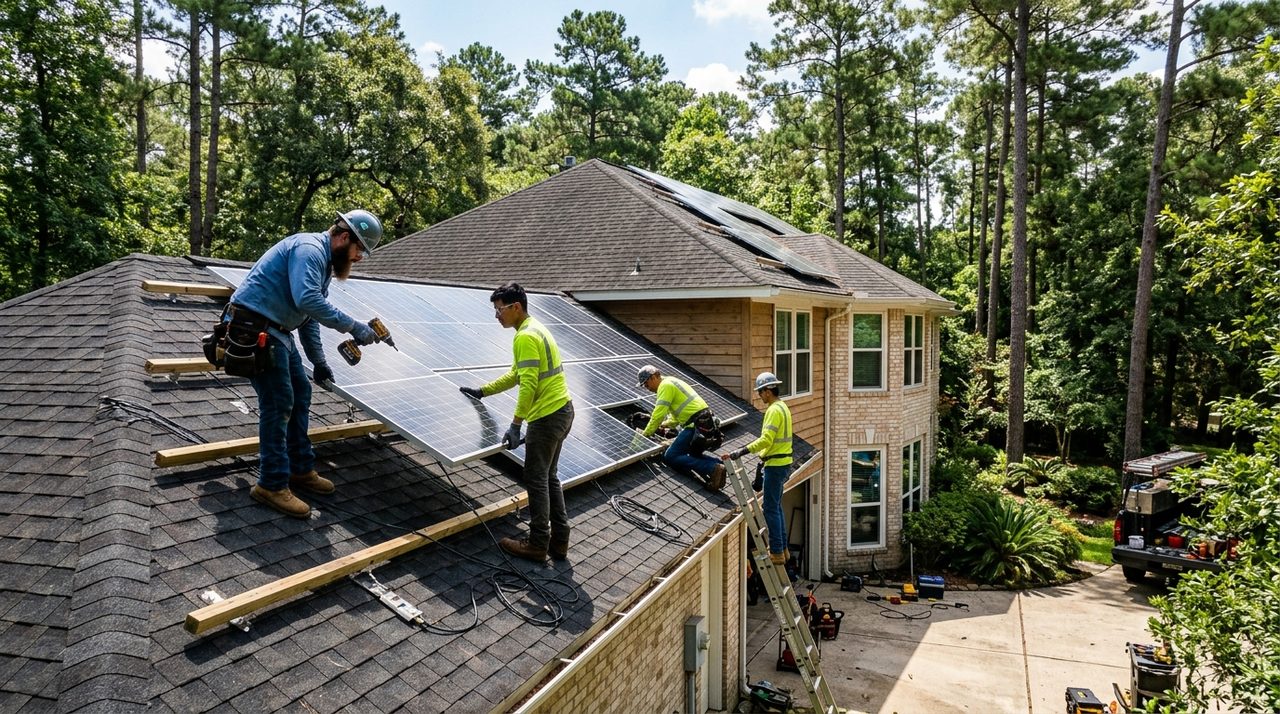
- Median home built
- 1978
- Median home value
- $191,400
- FEMA flood zone
- X (low)
- Typical system cost (est., before 30% ITC)
- $22,000–$35,000 for 8–10 kW
- Most common local issue
- Undersized pre-1980 electrical panels blocking battery integration
Ranked by verified Google rating × review volume × verification tier. How we rank →
Some highly-rated pros serve Highlands from nearby and may not keep a Highlands street address. Those are listed under "Also serving Highlands" with their real city and distance, so you always know where each business is based.
Min rating:
6 resultsBased in Highlands
Also serving Highlands
Highly-rated pros based nearby who cover Highlands. Distance shown from the Highlands area.
Closed
Serving Highlands Based in Baytown · 3.7 mi away
Open Now
Serving Highlands Based in Crosby · 5.2 mi away
Open Now
Serving Highlands Based in NE Houston · 6.9 mi away
Open Now
Serving Highlands Based in Galena Park · 8.9 mi away
Open Now
Serving Highlands Based in Deer Park · 10 mi away
Solar Installers in Highlands: What You Should Know
Harris County Permits, Not City of Houston—Your Installer Needs to Know the Difference
Why it matters to you
Because Highlands is unincorporated Harris County, every solar permit is submitted to the Harris County Engineering Department, not Houston's One-Stop permit center. Installers who primarily work inside Beltway 8 sometimes default to City of Houston submittal packages—wrong forms, wrong fee schedule, wrong inspection request process—adding weeks of back-and-forth to your project timeline before a single panel goes on the roof.
What a good pro does
Confirm in writing that your chosen installer has active, recent permitted projects in unincorporated Harris County and can name the correct county submittal portal and inspection contact. A reputable installer will also verify your parcel's floodplain status through HCFCD before finalizing structural drawings, since Harris County can flag a solar project under substantial-improvement rules on low-lying lots near the San Jacinto corridor—even if your FEMA map shows Zone X.
Sources: Municipal permit office (see area profile), FEMA National Flood Hazard Layer (NFHL)
Pre-1980 Electrical Panels Are the Hidden Cost in Almost Every Highlands Solar Quote
Why it matters to you
The median year built in Highlands is 1978, and a large share of those original ranch homes still carry 100-amp or 150-amp panels—many Federal Pacific or Zinsco-era equipment that insurers increasingly refuse to bind on. Adding a solar array and especially any battery storage to one of these panels isn't just a code problem; it's a physical impossibility without first upgrading the service, a cost that can run $2,500–$5,000 and is frequently buried in the fine print of initial solar proposals.
What a good pro does
Ask every installer for a written pre-installation electrical assessment that explicitly states whether your existing panel can accommodate the solar interconnection and, if battery backup is in scope, whether a panel upgrade is included in the quoted price. A TDLR-licensed master electrician must pull the electrical permit in Harris County regardless, so verify that credential before work begins—this is not optional in Texas.
Sources: Texas Department of Licensing & Regulation, International Residential Code (as adopted by City of Houston)
Low-Pitch Ranch Roofs and Houston's 52-Inch Annual Rainfall Make Racking Choices Critical
Why it matters to you
Highlands' dominant housing style—one-story brick ranch homes with shallow, low-pitch rooflines—creates two compounding problems for solar: water ponds around ballasted racking bases on near-flat sections, accelerating membrane degradation under and around mounts, and original 1960s–1980s asphalt shingles that have typically already exceeded their useful life in Houston's UV and heat cycle. Installing a 25-year panel array on a 12-year-old or older emergency-patched roof commits a homeowner to a $8,000–$14,000 remove-and-reinstall bill when the roof fails—sometimes within five years of the solar install.
What a good pro does
Before signing a solar contract, get an independent roof inspection documenting remaining service life. A responsible installer will provide this proactively; if they don't, treat that as a red flag. If the roof is within 7–10 years of end-of-life, bundling a full re-roof with the solar project—coordinated under a single Harris County permit package where possible—is almost always cheaper than two separate mobilizations later.
Sources: International Residential Code (as adopted by City of Houston), ENERGY STAR / U.S. Dept. of Energy
Sizing an Array on 1960s–1980s Homes With Houston's Extreme Cooling Load—National Averages Don't Apply
Why it matters to you
A typical 2,200 sq ft Highlands ranch home built in the 1970s—with its original or first-generation replacement HVAC, minimal attic insulation by today's standards, and single-pane aluminum windows common to that era—can easily consume 1,500–1,800 kWh per month during Houston's June–September cooling peak. Installers who size systems using national or even statewide Texas averages routinely deliver arrays that offset only 40–50% of actual load rather than the 80–100% quoted in their sales presentations.
What a good pro does
Require the installer to pull and analyze your last 12 months of actual CenterPoint billing data—Highlands is served by CenterPoint—before finalizing system size. If your home has a pool pump, EV charger, or any electric resistance heating added after Uri, those loads must be included in the model. A system sized this way costs more upfront but avoids the buyer's remorse of a $25,000 installation that barely moves the needle on summer bills.
Sources: ENERGY STAR / U.S. Dept. of Energy, Texas Department of Licensing & Regulation
Solar Installers in Highlands: What You Should Know
Hiring solar installers in Highlands? Highlands is an unincorporated community in northeast Harris County with a housing stock dominated by 1960s–1980s ranch-style homes on slab foundations. Proximity to the San Jacinto River and Cedar Bayou creates significant flood risk for many parcels despite some areas mapping outside the 100-year floodplain. Homeowners here frequently need foundation work, aging HVAC replacement, and flood-related repairs, with permits handled through Harris County rather than the City of Houston.
- Housing era
- Primarily 1960s–1980s, with scattered pre-1960 homes and post-2000 infill
- Foundation
- Predominantly concrete slab-on-grade
- Flood zone
- FEMA Zone X (low flood risk) at the sampled point per official NFHL API
- Permits
- Harris County Engineering Department (unincorporated Harris County)
Housing stock & systems
Building era
Primarily 1960s–1980s, with scattered pre-1960 homes and post-2000 infill.
Typical style
One-story ranch and traditional brick homes with low-pitch roofs and attached carports or garages; some manufactured/mobile homes on larger rural lots.
Foundations
Predominantly concrete slab-on-grade; pier-and-beam found on older pre-1960 structures and homes in low-lying areas near bayous and the San Jacinto River.
Common systems
Original or first-generation replacement central HVAC systems; copper or galvanized steel plumbing in older homes transitioning to PEX in renovations; 100–150 amp electrical panels common in pre-1980s homes, often in need of upgrade.
What that means for repairs
Kitchen and bathroom updates are common as original finishes from the 1960s–1970s age out. Flood damage remediation drives significant gut-renovation and elevation work in lower-lying parcels. Electrical panel upgrades are frequently triggered by insurance requirements or HVAC replacements.
Permits & restrictions
Permit jurisdiction
Harris County Engineering Department (unincorporated Harris County).
HOA & deed restrictions
No single area-wide mandatory HOA exists for Highlands. HOA presence is subdivision-specific; many properties have no HOA but may have recorded deed restrictions at the plat or lot level. Verify HOA status on a parcel-by-parcel basis through Harris County Clerk records.
Historic districts
No City of Houston historic district designation confirmed. Highlands is unincorporated Harris County with no known local historic protections.
Contractor note
Highlands is unincorporated, so Harris County building codes and permitting apply rather than City of Houston rules. Contractors should verify floodplain status for each parcel through HCFCD, as substantial improvement thresholds may trigger elevation or flood-proofing requirements even if the sampled point shows Zone X.
Flood & weather
FEMA flood zone
FEMA Zone X (low flood risk) at the sampled point per official NFHL API. However, the Highlands area includes significant 100-year and 500-year floodplain zones near the San Jacinto River and Cedar Bayou channels. Flood risk varies dramatically by parcel; individual FEMA determinations should be obtained for any specific property.
Hurricane Harvey impact
East Harris County near the San Jacinto River experienced significant flooding during Hurricane Harvey in 2017. While public summaries do not explicitly isolate Highlands by name with street-level detail, the community's proximity to the San Jacinto River and Cedar Bayou strongly suggests moderate to significant impact in low-lying portions. Not confirmed at the street level — check Harris County Flood Control District records and individual property disclosure histories.
Heat & humidity load
Aging HVAC systems in 1960s–1980s homes struggle with Houston's extreme summer heat and humidity, driving high service call volume from May through October. Poor attic ventilation and original single-pane windows in unrenovated homes increase cooling loads. Humidity-related issues including mold, wood rot, and condensation in ductwork are common given proximity to waterways.
Working with contractors here
Contractors in Highlands most commonly handle HVAC replacement, re-roofing, plumbing re-pipes, and foundation repair on aging 1960s–1980s slab homes. Flood damage restoration and mold remediation are recurring specialties given the area's proximity to the San Jacinto River and low-lying bayou corridors. Many homes still have original galvanized plumbing and undersized electrical panels, so whole-house re-pipes and panel upgrades are frequent companion jobs during renovations. Scoping should account for the mix of slab and pier-and-beam foundations, as access and repair methods differ significantly. Because the area is unincorporated, contractors must navigate Harris County permitting processes, which differ from City of Houston requirements in inspection scheduling and code interpretations.
Local Tip
Always ask for a written estimate before work begins. Texas contractors are required to provide one on jobs over $1,000.
About Highlands
Highlands is an unincorporated community in northeast Harris County with a housing stock dominated by 1960s–1980s ranch-style homes on slab foundations. Proximity to the San Jacinto River and Cedar Bayou creates significant flood risk for many parcels despite some areas mapping outside the 100-year floodplain. Homeowners here frequently need foundation work, aging HVAC replacement, and flood-related repairs, with permits handled through Harris County rather than the City of Houston.
- Median year built
- 1978
- Median home value
- $191,400
- Owner-occupied
- 75.6%
- Population
- 7,339
- Housing units
- 2,970
- Median income
- $54,524
Source: U.S. Census Bureau, ACS 5-Year 2023
Flood & storm risk
FEMA Zone XLow flood riskMost of Highlands maps to FEMA Zone X (low mapped flood risk), but Houston's flash-flood reality means even low-risk blocks benefit from smart drainage and storm-hardened installs; risk climbs sharply on blocks nearest the San Jacinto River, where it varies parcel to parcel.
Source: FEMA National Flood Hazard Layer (NFHL). Flood zones vary by parcel — verify your individual FIRM panel.
Houston Storm Readiness in Highlands
Hurricane & flooding
After extended outages during past Gulf storms, homeowners in Highlands, TX discovered that grid-tied solar without battery storage goes dark the moment CenterPoint cuts power for line-worker safety. Ask your licensed solar installer about adding a code-compliant rapid-shutdown device and a battery backup that can island critical loads during a multi-day outage. Because Highlands drains toward the San Jacinto River, block-level runoff can differ sharply from the mapped zone.
Severe storms & hail
Wind uplift from severe thunderstorm straight-line winds — not just hurricanes — is the most common cause of panel dislodgement in Highlands, TX; confirm with your TDLR-licensed installer that your racking was installed with hurricane-rated lag screws into verified rafter locations, not just into decking. The May 2024 derecho demonstrated that 80-plus-mph gusts arrive with little warning and no opportunity for last-minute hardware checks. As a Harris County community, Highlands may follow county rather than City of Houston storm rebuild rules.
Ice storms & freezes
Ice accumulation temporarily cuts solar panel output in Highlands, TX, but the larger freeze-related risk for solar homeowners is an inverter or battery enclosure mounted in an uninsulated garage or attic space exposed to sub-freezing temperatures — equipment manufacturers specify minimum operating temperatures, and falling below them can cause shutdowns or permanent damage. Ask your installer to confirm all system components are within their rated temperature range before the next hard freeze. With a median build year of 1978, the older building stock here is more exposed to hard-freeze damage than newer construction. Because Highlands drains toward the San Jacinto River, block-level runoff can differ sharply from the mapped zone.
Sources: FEMA National Flood Hazard Layer (NFHL), Ready.gov -- Hurricanes, CenterPoint Energy -- Storm Center, City of Houston -- Emergency Preparedness, Ready.gov -- Winter Weather, Harris County Flood Control District
Free Highlands Tools & Calculators
Houston-specific estimators to plan your project before you call a pro. All results are planning estimates — a licensed local pro confirms the details on site.
Houston Freeze Prep & Pipe Insulation Checklist
Open full tool & FAQ →Your freeze checklist — 4 tasks
- 1
Disconnect & drain every outdoor hose bib
Remove hoses, drain the spigots, and cover each with an insulated faucet sock. Un-drained hose bibs are the #1 burst point in a Houston freeze.
- 2
Insulate exposed pipes in the attic & garage
Wrap any pipe in an unconditioned space (attic runs, garage walls) with foam sleeves. Houston homes rarely insulate these because they only matter a few nights a year — which is exactly why they burst.
- 3
Open cabinet doors & keep a pencil-width drip
On hard-freeze nights, open kitchen/bath cabinets so warm air reaches the pipes and let faucets on exterior walls drip to relieve pressure.
- 4
Protect the attic/garage water heater & its lines
An attic or garage tank sits in unconditioned space. Insulate the cold-inlet and hot-outlet lines and confirm the emergency drain pan is clear so a leak doesn't reach the ceiling.
This is a planning estimate only — actual requirements depend on an on-site assessment by a licensed Houston pro. If a pipe has already burst, shut off your main water supply and call a licensed Houston plumber immediately — freeze bursts flood fast.
Frequently Asked Questions
Does Harris County Engineering Department require a separate structural permit and electrical permit for solar in Highlands, or just one combined permit?
Harris County typically requires both a building/structural permit and an electrical permit for a rooftop solar installation in unincorporated Highlands — they are not combined into a single application the way some City of Houston projects can be handled. Your installer must pull the electrical permit under a TDLR-licensed master electrician, and the structural submittal must include racking load calculations acceptable to Harris County Engineering. Plan on submitting to the Harris County Engineering Department in Humble, not any City of Houston office, and confirm current inspection scheduling with the county directly since timelines differ from COH's published averages.
Sources: Texas Department of Licensing & RegulationMunicipal permit office (see area profile)
My Highlands home is in FEMA Zone X, but neighbors say some blocks near Cedar Bayou flooded during Harvey. Does flood zone status affect my solar permit or how the system is installed?
Zone X is the mapped low-risk designation, but Harris County's substantial improvement rules mean that if your permitted solar project is part of a broader renovation that pushes total improvements above 50% of the structure's pre-improvement value, floodplain compliance requirements can be triggered even in Zone X — so parcel-level review through HCFCD matters. For the solar installation itself, flood zone status doesn't change the electrical or structural permit requirements, but a ground-mount system on a lower-lying lot near Cedar Bayou should have conduit entries and inverter locations set well above anticipated water intrusion levels as a practical precaution. Ask your installer to verify your specific parcel's flood status through HCFCD rather than relying on neighborhood-level Zone X assumptions.
How does CenterPoint Energy's interconnection process work for a Highlands address, and how long does it actually take before the system can be turned on?
Highlands is within CenterPoint Energy's service territory, so after Harris County issues final inspection approval, your installer submits a separate interconnection application to CenterPoint before the system can legally be energized. CenterPoint's standard residential interconnection review runs roughly 4–8 weeks for a straightforward grid-tied system, but adding battery storage requires a separate metering application that can extend the timeline by an additional 6–10 weeks based on current processing loads — treat all timelines as estimates. The practical result is that many Highlands homeowners wait 3–5 months from contract signing to a live, net-metered system, and that full timeline should be part of any honest installer quote.
Highlands has a lot of 1960s–1970s brick ranch homes with carports instead of garages — can inverters and disconnect equipment be mounted on a carport wall or exterior brick, and will Harris County inspect that?
Inverters and AC disconnects can be mounted on exterior masonry walls or carport structures, but Harris County's electrical inspection will verify that conduit runs, weatherproof enclosures, and working clearances meet NEC requirements — the same code base used statewide, though Harris County inspectors apply it independently from City of Houston inspectors. Carport-mounted equipment on older 1960s brick must be anchored into mortar joints or structural framing that hasn't deteriorated, which your installer should assess before finalizing the equipment layout. If the carport is detached and shares a sub-panel with the house, that sub-panel's ampacity and grounding will also be reviewed as part of the solar electrical permit.
Sources: International Residential Code (as adopted by City of Houston)
Most Highlands homes don't have HOAs — does that mean I can put panels wherever I want on the roof without any approval process?
The absence of a mandatory area-wide HOA in Highlands does remove the most common approval hurdle, but you should verify through Harris County Clerk records whether your specific plat or lot has recorded deed restrictions that could govern exterior modifications, since individual subdivisions from the 1960s–1970s sometimes have restrictions on file even without an active HOA enforcing them. If your parcel is clear of deed restrictions, panel placement is governed only by Harris County's structural and electrical permit requirements and manufacturer racking specifications — you are not subject to Texas Property Code HOA placement rules if there is no HOA. This freedom to optimize south-facing placement without aesthetic constraints is a genuine production advantage for Highlands homeowners compared to master-planned suburb neighbors.
Sources: Local HOA / deed restrictions (see area profile)
Is there a better or worse time of year to start a solar project in Highlands to avoid permit or inspection delays?
Starting your Harris County permit application in late fall or winter — October through January — tends to avoid the spring storm-damage surge that floods the county permit office with roofing and structural submittals after hail seasons and hurricane scares, which can push solar inspection slots out by weeks. Summer installs are feasible but rooftop work on Highlands's low-pitch ranch homes during June–August heat is grueling, and scheduling pressure on installer crews peaks then too, which can affect attention to detail on flashing and torque specs. As a practical estimate, a project kicked off in November or December can realistically achieve a live system by late February or March, putting net-metering production in place right before the high-consumption cooling season begins.