Open Now
6740 Theall Rd, Houston, TX 77066
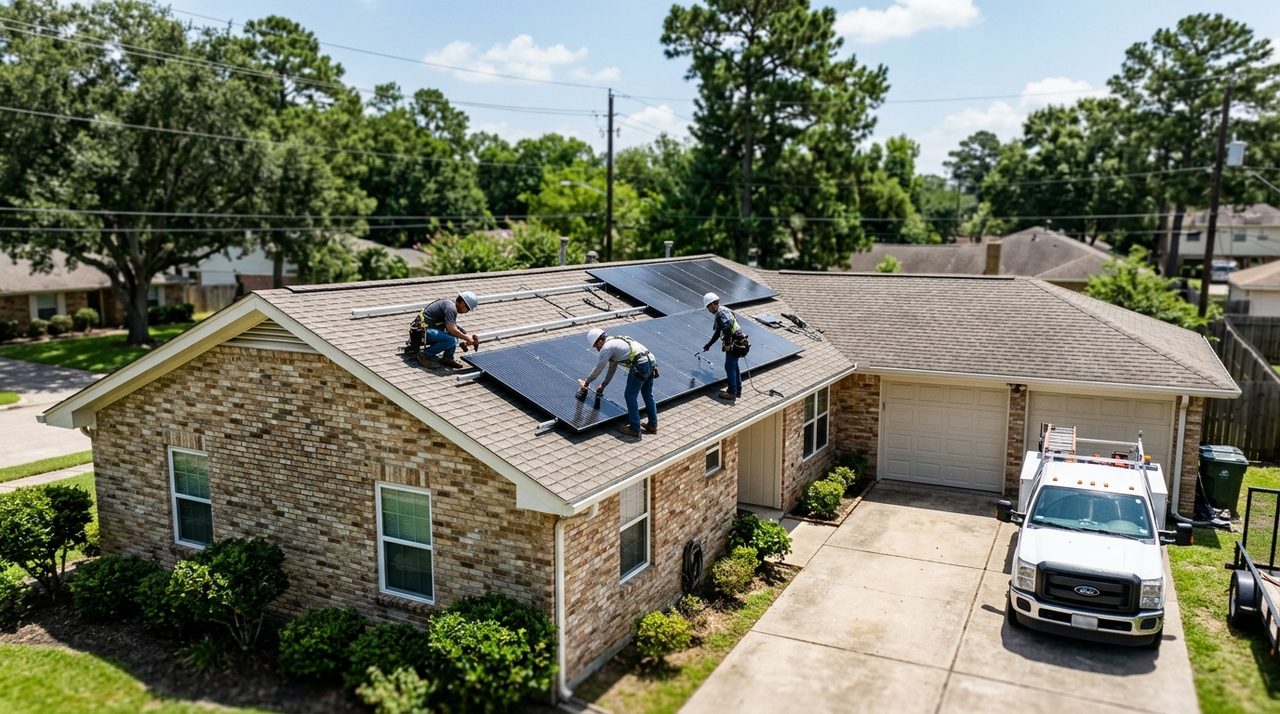
Champions Forest's 1,000-plus-home, mid-1970s-to-late-1980s brick subdivisions in unincorporated northwest Harris County sit squarely in FEMA Zone AE flood territory near Cypress Creek, meaning every exterior upgrade—including rooftop solar—carries permitting, elevation, and HOA-approval layers that catch many installers off guard. Electrical panels in this era of homes are commonly 100–150 amp service, and roughly a decade of deferred roof wear under Houston's brutal UV and humidity cycle means the shingle question must be settled before a single rail goes up. This page explains specifically what Champions Forest homeowners need to verify before signing a solar contract.
Ranked by verified Google rating × review volume × verification tier. How we rank →
Some highly-rated pros serve Champions Forest from nearby and may not keep a Champions Forest street address. Those are listed under "Also serving Champions Forest" with their real city and distance, so you always know where each business is based.
6740 Theall Rd, Houston, TX 77066
14925 Stuebner Airline Rd unit 301-b, Houston, TX 77069
6627 Theall Rd, Houston, TX 77066
Highly-rated pros based nearby who cover Champions Forest. Distance shown from the Champions Forest area.
Serving Champions Forest Based in Tomball · 3.2 mi away
Serving Champions Forest Based in Tomball · 3.3 mi away
Serving Champions Forest Based in Jersey Village · 4.5 mi away
Serving Champions Forest Based in Cypress · 4.6 mi away
Serving Champions Forest Based in Greenspoint · 4.8 mi away
Serving Champions Forest Based in Tomball · 4.9 mi away
Why it matters to you
Homes in Champions Forest Sections 1–10 and adjacent sections were built between the mid-1970s and late 1980s, putting their original roof decks at 35–50 years old. Houston's combination of 95°F summer heat, UV index averaging 10–11, and 52 inches of annual rainfall degrades standard 3-tab asphalt shingles in 12–15 years rather than the rated 20–25, so many of these roofs are on their second or third layer — and Harvey emergency re-roofs from 2017–2019 often used budget materials now approaching their own end of life. An installer who mounts a 25-year panel array on a marginal roof creates a near-certain scenario where you pay $8,000–$14,000 (est.) to remove and reinstall panels for a re-roof within a few years, a cost rarely disclosed upfront.
What a good pro does
Before signing a contract, ask any installer for a written roof-age assessment and a clear statement of remaining shingle life. A reputable installer holding NABCEP PV Installation Professional certification will coordinate with a licensed roofing contractor to evaluate decking integrity and, if replacement is warranted, schedule the re-roof first. The combined solar-plus-roof project should be permitted together through Harris County Engineering, not treated as two separate jobs that could create liability gaps between contractors.
Sources: North American Board of Certified Energy Practitioners (NABCEP), International Residential Code (as adopted by City of Houston), FEMA National Flood Hazard Layer (NFHL)
Why it matters to you
Every section of Champions Forest is governed by a mandatory property owners association — Champion Forest Fund, Inc. for Sections 1–10, with additional HOAs for Sections 11, 12, and the Villas. Under Texas Property Code §202.010, your HOA cannot block solar outright, but it can legally require that panels not be visible from the street, which on the Colonial and Georgian two-story elevations common here often means relegating the array to a north- or east-facing rear slope. Depending on your lot orientation, that placement shift can reduce annual production by 15–25% compared to an optimal south-facing layout — a reduction that should show up in the installer's shading and production model, not be discovered on your first utility bill.
What a good pro does
Submit ACC paperwork — including a site plan, panel layout diagram, and racking specs — before finalizing your contract so the HOA's response shapes the system design, not the other way around. A good installer will produce orientation-specific production estimates for both the preferred and HOA-approved layouts so you can make an informed decision. Build at least four to six weeks of ACC review time into your project schedule; Harris County permit processing runs concurrently but cannot be skipped.
Sources: Local HOA / deed restrictions (see area profile), Municipal permit office (see area profile)
Why it matters to you
Champions Forest's original homes were wired with 100- to 150-amp electrical service panels in an era before EV chargers, heat-pump HVAC, and home battery storage were anticipated. Post-Winter Storm Uri demand for battery backup (Tesla Powerwall, Enphase IQ Battery) is real in this neighborhood, but a battery-backed solar system typically requires a 200-amp main panel, a dedicated subpanel or critical-load panel, and separate metering documentation for CenterPoint Energy's interconnection application. Skipping the panel upgrade creates both a code violation and a warranty-voiding condition that Harris County inspectors will flag.
What a good pro does
Any installer scoping a storage-paired system in Champions Forest must start with a licensed master electrician's load calculation on the existing panel — required in Texas because all permitted solar electrical work must be pulled by a TDLR-licensed Electrical Contractor. If an upgrade to 200-amp service is needed, budget $2,500–$5,000 (est.) for that work before the solar quote is finalized. CenterPoint's interconnection queue for storage-plus-generation systems adds six to ten weeks beyond the standard grid-tie timeline, so the panel upgrade and interconnection application should be initiated simultaneously.
Sources: Texas Department of Licensing & Regulation, Municipal permit office (see area profile), International Residential Code (as adopted by City of Houston)
Why it matters to you
Significant portions of Champions Forest carry a FEMA AE flood zone designation tied to Cypress Creek, and that designation has direct consequences for solar installations beyond the panels themselves. Inverters, combiner boxes, rapid-shutdown devices, and battery enclosures are typically mounted at or near grade level on the exterior wall or in the garage — locations that took water in Harvey (2017) and in repeated Cypress Creek overflow events. Equipment flooded even once can fail silently, void manufacturer warranties, and create a shock hazard that is not immediately obvious to homeowners.
What a good pro does
Specify that all balance-of-system electrical equipment — inverters, disconnects, battery systems — be mounted at least 24 inches above the base flood elevation shown on your property's elevation certificate, or higher if your certificate documents first-floor elevation above BFE. Harris County's floodplain development rules may require a separate floodplain development permit for any ground-level structure associated with the array. A qualified installer will request your elevation certificate before finalizing equipment placement and will document mounting heights in the Harris County permit submittal.
Sources: FEMA National Flood Hazard Layer (NFHL), Municipal permit office (see area profile), International Residential Code (as adopted by City of Houston)
Hiring solar installers in Champions Forest? Champions Forest is a large, multi-section subdivision in the Klein ISD area of northwest Harris County, built primarily from the mid-1970s through the late 1980s. Homeowners here deal with aging slab-on-grade foundations, original-era HVAC and plumbing systems that are reaching or past their expected lifespan, and FEMA AE flood zone designations that affect insurance requirements and exterior renovation planning. Multiple mandatory HOAs with architectural control committees govern exterior modifications, so contractors must factor in ACC approval timelines.
Building era
Primarily mid-1970s through late 1980s, with some later sections extending into the early 1990s.
Typical style
Traditional brick two-story homes with Colonial and Georgian influences; some single-story ranch-style homes and occasional Tudor and French traditional elevations.
Foundations
Slab-on-grade (regional inference for 1970s–1980s production homes in NW Harris County; confirm via HCAD or individual inspection).
Common systems
Original homes likely have R-22 refrigerant HVAC systems nearing or past replacement age, copper or galvanized steel supply plumbing transitioning to PEX in renovated homes, and 100–200 amp electrical panels that may need upgrading for modern loads.
What that means for repairs
Kitchen and bathroom remodels are common as homes from this era are updated to modern standards. HVAC full-system replacements are frequent due to age. Foundation repair and re-leveling are periodic needs given expansive clay soils and slab-on-grade construction. Post-Harvey flood damage repairs drove significant interior renovation activity in affected sections.
Permit jurisdiction
Harris County Engineering (unincorporated Harris County, Klein area — not within City of Houston limits).
HOA & deed restrictions
Mandatory property owners associations govern all sections. Sections 1–10 are governed by Champion Forest Fund, Inc. (Champion Forest HOA). Additional mandatory HOAs include Champion Forest Eleven HOA (161 lots), Champion Forest Twelve Homeowners Association Inc., and Champion Forest Villas HOA. All require Architectural Control Committee (ACC) approval for exterior modifications.
Historic districts
No City of Houston historic district designation confirmed.
Contractor note
Contractors must obtain Harris County permits for structural, mechanical, and electrical work and should coordinate ACC approval from the applicable section's HOA before beginning any exterior modifications. Work in the FEMA AE flood zone may require elevation certificates and floodplain development permits.
FEMA flood zone
FEMA Zone AE (high flood risk) — source: fema_nfhl. Champions Forest is situated in northwest Harris County near Cypress Creek, a major drainage corridor that has historically been associated with significant flooding events.
Hurricane Harvey impact
No official neighborhood-wide flood impact summary was found in available HOA or public records. Areas near Cypress Creek in northwest Harris County experienced significant Harvey flooding and subsequent buyout activity, but specific street-level impact within Champions Forest is not clearly documented in available sources. Homeowners should check Harris County Flood Control District records and individual property flood history for confirmation.
Heat & humidity load
Homes from the 1970s–80s with original insulation and single-pane windows face high cooling costs during Houston summers. Aging HVAC systems are under maximum stress from May through September, making this the peak period for emergency AC repair calls. Humidity management is critical to prevent mold in homes that experienced prior flooding or have insufficient attic ventilation.
Working with contractors here
Contractors working in Champions Forest most commonly handle HVAC replacements, foundation leveling, and plumbing re-pipes — all driven by the 40–50-year age of the housing stock. Kitchen and bath remodels are a strong secondary market as homeowners modernize dated interiors. Flood mitigation work, including elevated electrical panels, moisture barriers, and drainage improvements, is relevant given the AE flood zone designation. All exterior work requires ACC approval from the applicable section's HOA (Champion Forest Fund for Sections 1–10, or the respective section HOA), so contractors should build approval lead time into project schedules. Harris County permitting applies rather than City of Houston permits, which affects inspection scheduling and code requirements.
Local Tip
Always ask for a written estimate before work begins. Texas contractors are required to provide one on jobs over $1,000.
Champions Forest is a large, multi-section subdivision in the Klein ISD area of northwest Harris County, built primarily from the mid-1970s through the late 1980s. Homeowners here deal with aging slab-on-grade foundations, original-era HVAC and plumbing systems that are reaching or past their expected lifespan, and FEMA AE flood zone designations that affect insurance requirements and exterior renovation planning. Multiple mandatory HOAs with architectural control committees govern exterior modifications, so contractors must factor in ACC approval timelines.
Source: U.S. Census Bureau, ACS 5-Year 2023
Much of Champions Forest maps to FEMA Zone AE (high flood risk), so flood-resilient detailing -- elevated equipment, water-tolerant materials, and drainage-first thinking -- is essential here, not optional.
Source: FEMA National Flood Hazard Layer (NFHL). Flood zones vary by parcel — verify your individual FIRM panel.
Battery backup systems installed in flood-prone Champions Forest should be mounted at least one foot above the Base Flood Elevation shown on FEMA Zone AE maps — ask your installer to relocate ground-level units now, before the next Harvey-scale event. A rapid-shutdown-compliant system also lets first responders safely de-energize your roof array if rising water forces evacuation. Confirm the current FEMA panel for your Champions Forest parcel — the area maps to Zone AE, but adjacent lots can differ.
After severe storms knock out CenterPoint feeders serving Champions Forest, a solar-plus-battery system with a properly wired critical-load panel can keep your refrigerator, medical devices, and phone chargers running — but only if the rapid-shutdown system and transfer relays were installed to code by a TDLR-licensed contractor. Verify those components are functional before storm season with a brief test cycle. In-city Champions Forest work falls under City of Houston floodplain and permitting rules.
After Uri's extended blackout, homeowners with solar-plus-storage in Champions Forest who had pre-positioned their battery state of charge at 100 percent before the freeze arrived were able to run heat and refrigeration for 48 hours or more without grid support. Ask your licensed solar installer to walk you through the manual charge-management settings so you can maximize stored energy before a forecast hard freeze. In-city Champions Forest work falls under City of Houston floodplain and permitting rules.
Sources: FEMA National Flood Hazard Layer (NFHL), Ready.gov -- Hurricanes, CenterPoint Energy -- Storm Center, City of Houston -- Emergency Preparedness, Ready.gov -- Winter Weather, Harris County Flood Control District
Houston-specific estimators to plan your project before you call a pro. All results are planning estimates — a licensed local pro confirms the details on site.
Disconnect & drain every outdoor hose bib
Remove hoses, drain the spigots, and cover each with an insulated faucet sock. Un-drained hose bibs are the #1 burst point in a Houston freeze.
Insulate exposed pipes in the attic & garage
Wrap any pipe in an unconditioned space (attic runs, garage walls) with foam sleeves. Houston homes rarely insulate these because they only matter a few nights a year — which is exactly why they burst.
Open cabinet doors & keep a pencil-width drip
On hard-freeze nights, open kitchen/bath cabinets so warm air reaches the pipes and let faucets on exterior walls drip to relieve pressure.
Protect the attic/garage water heater & its lines
An attic or garage tank sits in unconditioned space. Insulate the cold-inlet and hot-outlet lines and confirm the emergency drain pan is clear so a leak doesn't reach the ceiling.
This is a planning estimate only — actual requirements depend on an on-site assessment by a licensed Houston pro. If a pipe has already burst, shut off your main water supply and call a licensed Houston plumber immediately — freeze bursts flood fast.
Sources: Municipal permit office (see area profile)
Sources: Local HOA / deed restrictions (see area profile)
Sources: Texas Department of Licensing & RegulationNorth American Board of Certified Energy Practitioners (NABCEP)
Sources: Municipal permit office (see area profile)