Closed
100 E NASA Pkwy Suite 103, Webster, TX 77598
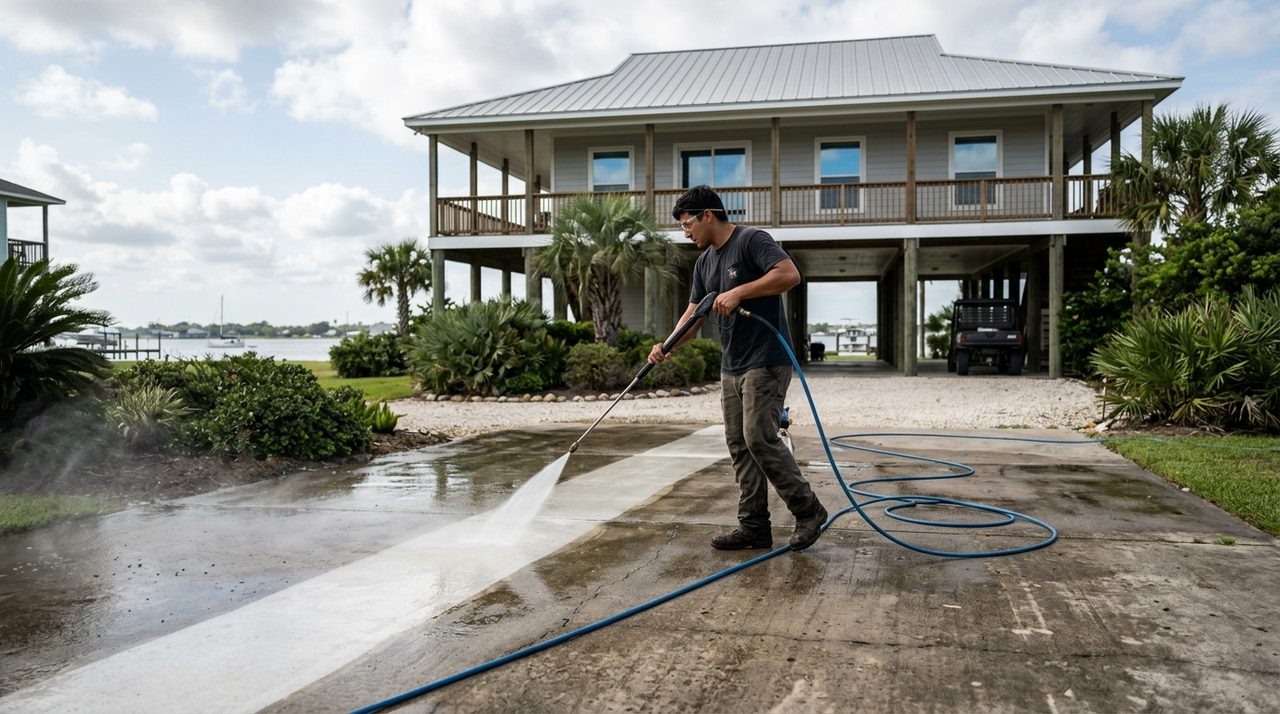
Webster's large stock of 1970s–1990s single-story brick ranch homes — sitting on slab-on-grade foundations over coastal Harris County clay — develops mold, efflorescence, and oil-stained driveways at a pace that catches many homeowners off guard. Subdivision-by-subdivision HOA structures in communities like Edgewater add a compliance layer that can mean a 30-day cure window before a fine, while the city's own permit authority means contractors must route any relevant work through the City of Webster rather than Houston or Harris County. Read on for the three pressure-washing realities that matter most on these streets.
Ranked by verified Google rating × review volume × verification tier. How we rank →
Some highly-rated pros serve Webster from nearby and may not keep a Webster street address. Those are listed under "Also serving Webster" with their real city and distance, so you always know where each business is based.
100 E NASA Pkwy Suite 103, Webster, TX 77598
15502 Galveston Rd, Webster, TX 77598
2323 W Bay Area Blvd, Webster, TX 77598
2808 W Bay Area Blvd, Webster, TX 77598
Highly-rated pros based nearby who cover Webster. Distance shown from the Webster area.
Serving Webster Based in Clear Lake · 0.9 mi away
Serving Webster Based in Clear Lake · 1.5 mi away
Serving Webster Based in Clear Lake · 1.9 mi away
Serving Webster Based in Friendswood · 2.9 mi away
Serving Webster Based in League City · 3.3 mi away
Serving Webster Based in League City · 3.4 mi away
Why it matters to you
Webster's homes sit on slab-on-grade foundations over Harris County's expansive coastal clay — the same Beaumont/Houston Black clay that swells after rain and shrinks in drought. As that clay cycles moisture, it wicks mineral salts upward through concrete driveways, mortar joints, and the brick veneer common on 1970s–1990s ranch homes, leaving white chalky streaks and red-clay mud staining that a garden-hose rinse will not touch. Homes near Clear Creek that see localized flash flooding compound this with periodic mud intrusion at the foundation edge.
What a good pro does
An experienced operator applies a diluted acidic pre-treatment (typically a low-concentration muriatic or phosphoric acid wash) to emulsify salt deposits before rinsing at moderate pressure — usually 1,200–1,800 PSI on aged concrete, lower on brick face — to avoid etching the mortar joints on these older masonry walls. Because Webster is an incorporated city with its own permit authority, any contractor running commercial-scale chemical rinse jobs should confirm disposal routing complies with TCEQ stormwater rules, as wash water carrying dissolved salts and cleaning agents cannot enter storm drains that drain to Clear Creek or Galveston Bay. Estimates for chemical pre-treatment driveway cleaning in the Houston metro typically run $180–$400 for a standard residential driveway, not including fence or house wash.
Sources: Texas Commission on Environmental Quality, FEMA National Flood Hazard Layer (NFHL)
Why it matters to you
Webster's position in SE Harris County — just a few miles inland from Clear Lake and the Galveston Bay system — keeps ambient humidity elevated even by Houston standards, feeding persistent Gloeocapsa magma (black algae) and green mold on the brick exteriors, painted wood fascia, and concrete patios of the neighborhood's circa-1985 median-vintage homes. These surfaces often go 18–24 months between professional cleanings, long enough for algae to root into mortar and painted trim where standard cold-water rinsing only removes surface growth while leaving the spore base intact.
What a good pro does
A low-pressure soft-wash approach using a sodium hypochlorite-based biocide — applied at controlled concentration, dwell time, and then thoroughly rinsed — is the only method that kills the root structure of Gloeocapsa magma rather than just blasting its visible layer off brick faces. Operators using algaecide solutions at certain concentrations may require a Texas Department of Agriculture (TDA) pesticide applicator license depending on product classification; homeowners should ask providers to confirm their chemical handling credentials before work begins. A post-treatment hydrophobic sealant on concrete patios can extend the clean interval from 6 to 12–18 months in Webster's high-humidity coastal environment — budget roughly $250–$550 for a full exterior soft-wash on a typical 2,000–2,500 sq ft Webster ranch home.
Why it matters to you
With a census median year built of 1992, many Webster driveways are original pours now 30-plus years old — porous, lightly spalled at the surface after years of Houston UV exposure, and stained with accumulated oil drips and tire rubber that have baked into the concrete under summer heat. Winter Storm Uri in February 2021 introduced freeze-thaw stress uncommon in SE Harris County, accelerating surface scaling on driveways that had never been sealed and creating a rougher, more absorbent surface that holds staining even more aggressively.
What a good pro does
Oil and tire staining on aged concrete requires hot-water pressure washing (180°F+) combined with a degreaser pre-soak — cold water alone will not lift polymerized oil from an open-pored surface. TCEQ rules prohibit degreaser-laden runoff from entering Webster's storm drainage infrastructure, so a responsible operator will either wet-vacuum the pre-soak solution before rinsing or use containment berms if the driveway drains directly toward a street inlet. Expect a 20–40% cost premium over standard driveway washing for a hot-water degreaser job, putting typical estimates in the $220–$490 range for a two-car Webster driveway.
Why it matters to you
Webster has no city-wide HOA, but communities like Edgewater operate mandatory HOAs with active architectural review committees that issue written violation notices for algae-stained driveways, discolored fences, and green or streaked roofs — with cure windows that can be as short as 30 days. The city's housing mix also includes newer stucco-and-brick townhomes near NASA Road 1 and I-45 where HOA boards may specify soft-wash-only requirements on stucco siding to prevent high-pressure water intrusion behind the cladding. Homeowners who ignore a notice and let the cure window lapse face compounding fines that often exceed the cost of the cleaning itself.
What a good pro does
Before scheduling any exterior wash in a Webster subdivision, pull the current CC&Rs via the Harris County real property records or the TREC HOA Management Certificate database to confirm whether pressure limits or approved chemical products are specified in the architectural guidelines. On stucco-clad townhomes, a good operator uses soft-wash (under 500 PSI) with an appropriate surfactant, which cleans without driving moisture behind the cladding — and can document the work with dated before-and-after photos that serve as your compliance record if the HOA requests confirmation. Roof soft-wash on a single-story Webster home typically runs $300–$600 estimated; request a written scope that specifies PSI and chemical type so you have documentation for the architectural review committee.
Sources: Local HOA / deed restrictions (see area profile), Texas Commission on Environmental Quality
Hiring pressure washing in Webster? Webster is a small incorporated city in SE Harris County near Clear Lake and the NASA corridor, with housing stock ranging from 1950s-era homes in the original town grid to 2000s master-planned communities like Edgewater. Homeowners here deal with aging slab-on-grade foundations on coastal clay soils, subdivision-specific deed restrictions, and proximity to Clear Creek floodplain areas. Permitting runs through the City of Webster rather than Houston or Harris County, which contractors must account for in project planning.
Building era
Mixed: some mid-century (1950s–1960s) in the original town grid, with the majority built from the 1970s through the 1990s; newer infill, townhomes, and master-planned sections (e.g., Edgewater) date to the 2000s–2010s.
Typical style
Single-story and 1.5-story ranch/suburban traditional brick homes dominate older subdivisions; newer sections feature contemporary suburban traditional and Mediterranean-influenced designs; townhomes and garden-style condos near NASA Rd 1 and I-45 are typically contemporary stucco/brick construction.
Foundations
Predominantly slab-on-grade for post-1960 suburban construction; pier-and-beam may exist in some older or custom structures but is uncommon.
Common systems
1970s–1990s homes typically have original or once-replaced central HVAC systems, copper or CPVC plumbing (some older homes may have galvanized supply lines), and 100–200 amp electrical panels. Newer 2000s construction features modern HVAC with higher SEER ratings and PEX plumbing.
What that means for repairs
Kitchen and bath remodels in 1970s–1990s homes are common as these properties age past the 30–40 year mark. HVAC replacements, slab foundation repair on expansive clay soils, and re-roofing after storm damage are frequent projects. Newer communities like Edgewater require HOA architectural approval before exterior modifications.
Permit jurisdiction
City of Webster Permitting (Webster is an incorporated city with its own permit authority).
HOA & deed restrictions
No single city-wide HOA exists. HOAs and POAs operate on a subdivision-by-subdivision basis. Master-planned communities like Edgewater have mandatory HOAs with architectural controls and dues. Condo complexes have mandatory council-of-co-owners associations. Some older platted areas may have lapsed or inactive deed restrictions. Confirm HOA status per property via Harris County real property records or the TREC HOA Management Certificate database.
Historic districts
No City of Houston historic district designation confirmed. Webster is an independently incorporated city with no known local historic district overlay.
Contractor note
Contractors must pull permits through the City of Webster, not Houston or Harris County. Each subdivision may have its own HOA architectural review process that must be satisfied before exterior work begins, particularly in Edgewater and newer communities.
FEMA flood zone
FEMA Zone X (low flood risk) per official NFHL data. However, properties near Clear Creek along Webster's southern boundary may fall within higher-risk flood zones; homeowners in those areas should verify their specific parcel's FEMA designation. Clear Creek has historically been a source of localized flooding in the region.
Hurricane Harvey impact
SE Harris County, including the Clear Creek and Clear Lake corridor, experienced significant rainfall and localized flooding during Harvey, particularly near bayous and the Clear Creek floodplain. However, the worst catastrophic structural flooding in Harris County was concentrated in other areas (Addicks/Barker, Greens Bayou). No city-level official dataset specifically quantifying the number of flooded Webster homes was identified; impact appears to have been moderate and concentrated near low-lying drainage areas rather than catastrophic across the entire city.
Heat & humidity load
Houston's extreme summer heat and humidity drive heavy HVAC demand, especially in 1970s–1990s homes with aging or undersized systems. Slab-on-grade foundations on coastal clay soils are subject to seasonal expansion and contraction, making foundation monitoring and proper drainage maintenance critical during dry summer periods. Coastal proximity increases salt air corrosion risk on exterior metal components and roofing fasteners.
Working with contractors here
Contractors in Webster most commonly handle HVAC replacements, foundation repairs, and re-roofing on the large stock of 1970s–1990s suburban homes that have reached or exceeded their major system lifespans. Slab foundation issues driven by expansive clay soils are a recurring concern, particularly after extended dry spells followed by heavy rain. Kitchen and bath remodels are popular in these aging homes, often requiring updated plumbing and electrical to meet current code. In newer communities like Edgewater, contractors should expect HOA architectural review requirements and potentially stricter material and design specifications. Because Webster is independently incorporated, all permits must go through the City of Webster rather than Houston or Harris County, which can affect timelines and inspection scheduling.
Local Tip
Always ask for a written estimate before work begins. Texas contractors are required to provide one on jobs over $1,000.
Webster is a small incorporated city in SE Harris County near Clear Lake and the NASA corridor, with housing stock ranging from 1950s-era homes in the original town grid to 2000s master-planned communities like Edgewater. Homeowners here deal with aging slab-on-grade foundations on coastal clay soils, subdivision-specific deed restrictions, and proximity to Clear Creek floodplain areas. Permitting runs through the City of Webster rather than Houston or Harris County, which contractors must account for in project planning.
Source: U.S. Census Bureau, ACS 5-Year 2023
Most of Webster maps to FEMA Zone X (low mapped flood risk), but Houston's flash-flood reality means even low-risk blocks benefit from smart drainage and storm-hardened installs; risk climbs sharply on blocks nearest Clear Creek, where it varies parcel to parcel.
Source: FEMA National Flood Hazard Layer (NFHL). Flood zones vary by parcel — verify your individual FIRM panel.
Sources: Texas Commission on Environmental QualityFEMA National Flood Hazard Layer (NFHL)
Sources: Local HOA / deed restrictions (see area profile)