Closed
13410 FM1764, Santa Fe, TX 77510
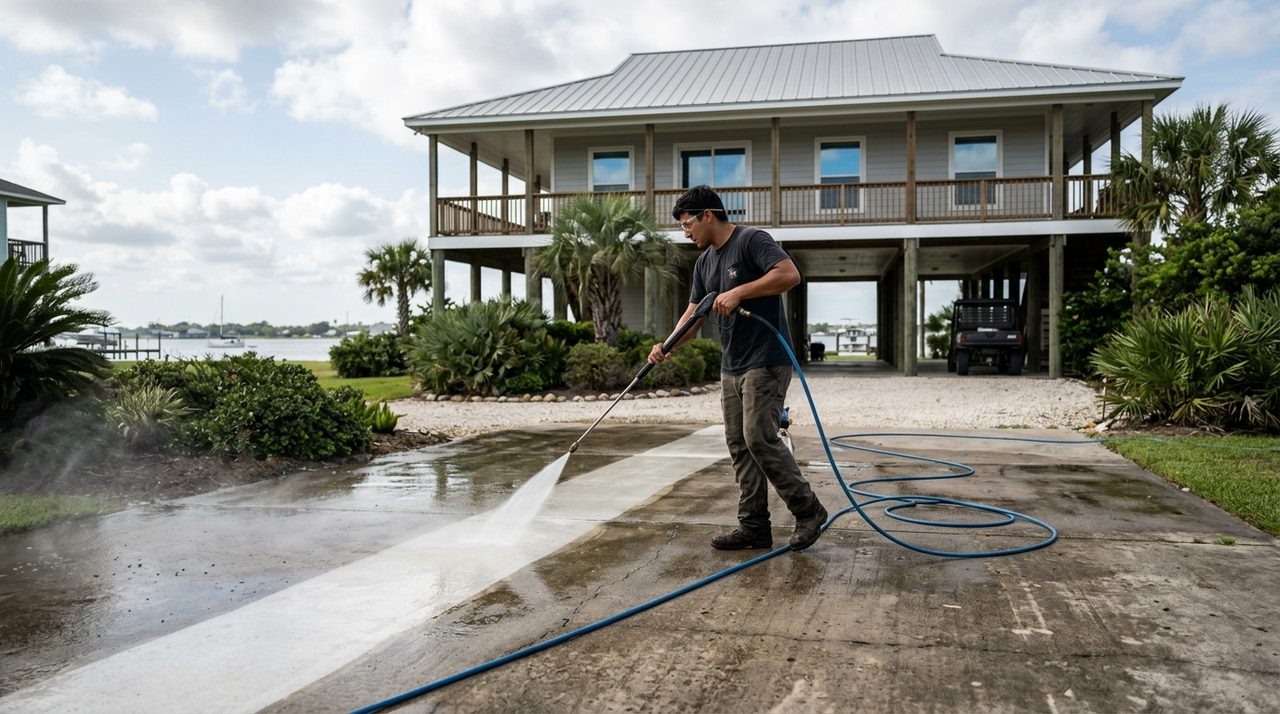
Santa Fe's position inside FEMA Zone AE — where Galveston County's coastal humidity, tropical storm surge, and recurring flood events converge — means exterior surfaces don't just accumulate normal grime: they collect flood-line staining, hurricane debris residue, and relentless Gulf-driven mold that can reappear within a single wet season. With a median year built of 1991 and roughly 81% owner-occupied homes, most Santa Fe properties carry three-plus decades of slab-on-grade concrete, wood privacy fencing, and asphalt shingles that need careful, surface-specific cleaning — not a single high-pressure blast. This page covers the specific pressure-washing challenges that come with living in a high-flood-risk Galveston County community, not generic suburban advice.
Ranked by verified Google rating × review volume × verification tier. How we rank →
Some highly-rated pros serve Santa Fe from nearby and may not keep a Santa Fe street address. Those are listed under "Also serving Santa Fe" with their real city and distance, so you always know where each business is based.
13410 FM1764, Santa Fe, TX 77510
10510 Autry Dr, Santa Fe, TX 77510
5106 Avenue L, Santa Fe, TX 77510
Highly-rated pros based nearby who cover Santa Fe. Distance shown from the Santa Fe area.
Serving Santa Fe Based in La Marque · 3.2 mi away
Serving Santa Fe Based in La Marque · 4.1 mi away
Serving Santa Fe Based in League City · 6.8 mi away
Serving Santa Fe Based in League City · 8 mi away
Why it matters to you
Santa Fe's FEMA Zone AE designation means many homes here have experienced actual inundation during major storm events, leaving a characteristic 'bathtub ring' of tannic mud, flood-borne debris, and mineral staining on brick, stucco, and foundation-level siding at exactly the waterline height. Hurricanes and tropical systems moving through Galveston County deposit layered organic material — leaf tannins, silt, and wind-driven grime — into every porous exterior surface, and without targeted cleaning these marks harden and permanently etch into masonry.
What a good pro does
A qualified operator will identify the flood-line height and apply a targeted alkaline pre-soak to break down mud-mineral bonds before any rinsing begins, rather than relying on pressure alone. Hot-water equipment or a sodium hypochlorite soft-wash solution is typically required for biological staining at the flood mark; expect a 20–40% cost premium over standard driveway cleaning when chemical pre-treatment is necessary. Confirm whether the property sits within the City of Santa Fe municipal limits or unincorporated Galveston County, as neither jurisdiction requires a municipal permit for routine residential pressure washing, but operators using chemical degreasers must comply with TCEQ stormwater discharge rules.
Sources: FEMA National Flood Hazard Layer (NFHL), Texas Commission on Environmental Quality
Why it matters to you
Santa Fe's proximity to Galveston Bay keeps ambient humidity elevated well above Houston's already-high metro average, meaning Gloeocapsa magma black algae, green mold, and mildew colonize driveways, vinyl siding, and wood fences on homes built in the late 1980s and 1990s remarkably fast — often visibly returning within six to nine months of cleaning if no post-treatment biocide is applied. The roughly 1,991-era homes common to this community often feature original concrete flatwork and wood-framed fences that are now porous enough to absorb biological growth deeply into the surface.
What a good pro does
An experienced soft-wash contractor will follow the cleaning with a residual algaecide application — often a diluted sodium hypochlorite or quaternary ammonium product — to slow regrowth cycles from the typical six-month window toward twelve months or longer. If the algaecide product qualifies as a pesticide under Texas Department of Agriculture definitions, the applicator is required to carry a TDA pesticide applicator license; homeowners should ask to see this credential before authorizing chemical treatment. Bundling a mold post-treatment into the initial job quote is almost always more cost-effective than scheduling a separate return visit mid-year.
Why it matters to you
The median Santa Fe home was built around 1991, meaning most original concrete driveways are now past the 30-year mark and showing surface spalling, hairline cracking from clay-soil movement, and deeply baked-in oil staining from decades of vehicle use. Galveston County's slab-on-grade construction norm places driveways in direct contact with the region's expansive clay, and the freeze event of Winter Storm Uri in 2021 accelerated micro-spalling in already-aged concrete across SE Houston and Galveston County, leaving even more porous surfaces that trap automotive fluids.
What a good pro does
Standard cold-water pressure washing at typical residential PSI will not lift polymerized motor oil from spalled, porous concrete; a hot-water unit (180°F+) combined with a degreaser pre-soak is the correct approach for these stains. Because degreasers are chemical cleaners, operators must ensure wash water does not flow into street storm drains — which in Galveston County drain directly toward coastal waterways — to remain in compliance with TCEQ's TPDES stormwater rules. Homeowners should ask the operator to describe their runoff containment method before the job begins, particularly on properties near roadside storm drain inlets.
Sources: Texas Commission on Environmental Quality, FEMA National Flood Hazard Layer (NFHL)
Why it matters to you
The 1991 median build year means a significant share of Santa Fe roofs have seen one or two shingle replacement cycles, and many current roofs are already ten or more years old — the threshold at which high-pressure washing (above 500 PSI) accelerates granule loss, shortens remaining shingle life, and can void manufacturer warranties. Gulf humidity and the warm, moist air that pushes inland from Galveston Bay make black algae streaks appear quickly on these shingles, which creates visible cosmetic deterioration that homeowners reasonably want addressed.
What a good pro does
The correct method for algae-streaked asphalt shingles in Santa Fe is a low-pressure soft-wash — typically under 100 PSI at the surface — using a diluted sodium hypochlorite solution applied and dwell-rinsed, not blasted off. Neither the City of Santa Fe nor Galveston County requires a permit for roof washing itself, but as noted above, any biocide product meeting the TDA pesticide definition requires the applicator to hold a TDA license. Request written confirmation from the operator that they will not exceed 500 PSI on shingle surfaces, and check whether their liability insurance covers granule-loss damage claims specifically.
Sources: International Residential Code (as adopted by City of Houston), Texas Commission on Environmental Quality
Hiring pressure washing in Santa Fe? Santa Fe sits in Galveston County's FEMA AE high-risk flood zone, making water management the dominant concern for homeowners. Specific details about the neighborhood's housing stock, HOA governance, and permit jurisdiction remain difficult to confirm without a precise subdivision name or ZIP code. Homeowners should prioritize flood-resistant materials, elevated mechanical systems, and proper drainage when planning any renovation or repair.
Building era
Not confirmed - check Galveston County Appraisal District records for primary build decades.
Typical style
Not confirmed - check Galveston County Appraisal District records for architectural styles.
Foundations
Not confirmed - slab-on-grade is typical for SE Houston and Galveston County areas, but verify with local inspection records.
Common systems
Not confirmed - typical SE Houston/Galveston County homes feature central AC systems, copper or PEX plumbing, and standard residential electrical panels, but specifics depend on build era.
What that means for repairs
Given the FEMA AE flood zone designation, flood mitigation upgrades such as elevated HVAC equipment, flood vents, and water-resistant building materials are likely common renovation priorities.
Permit jurisdiction
Not confirmed - if within the City of Santa Fe municipal limits, permits would be handled by the City of Santa Fe; if in unincorporated Galveston County, permits fall under Galveston County Engineering. Verify the exact jurisdiction by address.
HOA & deed restrictions
Not confirmed - research could not verify whether a mandatory HOA, voluntary civic club, or no organized HOA governs this specific area. Check Harris County Clerk and Galveston County Clerk records for recorded deed restrictions.
Historic districts
No City of Houston historic district designation confirmed. Santa Fe is in Galveston County and likely outside City of Houston HAHC jurisdiction.
Contractor note
Contractors should confirm whether the property falls within the City of Santa Fe or unincorporated Galveston County, as permit requirements and floodplain development regulations differ significantly between the two jurisdictions.
FEMA flood zone
FEMA Zone AE (high flood risk) - source: fema_nfhl. Properties in this zone face a 1% annual chance of flooding and require flood insurance for federally backed mortgages. Proximity to local bayous, creeks, or drainage channels could not be confirmed from available research.
Hurricane Harvey impact
Not confirmed from available research - Galveston County broadly experienced significant Harvey flooding in 2017, and the AE flood zone designation suggests this area is vulnerable, but specific street-level impact and recurring flood-prone areas could not be verified. Check Galveston County flood damage records and FEMA claims data for this area.
Heat & humidity load
Houston-area summers bring extreme heat and humidity that stress HVAC systems and promote mold growth, especially in flood-prone areas where moisture intrusion compounds seasonal humidity. Proper attic ventilation, dehumidification, and regular AC maintenance are critical for homes in this zone.
Working with contractors here
The FEMA AE flood zone designation means contractors working in Santa Fe should expect flood mitigation and storm damage repair to be among the most common project types. Elevated mechanical systems, foundation inspections for water damage, and mold remediation are frequent needs. Any substantial improvement or repair exceeding 50% of the structure's market value may trigger floodplain development requirements including elevation to base flood elevation. Contractors should verify the exact permit jurisdiction—City of Santa Fe versus unincorporated Galveston County—before bidding, as compliance requirements vary. Material selections should prioritize flood-resistant options below the base flood elevation per local floodplain ordinances.
Local Tip
Always ask for a written estimate before work begins. Texas contractors are required to provide one on jobs over $1,000.
Santa Fe sits in Galveston County's FEMA AE high-risk flood zone, making water management the dominant concern for homeowners. Specific details about the neighborhood's housing stock, HOA governance, and permit jurisdiction remain difficult to confirm without a precise subdivision name or ZIP code. Homeowners should prioritize flood-resistant materials, elevated mechanical systems, and proper drainage when planning any renovation or repair.
Source: U.S. Census Bureau, ACS 5-Year 2023
Much of Santa Fe maps to FEMA Zone AE (high flood risk), so flood-resilient detailing -- elevated equipment, water-tolerant materials, and drainage-first thinking -- is essential here, not optional; as a Galveston County coastal community, tropical surge and wind add a layer generic guidance misses.
Source: FEMA National Flood Hazard Layer (NFHL). Flood zones vary by parcel — verify your individual FIRM panel.